 Calc
Moment of Inertia Calculator – Disk, Sphere, Hoop & Rod
 Created by Rachel Novak · Senior Editor · All Topics · Last updated: November 2026
Use this free Moment of Inertia Calculator to find I for four common shapes — a solid disk, a solid sphere, a hoop and a rod — spinning about their usual central axes.
Mass measures how hard an object is to push in a straight line. Moment of inertia is the rotational twin: how hard an object is to start — or stop — spinning. But it comes with a twist that mass does not have. Two objects of exactly the same mass and exactly the same size can have wildly different moments of inertia, because rotation cares not just about how much material there is, but about where it sits relative to the axis. Mass near the axle barely counts; mass at the rim counts for much more than its share. This calculator evaluates I for the four shapes that cover most textbook and workshop reality: the solid disk, the solid sphere, the hoop and the rod.
Each shape's formula is the same skeleton — a pure number times M times a length squared — with only the fraction changing: ½ for the disk, 2/5 for the sphere, 1 for the hoop, 1/12 for the rod about its centre. Those fractions are a ranking of how far each shape keeps its mass from the axis, on average. The hoop, with every gram at the full radius, scores the maximum 1. The sphere, tucking much of its material close to the axis through its middle, scores the minimum 2/5. Learn to read the fractions and you can predict the winner of any rolling race or the feel of any spinning part before touching a calculator.
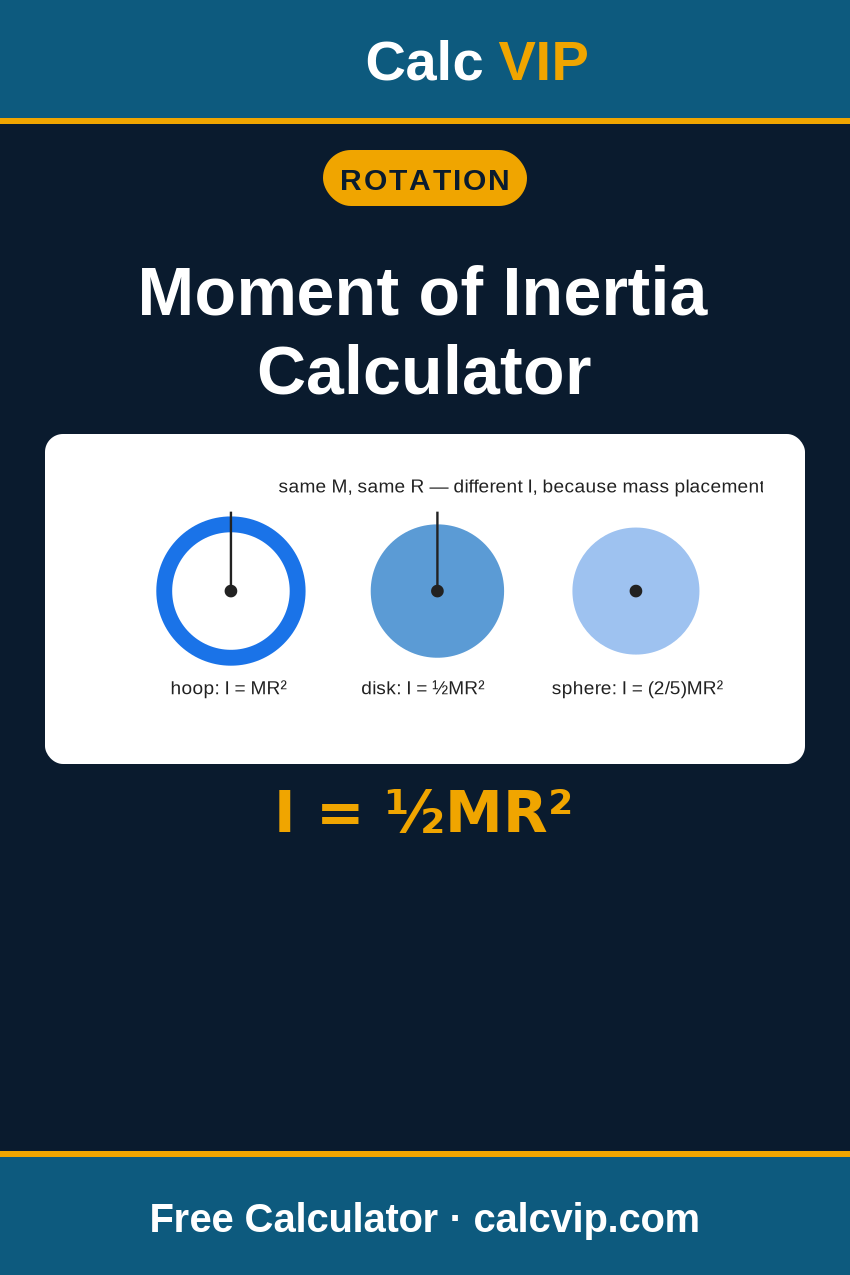
The stakes are practical as well as conceptual. Moment of inertia decides how much energy a flywheel stores, how sluggishly a satellite responds to its control thrusters, why a figure skater's spin explodes when she pulls in her arms, and which of two same-weight wheels accelerates faster under the same engine. It is the quantity engineers reach for whenever something turns — and the quantity students most often underestimate, because its dependence on the square of distance is stronger than intuition suggests.
Formulas
Solid disk: I = ½MR² • Solid sphere: I = (2/5)MR² • Hoop: I = MR² • Rod (about centre): I = (1/12)ML² — the further the mass sits from the axis, the larger I becomes.
Every formula above has the same anatomy: I = k × M × (length)², where k is a pure number fixed by the shape and the axis — 1 for the hoop, ½ for the solid disk (and solid cylinder), 2/5 for the solid sphere, 1/12 for a rod about its centre, 1/3 for the same rod about its end. There are no other rearrangements to learn: given I and the shape, M = I ÷ (k × length²) and the length = √(I ÷ (k × M)). The units are always kilogram-metres squared (kg·m²). The calculator asks for mass and radius (or rod length) and returns I for the four shapes about their standard central axes — if your axis differs, the parallel axis theorem in the depth section below is the tool you need.
| Symbol | Meaning | Units |
|---|---|---|
| I | moment of inertia — resistance to angular acceleration | kg·m² |
| M | total mass of the object | kilograms (kg) |
| R | radius (disk, sphere, hoop) | metres (m) |
| L | length (rod) | metres (m) |
| k | shape factor — set by geometry and axis choice | dimensionless |
Why distance is squared: every gram votes, weighted by r²
The true definition of moment of inertia is a sum: I = Σ mᵢrᵢ² — take every particle of the object, multiply its mass by the square of its distance from the axis, and add them all up. (For continuous objects the sum becomes an integral, and evaluating it is where the fractions ½, 2/5 and 1/12 come from.) The square is the whole story. A gram at 10 cm contributes 100 times as much as a gram at 1 cm — not ten times, a hundred — because it must both move faster (speed grows with radius at a given spin rate) and be swung around a longer lever. Doubling an object's size at the same mass quadruples its I; doubling its mass at the same size only doubles it. Size shouts, mass speaks.
This is why real rotating machinery is designed from the rim inwards. A flywheel that must store energy is built as a heavy rim on light spokes — the hoop configuration, k = 1 — because rim mass earns its keep quadratically. A racing bicycle wheel is the opposite philosophy: every gram is dragged as close to the hub as physics allows, because rim mass must be accelerated twice over, once in translation and once in rotation, and riders feel it as sluggishness. Same equation, opposite designs, both correct — the application decides whether I is the goal or the enemy.
How to use
- Select the shape that matches your object: solid disk, solid sphere, hoop, or rod (about its centre).
- Enter the mass M in kilograms.
- Enter the radius R in metres (for the rod, its full length L).
- Click "Calculate Moment of Inertia" to get I in kg·m². To compare shapes fairly, rerun with the same M and R — the ranking is always hoop > disk > sphere.
Worked examples
Example 1 — disk versus hoop. A solid disk of mass 4 kg and radius 0.5 m:
I = ½ × 4 × 0.5² = ½ × 4 × 0.25 = 0.5 kg·m²
A hoop of the same mass and radius would give I = MR² = 1 kg·m² — twice as much, because all its mass is at the rim.
Example 2 — the sphere, same data. Give the 4 kg, 0.5 m of Example 1 to a solid sphere instead:
I = (2/5) × 4 × 0.5² = 0.4 × 4 × 0.25 = 0.4 kg·m². The full ranking for identical mass and radius: hoop 1.0, disk 0.5, sphere 0.4 kg·m². The sphere is the easiest of the three to spin — a fact the rolling race below turns into a finish-line order.
Example 3 — a rod about its centre. A uniform rod of 2 kg and length 1.2 m, spun about its middle:
I = (1/12) × 2 × 1.2² = (1/12) × 2 × 1.44 = 0.24 kg·m². Most of a rod's length lies at modest distances from the centre, so its k is small — a baton is easy to twirl about its middle.
Example 4 — the same rod about its end. Now grip that rod at one end, like a clock pendulum or a swung bat:
I = (1/3) × 2 × 1.44 = 0.96 kg·m² — exactly four times the centre value. The parallel axis theorem explains the factor: (1/12)ML² + M(L/2)² = (1/12 + 3/12)ML² = (1/3)ML². Axis choice is not a footnote; it can quadruple the answer.
Example 5 — a bicycle wheel. A wheel is nearly a hoop: tyre and rim at the radius, light spokes contributing little. For M = 1.5 kg and R = 0.35 m:
I = MR² = 1.5 × 0.35² = 1.5 × 0.1225 ≈ 0.184 kg·m². Small — until you remember the wheel must be spun up every time the bike accelerates, which is why climbers pay fortunes to shave grams from rims rather than frames.
Example 6 — an energy-storing flywheel. A steel disk of 20 kg and radius 0.3 m:
I = ½ × 20 × 0.3² = 0.9 kg·m². Spun at ω = 100 rad/s (about 955 rpm), it stores KE = ½Iω² = ½ × 0.9 × 100² = 4,500 J — enough to lift 100 kg by 4.6 m, held in nothing but rotation, ready the instant it is needed. That is the whole business model of flywheel energy storage.
Moment of inertia in real life
The rolling race. Release a hoop, a disk and a sphere of any masses and sizes down the same ramp: the sphere wins, the disk follows, the hoop trails — always, regardless of mass or radius. Their accelerations are g·sinθ/(1+k): sphere 5/7, disk 2/3, hoop 1/2 of g·sinθ. It is the purest demonstration in mechanics that arrangement, not amount, rules rotation.
Figure skating and diving. A skater who pulls in her arms cuts I roughly threefold and her spin rate triples in compensation (angular momentum is conserved — the sister calculator on this site takes the story further). Divers tuck for the same reason and open out to stop the rotation dead before entry.
Car engines and smoothing. The flywheel on an engine's crankshaft uses I to average out the pulses of individual piston strokes into steady rotation; dual-mass flywheels and torque converters are refinements of the same idea. A engine that stumbles at idle often has too little rotational inertia for its pulse rate.
Satellites and spacecraft. A satellite's I tensor — the full three-axis version of this page's quantity — decides how its thrusters and reaction wheels are sized. Deploying a long boom or antenna can change I mid-mission, and more than one spacecraft has surprised its operators by spinning up, skater-like, when appendages were drawn in.
Helicopter and drone rotors. Rotor blades are long rods about one end — the (1/3)ML² configuration of Example 4 — which is why spooling them up takes time and why their stored rotational energy, released in an engine failure, gives the pilot a few precious seconds of autorotation.
Potter's wheels and merry-go-rounds. The heavy rim of a potter's wheel is a hoop by design: high I means the wheel shrugs off the drag of the potter's hands and keeps a steady speed. Push a merry-go-round at its rim and you are exploiting the same r² weighting from the other side — maximum torque where the mass is.
The parallel axis theorem: I about any axis
The tabulated formulas hold for axes through the centre of mass. Real life pivots objects at edges, ends and mounting points — and the parallel axis theorem converts: I = I_cm + M × d², where d is the distance between the centre axis and yours. The correction Md² is always positive: any off-centre axis costs extra inertia, because every particle is, on average, further from the pivot. Example 4 verified the theorem against the rod's two tabulated values. The theorem also runs in reverse for measurement: swing an irregular object as a pendulum, time it, and you can extract its I about the pivot — then subtract Md² to learn the centre value that no formula could have given you for such a shape.
Rotational kinetic energy: why I is an energy quantity
A spinning object stores energy KE = ½ × I × ω², and this is where I stops being bookkeeping and becomes a battery specification. Note the parallel with ½mv² — I plays mass's role, ω plays velocity's — and note the square on ω: doubling spin speed quadruples stored energy, which is why high-speed flywheels in vacuum enclosures store serious power (and why their containment is engineered like bomb-proofing). Example 6's modest disk held 4,500 J at under 1,000 rpm; grid-scale carbon-fibre rotors at tens of thousands of rpm store megajoules. The same equation, read defensively, sizes the brakes of every vehicle: a spinning wheel's energy must go somewhere when you stop.
Quick reference: shape factors
| Shape and axis | I | k |
|---|---|---|
| hoop / thin ring (central axis) | MR² | 1 |
| hollow cylinder (central axis) | ≈ MR² | ≈ 1 |
| solid disk / cylinder (central axis) | ½MR² | 0.5 |
| solid sphere (diameter) | (2/5)MR² | 0.4 |
| rod about its end | (1/3)ML² | 0.333 |
| rod about its centre | (1/12)ML² | 0.0833 |
Memorise the ladder — 1, ½, 2/5, 1/12 — and you hold most of rotational mechanics' geometry in your head: any new shape you meet can be estimated by asking where it would sit on this ladder.
Common mistakes
- Using diameter instead of radius. I depends on R², so entering the diameter quadruples the answer. A 0.5 m diameter disk has R = 0.25 m. If your result looks four times too big, this is the first suspect.
- Forgetting the shape factor. I is never just MR² except for the hoop. Using MR² for a solid sphere overstates I by a factor of 2.5 — the difference between a control system that works and one that oscillates itself apart.
- Ignoring the axis. The same rod gives (1/12)ML² or (1/3)ML² depending on the pivot — a factor of four. A moment of inertia quoted without its axis is an unfinished sentence; this calculator's values are for the central axes named with each shape.
- Assuming equal masses mean equal I. Two 4 kg, 0.5 m objects on this page differ by a factor of 2.5 between hoop and sphere. Mass and size alone never determine I — distribution does.
- Adding moments of inertia about different axes. I values combine by simple addition only for parts sharing the same axis. For composite objects about a new axis, compute each part about that axis (parallel axis theorem where needed), then add.
FAQ
What is moment of inertia in simple words?
It is the rotational version of mass: it measures how hard it is to start or stop an object spinning. Mass far from the axis counts much more than mass near it.
Why does a figure skater spin faster when pulling in their arms?
Bringing the arms in lowers the moment of inertia, so with the same angular momentum the spin speed (ω) increases.
Does the axis choice change I?
Yes. The same rod has I = (1/12)ML² about its centre but (1/3)ML² about one end. This calculator uses the central axes listed for each shape.
Why does the shape matter more than the mass?
Because I counts mass weighted by the square of its distance from the axis. Ten kilograms in a hoop at 0.5 m gives I = 10 × 0.25 = 2.5 kg·m²; the same ten kilograms as a solid disk gives half that, 1.25; gathered near the axle it would give almost nothing. Two objects of identical mass and size can differ several-fold in I purely by how their material is arranged — arrangement is destiny in rotation.
What is the parallel axis theorem?
It finds I about any axis from I about a parallel axis through the centre of mass: I = I_cm + Md², where d is the distance between the axes. It explains the rod's two values on this page — (1/12)ML² about its centre becomes (1/12)ML² + M(L/2)² = (1/12 + 1/4)ML² = (1/3)ML² about its end — and it powers real engineering, from flywheels keyed off-centre to the swing of a door.
How is moment of inertia measured in practice?
Usually by timing a rotation: hang the object as a torsional pendulum on a wire of known stiffness and its oscillation period reveals I; or spin it, apply a known torque, and measure the angular acceleration (I = τ/α). Spacecraft moments of inertia are measured on air-bearing tables before launch, because thruster sizing and attitude control depend on them absolutely.
What is a radius of gyration?
It is the distance at which the whole mass could be concentrated (as a hoop) without changing I: k = √(I/M). For a solid disk, k = R/√2 ≈ 0.71R; for a hoop, k = R itself. Engineers use it to compare rotating parts of different sizes on one number, and structural engineers borrow the same idea for columns.
Why do tightrope walkers carry a long pole?
The pole's mass sits far from the walker's rotation axis (their body along the wire), so it contributes a large I. A large moment of inertia means a given wobble-torque produces only a small angular acceleration — the walker tips slowly, buying time to correct. Drooping the pole's weighted ends lowers the centre of mass too, but the rotational inertia is the main gift.
Does a rolling object care about I?
Completely. Rolling converts gravitational energy into both translation and rotation, and I decides the split — which is why a solid ball beats a hoop down any ramp (Example: the race below). The fraction of energy locked in spin is set by the shape factor k in I = kMR²: hoop 1, disk 1/2, sphere 2/5 — smaller k, faster descent, every time, regardless of mass or size.
What is the moment of inertia of the Earth?
About 8.0 × 10³⁷ kg·m² — but the interesting part is the factor: a uniform sphere would give (2/5)MR² ≈ 9.7 × 10³⁷, while Earth's measured value corresponds to a factor of about 0.33, not 0.40. The shortfall tells us Earth's mass is concentrated towards its centre — a dense iron core — a conclusion about the planet's deep interior drawn purely from how it rotates and wobbles.