 Calc
Parallel Axis Theorem Calculator – I = Icm + Md²
 Created by Rachel Novak · Senior Editor · All Topics · Last updated: November 2026
Use this free Parallel Axis Theorem Calculator to find the moment of inertia of an object about a new axis parallel to one through its centre of mass, using I = Icm + Md². Enter the centre-of-mass inertia, the mass and the distance between the axes.
Moments of inertia are quoted about convenient axes — usually the tidy line through the centre of mass, where the formulas are prettiest. But the world rarely spins things about their tidy lines. A rod swings from its end, a door turns on hinges at its edge, a connecting rod pivots about a pin offset from its middle. For every such case there is a theorem that saves you from redoing the calculus: the parallel axis theorem, I = Icm + Md², which says that moving the axis a distance d away from the centre of mass adds exactly Md² to the inertia — the whole mass, treated as if concentrated at the centre, swung at the new distance. This calculator performs that one addition, and the rest of the page explores why the addition has precisely this form.
The theorem — also called Steiner's theorem, after the 19th-century geometer Jakob Steiner — has a personality worth knowing. The added term is always positive, so an off-centre axis always means a larger inertia and a lazier rotation; the centre-of-mass axis is the easiest axis the object owns, the minimum against which all others are taxed. And the tax grows with the square of the offset: move twice as far away and the surcharge quadruples. A modest d is cheap; a large one dominates the whole answer, which is why the inertia of a swinging rod about its end (where d = L/2) is four times its centre value, a fact this batch's rod calculator confirms from the other direction.
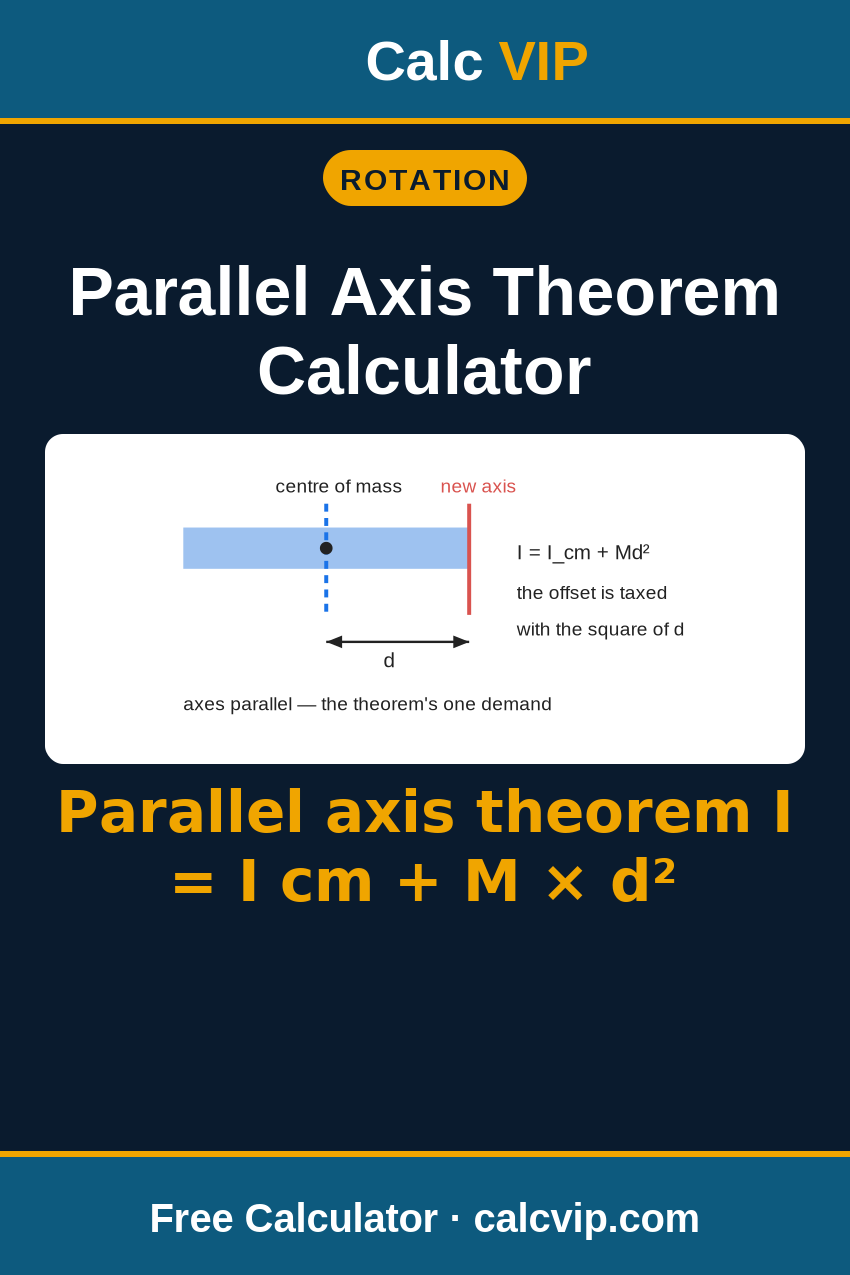
One restriction governs everything, and the FAQ below states it plainly because it is the theorem's only real trap: the known inertia must be the centre-of-mass one. The formula is a bridge that starts at the centre of mass and walks outward. To move between two axes neither of which is central, you walk the bridge twice — back to the centre, subtracting the first offset's Md², then out again, adding the second's. Example 5 works exactly such a case. With that single rule respected, I = Icm + Md² is exact — not an approximation, not a rule of thumb, but a theorem, true for every rigid body and every parallel shift.
Formula
Parallel axis theorem I = Icm + M × d² • I and Icm in kg·m², M in kg, d in metres
The formula rearranges for the return journey: Icm = I − Md² recovers the centre-of-mass value from a measurement made about any other axis — the standard laboratory trick for odd-shaped parts, which are swung about a convenient pivot and then translated back to the centre on paper. Between two non-central axes at distances d₁ and d₂ from the centre, the two steps combine into I₂ = I₁ + M(d₂² − d₁²). And the theorem nests with the shape formulas: a rod about its end is Icm = (1/12)ML² plus M(L/2)², giving (1/12 + 1/4)ML² = (1/3)ML² — the famous end value, derived rather than memorised. Units are unforgiving about d: it enters squared, so a centimetre-metre slip inflates the surcharge a hundredfold. This calculator wants metres throughout.
| Symbol | Meaning | Units |
|---|---|---|
| I | moment of inertia about the new axis | kg·m² |
| Icm | moment of inertia about a parallel axis through the centre of mass | kg·m² |
| M | total mass of the object | kg |
| d | perpendicular distance between the two axes | m |
Why the surcharge is exactly Md² — a one-paragraph proof
The theorem is not a coincidence, and its proof fits in a breath. Moment of inertia sums mr² over the body's pieces. Measure each piece's position from the new axis and it splits into two parts: its position relative to the centre of mass, plus the offset d of the centre itself. Squaring gives three terms: the piece's own r² (which sums to Icm), the offset's d² (which, summed over all pieces, gives the total mass times d² — the Md² term), and a cross term, 2d times the sum of the pieces' positions relative to the centre. But that cross term is zero by the very definition of the centre of mass: the mass-weighted positions about the centre always balance to nothing. What survives is exactly Icm + Md². The proof also explains the restriction — the cross term vanishes only when measured from the centre of mass, which is why the bridge must start there — and why the result is a minimum at the centre: everywhere else, you pay a positive tax on top of the smallest possible base.
There is a physical picture to hold alongside the algebra. Spinning about an off-centre axis can be thought of as two motions fused: the body rotating about its own centre, and the whole centre travelling in a circle around the new axis. The first motion costs Icm; the second costs what a point mass M at distance d would cost — Md². The theorem says the fused motion's inertia is exactly the sum, no more and no less, because the cross-talk between the two motions cancels by the centre's balancing property. A door on its hinges is the picture made furniture: the panel's own spread of mass, plus the whole panel's mass swung at half a door-width from the hinge line.
The theorem also runs the most practical measurement in rotational mechanics. An irregular part — a connecting rod, a propeller, a prosthetic limb — cannot have its Icm looked up, but it can be swung as a pendulum about any convenient pin and timed. The period gives the inertia about the pin through T = 2π√(I/Mgd); the theorem then carries that value home to the centre of mass with a single subtraction. Laboratories perform this two-step so routinely that the theorem is less a formula to them than a ferry: every measurement is taken on the far shore, where the pivots are, and ferried back to the centre, where the design equations live.
How to use
- Enter the moment of inertia about the centre-of-mass axis, Icm, in kg·m² — from a shape formula, a datasheet, or one of this batch's inertia calculators.
- Enter the object's total mass M in kilograms.
- Enter d, the perpendicular distance in metres between the centre-of-mass axis and your new axis. The axes must be parallel — that is the theorem's condition.
- Click "Calculate New Moment of Inertia" to get I about the new axis. To go the other way — from a known off-centre I back to Icm — subtract Md² from the known value instead.
Worked examples
Example 1 — the standard shift. An object with Icm = 0.5 kg·m² and mass M = 4 kg, new axis d = 0.3 m away:
Md² = 4 × 0.3² = 4 × 0.09 = 0.36 kg·m²
I = 0.5 + 0.36 = 0.86 kg·m²
Moving the axis away from the centre always makes the object harder to spin.
Example 2 — the rod about its end, derived. A rod of M = 3 kg, L = 2 m has Icm = (1/12) × 3 × 2² = 1 kg·m². Its end is d = L/2 = 1 m from the centre:
I = 1 + 3 × 1² = 4 kg·m² — the famous (1/3)ML² = (1/3) × 3 × 4 = 4 kg·m², obtained by theorem instead of by integration.
Example 3 — a disk about its rim. A solid disk of M = 2 kg, R = 0.4 m has Icm = ½MR² = 0.16 kg·m² about its centre. For an axis through the rim, parallel to the centre axis, d = R = 0.4 m:
I = 0.16 + 2 × 0.4² = 0.16 + 0.32 = 0.48 kg·m² — triple the centre value, the geometry of a coin rolling on its edge taken to the ledger.
Example 4 — a sphere about a tangent line. A solid sphere of M = 5 kg, R = 0.2 m has Icm = (2/5)MR² = 0.08 kg·m². About a line touching its surface, d = R = 0.2 m:
I = 0.08 + 5 × 0.2² = 0.08 + 0.20 = 0.28 kg·m² — which is (7/5)MR², the textbook tangent value, assembled from the centre value plus one surcharge.
Example 5 — between two off-centre axes. A part of M = 3 kg has Icm = 2 kg·m². Axis A sits 0.5 m from the centre; axis B sits 0.2 m on the other side.
IA = 2 + 3 × 0.5² = 2.75 kg·m²; IB = 2 + 3 × 0.2² = 2.12 kg·m². Note the route: both journeys start at the centre. Going directly from A to B by adding M(0.3)² would be wrong — the offsets are measured from the centre of mass, never from each other.
Example 6 — a hoop about a point on its rim. A hoop of M = 1.5 kg, R = 0.3 m has Icm = MR² = 0.135 kg·m² about its centre (axis perpendicular to the hoop's plane). About a parallel axis through the rim, d = 0.3 m:
I = 0.135 + 1.5 × 0.3² = 0.135 + 0.135 = 0.27 kg·m² = 2MR² exactly — the surcharge precisely equals the base, a coincidence of the hoop's geometry that makes a tidy check on the method.
The parallel axis theorem in real life
Doors and hinges. A door's inertia about its hinge line is this theorem in daily service: the panel's centre value plus its whole mass swung at half the door's width. It is why wide, heavy doors gather momentum so impressively and why door closers are sized by width as much as by weight.
Physical pendulums. Anything that swings — a rod, a bat, a wrecking ball's arm — has a period set by its inertia about the pivot, T = 2π√(I/Mgd). The pivot is never the centre of mass, so the theorem is the obligatory first step of every pendulum calculation, this batch's rod examples included.
Connecting rods and engine parts. A con-rod pivots about pins at both ends, neither through its centre of mass. Engine designers translate its inertia between the pin axes and the centre constantly, because the rod's effective inertia at each end decides real bearing loads at speed.
Satellite deployment. A satellite's inertia is measured about its centre of mass, but it is gripped, spun and released by mechanisms offset from that centre. The release dynamics are computed with the theorem — a small d at release becomes a tumble if the arithmetic was skipped.
Sports equipment. A bat's or racket's "swing weight" is precisely a moment of inertia about an axis near the hands — far from the centre of mass. Two bats of identical mass and balance point can swing differently because their Icm differs; the theorem connects the laboratory number to the felt one.
Crash and safety engineering. The inertia of a vehicle body about off-centre axes governs how it rotates in collisions and rollovers. Simulation models start from centre-of-mass inertias and shift them to whatever axis the impact defines — Steiner's theorem, working the night shift.
Quick reference: classic results the theorem rebuilds
| Case | I_cm | d | I about new axis |
|---|---|---|---|
| rod about its end | (1/12)ML² | L/2 | (1/3)ML² |
| disk about rim axis | ½MR² | R | (3/2)MR² |
| sphere about tangent | (2/5)MR² | R | (7/5)MR² |
| hoop about rim axis | MR² | R | 2MR² |
| door about its hinges | (1/12)Mw² | w/2 | (1/3)Mw² |
Every row is a formula that students are usually asked to memorise, rebuilt here from one centre value plus one surcharge. That is the theorem's real gift: it collapses a shelf of special cases into a single addition, performed by this calculator, that you can re-derive on a napkin from the proof above.
Common mistakes
- Starting from a non-centre axis. I = Icm + Md² is valid only when the known value is about the centre of mass. Feeding in an inertia about some other axis and adding Md² double-counts the offset. Return to the centre first — subtract the old Md² — then walk out again.
- Measuring d between the wrong points. d is the perpendicular distance between the two parallel axes — equivalently, from the centre of mass to the new axis. Measuring from the object's edge, or along a slant, corrupts the surcharge before it is even squared.
- Entering d in centimetres. Because d is squared, the slip is savage: entering 30 (cm) instead of 0.30 (m) makes d² — and therefore the whole surcharge — 10,000 times too large. Always convert d to metres first, as every worked example on this page does.
- Using non-parallel axes. The theorem moves an axis sideways without tilting it. A tilted axis is a different problem (it needs the perpendicular-axis or tensor machinery); no value of d will fix a tilt.
- Expecting I to shrink. Md² is never negative, so no parallel axis beats the centre-of-mass axis. An answer smaller than Icm is not a discovery — it is a sign error announcing itself.
FAQ
Why must one axis pass through the centre of mass?
The simple form I = Icm + Md² only works when the known value is about the centre of mass. To move between two other axes, first come back to the centre of mass, then move out again.
Can I ever be smaller than Icm?
No. Md² is always positive, so the centre-of-mass axis gives the smallest possible moment of inertia for that direction.
Where is this used in practice?
Everywhere a part spins about an off-centre axle — for example a rod swinging from one end: Icm = (1/12)ML² plus M(L/2)² gives the famous (1/3)ML².
Who was Steiner, and is this the same as the Huygens–Steiner theorem?
Yes — the same result carries both names: Christiaan Huygens used it for pendulum calculations in the 17th century, and Jakob Steiner gave the general proof in the 19th. Many textbooks call it the Huygens–Steiner theorem; "parallel axis theorem" is its descriptive English name.
Does the theorem work for three-dimensional objects?
Yes, for any rigid body, provided the two axes are parallel and one passes through the centre of mass. The shape does not matter — spheres, rods, engine blocks and satellites all obey it, because the proof only used the definition of the centre of mass.
What if the object is hollow or irregular?
The theorem does not care: it needs only Icm, M and d, however Icm was obtained — by formula, by measurement, or by swinging the object and timing it. Irregularity is a problem for finding Icm, never for shifting it.
How do I find I_cm for a measured, off-centre value?
Subtract: Icm = I − Md². This is the standard reduction in torsion-pendulum measurements, where the object is swung about a convenient wire axis and the centre value is recovered on paper afterwards.
Is there a version for area or for radius of gyration?
Both. For areas, the second moment shifts by Ad² in structural engineering — the same theorem in a hard hat. For radius of gyration k (where I = Mk²), the theorem becomes k² = kcm² + d²: the squares add, which is often the fastest mental form of all.
Why is the centre-of-mass axis the minimum?
Because the surcharge Md² is a square times a mass — it cannot be negative. Every parallel axis pays it in full, so the centre axis, the only one with d = 0, keeps the smallest inertia. Physically: spin about the centre and no part of the body has to travel in a circle around an external point.
Can d be larger than the object itself?
Certainly — the axis need not touch the object at all. A satellite gripped by a long arm, or a mass on a pendulum rod, rotates about an axis well outside its body, and the theorem handles it unchanged: Md² simply grows until it dominates, and the object behaves increasingly like a point mass on a string.