 Calc
Mass Defect Calculator – From Protons, Neutrons & Atomic Mass
 Created by Anna Kowalski · Physics Editor · Heat & Atoms · Last updated: November 2026
Use this free Mass Defect Calculator to find the mass defect of any nucleus from its proton number, neutron number and measured atomic mass. The defect — the mass that "goes missing" when a nucleus forms — is exactly the mass converted into binding energy.
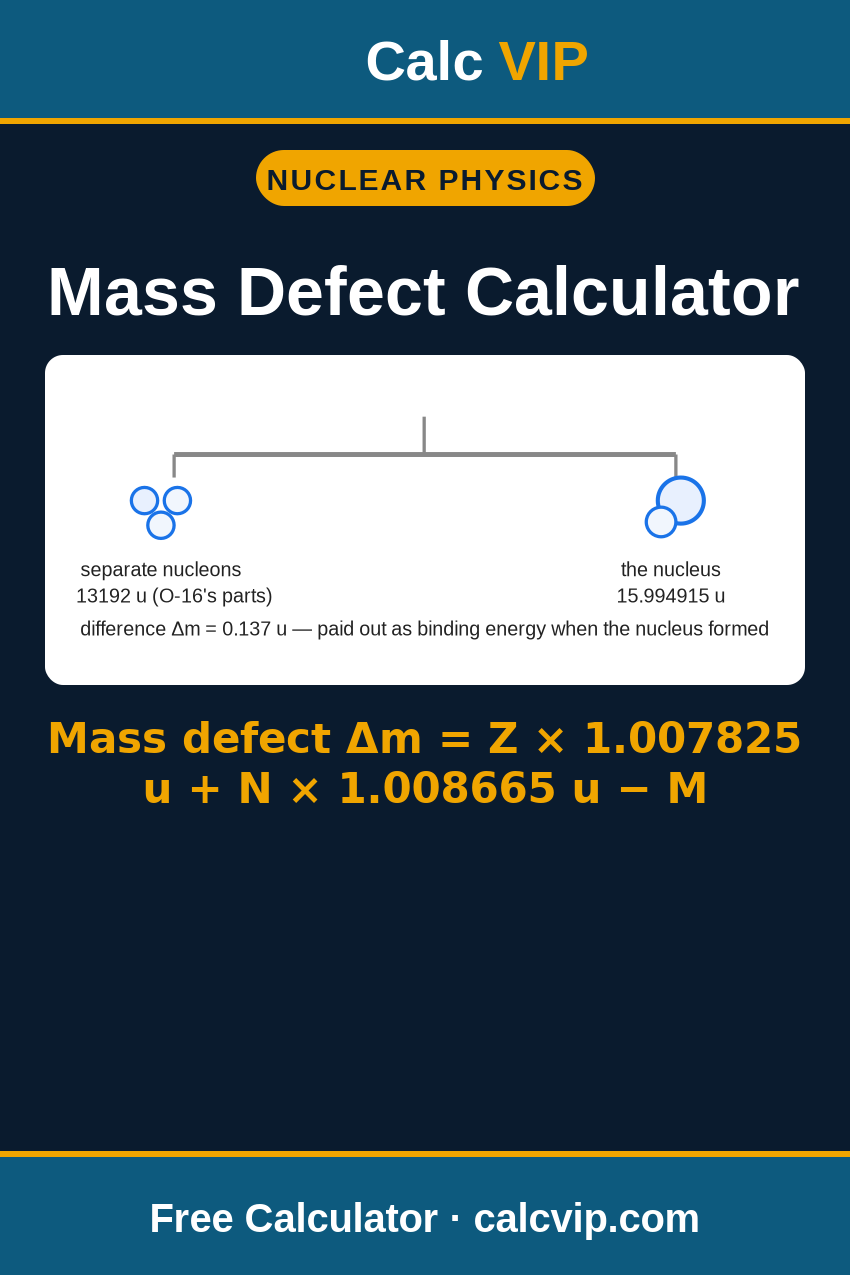
Weigh a nucleus and weigh its ingredients separately, and the two weighings disagree. Sixteen protons' and neutrons' worth of matter, assembled into oxygen-16, comes out 0.137 atomic mass units lighter than the parts — not through any error of the scales, but because assembling the nucleus released energy, and the released energy carried mass away with it, exactly as E = mc² demands. That missing mass is the mass defect, and multiplied by c² it is the binding energy: the energy you would have to repay, in full, to tear the nucleus back into separate protons and neutrons. This calculator performs the subtraction for any isotope whose proton number, neutron number and atomic mass you supply.
The numbers are small and the consequences are not. A mass defect is typically under 1% of the nucleus's mass — 0.86% for oxygen-16, about 0.95% for iron-56 — yet that sliver, converted at the brutal exchange rate of c², is the energy source of the Sun, of nuclear reactors and of atomic weapons. Chemical reactions also have mass defects, in strict principle, but theirs are a billion times smaller: burning a kilogram of coal "loses" a few ten-billionths of a gram, unmeasurable on any scale. Nuclear binding is where mass-energy conversion steps out of the philosophy books and into the power grid, and it starts with the subtraction on this page.
There is a bookkeeping subtlety that makes the calculation clean, and it is worth understanding once. The formula uses atomic masses — the masses of neutral atoms, electrons included — and counts each proton as a whole hydrogen atom (proton plus its electron). The isotope's own atom carries exactly Z electrons, matching the Z electrons smuggled in with the hydrogen atoms, so every electron mass cancels in the subtraction. What survives is purely nuclear: the mass the nucleus itself lost when it formed. That is why the calculator asks for the atomic mass from a data table, and why feeding it a bare nuclear mass instead would corrupt the answer by Z electron masses.
Formula
Mass defect Δm = Z × 1.007825 u + N × 1.008665 u − M • and binding energy BE = Δm × 931.5 MeV.
The constants: a hydrogen atom (proton + electron) has mass 1.007825 u; a neutron, 1.008665 u — slightly heavier than the hydrogen atom, a fact with cosmic consequences — and one atomic mass unit converts to energy as 1 u = 931.5 MeV/c² = 1.6605 × 10⁻²⁷ kg. The formula runs the other way too: given a measured binding energy, Δm = BE / 931.5 u is the mass the nucleus is missing. Two consistency checks guard the arithmetic: Δm must come out positive for any genuinely bound nucleus (a negative answer means the mass you entered does not belong to the Z and N you entered), and Δm should be a small fraction of M — roughly 0.1% for the lightest nuclei, rising to about 0.95% near iron. Anything wildly outside that band is a data-entry error announcing itself.
| Symbol | Meaning | Units |
|---|---|---|
| Δm | mass defect — parts mass minus nucleus mass | u (or kg) |
| Z | proton number (each counted as a hydrogen atom) | count |
| N | neutron number | count |
| M | measured atomic mass of the isotope (electrons included) | u |
| BE | total binding energy, Δm × 931.5 | MeV |
Where the missing mass actually goes
"Missing" is bookkeeping language, not mystery. When protons and neutrons bind, the strong nuclear force pulls them into a lower-energy configuration, and the surplus energy must leave — it is radiated away as gamma rays (and shared as kinetic energy) during formation. Einstein's relation says that energy has mass: E/c² of it. The departing photons carry away exactly Δm worth of mass-energy, leaving the nucleus lighter by that amount. Run the film backwards and the symmetry is perfect: to dismantle the nucleus you must supply the full binding energy again, photon by photon or collision by collision, and the separated nucleons weigh the full original sum once more. Mass is not destroyed in either direction; it is converted, at the fixed exchange rate c², between the mass of matter and the energy of radiation and motion.
The exchange rate is what makes nuclear physics a different economic world from chemistry. One atomic mass unit is 931.5 MeV; a chemical bond is a few eV. Assemble a mole of oxygen-16 nuclei from free nucleons and the binding energy released is 2.044 × 10⁻¹¹ J per nucleus × 6.022 × 10²³ nuclei ≈ 1.23 × 10¹³ joules — the output of a large power station for hours, from 16 grams of matter. Per kilogram, fully binding oxygen nuclei from nucleons would release about 7.7 × 10¹⁴ J — roughly 184,000 times the energy density of TNT (4.184 × 10⁹ J/kg). No practical process performs that assembly wholesale, but fusion and fission skim percentage points off exactly this reservoir, which is why skimming is enough.
How to use
- Enter the proton number Z and neutron number N of the isotope (Z + N is its mass number A).
- Enter the isotope's atomic mass M in u from a data table — the mass of the neutral atom, electrons included (oxygen-16: 15.994915 u; iron-56: 55.934937 u). Precision matters: the defect is a small difference of large numbers, so use at least six decimal places.
- Click "Calculate Mass Defect" to get Δm in u and kilograms, and the corresponding total binding energy in MeV.
- If the result is negative, do not force it — the calculator is telling you the mass does not match that Z and N. Check for a neighbouring isotope's mass or a transposed digit.
Worked examples
Example 1 — oxygen-16, the reference case. Z = 8, N = 8, M = 15.994915 u.
Separate parts: 8 × 1.007825 + 8 × 1.008665 = 8.0626 + 8.06932 = 16.13192 u.
Δm = 16.13192 − 15.994915 = 0.137005 u = 2.275 × 10⁻²⁸ kg — 0.857% of the atom's mass.
Binding energy: 0.137005 × 931.5 = 127.62 MeV.
Example 2 — helium-4, the overachiever. Z = 2, N = 2, M = 4.002603 u.
Δm = 2.01565 + 2.01733 − 4.002603 = 0.030377 u, so BE = 0.030377 × 931.5 = 28.30 MeV. For a four-nucleon nucleus that is a remarkable total — 7.07 MeV per nucleon, far up the stability curve — which is why helium-4 is the ash of fusion and the payload of alpha decay.
Example 3 — carbon-12, the definition made flesh. Z = 6, N = 6, and M = 12.000000 u exactly — the atomic mass unit is defined by this atom.
Δm = 6.04695 + 6.05199 − 12 = 0.09894 u; BE = 92.16 MeV. Even the standard atom itself is nearly a tenth of a unit lighter than its parts.
Example 4 — deuterium, barely bound. Z = 1, N = 1, M = 2.014102 u.
Δm = 1.007825 + 1.008665 − 2.014102 = 0.002388 u; BE = 2.224 MeV. One proton holding one neutron with the smallest binding in this set — a gamma ray of just 2.224 MeV breaks it apart, a fact used to calibrate detectors and to run photodisintegration experiments.
Example 5 — uranium-238, the heavyweight. Z = 92, N = 146, M = 238.050788 u.
Parts: 92 × 1.007825 + 146 × 1.008665 = 92.7199 + 147.26509 = 239.98499 u.
Δm = 239.98499 − 238.050788 = 1.934202 u (3.212 × 10⁻²⁷ kg); BE = 1,801.7 MeV. The largest total binding here — yet divided among 238 nucleons it is only 7.57 MeV each, well below iron's figure, which is precisely why this nucleus can profit energetically from splitting.
Example 6 — iron-56, the champion. Z = 26, N = 30, M = 55.934937 u.
Δm = 26.203450 + 30.259950 − 55.934937 = 0.528463 u; BE = 492.26 MeV, or 8.79 MeV per nucleon — the greatest fractional defect on the chart of nuclides' practical summit. The Binding Energy per Nucleon Calculator takes exactly this next step of dividing by A.
Mass defect in real life
Predicting decay energies. Every radioactive decay's Q-value — the energy it can release — is a mass-defect subtraction between parent and products. Uranium-238's alpha decay, for instance, releases 4.27 MeV because the products (thorium-234 plus helium-4) are together 0.00458 u lighter. If the subtraction comes out negative, the decay is forbidden, full stop.
Stellar energy budgets. A star's lifetime is its mass defect spent slowly: the Sun converts about 4.3 million tonnes of mass into energy every second (its luminosity divided by c²), fusing hydrogen toward helium and banking the 0.7% defect difference as light.
Reactor and weapon physics. The ~200 MeV of a uranium fission is the mass defect difference between the original nucleus and its fragments plus neutrons — computed with this page's arithmetic before it is ever measured in a calorimeter.
Mass spectrometry. Modern Penning-trap measurements weigh single ions to parts in 1011, turning mass defects into the sharpest tests of nuclear models and of fundamental constants — the subtraction is the experiment.
Medical isotope production. Whether a production reaction (bombarding a target to make a medical tracer) releases or consumes energy is decided by the mass defects of target, projectile and product — endoergic reactions need faster beams, exoergic ones nearly run themselves.
Exotic atoms and precision physics. Tiny refinements — the electron binding energies that the simple cancellation ignores, totalling a few hundred keV for the heaviest atoms — become visible at the precision frontier, where mass defect work tests quantum electrodynamics itself.
Precision: when the electron bookkeeping matters
The hydrogen-atom trick cancels electron masses exactly, but electrons also have binding energies — an atom's electrons are themselves bound, by 13.6 eV in hydrogen up to a total of a few hundred keV summed over all 92 electrons of uranium. Those energies are also missing mass, in principle, so the atomic-mass subtraction quietly includes them. Against binding energies of hundreds of MeV, a few hundred keV is a fraction of a percent — invisible at this calculator's precision, and one reason its answers match tabulated binding energies so well. At the frontier of mass spectrometry, where defects are measured to eV precision, the electron terms are carefully restored. Know which regime you are in: for every isotope-identification, energy-budget and examination purpose, the cancellation on this page is exact enough; for testing QED, it is the interesting remainder.
One subtraction, an entire chart of physics
It is worth pausing on how much of nuclear science is this single subtraction repeated. Apply it to every known isotope — some 3,000 measured masses — and patterns emerge that no one put in by hand: binding per nucleon rises, peaks at iron, and falls; odd-even staggering appears as pairing forces switch on and off; sudden jumps betray closed nuclear shells, the "magic numbers" 2, 8, 20, 28, 50, 82, 126 where nuclei are anomalously tightly bound. The semi-empirical mass formula, with its volume, surface, Coulomb, asymmetry and pairing terms, is essentially a five-parameter attempt to reproduce this page's subtraction from theory. Where formula and measurement disagree, new physics is usually hiding. A calculator that subtracts two masses looks humble; used three thousand times, it maps the strong force itself.
Quick reference: mass defects of landmark nuclei
| Nucleus | Δm (u) | Binding energy |
|---|---|---|
| deuterium (H-2) | 0.002388 | 2.224 MeV |
| helium-4 | 0.030377 | 28.30 MeV |
| carbon-12 | 0.098940 | 92.16 MeV |
| oxygen-16 | 0.137005 | 127.62 MeV |
| iron-56 | 0.528463 | 492.26 MeV |
| uranium-238 | 1.934202 | 1,801.7 MeV |
Total binding grows relentlessly with size — uranium's defect is fourteen times oxygen's — which is exactly why the per-nucleon division, not the total, is the true measure of stability.
Common mistakes
- Using the proton mass (1.007276 u) with an atomic mass. That strips Z electron masses from one side of the subtraction only, shifting Δm by Z × 0.00055 u — for uranium, a spurious 0.05 u, or 47 MeV of phantom binding. Proton-count-as-hydrogen-atom is the matched convention.
- Entering the mass number instead of the atomic mass. Typing M = 16 for oxygen-16 gives Δm = 0.132 u by luck-adjacent accident; for most isotopes the error is gross. The defect lives in the decimals — use the full tabulated mass.
- Rounding the atomic mass too early. Δm is a small difference of large numbers: rounding M to two decimals can halve or double it. Carry at least six decimal places through the subtraction.
- Reading a negative defect as a discovery. A bound nucleus cannot have one. Negative means mismatched data — the mass belongs to a different isotope, or Z and N were swapped with another element's.
- Comparing total binding energies across nuclei. Uranium's 1,801.7 MeV dwarfs helium's 28.30 MeV, yet helium is far more stable per nucleon. Totals reward size; stability lives in the per-nucleon figure.
FAQ
Why does the nucleus weigh less than its parts?
Forming a nucleus releases energy (the binding energy). By E = mc² that released energy carries mass away with it, so the bound nucleus is lighter than the separate protons and neutrons by exactly Δm = BE/c².
Can the mass defect be negative?
Not for a real, bound nucleus — a negative result would mean the nucleus is heavier than its parts and would fall apart spontaneously. If you get one, check that the atomic mass matches the Z and N you entered.
What atomic mass should I enter for hydrogen or helium?
Use the atomic mass of the neutral atom, electrons included: H-1 = 1.007825 u (by definition the same as the hydrogen atom used in the formula) and He-4 = 4.002603 u, which gives Δm = 0.030377 u.
How is the mass defect related to E = mc²?
It is E = mc² in its most literal working form: the binding energy E and the missing mass Δm are the same quantity in two units, joined by E = Δm × c². The conversion 1 u = 931.5 MeV/c² is just c² expressed in the units of the atomic world.
Why is the neutron heavier than the hydrogen atom?
By 0.000840 u — about 0.78 MeV/c². That small excess is why a free neutron is unstable, decaying into a proton (plus electron and antineutrino) with a mean life of about 15 minutes, while neutrons inside stable nuclei, where decay would cost binding energy, endure.
Where do atomic masses come from?
From mass spectrometry — today, Penning traps that weigh single ions by their cyclotron frequency in a magnetic field, and time-of-flight instruments. The Atomic Mass Evaluation maintains the standard table this calculator's inputs are drawn from, updated as measurements sharpen.
Does the mass defect include the electrons' own binding?
Implicitly, yes, at the few-hundred-keV level for heavy atoms — negligible here, as the depth section explains. The electron masses themselves cancel exactly; only their (tiny) binding energies ride along.
Can the mass defect tell me if an isotope is radioactive?
Not by itself. Stability is a competition between neighbouring nuclei: an isotope decays if some reachable arrangement of its nucleons has a larger total binding. The defect gives you the raw material — total binding — from which such comparisons (and all Q-values) are built.
Why is 931.5 MeV the conversion?
Because 1 u is defined as one twelfth of a carbon-12 atom's mass, 1.6605 × 10⁻²⁷ kg, and multiplying that kilogram figure by c² and converting joules to MeV gives 931.5. More precise tables use 931.494; the difference is one part in 105, invisible at this page's precision.
Is mass really lost when a nucleus forms in a star?
The mass-energy leaves as light and neutrinos, yes — a star literally weighs less, moment by moment, by the mass equivalent of the energy it radiates. The Sun's 4.3-million-tonnes-per-second loss is this calculator's subtraction written across the sky.