 Calc
Neutron Wavelength Calculator – de Broglie Wavelength from Energy
 Created by Anna Kowalski · Physics Editor · Heat & Atoms · Last updated: November 2026
Use this free Neutron Wavelength Calculator to find the de Broglie wavelength of a neutron from its kinetic energy or temperature. Slow "thermal" neutrons have wavelengths about the size of atoms — which is why they work like X-rays for probing crystal structures.
Here is the beautiful oddity this calculator captures: a neutron is a particle with nearly the mass of a proton, yet when it slows down to room-temperature energies it spreads out into a wave 1.8 ångströms long — the size of the spacing between atoms. That coincidence is not a curiosity; it is an industry. Because their wavelengths match crystal geometry, thermal neutrons diffract from crystals exactly as X-rays do, and neutron diffraction has become one of the great structure-probing tools of physics, chemistry and biology. The wavelength is set entirely by the energy through de Broglie's relation, so this one conversion — energy or temperature in, wavelength and speed out — is the dial that neutron scientists turn all day.
The energy scale deserves a moment. Thermal neutrons carry about 0.025 eV of kinetic energy — the energy of ordinary thermal motion at room temperature, which is how they got their name: they have come into thermal equilibrium with their surroundings. Compare that with the millions of electronvolts (MeV) of the neutrons born in fission or spallation, and the story of every neutron facility is a story of slowing down: moderators of water, graphite or liquid hydrogen bleed away a factor of a hundred million in energy, collision by collision, until the neutrons are slow, wave-like and useful. Hot sources run the moderator warm to shift the spectrum up; cold sources chill it to ~20 K to push wavelengths out toward 6–9 Å, the scale of proteins and polymers.
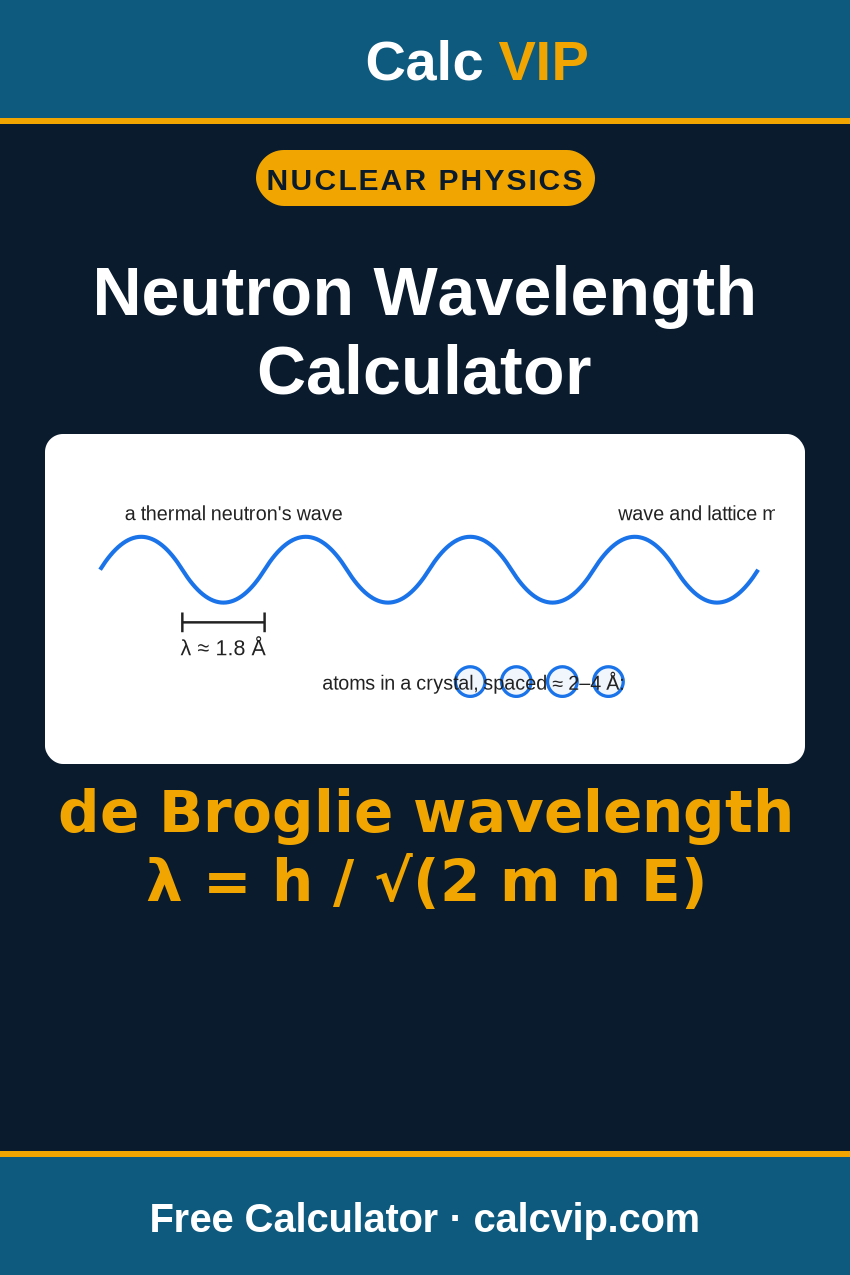
De Broglie's formula, λ = h/(mv) = h/√(2mE), is democratic — it applies to electrons, atoms, even baseballs — but the neutron is its sweet spot. An electron at 0.025 eV would have a wavelength of about 77.6 Å, nearly 43 times longer (the factor is √(mn/me) ≈ 42.9), too long for atomic spacings. The neutron's hefty mass pulls its thermal wavelength down to exactly the ångström scale of the solid state. Add that neutrons are uncharged — they slip deep into matter and scatter from nuclei themselves, not electron clouds — and that they carry a magnetic moment, and you have a probe unlike any other. This calculator finds where on that wave-particle dial your neutron sits.
Formula
de Broglie wavelength λ = h / √(2 mn E) • λ in metres, h = 6.626 × 10⁻³⁴ J·s, mn = 1.675 × 10⁻²⁷ kg, E in joules.
Two companion relations complete the picture. The speed is v = √(2E / mn), and the temperature mode uses E = kT with k = 8.617 × 10⁻⁵ eV/K, the convention that makes 293 K correspond to 0.025 eV. (A thermal distribution is broad — neutrons in a moderator follow a Maxwell spectrum with mean energy 1.5 kT; the calculator, like the whole field's shorthand, quotes the characteristic kT value.) Because the square root governs everything, the working shortcut is worth memorising: λ (Å) ≈ 0.286 / √E (eV), and v ≈ 13,830 × √E (eV) m/s. Check it against the reference case: 0.286 / √0.025 = 0.286 / 0.158 = 1.81 Å. Energies must enter in electronvolts converted to joules (1 eV = 1.602 × 10⁻¹⁹ J) before the SI formula is used — the single most common source of error with this calculator's physics.
| Symbol | Meaning | Units |
|---|---|---|
| λ | de Broglie wavelength of the neutron | m; usually quoted in Å or pm |
| E | kinetic energy of the neutron | eV (converted to J in the formula) |
| T | temperature of the moderator the neutron equilibrated with | kelvin (K) |
| v | neutron speed | m/s |
| mn, h, k | neutron mass; Planck and Boltzmann constants | kg; J·s; eV/K |
The square-root law and what it buys you
Everything about neutron optics flows from λ ∝ 1/√E. Quadruple the energy and the wavelength only halves; to stretch λ tenfold you must cool the neutron a hundredfold in energy. That sluggish square root is why the neutron world spans such extravagant energies for a modest range of wavelengths: from ultracold neutrons below 0.001 eV (λ above 9 Å, slow enough to be trapped in bottles and to fall measurably in gravity) to the MeV neutrons of fission (λ ≈ 0.000286 Å, particles in every practical sense). It also means wavelength selection is energy selection: a crystal monochromator or a mechanical chopper that picks neutrons of one speed has, by this formula, picked one wavelength, and time-of-flight instruments simply clock each neutron over a known distance, compute v, and read off λ.
Set beside X-rays, the neutron's personality sharpens. An X-ray of the same 1.8 Å wavelength carries about 6.9 keV of energy; the neutron carries 0.025 eV — a quarter-million times less — yet diffracts identically, because diffraction cares about wavelength alone. The neutron therefore probes structure gently, deeply and magnetically: it penetrates centimetres of metal, scatters strongly from light hydrogen atoms that X-rays barely see, and its magnetic moment reports the direction of atomic magnets inside the sample. Every neutron facility on Earth — ILL in Grenoble, ISIS in Oxfordshire, SNS in Tennessee — is a machine for manufacturing neutrons at the energies this calculator converts.
How to use
- Choose what you know: the neutron's kinetic energy in electronvolts, or the temperature (in kelvin) of the moderator it has equilibrated with.
- Enter the value — 0.025 eV (or 293 K) for the classic thermal neutron, ~0.002 eV for a cold-source neutron, 1e6 eV for a fission neutron.
- Click "Calculate Neutron Wavelength" to get the wavelength in metres, ångströms and picometres, together with the neutron's speed.
- Compare λ with the structure you care about: diffraction needs λ comparable to the spacings under study (1–5 Å for crystals, 5–10 Å and beyond for polymers, membranes and magnetic textures).
Worked examples
Example 1 — the thermal neutron. E = 0.025 eV = 4.005 × 10⁻²¹ J.
λ = 6.626 × 10⁻³⁴ / √(2 × 1.675 × 10−27 × 4.005 × 10−21) = 1.809 Å (180.9 pm), and v = √(2E/mn) = 2,186.8 m/s — about six times the speed of sound in air, yet slow enough that gravity bends a long neutron beam's path measurably. This is the workhorse neutron of diffraction and reactor physics.
Example 2 — temperature mode. A moderator at 293 K: E = kT = 8.617 × 10−5 × 293 = 0.0252 eV, giving λ = 1.80 Å. The tiny difference from Example 1 is the difference between the round 0.025 eV convention and an exact room temperature — a reminder that "thermal" names a distribution, not a single energy.
Example 3 — an epithermal neutron. At E = 1 eV, λ = 0.286 / √1 = 0.286 Å and v = 13,831 m/s. The wavelength has already shrunk below atomic spacings — such neutrons are used for resonance absorption studies and deep inelastic scattering rather than crystallography.
Example 4 — a cold neutron. Liquid hydrogen at 20 K gives E = 8.617 × 10−5 × 20 = 0.00172 eV, so λ = 0.286 / √0.00172 = 6.89 Å. Waves this long match the architecture of soft matter — polymer coils, lipid membranes, micelles — which is why cold sources feed small-angle scattering instruments.
Example 5 — a hot moderator. At 1,000 K, E = 0.0862 eV and λ = 0.974 Å. Graphite hot sources running near this temperature serve instruments that need shorter wavelengths and higher energies than a room-temperature moderator provides, without going fully epithermal.
Example 6 — a fission neutron, the particle limit. Born at E = 1 MeV = 106 eV: λ = 0.286 / 1,000 = 0.000286 Å, and v = 1.383 × 10⁷ m/s — 4.6% of light speed. The wavelength is ten thousand times smaller than an atom; wave behaviour is irrelevant until a moderator has staged the neutron down through some 18 collisions with hydrogen nuclei (each removing, on average, a fixed logarithmic share of energy) to thermal energies.
Neutron wavelength in real life
Crystal structure determination. Neutron diffraction locates hydrogen atoms in crystals — in pharmaceuticals, hydrogen-storage materials and ice physics — where X-rays, scattering from electrons, nearly miss them. The 1.8 Å thermal wave is the standard probe, chosen by exactly this calculator's conversion.
Magnetism research. The neutron's magnetic moment scatters from atomic magnetic moments, mapping antiferromagnetic order, spin waves and skyrmions. Much of what is known about high-temperature superconductors' magnetism came from thermal and cold neutron beams.
Engineering stress scans. Neutrons penetrate centimetres of steel, so diffractometers measure residual strain deep inside turbine blades, railway rails and welds — non-destructively, at the exact component locations where cracks are born.
Soft matter and biology. Cold neutrons at 5–10 Å, in small-angle scattering, size up proteins, viruses, emulsions and battery electrodes in solution — structures too large for crystallography and too delicate for electron microscopy.
Neutron imaging. Radiography with thermal neutrons images water inside fuel cells, oil in engines and roots in soil: hydrogen-rich matter blocks neutrons strongly while metal stays transparent — the photographic negative of an X-ray.
Medicine — boron neutron capture therapy. BNCT irradiates tumours loaded with boron-10 using epithermal neutrons that thermalise inside tissue; the treatment's dosimetry begins with the energy–wavelength–speed bookkeeping of this page.
Moderation: how neutrons earn their wavelength
No neutron source emits thermal neutrons directly — fission and spallation birth them at MeV energies, a hundred million times too hot. The moderator closes that gap by elastic scattering, and the neutron's near-twin, the proton, is the perfect brake: equal masses exchange energy most efficiently, like colliding billiard balls. Averaged over angles, each hydrogen collision removes a constant fraction of the neutron's energy on the logarithmic scale (the "lethargy" decrement ξ = 1 for hydrogen), so the journey from 2 MeV to 0.025 eV — a factor of 8 × 10⁷, or ln(8 × 10⁷) ≈ 18.2 in logarithmic units — takes only about 18 collisions. In heavy water or graphite the same journey takes hundreds of collisions, which is why reactor moderators are bulky. The endpoint is set by temperature alone: leave the neutron colliding long enough and it forgets its birth entirely, emerging with the moderator's kT — and with the wavelength this calculator reports.
From wavelength to a diffraction pattern
The wavelength earns its keep through Bragg's law, nλ = 2d sin θ: a crystal plane family with spacing d reflects the beam strongly at the angle where waves scattered from successive planes reinforce. Put numbers in: a thermal neutron at λ = 1.81 Å striking planes spaced d = 2.5 Å apart gives sin θ = 1.81 / (2 × 2.5) = 0.362, so the first-order reflection appears at θ ≈ 21.2° — a comfortable, measurable angle, neither grazing nor backscattered. That is the design sweet spot this whole subject aims at: λ comparable to d, angles in the convenient middle range. If λ exceeded 2d, no solution would exist at all — the wave could not diffract from those planes at any angle — which is why long-wavelength cold neutrons are useless for atomic crystallography but perfect for the 50–500 Å spacings of soft matter, where the same law pushes the scattering to tiny angles near the direct beam, the small-angle regime. One formula, λ = h/√(2mE), feeding one law, nλ = 2d sin θ, covers the whole of neutron scattering.
Quick reference: neutron energies, wavelengths, speeds
| Neutron | Energy | λ | Speed |
|---|---|---|---|
| cold (20 K source) | 0.00172 eV | 6.89 Å | ≈ 574 m/s |
| thermal (293 K) | 0.025 eV | 1.81 Å | 2,187 m/s |
| epithermal | 1 eV | 0.286 Å | 13,831 m/s |
| fast | 100 eV | 0.0286 Å | 138,305 m/s |
| fission-born | 1 MeV | 0.000286 Å | 1.38 × 10⁷ m/s |
One table, three regimes: waves you can bottle, waves that read crystals, and particles that must be slowed before they are good for anything but damage.
Common mistakes
- Using the electron mass in de Broglie's formula. The neutron is 1,839 times heavier; its wavelength at the same energy is √1,839 ≈ 43 times smaller. A thermal electron's 77.6 Å and a thermal neutron's 1.81 Å are different instruments entirely.
- Forgetting the eV-to-joule conversion. The SI formula needs E in joules. Feeding 0.025 straight in as joules inflates the energy by nineteen orders of magnitude and shrinks λ to absurdity — convert with 1 eV = 1.602 × 10⁻¹⁹ J first.
- Expecting λ to scale as 1/E. It scales as 1/√E: cutting the energy by 100 only stretches the wavelength tenfold. Design decisions for cold sources live and die by that square root.
- Treating "thermal" as one exact energy. A moderator emits a Maxwell distribution of energies around kT; instruments select slices of it. The calculator's value is the characteristic energy the whole field uses as shorthand.
- Reaching for the relativistic formula at MeV energies. Even at 1 MeV a neutron moves at 4.6% of light speed and the non-relativistic formula errs by well under 1%. Save relativity for hundreds of MeV.
FAQ
Why are thermal neutrons used in diffraction?
Their wavelength (≈ 1.8 Å) is the same size as the gaps between atoms in a crystal, so they diffract like X-rays — but neutrons scatter off nuclei and magnetic moments, revealing things X-rays cannot, such as hydrogen positions and magnetism.
How does the wavelength change with energy?
λ shrinks with the square root of energy: a 1 eV neutron has λ ≈ 0.286 Å, and a 1 MeV neutron only about 0.000286 Å. Faster neutrons behave more like particles, slower ones more like waves.
What temperature is a "cold" neutron?
Neutrons moderated in liquid hydrogen at about 20 K have energies near 0.002 eV and wavelengths around 6 Å. These cold neutrons are prized for studying soft matter like polymers and proteins.
What is an ångström?
1 Å = 10−10 m = 0.1 nm — the natural unit of atomic dimensions. A hydrogen atom is about 1 Å across, crystal lattice spacings run 2–5 Å, and the thermal neutron's 1.81 Å sits squarely in that world, which is the entire point.
How is a neutron's wavelength measured in practice?
By time of flight: chop the beam into pulses, clock each neutron over a flight path of known length (thermal neutrons take milliseconds over metres), and convert speed to wavelength with this page's relations. Alternatively, Bragg diffraction from a crystal of known spacing reads λ directly.
Why not just use electrons or X-rays instead?
Each probe sees a different sample. X-rays scatter from electron clouds and miss hydrogen; electrons interact so strongly they only skim surfaces; neutrons penetrate deeply, find hydrogen, distinguish neighbouring elements and isotopes, and report magnetism. Neutron time is scarce and expensive precisely because the probe is irreplaceable.
What are ultracold neutrons?
Neutrons slowed below about 0.001 eV (λ beyond ~9 Å), moving slower than ~10 m/s. They reflect from suitable surfaces at any angle and can be stored in material bottles for hundreds of seconds — slow enough to watch them fall in gravity and to hunt for a neutron electric dipole moment.
Do neutrons in a reactor all have this wavelength?
No — a reactor core holds the full spectrum at once: fresh fission neutrons at MeV energies, a slowing-down tail, and the thermal Maxwellian peak near 0.025 eV that sustains the chain reaction in uranium-235. Fuel and moderator design is the art of managing that spectrum.
Can a neutron's wavelength be longer than a metre?
In principle the formula allows it as E → 0, but such a neutron would move at centimetres per second, fall out of any beam under gravity almost immediately, and be absorbed by everything. Practical wavelengths end at the ultracold frontier, around 100 Å in specialised instruments.
Why does the calculator ask for temperature at all?
Because at a neutron facility you rarely set an energy directly — you choose a moderator and its temperature (room-temperature water, 20 K liquid hydrogen, 1,000 K graphite) and the spectrum follows. Temperature is the engineer's dial; energy and wavelength are what the dial selects.