 Calc
Efficiency Calculator – Useful Output vs Total Input (%)
 Created by Priya Sharma · Physics Editor · Energy & Gravity · Last updated: November 2026
Use this free Efficiency Calculator to find what percentage of the input energy (or power) a machine turns into useful output. Enter the useful output and the total input — in joules for energy, or watts for power — and get the efficiency as a percentage.
Every machine ever built is a compromise. You feed it energy in one form — electricity, petrol, food, falling water — and it hands you back energy in the form you actually wanted: motion, light, heat in the right place. But it never hands back all of it. Some is always diverted along the way into heat you did not ask for, noise, vibration and friction. Efficiency is the score that measures the compromise: the useful output divided by the total input, expressed as a percentage. This calculator works it out from any two matching numbers, and also tells you how much was wasted.
The idea is older than the word. Engineers of the steam age compared engines by "duty" — how much water an engine could lift per bushel of coal — because coal cost money and wasted energy was wasted profit. The modern percentage is the same instinct tidied up, and it now sits behind appliance energy labels, car fuel-economy figures, power-station design and the training plans of athletes, whose muscles are machines with an efficiency of only about 25%. Wherever energy is bought, burned or eaten, somebody is asking this page's question.
Two features make the percentage so handy. First, it is a pure ratio, so it does not matter whether you measure in joules or kilowatt-hours, watts or horsepower — as long as the input and output share a unit, the percentage is the same. Second, it has a hard ceiling. Conservation of energy forbids any machine from returning more useful energy than it receives, so an efficiency above 100% is not a breakthrough; it is a measurement error waiting to be found. Real machines live far below the ceiling, and the gap between a machine's actual score and 100% is a map of where its energy is escaping.
Formula
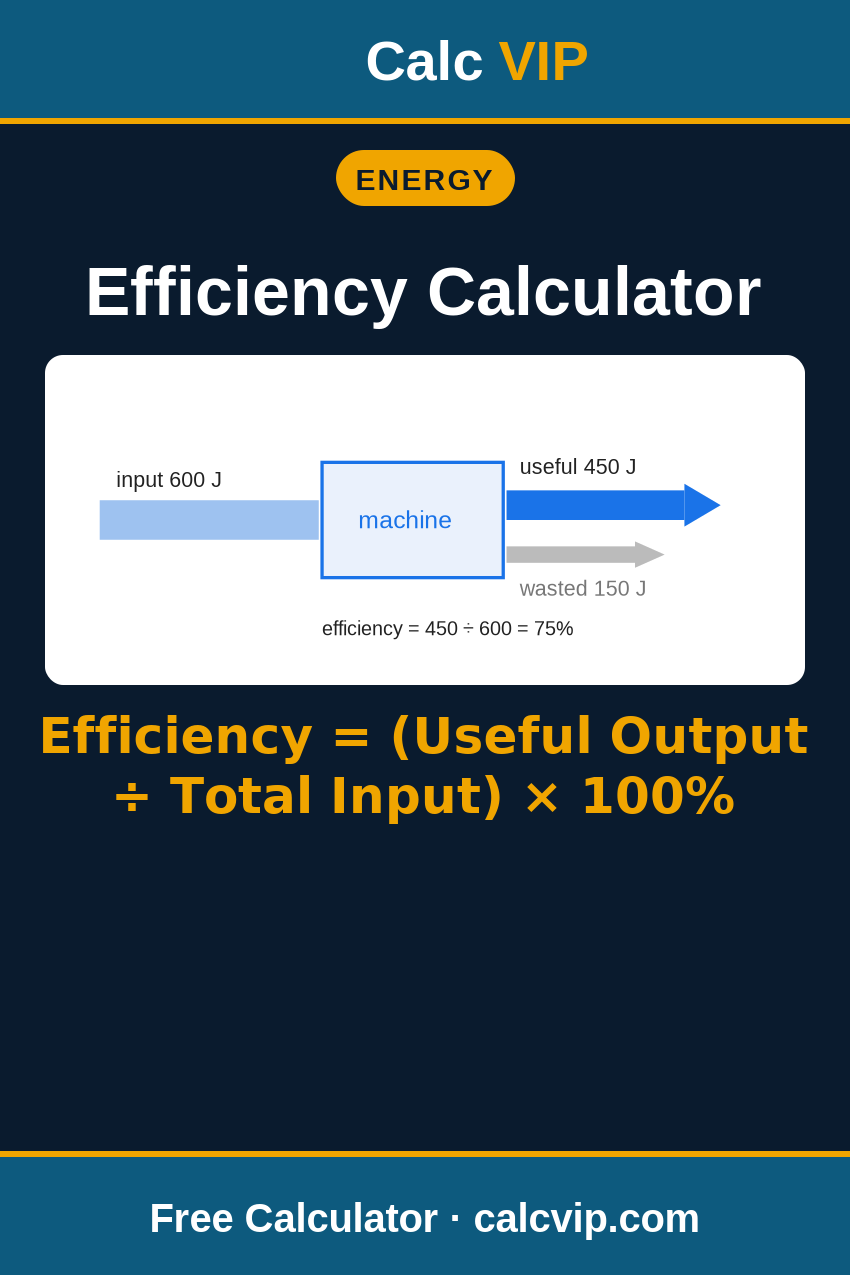
Efficiency = (Useful Output ÷ Total Input) × 100%
The same formula works with energy (joules) or power (watts), as long as both numbers use the same unit. The rest of the input is wasted, usually as heat, sound or friction: wasted = total input − useful output. The formula rearranges to answer the other two questions engineers ask. Want to know how much useful output a machine of known efficiency will give? Useful output = efficiency (as a decimal) × total input — a 90% efficient motor fed 1,000 J delivers 900 J. Want to know how much input a job requires? Total input = useful output ÷ efficiency (as a decimal) — lifting something with 500 J of useful work through a 75% efficient hoist costs 500 ÷ 0.75 = 667 J of input. Watch the two forms of the number: the formula wants a decimal (0.75) in the rearrangements and gives a percentage (75%) in the headline version; mixing them up is the commonest slip on this page.
| Symbol | Meaning | Units |
|---|---|---|
| η (eta) | efficiency — the Greek letter used for it in engineering | % or a decimal |
| useful output | the energy (or power) delivered in the form you wanted | J or W |
| total input | all the energy (or power) supplied to the machine | J or W |
| wasted | input − useful output, mostly heat, sound and friction | J or W |
Every machine is a leaky bucket
The most useful way to picture efficiency is as a bucket with holes. You pour energy in at the top; the useful output is what reaches the tap; the holes are friction in bearings, electrical resistance heating the wires, exhaust gases leaving hot, sound radiating away. The percentage tells you what fraction of the pour survived the journey. Improving a machine means finding its biggest holes and plugging them — ball bearings for sliding friction, thicker wires for resistance, insulation for stray heat — which is why an efficiency figure is less a grade than a diagnostic: it tells the engineer how much room is left to improve, and the wasted figure tells them how much energy is available to hunt for.
Heat is almost always the biggest hole, and there is a deep reason. Useful outputs — motion, light, electricity — are organised forms of energy. Heat is energy in its most disorganised form, the random jiggling of particles, and every real process shuffles a little organisation into randomness. Turning heat fully back into organised energy is the one conversion nature refuses outright: even a perfect heat engine must throw away a share of its heat, a limit set by the temperatures involved and discovered by Sadi Carnot in 1824. That is why power stations that burn fuel cluster around 35–40% while electric motors, which never pass through heat, can exceed 90%.
Because efficiency is a ratio, it quietly hides scale. A toy motor and a power station can both score 40%, though one wastes milliwatts and the other wastes a city's worth of heat. And the score can shift with how the machine is used: car engines are efficient at steady motorway loads and dismal in stop-start traffic; electric motors peak near their rated load and sag when idling. Treat any single percentage — including the ones this calculator produces — as the score for the conditions you measured, not a permanent property stamped on the machine.
How to use
- Pick Energy mode for joules (J) or Power mode for watts (W).
- Enter the useful output the machine produces — the part delivered in the form you wanted.
- Enter the total input the machine takes in, in the same unit.
- Click "Calculate Efficiency" to see the percentage and the wasted amount.
- If you only know the input and a manufacturer's efficiency claim, rearrange: useful output = efficiency (as a decimal) × input — and you can check the claim by entering the result here.
Worked examples
Example 1 — the headline case. A motor takes in 600 J of electrical energy and produces 450 J of useful mechanical energy. Efficiency = (450 ÷ 600) × 100 = 75%. The other 150 J is wasted, mostly as heat in the windings and friction in the bearings — which is why motors have cooling fins and feel warm in use.
Example 2 — an electric kettle. A kettle draws 2,000 W and delivers 1,700 W into heating the water; the rest warms the kettle body and the kitchen air. Efficiency = (1,700 ÷ 2,000) × 100 = 85%, wasted 300 W. Kettles score well because electricity converts to heat almost perfectly and the water surrounds the element — the main leak is simply heating the jug itself.
Example 3 — a car journey. Over a trip, a petrol car burns fuel containing 100 MJ of chemical energy and delivers 28 MJ as motion at the wheels. Efficiency = (28 ÷ 100) × 100 = 28%, with 72 MJ leaving as exhaust heat, engine warmth, noise and braking. This dismal score is the single biggest reason electric cars — whose motors score 85% or better — use so much less energy per kilometre.
Example 4 — a power station. A gas-fired station burns fuel at 1,000 MW and sends out 380 MW of electricity: efficiency = (380 ÷ 1,000) × 100 = 38%. The wasted 620 MW is carried away by cooling towers — the great plumes above power stations are this page's "wasted" figure made visible, and Carnot's temperature limit is why no amount of clever engineering pushes a steam plant anywhere near 100%.
Example 5 — the cyclist's legs. Over a hard stretch of riding, a cyclist's muscles consume 2,000 J of chemical energy from food and deliver 500 J of mechanical work to the pedals: efficiency = (500 ÷ 2,000) × 100 = 25%. The wasted 1,500 J becomes body heat — which is why exercise makes you hot and why riders dress in layers they can shed. Human muscle is a respectable engine, roughly a match for a car engine, but nobody would call it efficient.
Example 6 — a solar panel. Sunlight delivers 1,000 W to a rooftop panel on a bright day, and the panel outputs 220 W of electricity: efficiency = (220 ÷ 1,000) × 100 = 22%. The rest is reflected or becomes heat in the panel. Twenty-two percent sounds low until you remember the fuel is free and arrives whether you harvest it or not — panel economics are about cost per watt, not about beating a motor's score.
Efficiency in real life
Appliance labels. The A-to-G energy ratings on fridges, washing machines and televisions are efficiency scores in disguise — they compare the service delivered (cold food, clean laundry) against the electricity consumed. Two fridges of the same size can differ by a factor of two in running cost, and the label is the calculator's percentage wearing a colour code.
The electric-car advantage. A petrol engine scores 25–30%; an electric motor scores 85–95%, and an EV has no idling losses and recovers braking energy. That gap — not battery magic — is why an electric car travels roughly three times as far on a unit of energy as a petrol one.
Lighting your home. An old incandescent bulb converts only about 8% of its electricity into light; the rest is heat. An LED making the same light from a tenth of the power is the most cost-effective efficiency upgrade in most houses, paying for itself in months.
Why athletes overheat. At 25% efficiency, a runner producing 200 W of mechanical power is also producing about 600 W of heat — six old light bulbs' worth, inside a body that must stay near 37 °C. Sweating, pacing and water stops are the cooling system for that wasted figure.
Standby and small leaks. Chargers, televisions on standby and draughty houses each waste a thin stream of energy around the clock. The amounts look trivial per hour, but efficiency thinking multiplies them by 8,760 hours a year — which is how "vampire loads" quietly reach a tenth of a household bill.
Data centres. The computing industry measures its version of efficiency as PUE — total facility power divided by the power that actually reaches the servers. A PUE of 1.5 means a third of the bill is cooling and overhead; the best operators push toward 1.1, plugging the same leaky-bucket holes at warehouse scale.
The heat pump puzzle: efficiency over 100%?
Heat pumps are advertised with figures like "300% efficient", which seems to break this page's ceiling. It does not, because a heat pump is not converting energy — it is moving it. A pump that consumes 1 kW of electricity may deliver 3 kW of heat into a house, but 2 kW of that heat was harvested from the outdoor air, not created from the electricity. Engineers keep the ideas separate by calling the heat pump's figure a coefficient of performance (COP) rather than an efficiency. Count all the inputs honestly — electricity plus harvested heat — and the total output never exceeds the total input. The calculator's rule stands: a genuine efficiency above 100% always means an input has been left off the books.
Quick reference: typical efficiencies
| Machine or system | Typical efficiency | Main losses |
|---|---|---|
| Electric motor | 85–95% | heat in windings, bearing friction |
| Power station (steam) | 35–40% | heat rejected to cooling (Carnot limit) |
| Diesel engine | 35–40% | exhaust heat, friction |
| Petrol car engine | 25–30% | exhaust heat, idling, friction |
| Human muscle | ≈ 25% | body heat |
| Solar panel | 20–23% | reflection, heat in the cells |
| LED lamp (as light) | 30–40% | heat in the diode and driver |
| Incandescent bulb (as light) | 5–10% | almost everything becomes heat |
Use the table as a sanity check on your own calculations. If this calculator tells you a car engine is 80% efficient or an electric motor is 30%, the inputs have probably been swapped or a unit has slipped — the plausible ranges above are narrow because the physics behind each machine pins them down.
Common mistakes
- Reporting an efficiency above 100%. It cannot happen for a true efficiency. If your output exceeds your input, one of the numbers is wrong — usually the input was measured in different conditions, or an input (like a heat pump's harvested heat) was left out.
- Mixing units between input and output. The ratio only works in matching units: joules with joules, watts with watts. Entering the input in kWh and the output in joules shrinks the answer by a factor of 3.6 million.
- Comparing energy with power over different times. An input power of 2,000 W for ten minutes is 1,200,000 J, not 2,000 of anything. Either convert both sides to energy over the same period, or use power on both sides.
- Treating wasted energy as destroyed. Wasted energy still exists — as heat, sound and vibration. "Lost" means lost to the purpose, not lost to the universe, and in some designs (a kettle, a heater) the "waste" heat is the product itself.
- Assuming one percentage fits all conditions. Efficiency changes with load, speed and temperature. A car engine's 28% is a trip average; at idle its efficiency is exactly 0%, because it burns fuel while delivering no useful output at all.
FAQ
Can efficiency be more than 100%?
No. A machine can never output more useful energy than it takes in — that would break the law of conservation of energy. Anything claiming over 100% has a measurement error.
Why are real machines never 100% efficient?
Friction, heat, sound and vibration always carry some energy away. Even the best electric motors reach roughly 95%, and a typical car engine only about 25–30%.
Does it matter whether I use energy or power?
No — the percentage is the same either way, because efficiency is a ratio. Just make sure the output and input are measured in the same unit.
How do I calculate efficiency from power ratings alone?
Exactly the same way — divide useful power out by total power in and multiply by 100. A power supply rated to deliver 450 W while drawing 600 W from the wall is 75% efficient. Power is just energy per second, so the ratio is identical.
What counts as a good efficiency?
It depends entirely on the machine. Above 85% is excellent for anything involving motion or electricity; 35–40% is respectable for a heat engine, which physics caps far below 100%; and 22% is state of the art for an affordable solar panel. Judge a score against its own category's table, not against 100%.
Where exactly does the wasted energy go in an electric motor?
Mostly into heat: electrical resistance warms the copper windings, friction warms the bearings, and rapidly switching magnetic fields warm the iron core. The rest leaves as sound and vibration. Motor designers attack each leak separately — better bearings, thicker wire, laminated cores — which is how premium motors climb past 95%.
How much could I save by switching to LED bulbs?
An LED gives the light of a 60 W incandescent bulb from about 8 W, saving 52 W every hour it burns. Over 1,000 hours of use that is 52 kWh — the saving is the efficiency difference (roughly 8% versus 35% as light) turned directly into money.
Does efficiency change as a machine ages?
Usually for the worse. Worn bearings add friction, scaled-up kettle elements and clogged filters force longer running, and engine deposits waste fuel. The drop is often a few percentage points over years — small per hour, but it compounds across every hour of use, which is why servicing machinery is an energy measure as well as a mechanical one.
Why are power stations built if they waste 60% of their fuel?
Because electricity is worth far more per joule than heat. A joule of electricity can run motors, computers and lights; a joule of lukewarm cooling water can do almost nothing. Society happily trades quantity for quality — and engineers claw back some of the waste by using the rejected heat for district heating, pushing total useful output far above the electrical 38%.
Is a more efficient machine always the greener choice?
Almost always in running costs and emissions, but the full picture includes making and disposing of the machine. A super-efficient appliance replaced every two years may lose to a slightly less efficient one kept for fifteen. Efficiency of use is the biggest term for energy-hungry devices, though — for cars, heating and motors it dominates the lifetime footprint.