 Calc
Energy Cost Calculator – Electricity Usage in kWh & Running Cost
 Created by Priya Sharma · Physics Editor · Energy & Gravity · Last updated: November 2026
Use this free Energy Cost Calculator to find out how much electricity an appliance uses and what it costs to run. Enter the power in watts, how many hours it runs each day, the number of days, and your electricity price per kWh.
An electricity bill is physics wearing a price tag. Behind every total sits one multiplication: energy equals power multiplied by time, and cost equals energy multiplied by the price per unit. The unit is the kilowatt-hour — the energy a 1 kW appliance uses in one hour — and this calculator performs the whole chain in one place: watts to kilowatts, hours per day across days, kilowatt-hours out, and finally money. It answers the two questions every household eventually asks about some humming box in the corner: how much do you eat, and what do you cost me?
The answers are routinely surprising, in both directions. The feared appliances — kettles, heaters, ovens — draw enormous power but run for minutes, so their totals stay modest. The invisible ones — a router blinking all year, a standby television, an old fridge in the garage — draw trivial power but run for thousands of hours, and time, multiplied faithfully, wins. Power × time is an equation with two levers, and this calculator exists because intuition consistently grabs the wrong one.
Everything here is currency-neutral: enter your price per kWh in whatever unit your bill uses and the cost comes out in the same currency. What the calculator cannot know is your tariff's fine print — standing charges, tiered rates, off-peak discounts — so treat its figure as the energy cost of the appliance itself, the part of the bill this appliance is truly responsible for. That is almost always the number you actually wanted.
Formula
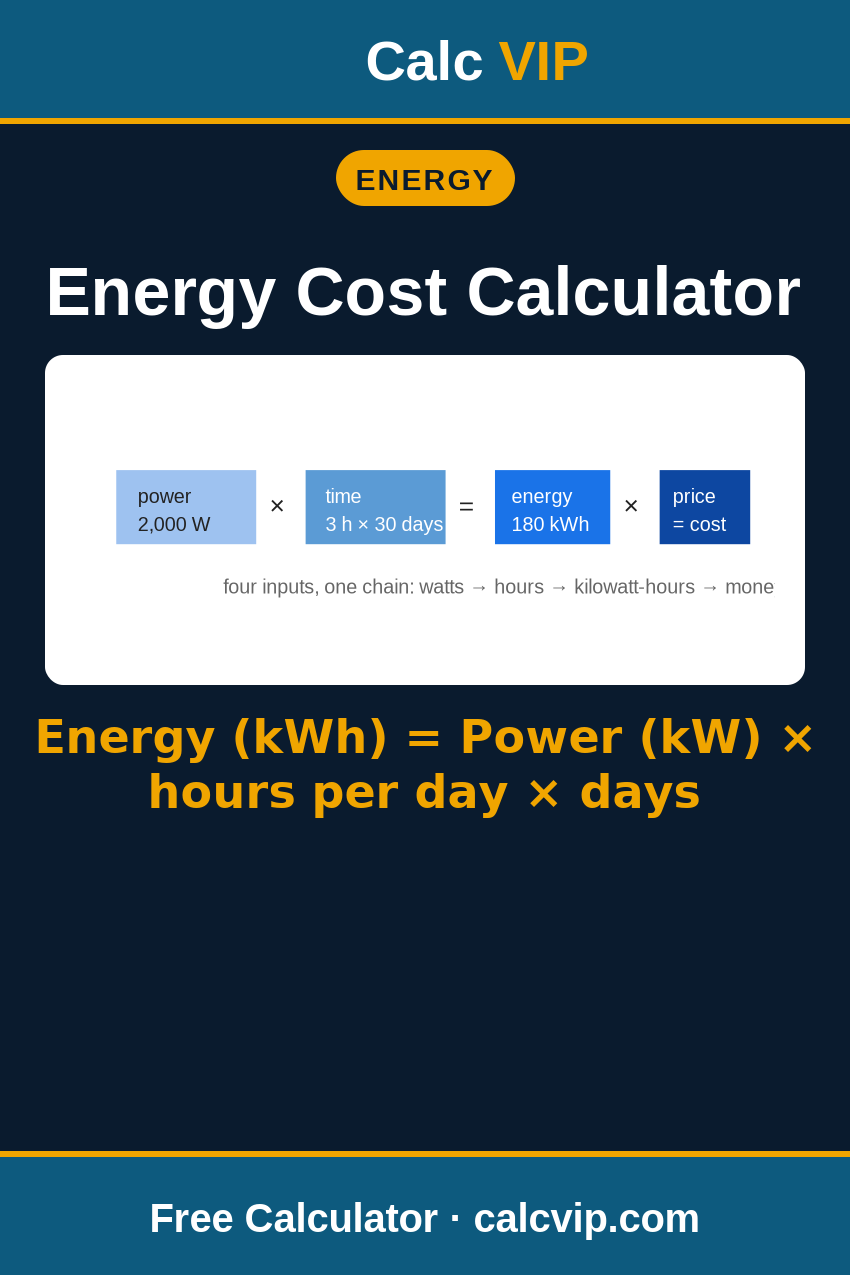
Energy (kWh) = Power (kW) × hours per day × days • Cost = Energy (kWh) × price per kWh
The chain has three links. First, convert the appliance's power from watts to kilowatts by dividing by 1,000 — the kilowatt-hour is built from kilowatts, and forgetting this step inflates everything a thousandfold. Second, multiply by the total hours: hours per day times the number of days. Third, multiply the resulting kilowatt-hours by your tariff's price per kWh to get the cost in your own currency. Underneath it all sits the joule: 1 kWh = 3.6 million joules, the energy of a 1,000 W device running 3,600 seconds. The calculator also reports the energy per day, which is often the most useful figure of all — it is the number to compare when two appliances are candidates for the same job. Results are rounded to two decimal places.
| Symbol | Meaning | Units |
|---|---|---|
| P | appliance power (nameplate rating) | watts (W), converted to kW |
| t | total running time = hours/day × days | hours (h) |
| E | electrical energy used | kilowatt-hours (kWh) |
| price | tariff rate per unit of energy | currency per kWh |
Power × time: the tortoise appliances beat the hares
The single most useful insight this calculator teaches is that running time routinely defeats wattage. Compare two residents of the same kitchen. A 2,000 W kettle, feared for its power, boils for perhaps 10 minutes a day: 2 kW × (1/6 h) × 30 days = 10 kWh a month. A 150 W fridge-freezer, ignored for its modesty, runs around the clock: 0.15 kW × 24 × 30 = 108 kWh a month — more than ten times the kettle. Bills are written by tortoises. Any appliance that never sleeps — routers, set-top boxes, aquariums, dehumidifiers, that second fridge — deserves a run through this calculator before the dramatic high-wattage items do.
A useful habit is to compute a personal exchange rate: at your tariff, one watt left on all year costs 0.001 kW × 8,760 h × price — at 0.15 per kWh, about 1.31 per watt per year. Suddenly every device has a legible annual rent: the 5 W standby costs about 6.57 (as the standby section shows), a 60 W always-on server about 79, a 300 W pond pump about 394. Numbers like these end arguments about whether small loads "matter" — they matter at exactly their wattage times 8,760 hours, neither more nor less, whatever anyone's intuition says beforehand.
The mirror-image insight applies to savings. Cutting the time a hungry appliance runs is as powerful as cutting its wattage, and often easier: a heater on a timer, a dryer run only when full, a PC that actually sleeps. Halving either factor halves the cost; the equation does not care which lever you pull. When you experiment below, try both — reduce the watts, then restore them and halve the hours — and watch the same saving arrive by two different doors.
How to use
- Enter the appliance's power in watts — from its label, manual or plug (a kettle is typically 2,000–3,000 W, an LED bulb about 10 W).
- Enter how many hours it runs per day (part hours are fine: 20 minutes is 0.33 h) and the number of days — 30 for a monthly estimate, 365 for a year.
- Enter your electricity price per kWh from your bill, in your own currency.
- Click "Calculate Cost" to see the energy per day, the total energy and the total cost. For an always-on device, use 24 hours and let the days do the talking.
Worked examples
Example 1 — the manifest check: a light bulb. A 100 W bulb runs 5 hours a day for 30 days at a price of 0.15 per kWh.
Power = 0.1 kW; energy per day = 0.1 × 5 = 0.5 kWh; total = 0.5 × 30 = 15 kWh; cost = 15 × 0.15 = 2.25. A month of evening light for the price of a coffee — bulbs were never the problem.
Example 2 — the space heater. A 2,000 W heater runs 3 hours a day for 30 days at 0.15 per kWh.
Energy = 2 × 3 × 30 = 180 kWh; cost = 180 × 0.15 = 27.00. Twelve times the bulb's bill — heaters genuinely are expensive, and this is the appliance to interrogate first in a winter bill shock.
Example 3 — the fridge. A 150 W fridge runs 24 hours a day for 30 days at 0.15 per kWh.
Energy = 0.15 × 24 × 30 = 108 kWh; cost = 108 × 0.15 = 16.20. (Real fridges cycle their compressors, so treat this as an upper bound — the nameplate watts are the compressor's draw while running.)
Example 4 — air conditioning. A 1,500 W air conditioner runs 8 hours a day for 30 days at 0.15 per kWh.
Energy = 1.5 × 8 × 30 = 360 kWh; cost = 360 × 0.15 = 54.00 — the single biggest line in many summer budgets, and the reason thermostat discipline pays so visibly.
Example 5 — an LED bulb for a whole year. A 10 W LED runs 6 hours a day for 365 days at 0.20 per kWh.
Energy = 0.01 × 6 × 365 = 21.9 kWh; cost = 21.9 × 0.20 = 4.38 for a year of light. Compare Example 1's old-style bulb doing a similar job: modern lighting is one of the great quiet bargains of physics.
Example 6 — the tumble dryer. A 2,500 W dryer runs 1 hour on 12 days of the month at 0.15 per kWh.
Energy = 2.5 × 1 × 12 = 30 kWh; cost = 30 × 0.15 = 4.50. Drying is a high-power, short-time job — noticeable, but the always-on appliances in Examples 3 and 4 still outspend it.
Running costs in real life
Bill shock investigations. When a quarterly bill jumps, this calculator is the detective: list the appliances, estimate hours honestly, and the culprit — usually something new, hot or always on — identifies itself by its kWh column.
Appliance purchasing. Two freezers with different wattages can be compared over a year before buying: the cheaper-to-run model often repays a higher shelf price within a couple of years, and this calculation is the receipt.
Solar and battery sizing. A home's daily kWh — the sum of calculations like these — is the number a solar installer needs. Each appliance's daily figure is a brick in that total.
Landlords and shared houses. Fair splitting of a shared bill starts from estimated usage per room or appliance. Power × time × price gives a defensible, physics-based split instead of an argument.
Standby hunts. Devices idling at a few watts around the clock are invisible on any single day and material over 365 of them. The calculator's day count is the weapon: run any suspect at 24 hours × 365 days and see its true annual appetite.
Business equipment. A café's espresso machine, a workshop's compressor, a server cabinet — multiplying nameplate watts by opening hours by the commercial tariff prices each machine's silent monthly rent in electricity.
Standby power: the vampire load, priced
Standby is where this calculator earns its keep most dramatically, because the day-count does something shocking to small numbers. Take a device idling at just 5 W — a television on standby, a console, a charger left warm. Run it through the formula at 24 hours a day for a year: 0.005 kW × 24 × 365 = 43.8 kWh, costing 43.8 × 0.15 = 6.57 annually — for a device doing nothing at all. Multiply by the dozen such devices in a modern home and the vampire load rivals a real appliance. The physics offers no loophole: watts times hours is pitiless arithmetic, and the only fixes are switches, smart plugs and unplugging — reducing either factor to zero zeroes the product.
Standby also teaches the right way to read every other result on this page. Any figure can be interrogated with one question: how many hours are hiding inside it? A scary wattage with a tiny hour count is a paper tiger; a modest wattage with 8,760 hours behind it is a genuine expense wearing a disguise. Energy auditors walk into a building and look first for the things that never turn off — pumps, servers, vending machines, emergency systems — because experience has taught them where the multiplication bites. Your home obeys the same law at a smaller scale, and this calculator, given honest hours, will show you exactly where.
Nameplate watts versus real watts
There is a middle path between guessing and metering: the annual-consumption label. Fridges, freezers, washing machines and televisions in many countries carry a tested yearly kWh figure, measured over a standard usage pattern. Divide it by 365 for a daily estimate grounded in laboratory reality rather than nameplate optimism, or compare two models' labels directly — the difference, multiplied by your tariff and the appliance's expected lifespan, is a genuine lifetime price gap that the shelf tags never show. A model costing 40 more but using 100 kWh less per year repays its premium in under three years at 0.15 per kWh, and keeps paying for a decade.
The wattage printed on an appliance is usually its maximum or its rating under test conditions, and many devices spend their lives below it. A fridge's compressor cycles on and off; a washing machine's 2,000 W heater fires only during the hot phase while its motor sips a few hundred watts; a PC's 500 W supply delivers 60 W at idle. The calculator computes faithfully from the number you give it, so the craft lies in the estimate: use the nameplate for heaters, kettles and dryers (they really do run flat out), and a realistic average — from a plug-in energy meter, or the manufacturer's annual-kWh label — for cycling appliances. An honest average wattage over honest hours beats a precise calculation built on the box's biggest number.
Quick reference: cost of one hour
| Appliance | Power | Energy in 1 hour | Cost at 0.15/kWh |
|---|---|---|---|
| LED bulb | 10 W | 0.01 kWh | 0.0015 |
| television | 100 W | 0.1 kWh | 0.015 |
| microwave | 1,000 W | 1 kWh | 0.15 |
| electric oven | 2,400 W | 2.4 kWh | 0.36 |
| kettle / heater | 2,000 W | 2 kWh | 0.30 |
One hour is the natural unit for intuition: nothing in a home costs much for one hour. Bills are built by repetition — the same hour, hundreds of times — which is why the calculator's hours and days inputs matter more than any single wattage.
Common mistakes
- Forgetting the watts-to-kilowatts conversion. Entering 2,000 where the formula expects 2 (kW) multiplies the bill by a thousand. This calculator converts for you — but if you check by hand, divide watts by 1,000 first, every time.
- Using the nameplate watts for cycling appliances. A fridge or washing machine does not draw its rated power continuously. Nameplate × 24 hours gives an upper bound, sometimes double the truth. Use an average draw or the manufacturer's annual kWh figure for cycling devices.
- Ignoring standby. "Off" devices with glowing lights or warm plugs still draw watts, and at 8,760 hours a year those watts compound into real money (43.8 kWh a year for a mere 5 W). Include the suspects.
- Estimating hours from memory — optimistically. People under-report heater, screen and dryer time by wide margins. When a calculated bill comes out far below the real one, the hours column is the first place to look, not the tariff.
- Mixing up kW and kWh. The kilowatt is the rate; the kilowatt-hour is the amount. A bill charges for amounts. If your result is labelled in kW, you have stopped one link early in the chain.
FAQ
What is a kilowatt-hour (kWh)?
It is the unit on your electricity bill: the energy used when a 1 kW (1000 W) appliance runs for 1 hour. 1 kWh = 3.6 million joules.
How much does a heater cost to run?
A 2000 W heater used 3 hours a day for 30 days uses 2 × 3 × 30 = 180 kWh — far more than a light bulb, because its power is much higher.
Does the currency matter?
No. Enter the price per kWh in whatever currency your bill uses, and the cost comes out in the same currency.
Why is my calculated cost lower than my actual bill?
Because bills include more than energy: standing charges, taxes, and possibly tiered pricing where later units cost more. This calculator isolates the energy cost of one appliance — the part physics controls. Add your supplier's fixed charges separately for a full-bill estimate.
How do I handle an appliance used for minutes, not hours?
Convert: 20 minutes is 20 ÷ 60 = 0.33 hours. Part-hours are fine as inputs. A 2,000 W kettle used 0.33 h a day uses 0.66 kWh daily — small, exactly as the tortoise-and-hare section predicts.
What price per kWh should I use if my tariff has tiers or off-peak rates?
Use the rate that applies when the appliance runs. For an off-peak appliance like a storage heater or a timer-run dishwasher, the night rate is the honest figure; for everything else, use your standard daytime rate or the blended average printed on your bill.
Does a higher-wattage appliance always cost more?
No — only at equal running time. A 2,500 W dryer used an hour a week costs less than a 150 W fridge running all month. Power × time decides, and this calculator exists because the time factor is so easy to underestimate.
How accurate is the nameplate wattage?
For resistive heaters — kettles, ovens, space heaters — very accurate: they draw their rating whenever on. For motors and electronics it is a maximum. A plug-in energy meter, left attached for a week, replaces estimates with measurements if a particular appliance really matters.
Can I estimate a whole house with this?
Yes, appliance by appliance: calculate each one's daily kWh and add them. The total is the figure solar installers and battery systems are sized from — and the exercise usually reveals the two or three appliances that dominate the home's appetite.
What is the cheapest appliance to run?
Typically an LED bulb: about 0.01 kWh per hour, so even a year of evenings (Example 5) costs only a few units of currency. Modern lighting, phone chargers and radios all live in this near-free zone; heat-producing appliances live at the expensive end.