 Calc
Energy Converter – Joules, kWh, Calories & Electron-Volts
 Created by Priya Sharma · Physics Editor · Energy & Gravity · Last updated: November 2026
Use this free Energy Converter to change energy between joules (J), kilojoules (kJ), kilowatt-hours (kWh), calories (cal), kilocalories (kcal) and electron-volts (eV). Enter a value in any unit and see it in all six at once.
Energy is one quantity, but it speaks at least six dialects. Your electricity bill counts it in kilowatt-hours, your lunch counts it in Calories, your physics textbook counts it in joules, and the physicist studying atoms counts it in electron-volts — a unit so small that a single joule contains more than six billion billion of them. None of these communities is wrong; each simply chose a ruler sized to its own problems. This converter translates between all of them, instantly and exactly, by passing every value through the common currency of joules.
The reason translation is possible at all is conservation of energy: energy never appears or disappears, it only changes form, so a fixed amount of it is the same amount in any unit. The conversion factors are definitions, not measurements — 1 kWh is exactly 3,600,000 J because it is defined as a thousand watts running for an hour; 1 cal is exactly 4.184 J by international agreement. That makes this the most honest calculator on the site: there is no approximation hiding anywhere, only arithmetic.
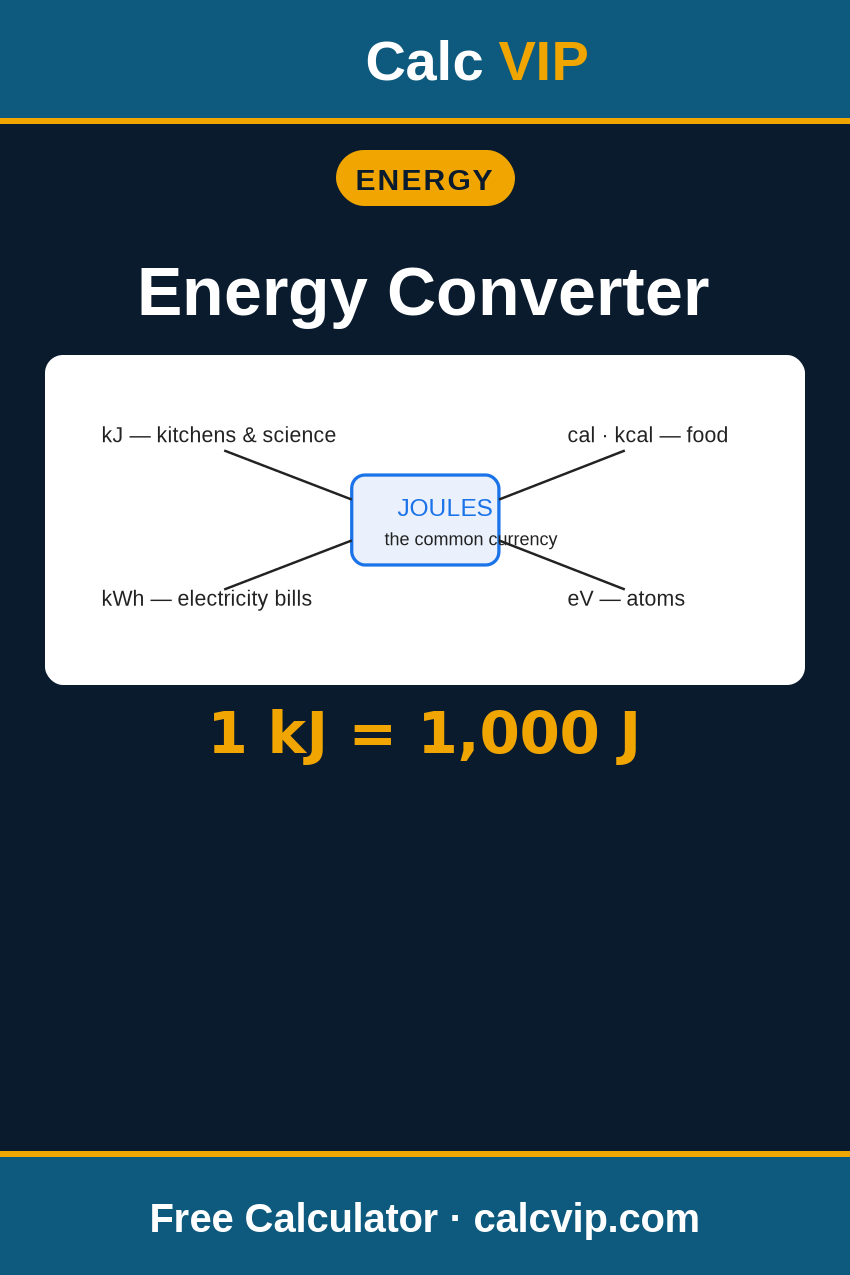
Learning to move between these units is quietly one of the most useful skills in everyday science. It lets you compare a chocolate bar with a phone battery (the bar stores about nineteen times more energy), read a diet plan in the same language as an electricity bill, and see why particle physicists need their own microscopic unit while power companies need a huge one. Enter any value, in any of the six units, and the other five appear — a small demonstration that the universe keeps one set of books, however many currencies we insist on printing.
Formula
All conversions go through joules: 1 kJ = 1,000 J, 1 kWh = 3,600,000 J, 1 cal = 4.184 J, 1 kcal = 4,184 J, 1 eV = 1.602 × 10⁻¹⁹ J.
The method never changes: multiply your value by its unit's joules-per-unit figure to reach joules, then divide by the target unit's figure to land there. Going from kilowatt-hours to kilocalories, for instance, is 1 kWh → 3,600,000 J → 3,600,000 ÷ 4,184 = 860.42 kcal. Two habits keep conversions error-free. First, treat the kilowatt-hour honestly: it is a power multiplied by a time (1,000 W × 3,600 s), which is why it is an energy at all. Second, respect the thousand hiding between cal and kcal — the commonest conversion error in all of nutrition is dropping or adding that factor of 1,000. This calculator shows all six units at once precisely so that a slipped factor stands out: if the kcal figure is not roughly a thousand times smaller than the cal figure, something has gone wrong.
| Unit | Symbol | Equals in joules | Where it rules |
|---|---|---|---|
| joule | J | 1 J | physics, engineering — the SI unit |
| kilojoule | kJ | 1,000 J | food labels (alongside kcal), science |
| kilowatt-hour | kWh | 3,600,000 J | electricity bills, batteries, EVs |
| calorie | cal | 4.184 J | chemistry, heat calculations |
| kilocalorie | kcal | 4,184 J | food energy — the dieters' "Calorie" |
| electron-volt | eV | 1.602 × 10⁻¹⁹ J | atomic, nuclear and particle physics |
Five rulers for one quantity
Each unit on this page survives because it is the right size for somebody's daily work. The electron-volt is the energy an electron gains crossing a one-volt potential difference — tailor-made for atoms, whose transactions run from a few eV (a chemical bond, a photon of visible light at about 2 eV) to millions of eV inside nuclei. The calorie was built for kitchen-and-laboratory heat: the energy to warm one gram of water by one degree Celsius, with its big sibling the kilocalorie warming a kilogram — and thereby becoming the natural unit for food, since our bodies are mostly water being kept warm. The joule, one newton of force pushing through one metre, is sized for machines and textbooks. And the kilowatt-hour is sized for households: a joule is so small that a home's monthly energy in joules would be a twelve-digit number, while in kWh it is a friendly few hundred.
The spread of scales is the real story. From a single photon (about 3 × 10⁻¹⁹ J) to a country's daily electricity use (about 10¹⁵ J) is a range of more than thirty powers of ten — wider than the range from the width of an atom to the width of the observable universe, proportionally speaking. No single unit could serve both ends readably, which is why the dialects persist and why converters like this one earn their keep. Notice, too, that every unit is anchored to the joule by an exact definition, so the whole family is one ruler with several scales printed on it.
There is a practical moral: whenever two energy figures are quoted in different units, convert before you compare — the comparison is often rigged by the choice of unit. A snack bar advertised as "only 250" (kilocalories) holds over a million joules; a battery boasting "54,000" (joules) holds less than a twentieth of the snack. Marketers choose the unit that makes their number sound best. This page exists so that the trick never works on you.
How to use
- Enter the energy value you have.
- Choose its unit from the list.
- Click "Convert" to see the value in all six units.
- Use the cal and kcal rows together as a built-in check: the kcal number should always be the cal number divided by 1,000. If it is not, re-check the unit you selected.
Worked examples
Example 1 — one unit of electricity, in everything. 1 kWh equals 3,600,000 J = 3,600 kJ = 860,420.65 cal = 860.42 kcal = about 2.25 × 10²⁵ eV. One humble unit from a bill, expressed at the scale of atoms, needs a 26-digit headcount of electron-volts — the single best illustration of why both units exist.
Example 2 — a chocolate bar. A bar labelled 250 kcal stores 250 × 4,184 = 1,046,000 J = 1,046 kJ. In electricity units that is 1,046,000 ÷ 3,600,000 = 0.29 kWh — enough chemical energy to run a 100 W bulb for nearly three hours, if only your body could spend it that way. (It spends it as a 100 W human instead — see the real-life section.)
Example 3 — a phone battery. A phone battery rated at 15 watt-hours holds 0.015 kWh, which is 0.015 × 3,600,000 = 54,000 J = 54 kJ. In food units: 54,000 ÷ 4,184 = 12.91 kcal — about two bites of the chocolate bar from Example 2. The bar stores roughly nineteen times the energy of the battery, which is why eating the battery's worth of food is trivial and charging the phone from a snack is not (yet) an option.
Example 4 — down at the atomic scale. A single joule is 1 ÷ (1.602 × 10⁻¹⁹) = 6.24 × 10¹⁸ eV. Working the other way, a photon of green light carrying about 2 eV holds 2 × 1.602 × 10⁻¹⁹ = 3.204 × 10⁻¹⁹ J. Numbers like these are why particle physicists never touch joules at work: their energies are homeopathic by engineering standards, and the eV keeps them human-sized.
Example 5 — heating a bath. By definition, 1 kcal raises 1 kg of water by 1 °C, so warming a 100 kg bath by 30 °C takes 100 × 30 = 3,000 kcal = 3,000 × 4,184 = 12,552,000 J. Converted: 12,552,000 ÷ 3,600,000 = 3.49 kWh. This is the conversion behind every water-heating bill — and why a daily bath is one of the most expensive habits in the house, priced in kWh but defined by the calorie.
Example 6 — the bulb that ties it together. A 100 W bulb left on for 10 hours uses 100 × 10 = 1,000 Wh = 1 kWh — which Example 1 already translated: 3.6 million joules, or 860.42 kcal, roughly three and a half chocolate bars. Power × time = energy, and every unit on this page is just a different way of writing the result.
Energy conversion in real life
Reading your electricity bill. The bill charges for kilowatt-hours, but every appliance is labelled in watts. The bridge is time: a 2,000 W heater running for 3 hours uses 6 kWh. Converting appliance ratings into kWh before buying — this page's Example 6 in reverse — is the whole skill of predicting a bill.
Food labels and diets. Labels print both kJ and kcal in many countries (2,000 kcal = 8,368 kJ). A day's food energy of 2,000 kcal is 8,368,000 J, which is 2.32 kWh — spread over 24 hours, the human body runs at about 97 W, roughly one bright old light bulb. Dieting, translated, is managing a 100 W appliance's fuel supply.
Batteries and electric cars. Battery capacity is quoted in watt-hours or kilowatt-hours — energy, not power. A 60 kWh car battery holds 60 × 3,600,000 = 216,000,000 J (216 MJ). Converting to kcal gives 51,625 kcal — the food energy of about 26 days of eating, released in an afternoon's driving.
Explosives and the calorie's giant cousin. Yields of explosives are measured against TNT, defined so that one tonne of TNT releases 4.184 × 10⁹ J — exactly one billion calories. The humble calorie, scaled by a billion, is the unit of earthquakes and asteroid impacts as reported by geologists.
Exercise machines. Treadmills and rowing machines display "calories burned" — always kilocalories, whatever the screen says. Burning off the 250 kcal chocolate bar means producing 1,046,000 J of combined heat and work; at a muscle efficiency of about 25%, roughly a quarter of it was ever mechanical work at all.
Solar panels and sunshine. A square metre of rooftop in strong sun receives about 1 kW; over five good hours that is 5 kWh = 18,000,000 J per square metre per day. Panels convert perhaps a fifth of it to electricity. Quoting sunshine in kWh per square metre per day — the converter's language — is how the whole solar industry plans.
The calorie confusion, settled
No unit causes more everyday muddle than the calorie, because three different things share its name. The small calorie (cal) — 4.184 J — warms one gram of water by one degree and belongs to chemistry. The kilocalorie (kcal) is a thousand of those and warms a kilogram of water by one degree. And the Calorie with a capital C printed on food packaging is simply the kilocalorie wearing a friendlier name, a convention dating to nineteenth-century nutrition science. So a "250-Calorie" snack is 250 kcal = 250,000 cal = 1,046,000 J. There is a further historical wrinkle: the calorie was once defined by the water experiment itself, and slightly different experimental versions (4.184 J, 4.1868 J) circulated before the thermochemical value of exactly 4.184 J was standardised — the figure this calculator uses. When a conversion matters, state your calorie.
Quick reference: the units against each other
| Convert | Multiply by | To get |
|---|---|---|
| kWh → J | 3,600,000 | joules |
| J → kWh | 0.000000278 | kilowatt-hours |
| kcal → J | 4,184 | joules |
| J → kcal | 0.000239 | kilocalories |
| cal → J | 4.184 | joules |
| eV → J | 1.602 × 10⁻¹⁹ | joules |
| J → eV | 6.24 × 10¹⁸ | electron-volts |
| kWh → kcal | 860.42 | kilocalories |
Keep one anchor from the table and the rest can be rebuilt: 1 kWh = 3.6 million joules. Every household conversion — bills, batteries, heating — is that fact combined with a power and a time.
Common mistakes
- Dropping the thousand between cal and kcal. A food's 250 kcal is 250,000 cal. Entering it as 250 cal understates the energy a thousandfold — the single most common conversion error in nutrition, and the reason this calculator always displays both rows side by side.
- Treating kilowatts as energy. A kW is a rate, not an amount. A 3 kW heater has no fixed energy until you say for how long: one hour makes it 3 kWh (10,800,000 J), one minute makes it a sixtieth of that. Bills, batteries and this calculator all deal in kWh, never bare kW.
- Losing the exponent on the electron-volt. 1 eV = 1.602 × 10⁻¹⁹ J. Forgetting the 10⁻¹⁹ turns an atomic energy into a power station's — nineteen orders of magnitude of error from two missing characters. Always sanity-check: eV amounts should be astronomically numerous, joule amounts tiny.
- Believing the conversion changes the energy. 1 kWh and 860.42 kcal are the same energy wearing different clothes. A diet or a bill does not change because you re-expressed it — if a conversion seems to make an energy bigger or smaller in substance, a factor has slipped.
- Mixing calorie definitions in precise work. The thermochemical calorie (4.184 J, used here) and the International Table calorie (4.1868 J) differ by 0.07%. Irrelevant for diets and bills; not irrelevant when a chemistry result is quoted to four significant figures. State which calorie you used.
FAQ
Why is the kWh used for electricity bills?
The joule is too small for household energy. One kilowatt-hour is the energy of a 1000 W appliance running for one hour — 3.6 million joules.
Are food "Calories" the same as cal?
Food labels use kilocalories (kcal) but call them "Calories" with a capital C. One food Calorie = 1000 cal = 4184 J.
What is an electron-volt used for?
The eV is a tiny unit used in atomic and particle physics for the energy of single particles — far too small for everyday use, which is why 1 kWh equals an enormous number of eV.
How many joules are in one kilowatt-hour?
Exactly 3,600,000 J. The kilowatt-hour is a kilowatt (1,000 joules per second) sustained for an hour (3,600 seconds), and 1,000 × 3,600 = 3,600,000. It is a definition, not a measurement, so the figure is exact.
What does the watt-hour on a battery label mean?
The same idea at a smaller scale: one watt-hour is one watt delivered for one hour, equal to 3,600 J. A 15 Wh phone battery therefore holds 54,000 J. Bigger batteries scale up the same unit — laptop batteries around 50 Wh, electric car batteries in kWh, a thousand times larger again.
How much energy do I eat in a day, in electrical units?
A typical 2,000 kcal day is 2,000 × 4,184 = 8,368,000 J, which is 2.32 kWh. Spread evenly, your body consumes energy at about 97 W — you are, thermally speaking, a bright incandescent bulb that walks. Athletes in heavy training may eat and burn twice that.
How do particle accelerators use the electron-volt?
Directly: a proton accelerated through a voltage gains that many electron-volts. The Large Hadron Collider accelerates protons to about 6.5 trillion eV (6.5 TeV) each — which sounds cosmic until you convert: 6.5 × 10¹² × 1.602 × 10⁻¹⁹ ≈ 0.000001 J per proton. The machine's power lies in accelerating enormous numbers of them, not in any single particle's energy.
Why not just use joules for everything?
Readability. A home's monthly electricity in joules is about 2,000,000,000 J; a photon's energy is 0.0000000000000000003 J. Science keeps the joule as the official unit but lets each field print its own scale on the ruler — exactly as we measure roads in kilometres and atoms in nanometres while agreeing both are lengths.
Is the calorie on food labels the same in every country?
The unit is — a food Calorie is a kilocalorie everywhere. What varies is the label format: some countries lead with kilojoules, some with kcal, some print both. The energy in the food is identical; only the dialect of the label changes, which is what this converter is for.
Can energy units be converted for fuels like petrol?
Yes, once you know the fuel's energy content. A litre of petrol contains about 34,200,000 J (34.2 MJ), which is 9.5 kWh or about 8,174 kcal. Fuels are compared fairly only in a common unit — per litre, petrol beats batteries easily; per kilogram of CO₂ emitted, the ranking reverses. The conversion is neutral; the conclusion depends on the question.