 Calc
Hydroelectric Energy Calculator – Reservoir Energy E = ρVgh in J, kWh & MW
 Created by Priya Sharma · Physics Editor · Energy & Gravity · Last updated: November 2026
Use this free Hydroelectric Energy Calculator to find the potential energy stored in a reservoir of water behind a dam. Enter the water volume and the head (height) and get the energy in joules and kilowatt-hours, plus the average power if the water is released over a set time.
A reservoir is a battery built out of altitude. Every cubic metre of water held behind a dam carries gravitational potential energy in proportion to the height it will fall, and the total stored energy is one multiplication: E = ρVgh — the water's density times its volume (which together give its mass), times g, times the head. This calculator evaluates that store in joules and kilowatt-hours, and, if you say over how many hours the water will be released, the average power the release represents.
Two levers control the store, and they are not equal in practice. Volume is bought with valley size and dam length; head is bought with dam height and terrain, and it is usually the scarcer, more precious quantity — a site with half the water but twice the head stores exactly the same energy, through a smaller, cheaper reservoir. The formula also exposes water's honest limitation as an energy store: a cubic metre falling 50 m yields barely a seventh of a kilowatt-hour (Example 6), so hydroelectricity is a game of enormous volumes — millions of tonnes of water, patiently accumulated by rivers, spent through turbines in hours.
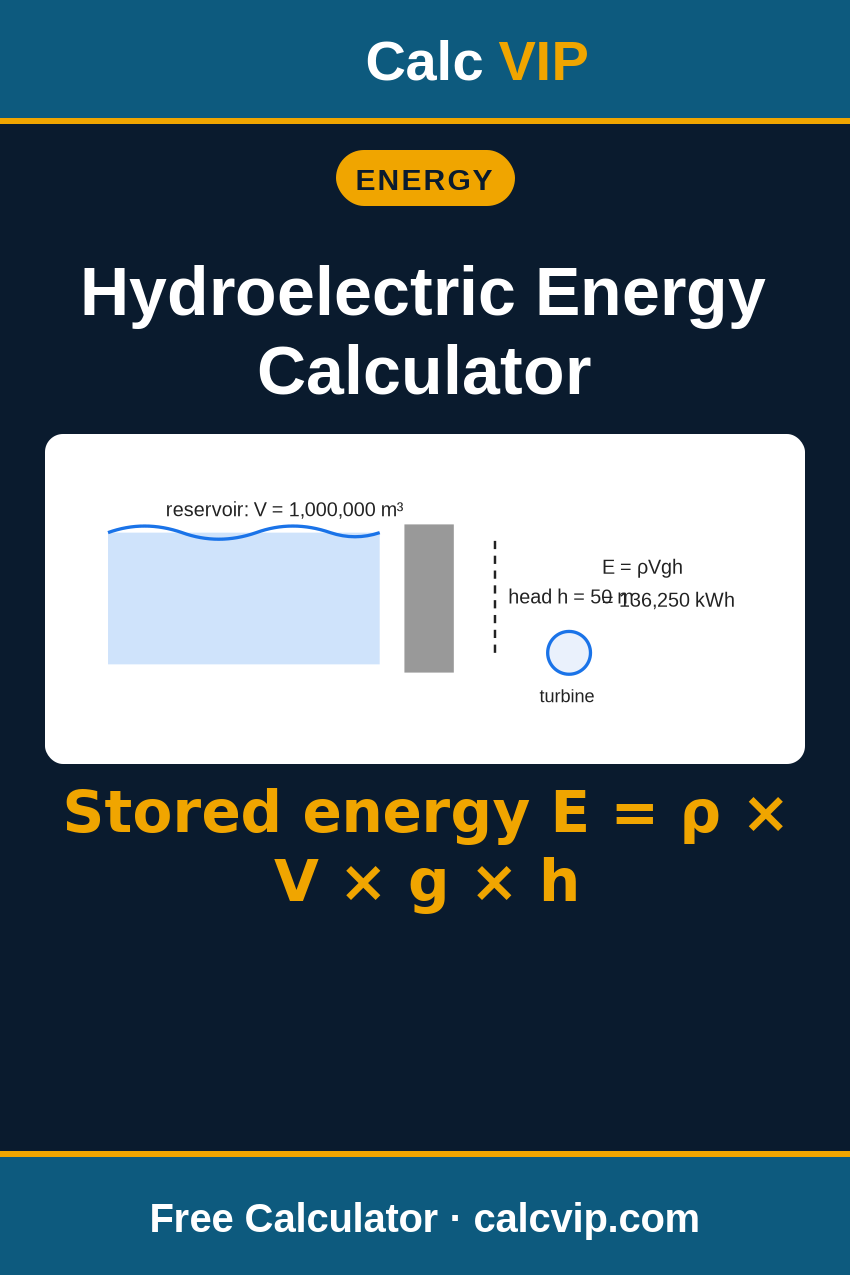
What the calculator returns is the stored energy — the water's full potential. Turning it into electricity costs the turbine and generator their share, conventionally 10–20%, and one of the FAQs prices that conversion for the headline example. Treat this page's number as the reservoir's bank balance, the efficiency as the withdrawal fee, and the release time as the spending rate: three ideas, one equation.
Formula
Stored energy E = ρ × V × g × h • Average power P = E ÷ t (ρ = 1,000 kg/m³ for water, g = 9.81 m/s²)
This is the schoolroom potential energy E = mgh with the mass written out as density × volume — the only elaboration a reservoir needs. The head h is the vertical drop from the reservoir surface to the turbine, and it is worth pausing on: energy grows in direct proportion to both V and h, so a surveyor's two numbers — how much water, how high — completely determine the store. The energy emerges in joules; dividing by 3,600,000 converts to the kilowatt-hours of electricity accounting (1 kWh = 3.6 × 10⁶ J). Average power is the energy spread over the release time: the same reservoir emptied in 5 hours instead of 10 delivers twice the megawatts for half as long — energy is the cake, power is the slicing rate, and this calculator reports both.
| Symbol | Meaning | Units |
|---|---|---|
| E | stored potential energy of the water | J (kWh) |
| ρ | density of water | 1,000 kg/m³ |
| V | usable volume of water | m³ |
| h | head — surface-to-turbine height | m |
| P, t | average power over release time t | W (MW), h |
Water is a dilute battery — and why dams are huge anyway
Run the formula per cubic metre and the numbers are humbling: 1 m³ (a tonne) of water at a 50 m head stores 490,500 J ≈ 0.136 kWh — enough to run a kettle for a few minutes. A kilogram of petrol, by contrast, holds about 12 kWh of chemical energy, roughly ninety thousand times the energy density of a kilogram of water at that head. Hydroelectricity wins not on density but on scale and renewability: the "fuel" arrives by river, free and indefinitely, and the store is built by holding back a landscape's worth of it. A reservoir of a cubic kilometre at 100 m head banks 272.5 GWh (Example 4) — grid-scale storage no battery installation yet matches — which is why pumped-hydro reservoirs, charged by surplus wind and solar power, remain the world's dominant energy-storage technology by an enormous margin.
The head deserves its reputation as the precious variable. Doubling the head doubles the energy from the same water and also doubles the pressure at the turbine, letting smaller, faster machines handle the flow; doubling the volume merely doubles the lake. Mountain sites with modest streams but hundreds of metres of head are hydro prizes, while vast lowland rivers compensate with torrents of volume through turbines the size of houses. Every dam on Earth is a negotiated settlement between those two terms of ρVgh.
How to use
- Enter the usable water volume in cubic metres — the water actually available above the turbine intake, not the reservoir's brim-full capacity if the two differ.
- Enter the head in metres: the vertical distance from the reservoir surface down to the turbine.
- Optionally enter a release time in hours to convert the stored energy into an average power in megawatts.
- Click "Calculate Energy" for the store in joules and kWh (and MWh). For a realistic electricity figure, multiply by the plant's efficiency — about 0.85 if you have no better number.
Worked examples
Example 1 — the reference reservoir. 1,000,000 m³ of water behind a 50 m head: E = 1,000 × 1,000,000 × 9.81 × 50 = 4.905 × 10¹¹ J = 136,250 kWh. Released steadily over 10 hours, that is an average power of 13.625 MW — a respectable small power station, from a lake of a million tonnes.
Example 2 — the farm dam. A modest 10,000 m³ pond with a 20 m head: E = 1,000 × 10,000 × 9.81 × 20 = 1.962 × 10⁹ J = 545 kWh. Two orders of magnitude below Example 1, yet still a meaningful store for a farm — days of lighting and refrigeration, priced by one multiplication.
Example 3 — the withdrawal fee. Example 1's reservoir through a plant of 85% overall efficiency delivers 136,250 × 0.85 = 115,812.5 kWh of actual electricity, and its 10-hour average power becomes about 11.58 MW. The stored-energy figure is the ceiling; efficiency decides how much of the ceiling reaches the grid.
Example 4 — the giant. A great reservoir of 1,000,000,000 m³ (a cubic kilometre) at a 100 m head: E = 1,000 × 10⁹ × 9.81 × 100 = 9.81 × 10¹⁴ J = 272,500,000 kWh = 272.5 GWh. Numbers at this scale stop being about electricity bills and become national infrastructure — a single such store can carry a city's evening peak.
Example 5 — same water, twice the hurry. Example 1's 136,250 kWh released in 5 hours instead of 10 averages 27.25 MW. The energy is untouched; only the rate doubles. Grid operators buy exactly this flexibility — reservoirs are valued as much for how fast they can spend as for how much they hold.
Example 6 — one cubic metre, honestly. A single cubic metre at the 50 m head: E = 1,000 × 1 × 9.81 × 50 = 490,500 J ≈ 0.136 kWh. Keep this figure in your pocket: it is the exchange rate between water and electricity at a typical head, and it instantly exposes any claim of serious power from a rooftop tank or a garden stream as innumerate.
Hydroelectric energy in real life
Pumped storage. Two reservoirs, one high, one low: surplus electricity pumps water up (charging at ρVgh per cubic metre), and peak demand lets it back down through the turbines. Round-trip efficiency runs around 70–85%, and the pair functions as the largest class of battery humanity operates.
Micro-hydro for farms and villages. A hillside stream diverted through a pipe gains head from the slope itself: a flow of just 0.1 m³/s falling 10 m delivers P = ρgQh = 1,000 × 9.81 × 0.1 × 10 = 9,810 W continuously — the flow form of this page's formula, running a farmhouse around the clock.
Valuing a dam site. Before any concrete, surveyors measure a valley's storage curve (volume against height) and the available head; ρVgh converts those two survey products into the site's energy worth, and the economics of the entire project hang on that product.
Tidal barrages. A tidal lagoon is a reservoir the sea fills twice a day: the same formula prices each tide's store from the basin's area, the tidal range (its head) and the water's density — with seawater's 1,025 kg/m³ buying a 2.5% bonus over fresh water.
Irrigation with a power dividend. Irrigation dams release water on agriculture's schedule, and turbines on the release turn an existing flow into electricity at no extra water cost — the energy was always in the ρVgh; the turbine merely collects it on the way past.
Comparing storage technologies. Example 6's 0.136 kWh per cubic metre at 50 m is the honest benchmark against which flow batteries, compressed air and hydrogen stores are pitched: water is dilute but nearly free, and the comparison disciplines every storage claim.
From stored energy to flowing power: P = ρgQh
Reservoirs are stocks; rivers are flows, and the flow version of the formula prices the second kind. If water passes through a turbine at Q cubic metres per second under a head h, each second delivers a fresh ρQ kilograms to fall the height h, so the power is P = ρgQh. The micro-hydro figure above — 0.1 m³/s at 10 m giving 9,810 W — is this equation at cottage scale; a great river plant is the same equation with Q in the thousands. The two forms are one physics: E = ρVgh is P = ρgQh integrated over the release, and the calculator's optional release time is exactly the bridge between them. Turbine choice follows the head-to-flow ratio the pair defines: high head and low flow suit Pelton wheels, low head and high flow suit Kaplan propellers, and the broad middle belongs to Francis turbines — a taxonomy that is, at root, this section's two variables arguing.
Two comparisons fix the scale in the mind. Against batteries: Example 1's 136,250 kWh equals the capacity of roughly 1,817 electric-car battery packs of 75 kWh each — a small lake quietly out-storing a warehouse of the best electrochemical technology, at a fraction of the cost per kilowatt-hour and with a working life measured in generations rather than charge cycles. Against flow: a mid-size river plant passing Q = 2 m³/s under a 30 m head generates P = ρgQh = 1,000 × 9.81 × 2 × 30 = 588,600 W ≈ 588.6 kW continuously — Example 1's entire reservoir is what such a plant spends in about ten days of ordinary running, which is why storage hydro and run-of-river hydro are planned as partners: one provides the reservoir of energy, the other the river of power, and ρgh prices both.
Checking a real dam claim
The formula's best everyday use is auditing the numbers attached to real projects, which are often quoted in units chosen to impress. Suppose a proposed dam is said to hold 500,000,000 m³ of water behind an 80 m head and to store "over a hundred gigawatt-hours". The check takes seconds: E = 1,000 × 5 × 10⁸ × 9.81 × 80 = 3.924 × 10¹⁴ J, and dividing by 3.6 × 10⁶ gives ≈ 109,000,000 kWh = 109 GWh — the claim stands. Run the same audit on a scheme promising city-scale storage from a hillside pond and the claim collapses just as quickly, because ρVgh cannot be argued with: volume and head are surveyable facts, and their product is the store, whatever the brochure says. Keep Example 6's exchange rate — 0.136 kWh per cubic metre at 50 m — as the pocket version of the audit.
Quick reference: stored energy in 1,000,000 m³ of water
| Head | Stored energy | In joules |
|---|---|---|
| 10 m | 27,250 kWh | 9.81 × 10¹⁰ J |
| 25 m | 68,125 kWh | 2.4525 × 10¹¹ J |
| 50 m | 136,250 kWh | 4.905 × 10¹¹ J |
| 100 m | 272,500 kWh | 9.81 × 10¹¹ J |
Scale by volume at will: ten million cubic metres multiplies every row by ten. The table's clean proportionality — energy strictly linear in both V and h — is what makes reservoir arithmetic the most back-of-envelope-friendly in all of energy engineering.
Common mistakes
- Using the volume as the mass. E = mgh needs kilograms: a cubic metre of water is 1,000 kg, so skipping ρ undervalues the store a thousandfold. (The happy coincidence that 1 m³ of water masses exactly one tonne is why the error is so easy to make — and so easy to catch.)
- Measuring the head to the wrong place. Head is surface-to-turbine, not dam height from its foundations and not the depth at the dam wall if the turbine sits lower in a powerhouse. A few metres of error is a few percent of the entire store.
- Quoting stored energy as generated electricity. Turbines, generators and friction take their 10–20%. Example 3's correction — 136,250 down to 115,812.5 kWh — is not pessimism; it is the difference between a prospectus and a power station.
- Confusing the energy with the power. 136,250 kWh says nothing about megawatts until a release time is chosen: the same store is 13.625 MW over 10 hours or 27.25 MW over 5. kWh is the tank; MW is the tap.
- Entering litres as cubic metres. A farm pond of 10,000,000 litres is 10,000 m³. The factor of 1,000 between the units is the classic route to a reservoir that seems to power a city and can actually power a farmhouse.
FAQ
Is all of this energy turned into electricity?
No. Real turbines and generators are about 80–90% efficient, so multiply the result by roughly 0.85 for a realistic electricity output. This calculator gives the stored potential energy.
What is "head" exactly?
The vertical distance between the reservoir surface and the turbine. A taller dam means a bigger head, and energy grows in direct proportion to it.
How much water is in 1 m³?
Exactly 1000 litres, with a mass of 1000 kg (one tonne) for fresh water.
How many homes could Example 1's reservoir supply?
At a typical 30 kWh per household per day, 136,250 kWh is about 4,540 household-days — one day for a town of four and a half thousand homes, or one home for twelve years. Reservoirs are best understood in household-days; the conversion keeps megawatt-hours honest.
Why build dams as high as possible?
Because energy is proportional to head, and head is created by height. A dam twice as tall stores twice the energy in the same water — and delivers it at twice the pressure, through smaller turbines. Height is expensive concrete, but it is the only term in ρVgh that engineering can multiply without more water or more valley.
What efficiency do modern hydro plants reach?
Large modern turbines convert 90% or more of the water's energy to shaft work, and the best complete plants (turbine plus generator) reach the high 80s to low 90s percent — the most efficient large-scale energy conversion in common use, far beyond any heat engine.
Does the reservoir's own depth distribution matter?
Slightly: strictly, each layer of water falls a different distance, and the exact energy uses the height of the water's centre of mass above the turbine. For a reservoir drawn down modestly against a large head, the surface-to-turbine figure this calculator uses is the standard, close approximation.
Can seawater be used?
Yes — tidal schemes do exactly that. Seawater's density of about 1,025 kg/m³ stores 2.5% more energy per cubic metre than fresh water at the same head; the formula's ρ is where the difference enters.
How fast can a reservoir's energy be released?
As fast as the turbines and waterways allow — hydro plants are prized for ramping from still to full power in minutes, sometimes seconds. The store's size is set by ρVgh; its strategic value is set by that ramp, which is why reservoirs balance grids full of weather-dependent wind and solar.
Is the energy really "stored" if the water would flow anyway?
Yes — a run-of-river plant harvests the same ρgQh as water passes, but a dammed reservoir decouples arrival from use: the river delivers energy on its schedule, the dam spends it on the grid's. Storage is the entire product; the water is the same water.