 Calc
Hoist Power Calculator – Power to Lift a Load P = mgv, Time & Energy
 Created by Priya Sharma · Physics Editor · Energy & Gravity · Last updated: November 2026
Use this free Hoist Power Calculator to find the power a crane, lift or winch needs to raise a load vertically at a steady speed. Enter the mass and lifting speed, and optionally the height, to get the power, the lifting time and the energy used.
Power is the price of hurry. Lifting a load to a given height always costs the same energy — mgh joules, set by gravity and the height — but how much power the job demands depends entirely on how fast you insist on doing it. A hoist raising a load at a steady speed v must work against the load's weight mg continuously, and the rate at which it delivers energy is P = mgv. This calculator evaluates that power from the load's mass and lifting speed, and — if you give it the height as well — also returns the lifting time and the total energy the lift will consume.
The formula's most instructive feature is what is missing from it: the height. Power does not care how far the load is going, only how fast it is rising right now. A crane lifting a beam to the second floor and the same crane lifting it to the twentieth need identical power at identical speed; the taller job simply runs the meter longer, accumulating more energy and more time. That separation — speed sets power, distance sets energy — is the conceptual hinge of the whole page, and the worked examples lean on it repeatedly.
Everything here assumes the steady middle of the lift: not the first moment, when the motor must also accelerate the load, nor the last, when it eases to a stop, but the long constant-speed haul in between, which is how cranes, lifts and mine hoists spend most of their working lives. The result is therefore the minimum mechanical power; the concept and FAQ sections handle the honest corrections — efficiency, acceleration, counterweights — that turn it into a motor you can actually buy.
Formula
Hoisting power P = m × g × v • Energy for a lift of height h E = m × g × h • Time t = h ÷ v (g = 9.81 m/s²)
The power formula is the work–energy theorem in a hurry: the motor does work mgh over a time h ÷ v, so P = mgh ÷ (h ÷ v) = mgv — the height cancels, leaving force (the weight mg) multiplied by speed. That cancellation is worth performing once by hand, because it converts a memorised formula into an understood one, and it generalises: power is always force × velocity for motion along the force's line, whether the force is gravity here, drag on a car or tension in a tow rope. The calculator reports power in watts and kilowatts; for the optional height it adds the time (t = h ÷ v) and the energy in joules and kilowatt-hours — the quantity your electricity bill would recognise.
| Symbol | Meaning | Units |
|---|---|---|
| P | mechanical power the hoist must deliver | W (kW) |
| m | mass of the load (plus hook, cage or sling) | kg |
| g | gravitational field strength | 9.81 m/s² |
| v | steady lifting speed | m/s |
| E, h, t | energy used, lift height, time taken | J (kWh), m, s |
Why the height cancels — and when it comes back
Students meeting P = mgv often suspect a misprint: surely a taller lift needs a more powerful motor? It does not — it needs a motor that can endure longer, which is a different specification (cooling, duty cycle, cable length). The physics is the cancellation shown above: doubling h doubles both the work and the time it takes at fixed speed, and power, being work per time, stands still. What height does govern is the energy total — and therefore the electricity cost and the heat the motor must shed over the whole job. A stalled hoist makes the point from the other side: holding a load motionless (v = 0) demands force but zero mechanical power, which is why a brake, not a motor, does the holding in real machines.
The steady-speed assumption has edges, and they matter at the ends of the lift. To start the load moving, the motor must supply weight plus the force to accelerate it, so starting power overshoots mgv; to stop, it must absorb or brake the load's kinetic energy. Well-run hoists ramp gently precisely to keep those peaks near the steady value, and motor nameplates carry margins for them. But for sizing the machine — and for every estimate on this page — the long steady middle is the right basis: it is where nearly all the energy is spent.
How to use
- Enter the total mass being lifted in kilograms — load plus anything that rises with it: hook, sling, cage or skip.
- Enter the steady lifting speed in metres per second (a typical building lift travels at 1–2.5 m/s; a tower crane hoists at a few metres per second under load).
- Optionally enter the lift height in metres to add the lifting time and the energy used, in joules and kWh.
- Click "Calculate Power". Treat the answer as the minimum mechanical power: divide by the system's efficiency (0.8 is a fair first guess) before comparing it with motor nameplates.
Worked examples
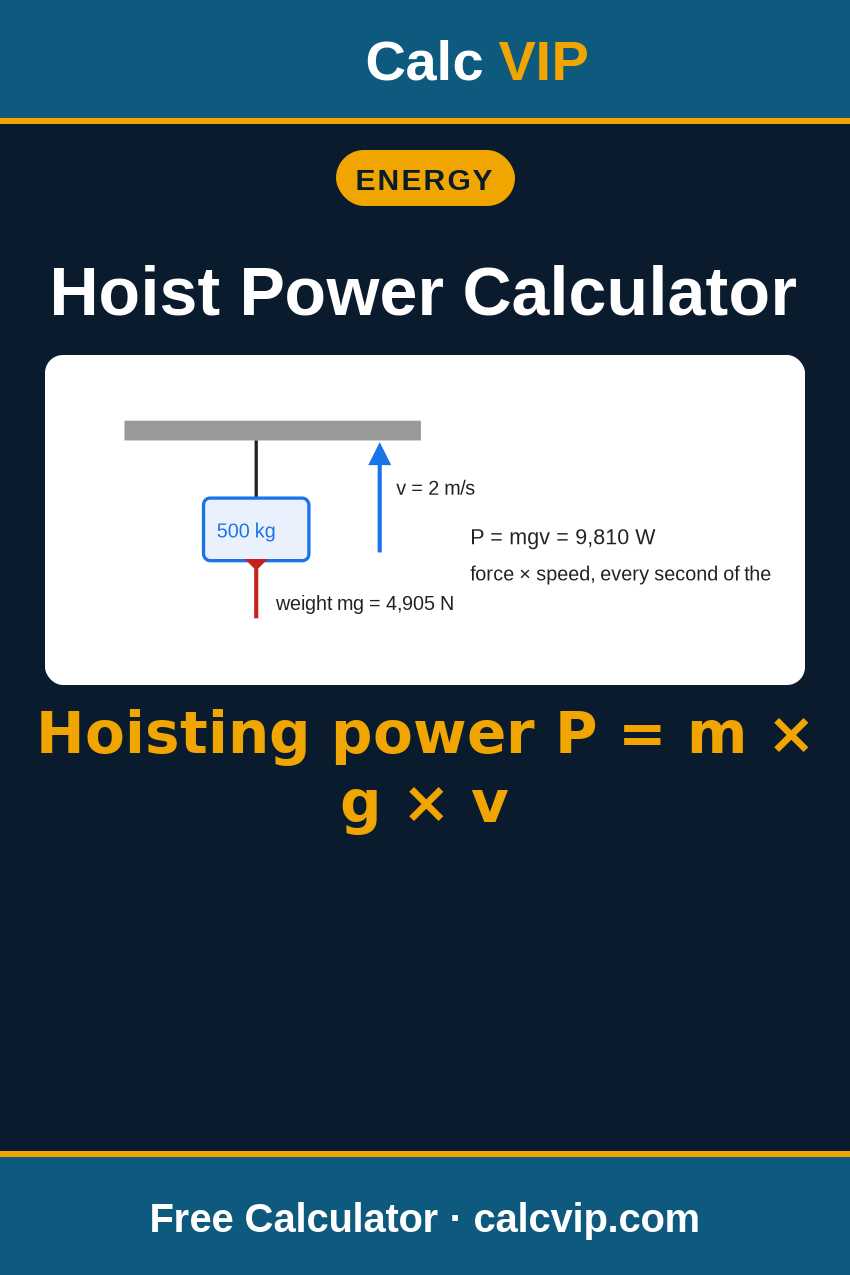
Example 1 — the crane. A crane lifts 500 kg at a steady 2 m/s: P = 500 × 9.81 × 2 = 9,810 W (9.81 kW). Raising the load 30 m takes t = 30 ÷ 2 = 15 s and uses E = 500 × 9.81 × 30 = 147,150 J — about 0.041 kWh, a few cents of electricity for a lift that needs nearly ten kilowatts while it lasts. Power and energy tell very different stories.
Example 2 — the passenger lift. A lift car with passengers totalling 800 kg rises at 1.5 m/s: P = 800 × 9.81 × 1.5 = 11,772 W. A 45 m ride takes 30 s and uses 353,160 J. Real lifts cheat this number downwards with a counterweight — see the applications — but the uncorrected figure is the honest starting point.
Example 3 — the human hoist. A 70 kg climber ascending a rope at an average vertical speed of 0.3 m/s (3 m of height in 10 s) produces P = 70 × 9.81 × 0.3 ≈ 206 W of lifting power, spending about 2,060 J on those 3 metres. Sustained human output is a few hundred watts at best — which is why the climber's 206 W effort feels heroic while the crane's 9,810 W is a modest motor.
Example 4 — from physics to a motor. Example 1's crane, with a realistic overall efficiency of 0.8 (motor, gearbox, drum and rope losses), needs an electrical input of 9,810 ÷ 0.8 = 12,262.5 W ≈ 12.26 kW. The next standard motor size up — not the physics answer — is what gets bolted on. Every honest hoist specification performs this division.
Example 5 — the mine hoist. A mine skip of 5,000 kg hauled at 8 m/s from 800 m deep: P = 5,000 × 9.81 × 8 = 392,400 W (392.4 kW), the trip takes 100 s, and each lift spends 39,240,000 J = 10.9 kWh. Deep mines are power stations run in reverse — this formula, scaled, is their electricity budget.
Example 6 — the workshop winch. A 120 kg engine block on a winch rising at 0.5 m/s: P = 120 × 9.81 × 0.5 = 588.6 W. Twelve metres of lift takes 24 s and 14,126.4 J. A one-horsepower-class motor (746 W) with ordinary efficiency is marginal for the job — exactly the sort of judgement this calculator exists to make before purchase, not after.
Hoisting in real life
Elevators and the counterweight trick. A lift's counterweight balances the car plus roughly half its rated load, so the motor only lifts the imbalance. Example 2's 11,772 W is the uncorrected worst case; counterweighting is why real lift motors are smaller than naive mgv suggests — and why the formula must be applied to the net mass in a balanced system.
Tower cranes. A crane's hoist motor is fixed, so its lifting speed falls as loads grow: v = P ÷ (mg). Operators feel the formula directly — the heaviest picks creep, the light ones fly — and load charts are, in effect, printed versions of that trade-off.
Ski lifts and cable cars. Dozens of chairs, each with passengers, all rising at line speed: the drive station's power is the sum of every chair's mgv on the uphill side, partially repaid by the empty chairs descending — a hoist calculation done by the tonne.
Escalators. An escalator is a hoist tilted: the lifting component is mgv with v the vertical rise rate. A crowded escalator in a station is a multi-kilowatt hoist that never stops, which is why their motors are rated for continuous duty.
Stair-climbing and fitness. Example 3 inverted is the physics of step machines and vertical races up skyscrapers: the scoreboard is really a wattmeter, and 206 W sustained is a strong amateur performance by this formula's accounting.
Garage and workshop winches. Example 6's marginal motor is a common purchase regret. The calculator's division by efficiency — motor, gearbox and battery sag included — is the difference between a winch that pulls its rating and one that stalls warmly at half of it.
Sizing the motor: efficiency, margins and money
The path from this page's answer to a purchasable motor has three standard steps. First, divide by efficiency: electric motors run at 0.85–0.95, gearboxes surrender a few percent per stage, wire ropes and drums a few more — Example 4's single division by 0.8 is the honest shortcut. Second, round up to a nameplate size with margin for the starting peak (acceleration adds its force to the weight) and for duty: a motor delivering 9.81 kW continuously in a hot plant room is specified more generously than the same power in bursts. Third, check the energy side for cost: Example 1's lift spends about 0.041 kWh — pennies — while Example 5's mine spends 10.9 kWh per trip, hundreds of trips a day, which is why mines negotiate electricity tariffs and homes never think about their lift. In horsepower, Example 1's 9,810 W is about 13.2 hp (divide watts by 746) — a useful translation when a winch or hoist is sold in imperial units.
The same arithmetic runs the descent. Lowering Example 1's 500 kg load at a steady 2 m/s releases potential energy at exactly the lifting rate — 9,810 W — and the machine must absorb or export every watt of it. A brake turns it into heat (and a 9.81 kW brake is a serious heater, which is why lowering heavy loads slowly is a thermal decision, not just a cautious one); a regenerative drive at 80% recovery returns about 7,848 W to the supply, turning the descent into a generating run. Cranes on construction sites increasingly do the latter, and the energy accounts of a whole build — lifts up at mgv, partial refunds on the way down — are kept in precisely this page's currency.
At the domestic end of the scale the same formula explains why small goods lifts are so undemanding: a shop lift raising 200 kg of stock at 0.4 m/s needs P = 200 × 9.81 × 0.4 = 784.8 W of mechanical power — under a kilowatt, within reach of an ordinary motor on an ordinary supply, even after the efficiency division roughly doubles the electrical ask. Hoisting feels like heavy industry, but at modest masses and speeds it is a kettle's worth of power pointed upwards; the formula's job is to say exactly where, for any given job, the boundary between "small motor" and "serious machine" falls.
Quick reference: power to lift 100 kg
| Lifting speed | Power required | Everyday comparison |
|---|---|---|
| 0.5 m/s | 490.5 W | a strong cyclist's sprint output, roughly |
| 1 m/s | 981 W | a small electric hoist |
| 2 m/s | 1,962 W | a kettle's worth of power, lifting |
| 5 m/s | 4,905 W | a small car's engine at cruise, scaled down |
Scale any row by the load in hundreds of kilograms: 500 kg at 2 m/s is the 1 m/s row's power times ten — 9,810 W, Example 1 exactly. The table is the formula with g already multiplied through.
Common mistakes
- Expecting height to change the power. It changes energy and time, never the steady power. If a taller lift "needs a bigger motor" in some claim, the real reason is duty, cooling or cable weight — not P = mgv.
- Comparing the raw answer with motor nameplates. The calculator returns minimum mechanical power. Without the efficiency division (Example 4), the chosen motor will run hot, slow or stalled. Physics watts and purchasable watts differ by the losses.
- Forgetting what else rises. Hook, block, sling, cage, skip — and on deep shafts, hundreds of metres of steel rope — all add to m. Mine hoists famously lift as much rope as ore at the start of a wind.
- Ignoring the start and stop. mgv is the steady middle. Snatching a load (jerking it from rest) can briefly demand far more force; gentle ramping exists precisely to keep reality near this formula.
- Slipping a factor of 1,000. Watts and kilowatts differ by 10³, and 9,810 W is 9.81 kW — misreading either direction has burnt out real motors and undersized real generators. The calculator prints both; quote both when ordering.
FAQ
Is this the motor size I need?
It is the minimum mechanical power. A real motor must be bigger because of friction and electrical losses — divide by the efficiency (for example 0.8) to get a realistic motor rating.
Why doesn't the height change the power?
Power depends on how fast you lift, not how far. Height changes the total energy and time, but lifting the same load twice as fast always needs twice the power.
Does acceleration matter?
Briefly, yes — speeding the load up needs extra force. This calculator assumes a steady speed, which is how cranes run most of the time.
What power lifts a person?
A 70 kg person rising at 0.5 m/s needs 70 × 9.81 × 0.5 ≈ 343 W of mechanical power — which is why stair lifts and home elevators run comfortably on small motors, and why a fit human (Example 3) can briefly be the hoist.
Why do cranes slow down under heavy loads?
Because their motors deliver roughly fixed power, and v = P ÷ (mg): double the mass and the same motor lifts at half the speed. The slowdown is the formula rearranging itself in real time.
Does lowering a load give the energy back?
The potential energy must go somewhere: small hoists waste it as heat in brakes, while modern lifts and mine winders can regenerate — feeding a substantial share back to the grid on the way down. Either way the descent is an energy transaction of exactly mgh.
How does a counterweight change the calculation?
Apply the formula to the net unbalanced mass. If a counterweight balances the car and half the load, the motor lifts only the remaining imbalance — the reason passenger lifts use far smaller motors than the raw car-plus-passengers figure suggests.
What about lifting at an angle, like a ski tow or funicular?
Only the vertical component of the speed raises the load: use v × sin θ for a slope of angle θ (equivalently, the rate of height gain). The rest of the motor's work fights friction along the track, which this calculator does not include.
How many horsepower is Example 1's crane?
9,810 W ÷ 746 ≈ 13.2 hp. The conversion matters because hoists, winches and small engines are still widely sold in horsepower across North America — divide watts by 746 (or multiply kilowatts by 1.34) before comparing catalogues.
Does the rope's own weight matter?
On a workshop winch, negligibly; on an 800 m mine shaft, the rope can outweigh the skip, and the motor's hardest work comes at the start of the wind when the full rope is hanging. Deep-hoist design adds the rope's mass to m — sometimes with tapered or multiple ropes to manage exactly this term.