 Calc
Horsepower Converter – hp to Watts & Kilowatts
 Created by Priya Sharma · Physics Editor · Energy & Gravity · Last updated: November 2026
Use this free Horsepower Converter to change power between horsepower (hp), watts (W) and kilowatts (kW). Enter a value in any one unit and see all three at once — handy for car engines, motors and appliances.
Horsepower is the most successful piece of marketing in the history of units. In the 1780s James Watt needed to sell steam engines to mine owners who measured work in horses, so he measured what a strong horse could do — and, by most accounts, rounded generously upward — and priced his engines against it. An engine of "10 horsepower" replaced ten horses, ate no hay and never slept. The unit he invented to make that sale, 33,000 foot-pounds of work per minute, is still with us nearly 250 years later, long after the horses left the mines: 1 hp = 745.7 watts, exactly the conversion this calculator performs.
Today the unit lives a double life. Car brochures, boat engines, lawn mowers and motorbikes still speak horsepower, because buyers feel the difference between 150 and 200 hp in their bones. Meanwhile everything electrical — motors, appliances, power stations, and increasingly the cars themselves — is rated in watts and kilowatts, the SI units of power. Anyone comparing an electric car's 150 kW motor with a petrol car's 200 hp engine, or wondering whether a 2 hp treadmill motor is strong, needs a translator between the two dialects. That is the whole job of this page.
One thing to hold onto before converting: horsepower measures power — how fast work is done — not energy itself. A 2 hp motor and a 1 hp motor can do the same total work; the 2 hp motor simply does it in half the time. Multiply power by time and you get energy (which is why your electricity bill counts kilowatt-hours, not kilowatts). Keep that distinction and the conversions here will never mislead you: hp, W and kW are three rulers for the same quantity, and the calculator swaps between them instantly.
Formula
1 hp = 745.7 W and 1 kW = 1000 W
So: watts = hp × 745.7, kilowatts = watts ÷ 1000, and horsepower = watts ÷ 745.7. Two shortcuts cover most mental arithmetic: to turn kilowatts into horsepower, multiply by 1.34 (a 100 kW motor is about 134 hp); to turn horsepower into kilowatts, multiply by 0.746 (a 200 hp engine is about 149 kW). Notice the direction of the sizes: the kilowatt figure is always the smaller number, because a kilowatt (1,000 W) is a bigger unit than a horsepower (745.7 W). If a conversion ever gives you more kilowatts than horsepower for the same machine, the two have been swapped by mistake. The watt is the pivot of the whole system — every conversion on this page passes through watts, exactly as the calculator does.
| Symbol | Meaning | Units |
|---|---|---|
| hp | horsepower — mechanical (imperial) horsepower | 1 hp = 745.7 W |
| W | watt — the SI unit of power, one joule per second | 1 W = 1 J/s |
| kW | kilowatt | 1 kW = 1,000 W = 1.34 hp |
| PS | metric horsepower (Pferdestärke), used in Germany and Japan | 1 PS = 735.5 W = 0.986 hp |
| bhp | brake horsepower — power measured at the output shaft | same size as hp |
A unit invented to sell engines
Watt's definition was a measurement before it was a slogan. He watched horses turning mill machinery and hauling coal and settled on a rate a good horse could sustain: lifting 33,000 pounds one foot in one minute — equivalently, 550 foot-pounds per second. Converted into modern units, 550 ft·lb/s works out to 745.7 joules per second: 745.7 watts. Historians suspect Watt padded the figure so no customer could complain his engine underperformed a real horse; if so, it was honest padding, and it means a genuine horse working steadily delivers close to — but usually a little under — the unit named after it. A horse sprinting or hauling at full stretch can far exceed it briefly, reaching perhaps 15 hp for a few seconds, which says more about the difference between peak and sustainable power than about Watt's arithmetic.
The unit refuses to die because it is well sized for its job. A watt is tiny — a phone charger uses five — and a kilowatt undersells a car. Horsepower lands in the comfortable hundreds for engines people buy, and two and a half centuries of brochures have taught buyers what the numbers feel like. The cost of that comfort is a small zoo of near-identical units: the mechanical hp of this page (745.7 W), the metric PS (735.5 W) still printed in German and Japanese specs, the electrical hp (746 W) on American motor plates, and the boiler hp (about 9,810 W) of steam engineering, which measures something else entirely. They differ by barely 1.5% — small enough to ignore at the pub, large enough to matter in an engineering contract, and the reason spec sheets should always say which horsepower they mean.
Underneath the folklore sits a clean physical idea: power is a rate. Two engines with the same energy to spend — the same tank of fuel — differ only in how fast they can spend it, and horsepower ranks them by exactly that. It is also why power alone never tells the whole story of performance: a 150 hp engine in a light car and the same engine in a loaded truck produce very different journeys. Power-to-weight ratio, torque and gearing share the stage — but the conversion between the units, at least, is a closed question, and it is answered by 745.7.
One more distinction hides inside most ratings: peak versus continuous. A petrol engine's brochure horsepower is a peak — the most it can produce at one favourable engine speed, not a figure it could hold up a long mountain pass without strain. Electric motors are often quoted by continuous output, the power they can sustain indefinitely without overheating, with a higher peak available for short bursts. This is why two machines with the same headline number can behave differently under hard, sustained work, and why careful comparisons ask not just "how many horsepower?" but "for how long, and at what engine speed?" The conversion factor never changes — but what the converted number promises depends on which kind of rating you converted.
How to use
- Enter the power value you have.
- Choose its unit: horsepower, watts or kilowatts.
- Click "Convert" to see the value in all three units.
- For a quick mental check, remember the two anchor points: 1 hp ≈ 0.75 kW and 1 kW ≈ 1.34 hp. If your answer is far from those ratios, a unit has been mistyped.
Worked examples
Example 1 — the headline case. A motor rated at 2 hp produces 2 × 745.7 = 1,491.4 W, which is 1.49 kW. Two horses' worth of sustained work from a machine the size of a bucket — the comparison that sold Watt's engines, still startling today.
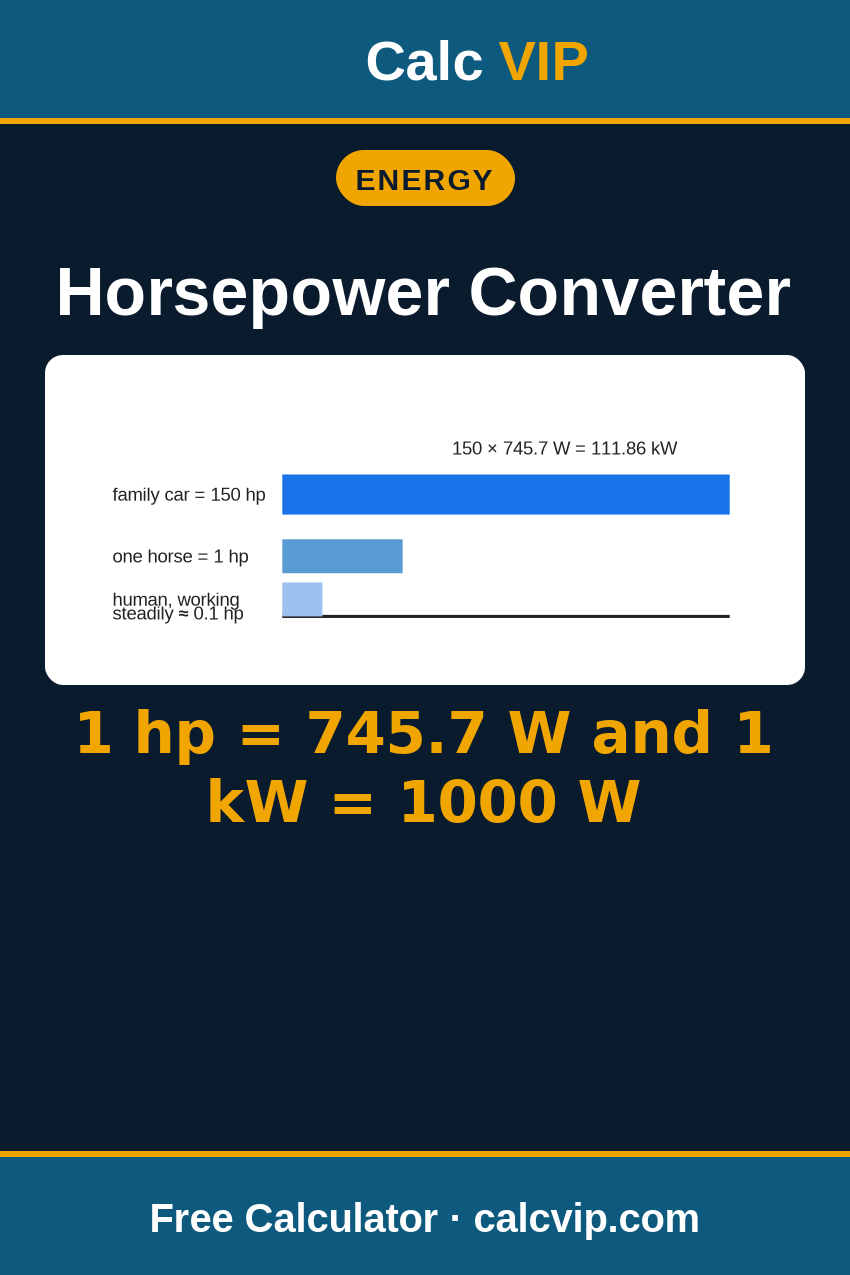
Example 2 — a family car. A car engine rated at 150 hp delivers 150 × 745.7 = 111,855 W = 111.86 kW. That is the number to compare with electric cars, whose motors are quoted in kW: a "112 kW" EV and a "150 hp" petrol car are, on paper, evenly matched.
Example 3 — an electric motor, backwards. An EV motor rated at 100 kW is 100,000 W, and 100,000 ÷ 745.7 = 134.10 hp. The shortcut gives the same answer: 100 × 1.34 ≈ 134 hp. Electric motors also deliver their power differently — full torque from a standstill — which is why the EV often feels quicker than the bare conversion suggests.
Example 4 — a kitchen kettle. A 1,000 W kettle is 1,000 ÷ 745.7 = 1.34 hp. The appliance that boils your tea is, while it runs, out-working a horse — a good reminder that the watt figures on domestic appliances are not small numbers wearing a disguise.
Example 5 — the athlete. A cyclist sprinting at 400 W is producing 400 ÷ 745.7 = 0.54 hp; a trained rider cruising at 200 W manages about 0.27 hp, and an average person working steadily all day sustains roughly 75 W — a tenth of a horsepower. Watt chose his unit at the top of what animal muscle can do all day, which is why human figures always look humbling next to it.
Example 6 — a truck engine. A lorry engine rated at 450 hp produces 450 × 745.7 = 335,565 W = 335.57 kW. It needs that rate of working not for speed but for hauling forty tonnes up motorway gradients — power is what lets a heavy vehicle climb a hill without slowing to a crawl.
Horsepower in real life
Comparing cars across markets. The same car may be advertised at 150 hp in America, 110 kW in an engineering document and 152 PS in Germany. They are the same engine: 150 hp = 111.86 kW, and the PS figure runs about 1.4% higher than hp because the metric unit is slightly smaller. Converting before comparing prevents a phantom "power difference" that is only a unit difference.
Electric vehicles. EVs are specified in kilowatts, and this page's conversion is the Rosetta stone for shoppers raised on horsepower. The useful rule: multiply kW by 1.34. A 200 kW family EV is a 268 hp car — sports-car territory a generation ago.
Motor nameplates and tools. Pumps, compressors, treadmills and workshop tools are sold in hp in some countries and watts in others. A 1.5 hp pool pump and a 1,100 W pool pump are the same machine (1.5 × 745.7 = 1,118.6 W), and the conversion stops a "stronger" label from being just a bigger-sounding unit.
Boats and outboards. Marine engines are almost universally rated in hp, while electric outboards are appearing in kW. A 9.9 hp outboard is a 7.38 kW motor — and on restricted lakes where the limit is written in one unit, the conversion decides which motor is legal.
Air conditioning and generators. Home generators are sold by watts, the tools they must run by a mixture of watts and hp. Adding up a fridge (150 W), a pump (0.5 hp = 373 W) and lights in a single unit — this calculator's job — is how you size a generator without buying twice what you need.
Why lawn mowers boast. Small engines are marketed hard on horsepower, sometimes with peak figures the engine cannot sustain. The watt conversion does not fix optimistic ratings, but it does expose them: a "6 hp" mower that draws like a 3 kW machine (4 hp) is telling two different stories in two units.
The flavours of horsepower
Not every horsepower is the same size, and the differences occasionally matter. The mechanical (imperial) hp of this page is 745.7 W. The metric horsepower, called PS in German and still common in European and Japanese specifications, is defined as 75 kilogram-force metres per second and equals 735.5 W — about 1.4% smaller, so PS figures read slightly higher than hp for the same engine (100 PS = 98.63 hp). The electrical hp used on American motor plates is exactly 746 W, a rounding of the mechanical figure. And the boiler hp of steam practice, about 9,810 W, measures the rate at which a boiler produces steam and should never be compared with shaft power at all. When a conversion must be exact — a contract, a homologation document — check which flavour the source is using; for everything else, 745.7 W serves.
Quick reference: common ratings converted
| Horsepower | Watts | Kilowatts |
|---|---|---|
| 1 hp | 745.7 W | 0.75 kW |
| 5 hp | 3,728.5 W | 3.73 kW |
| 10 hp | 7,457 W | 7.46 kW |
| 50 hp | 37,285 W | 37.29 kW |
| 100 hp | 74,570 W | 74.57 kW |
| 200 hp | 149,140 W | 149.14 kW |
| 500 hp | 372,850 W | 372.85 kW |
The table's anchor is the top row: everything else is that single fact multiplied. If you remember only one number from this page, remember 745.7 — or, for pub purposes, that a horsepower is roughly three quarters of a kilowatt.
Common mistakes
- Confusing power with energy. Horsepower says how fast work is done, not how much work exists. A 2 hp motor does not contain "more energy" than a 1 hp motor — it spends energy twice as fast. Energy figures need a time attached: kilowatt-hours, not kilowatts.
- Getting the conversion backwards. Kilowatts are the bigger unit, so the kW number is always smaller: 150 hp becomes 111.86 kW, not 201 kW. If the kW figure came out larger than the hp figure, the multiplication went the wrong way.
- Mixing up hp and PS. European figures in PS (or CV, or ch) are about 1.4% smaller units than hp. A 110 PS car is a 108.5 hp car. Ignoring the difference invents phantom performance gaps between identical cars sold in different countries.
- Assuming horsepower alone decides performance. A vehicle's acceleration depends on power-to-weight ratio, torque delivery and gearing. Two 150 hp cars — one a light hatchback, one a loaded SUV — are not equally quick, and no unit conversion can make them so.
- Confusing hp with torque. Torque is a twisting force, measured in newton-metres or pound-feet; power is torque multiplied by rotational speed. Engines are described by both because they answer different questions — torque for pulling away and towing, power for top speed and sustained pace.
FAQ
Where does the number 745.7 come from?
James Watt defined one horsepower as 33,000 foot-pounds of work per minute, which works out to about 745.7 watts in modern units.
Is horsepower still used today?
Yes — car and bike engines are still commonly rated in hp (or bhp), while electrical appliances and motors are usually rated in watts or kilowatts.
What is the difference between hp and bhp?
Brake horsepower (bhp) is the power measured at the engine's output shaft, after losses. It uses the same conversion: 1 bhp ≈ 745.7 W.
How many horsepower is 1 kilowatt?
1 kW = 1,000 W, and 1,000 ÷ 745.7 = 1.34 hp. This is the conversion electric-car shoppers use most: multiply any kW rating by 1.34 to think in horsepower.
Can a real horse actually produce one horsepower?
At a steady, all-day working pace, roughly yes — that was Watt's whole point. But a horse is not limited to its sustainable rate: measurements of horses hauling and galloping suggest brief peaks of around 15 hp. The unit records what a horse can sustain, not what it can briefly achieve — the same distinction as a marathon pace versus a sprint.
Why do European car specs use kW or PS instead of hp?
Because the watt is the legal SI unit, and the metric horsepower (PS) was the continent's own tradition before that. German brochures often print both kW and PS; British and American ones keep hp. All three describe the same engines — only the rulers differ.
Is a higher horsepower always better?
Not by itself. More power means a higher top speed and stronger acceleration for the same weight, but it usually brings higher fuel or electricity consumption, cost and insurance. What drivers feel day to day is power-to-weight ratio and how the power is delivered — which is why a 134 hp electric motor can feel livelier than a 150 hp petrol engine.
What is torque, and how is it different from horsepower?
Torque is the twisting force an engine or motor applies to its shaft, measured in newton-metres (N·m). Power is torque multiplied by how fast the shaft spins. High torque at low speed is what pulls trailers and climbs hills; high power is what sustains speed. The two figures together describe an engine; neither replaces the other.
How do I convert PS to horsepower?
Multiply by 0.986. Since 1 PS = 735.5 W and 1 hp = 745.7 W, a rating of 150 PS is 150 × 735.5 ÷ 745.7 = 147.95 hp. The difference is small — about 1.4% — but it is real, and it explains why the same car shows a slightly bigger number in a German brochure.
Why do some motors say 746 W instead of 745.7 W?
That is the electrical horsepower, an American convention for motors defined as exactly 746 W. The difference from the mechanical hp (745.7 W) is 0.3 W in 746 — about 0.04% — and matters only in precision engineering. For comparing motors, appliances and engines, treat them as identical.