 Calc
Electric Field Calculator – E = kQ/r² and E = F/q
 Created by Thomas Becker · Physics Writer · Electricity & Magnetism · Last updated: November 2026
Use this free Electric Field Calculator to find the strength of an electric field. You can work from a point charge (E = kQ/r²) or from the force on a test charge (E = F/q). Small charges can be typed in scientific notation, like 1e-6.
An electric field is the influence a charge exerts on the space around it — a property of every point in that space, present whether or not anything is there to feel it. Its strength is defined as the force that a single unit of positive charge would experience at that point: E = F/q. Place a tiny test charge in the field and the force on it is simply F = Eq, so the field is a standing instruction, written into space itself, telling any arriving charge exactly how hard and which way it will be pushed.
For the field of a single point charge the instruction can be written directly: E = kQ/r², Coulomb's law with the test charge divided out. The field weakens with the inverse square of distance, points away from a positive source and towards a negative one, and is measured in newtons per coulomb — a unit that turns out to be identical to the volt per metre, a first hint that field and voltage are two dialects of one language. This calculator works both routes: from a source charge and distance, or from a measured force and the test charge that felt it.
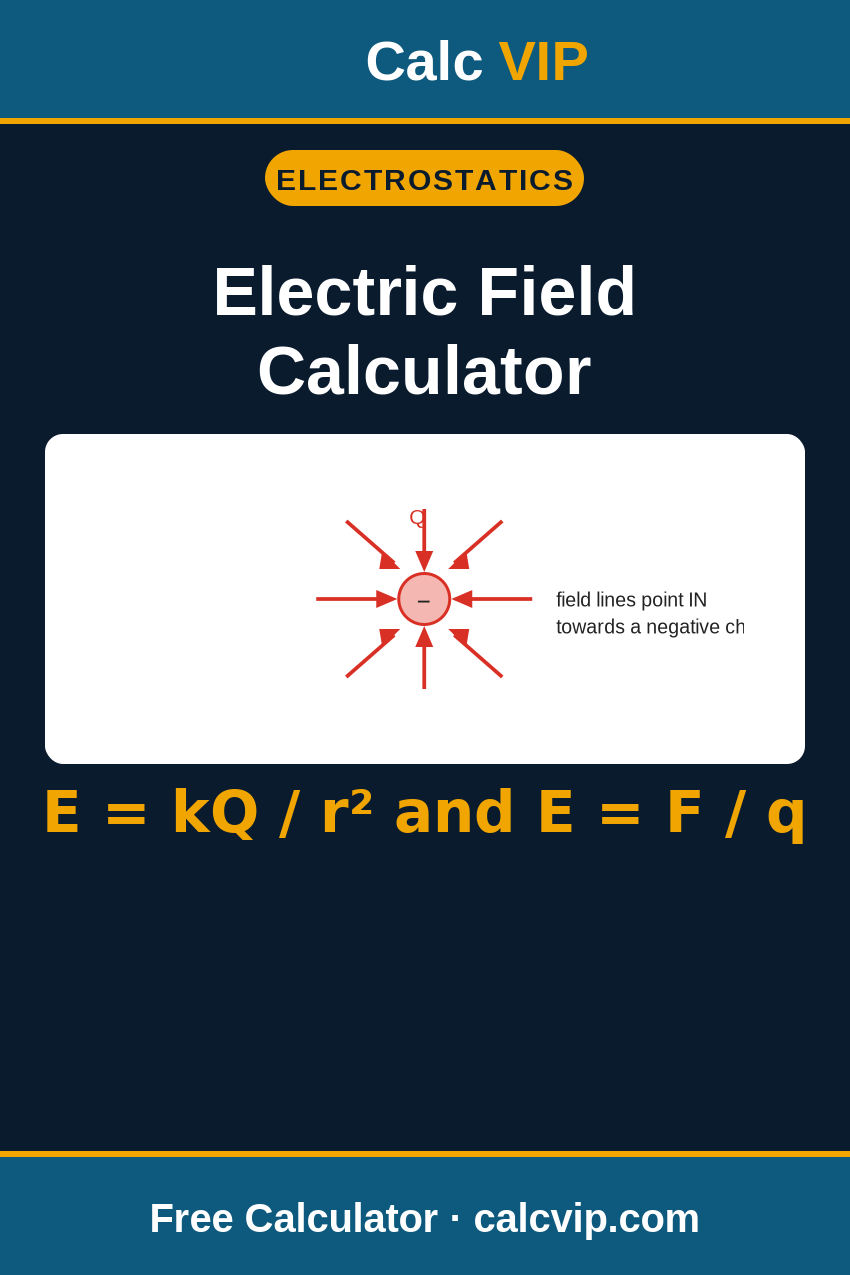
The field idea, introduced by Michael Faraday in the 1830s and 40s, replaced spooky action-at-a-distance with something local and physical. Charges do not reach across empty space to grab each other; each charge fills its surroundings with a field, and other charges respond only to the field where they stand. Drawn as lines that never cross, crowd where the field is strong and thin where it is weak, the field becomes a map you can read — and nearly every electrical technology, from inkjet printers to particle accelerators, is field-shaping by design.
Formula
Electric field = kQ ÷ r² • Electric field = Force ÷ charge → E = kQ / r² and E = F / q, with k = 8.99 × 10⁹ N·m²/C²
The two formulas are the same statement read from opposite ends. E = F/q is the definition — it works for any field, however produced, and needs only a measured force and the charge that felt it. E = kQ/r² is the special case for the field a lone point charge creates, and it is just Coulomb's law divided through by the test charge: the q cancels, which is the deep point — the field belongs to the source and the position, never to the visitor. Between parallel plates a third form rules, E = V/d, covered in the depth section below. Units are newtons per coulomb (N/C), equivalently volts per metre (V/m); charges enter in plain coulombs and distances in plain metres.
| Symbol | Meaning | Units |
|---|---|---|
| E | electric field strength — force per unit charge | N/C (equivalently V/m) |
| Q | the source charge creating the field | coulombs (C) |
| r | distance from the source charge — squared in the formula | metres (m) |
| F | force felt by a test charge in the field | newtons (N) |
| q | the test charge — small enough not to disturb the field | coulombs (C) |
Reading the map: what field lines tell you
Faraday's lines are a complete visual language, and four rules read the whole of it. Lines begin on positive charges and end on negative ones — a charge is a source or a sink of the field, never a passer-by. Lines never cross, because at a crossing the field would point two ways at once. The direction at any point is the direction a positive test charge would be pushed. And the strength is in the crowding: where lines pack tight the field is fierce, where they spread it is feeble — which is why the lines around a point charge thin out with the same inverse-square geometry as the formula, the picture and the algebra agreeing exactly.
Two courtesies keep the definition honest. The test charge must be small, or its own field would rearrange the very arrangement being measured — the field is defined in the limit of a vanishing visitor. And the field at a point from many charges is the vector sum of each charge's contribution, superposition again: real fields, in machines and in weather, are always sums, computed contribution by contribution exactly as this page computes the single-source case. Master E for one charge and the method for any assembly is already in your hands.
How to use
- Choose the method: from a point charge and a distance, or from a force and a test charge.
- Enter the two values — the labels change to match your choice. Scientific notation like 1e-6 is accepted.
- Click "Calculate" to get the field strength in newtons per coulomb (N/C), with the direction for the point-charge method.
- To find the force on any charge placed at that point, multiply: F = E × q. The calculator's two methods are inverses, and checking one against the other is good practice.
Worked examples
Example 1 — field of a point charge. A charge Q = 1 × 10⁻⁶ C, at a distance of 0.5 m.
E = 8.99 × 10⁹ × 1 × 10⁻⁶ ÷ 0.5² = 8990 ÷ 0.25 = 35,960 N/C, pointing away from the positive charge. A test charge placed there would feel 35,960 newtons for every coulomb it carried — which is why test charges are kept microscopic.
Example 2 — field from a measured force. A test charge of 2 × 10⁻⁶ C feels a force of 0.01 N.
E = F ÷ q = 0.01 ÷ (2 × 10⁻⁶) = 5,000 N/C. This is the experimentalist's route: you rarely know a field until something has been pushed by it, and this division is the whole measurement.
Example 3 — force from a field. In a field of 1,000 N/C, a charge of 5 × 10⁻⁶ C is placed.
F = E × q = 1,000 × 5 × 10⁻⁶ = 0.005 N. Note the round trip: divide a force by a charge to get the field (Example 2), multiply back to recover any force (this example) — the field is the exchange rate between charge and force.
Example 4 — an electron in a field. An electron (q = 1.6 × 10⁻¹⁹ C, mass 9.11 × 10⁻³¹ kg) enters a field of 5,000 N/C.
F = 5,000 × 1.6 × 10⁻¹⁹ = 8 × 10⁻¹⁶ N, and its acceleration is F ÷ m = 8.8 × 10¹⁴ m/s² — some hundred trillion times gravity's acceleration, directed opposite to the field because the electron's charge is negative. Fields this modest steer electrons effortlessly, which is the entire basis of electron optics.
Example 5 — between parallel plates. Two plates 1 cm apart (0.01 m) have 100 V between them.
E = V ÷ d = 100 ÷ 0.01 = 10,000 N/C (V/m), uniform everywhere between the plates. This is the field inside every capacitor and the working field of countless instruments, computed without a single charge in sight.
Example 6 — distance tames a bigger charge. A charge of 4 × 10⁻⁶ C — four times Example 1's — viewed from 2 m.
E = 8.99 × 10⁹ × 4 × 10⁻⁶ ÷ 4 = 8,990 N/C. Four times the charge, but the distance has also quadrupled, so the squared denominator has grown sixteenfold: the field ends up four times weaker than Example 1's. In field problems, distance outranks charge.
Electric fields in real life
Inkjet printing. Each ink droplet is given a precise charge as it leaves the nozzle, then flies between deflecting plates whose field steers it — more charge or a stronger field bends the droplet further, placing it on the page or diverting it to a gutter. Characters are written by Coulomb forces aimed by fields.
Old screens and oscilloscopes. In a cathode-ray tube, an electron beam passes between pairs of plates whose fields deflect it vertically and horizontally — Example 4's enormous accelerations put to work, painting a picture by steering electrons thousands of times per second. The oscilloscope is an electric-field instrument from end to end.
Photocopiers and precipitators. Both are field machines: fields charge the drum or the smoke particles, then oppositely directed fields pull those particles to where they are wanted — toner to the drum's image, ash to the collector plate. The field strength, set by voltage and spacing through E = V/d, is the design variable.
Particle accelerators. From X-ray tubes to the Large Hadron Collider, charges are accelerated by electric fields — the force F = Eq applied over distance is what "electron-volts" of beam energy means. Radio-frequency fields, flipping in time with the particles' arrival, do the pushing in the big machines.
Lightning and its warning instruments. A thundercloud's growing field is measured at the ground by field mills; when fields climb towards the air's breakdown strength of about 3 × 10⁶ N/C, a discharge becomes likely. Lightning rods work by concentrating the field at a sharp point, encouraging a controlled meeting place for the bolt.
The field you are standing in. Even in fair weather the Earth maintains a downward field of roughly 100 N/C — you are, right now, standing in a voltage gradient of about a hundred volts per metre of height, equalised within your conductive body so completely that you never notice it. Under a thundercloud that field can grow a hundredfold, which your hair sometimes reports before any instrument does.
The uniform field between plates: E = V/d
Between two large parallel plates the field lines run straight and evenly spaced — the field has the same strength and direction everywhere, the closest thing in electrostatics to a level floor. Its strength is disarmingly simple: E = V ÷ d, the voltage between the plates divided by their separation. No charges, no k, no squares. This is why the volt per metre is an honest unit for field strength, and why the inside of a capacitor is so easy to analyse: a 12 V battery across a 2 mm gap (Example: 12 ÷ 0.002) maintains 6,000 V/m. Halve the gap at the same voltage and the field doubles — the reason thin dielectrics, for all their capacitance benefits, live dangerously close to breakdown, and the reason plate spacing is the first knob engineers turn when a field must be strengthened or tamed.
Quick reference: field strengths in the wild
| Situation | Field strength |
|---|---|
| fair-weather field at Earth's surface | about 100 N/C |
| beneath an active thundercloud (approx.) | about 10,000 N/C |
| inside a capacitor: 12 V across 2 mm | 6,000 N/C |
| between the plates of Example 5 | 10,000 N/C |
| 10 cm from a 1 µC charge | 899,000 N/C |
| breakdown strength of air | about 3,000,000 N/C |
The table's last row is the universe's speed limit for fields in air: exceed roughly three million newtons per coulomb and the air itself ionises into a conducting path — a spark — and the field collapses. Every row above it is a negotiation with that ceiling.
How do you measure a field you cannot touch?
You cannot put a ruler against an electric field, so instruments measure its effects. The oldest probe is the test charge made real: a tiny known charge on a delicate suspension, whose deflection reports F and hence E = F/q — Coulomb's own approach, refined. Weather services use the field mill: a grounded rotating shutter alternately exposes and shields a sensing plate, so the atmospheric field induces an alternating charge on it whose size is directly proportional to E — a fair-weather murmur of about 100 N/C swelling to thousands as a storm approaches, exactly the numbers in the table above.
At the other extreme of sensitivity, electrometers and field-effect probes measure the fields inside electronics and across membranes — the field across a cell membrane, barely ten nanometres thick with about a tenth of a volt across it, works out near 10⁷ N/C, beyond the breakdown strength of air, sustained only because the membrane is not air. That a single formula, E = F/q, stretches from thunderstorm forecasting to cell biology is the best argument for Faraday's invention: the field is not a manner of speaking, but a measurable property of space everywhere.
Common mistakes
- Confusing field with force. The field exists whether or not a charge is present to feel it; force is what happens when one arrives. E is measured per coulomb precisely so that it describes the place, not the visitor.
- Letting the field depend on the test charge. Double q and the force doubles too — the ratio E = F/q is unmoved. A field calculation whose answer changes with the test charge has mistaken the messenger for the message.
- Getting the direction backwards. Field points away from positive and towards negative — the way a positive test charge would move. For an electron the force is opposite the field; forgetting that flip reverses every deflection in electron optics.
- Feeding centimetres into an inverse-square formula. As with Coulomb's law, r belongs in metres. Ten centimetres entered as 10 instead of 0.1 understates the field ten-thousandfold.
- Expecting a field inside a closed metal box. In electrostatic equilibrium the field inside a hollow conductor is zero — charges rearrange on the outer surface until it cancels. That is the Faraday cage protecting aircraft passengers and sensitive instruments alike.
FAQ
What are the units of electric field?
Newtons per coulomb (N/C) — the force felt by each coulomb of charge placed in the field. The same unit can be written as volts per metre (V/m); they are exactly equivalent.
Which way does the field point?
Away from a positive charge and towards a negative charge. The calculator uses the size of the charge, so it gives the field's strength; the direction follows this rule.
What is the difference between electric field and electric force?
The field (E) is a property of the space around a charge — it exists whether or not anything is there to feel it. The force (F) only appears when a second charge q is placed in the field, and F = Eq.
Who invented the idea of the electric field?
Michael Faraday, in the 1830s–40s, who pictured lines of force filling space around charges and magnets. James Clerk Maxwell later gave Faraday's picture its mathematics — the field equations that also predicted radio waves.
What is a test charge?
A hypothetical small positive charge used to probe a field without disturbing it. It must be small because a large probe's own field would rearrange the sources being measured; the field is defined as the force per unit charge in the limit of a vanishing probe.
Can the electric field be zero where charges are present?
Yes — wherever contributions cancel. Between two equal positive charges the midpoint feels equal pushes both ways and the field vanishes; inside a hollow conductor it vanishes everywhere. Zero field means zero net push, not zero charges.
How strong is the Earth's natural electric field?
About 100 N/C pointing downwards in fair weather, maintained by the global circuit of thunderstorms. Beneath a thundercloud it can reach thousands of N/C and reverse direction — one of the signals that lightning is near.
What does "breakdown" mean for a field?
Air insulates only up to about 3 × 10⁶ N/C. Beyond that, the field tears electrons from air molecules, the air becomes a conducting plasma, and the field discharges itself as a spark or a lightning bolt.
How are field and voltage related?
Voltage is the field accumulated along a distance. Between plates, E = V/d; in general, moving through a field against its direction raises the voltage by E × distance. Field is the slope of the voltage landscape — steep slope, strong field.
Why does the calculator ask for the size of the charge in force mode?
Because E = F/q needs both the push and the size of what was pushed. A 0.01 N force means a gentle field for a large test charge and a fierce one for a small charge — Example 2's 5,000 N/C comes from dividing by just 2 µC.