 Calc
Electric Field Solver Calculator – E = kQ/r² Solve for E, Q or r
 Created by Thomas Becker · Physics Writer · Electricity & Magnetism · Last updated: November 2026
Use this free Electric Field Solver Calculator to work with the field of a point charge, E = kQ/r². You can find the field strength E from a charge and distance, work backwards to the charge Q that makes a known field, or find the distance r where the field has a given strength. Charges are tiny, so you can type them in scientific notation — for example 4e-6 means four microcoulombs (0.000004 C).
An electric field is best pictured as a property of the space around a charge: at every point there is an arrow saying how hard that space would push on a positive charge placed there, and how the push would point. The strength of that push per coulomb is E. Double the charge you place there and the force doubles, but the field itself — the property of the space — is unchanged, which is exactly why physicists prefer to talk about E rather than listing forces for every possible test charge. This calculator works with the simplest and most important field of all: the one around a single point charge, spreading out evenly in every direction like light from a bare bulb.
The field's defining habit is its inverse-square fall. Move twice as far from the charge and the field is not half as strong but a quarter, because the same influence is being spread over the surface of a sphere with four times the area. This makes point-charge fields violent up close and feeble far away, across a staggering range. The field a single electron produces one ångström away — roughly the size of an atom — is about 1.44 × 10¹¹ N/C, while the fair-weather field of the whole Earth, generated by the planet's own charge, is a gentle 100 N/C or so pointing down at your feet right now. One formula, E = kQ/r², spans that entire range from atoms to planets.
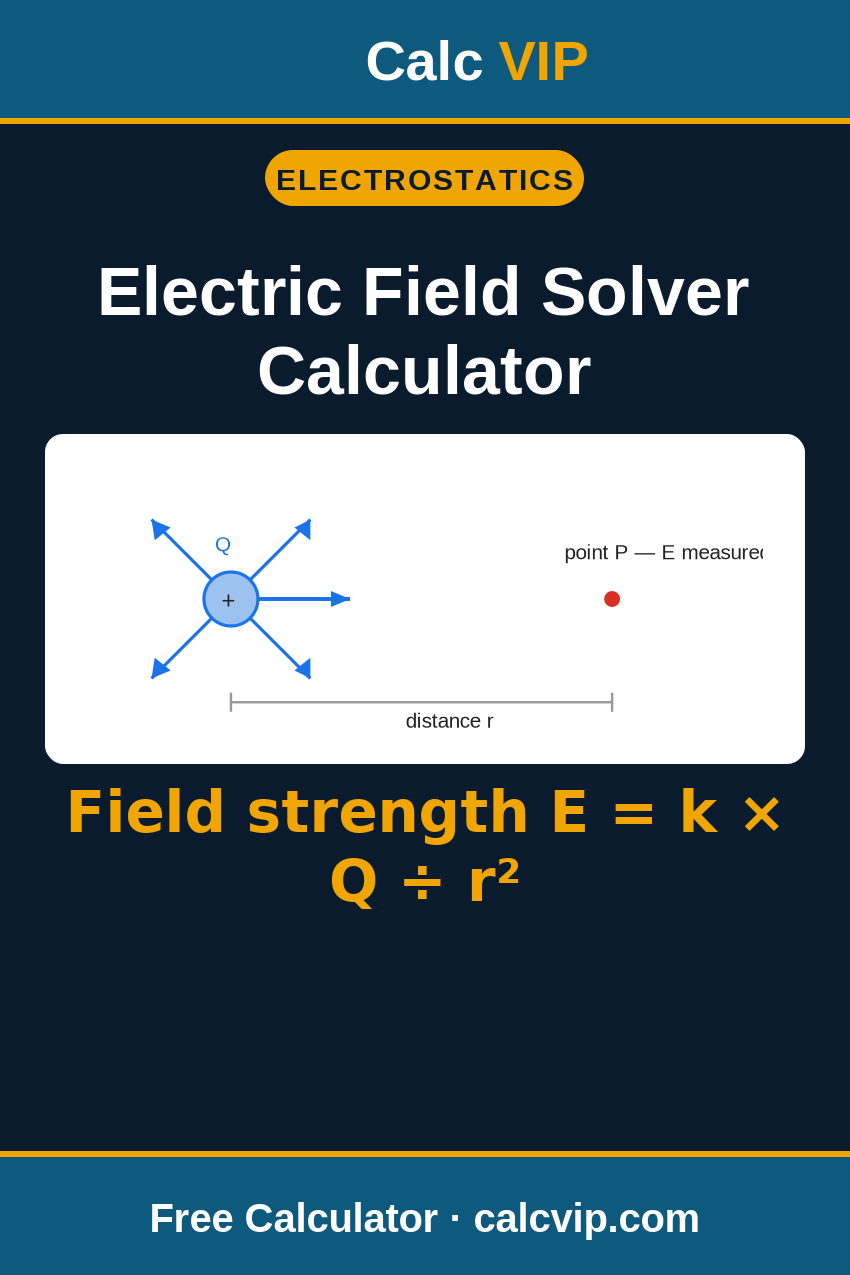
The solver runs the formula in all three directions because real problems arrive in all three forms. Sometimes you know the charge and want the field (a sensor specification, a safety check). Sometimes you measure a field and want to know what charge made it — this is how the Earth's charge and the charge on industrial machinery are actually estimated. And sometimes you need the distance at which a field drops to a safe or detectable level, which is a question about exposure limits, instrument placement and insulation design. Choose the mode, enter the two values you have, and the third follows.
Formula
Field strength E = k × Q ÷ r² • E in newtons per coulomb (N/C), Q in coulombs (C), r in metres (m), k = 8.99 × 10⁹ N·m²/C²
The same relation rearranges to answer the other two questions: Q = E × r² ÷ k finds the charge that produces a measured field at a known distance, and r = √(k × Q ÷ E) finds how far from a charge the field has a chosen strength. Notice what the rearrangements share: everything runs through the product kQ, the charge's "field-making power", and through r² — the square is the whole story of this formula, the reason fields collapse so fast with distance and explode so fast up close. A useful mental check: for Q = 1 µC, kQ = 8,990, so the field at 1 m is 8,990 N/C, at 0.5 m it is four times that, and at 2 m a quarter. If your answer does not scale that way when you change r, an input has slipped.
| Symbol | Meaning | Units |
|---|---|---|
| E | electric field strength at the point | N/C (same as V/m) |
| Q | the point charge creating the field | coulombs (C) |
| r | distance from the charge to the point | metres (m) |
| k | Coulomb's constant, 1/(4πε0) | 8.99 × 10⁹ N·m²/C² |
Why 1/r²? The spreading-sphere picture
Imagine the charge's influence as a fixed number of field lines streaming outwards, never created or destroyed in empty space. Close in, those lines are crowded through a small sphere; far away, the same lines are spread thinly over a huge one. The sphere's surface area is 4πr², so the density of lines — which is what field strength measures — must fall as 1/r². This is not a coincidence of electrostatics: gravity and light intensity obey the same law for the same geometric reason, and it is why all three are called inverse-square laws. Whenever anything radiates evenly into three-dimensional space, 1/r² is waiting.
There is a bookkeeping version of the same idea that physicists use constantly: multiply E by the sphere's area and the r² cancels — E × 4πr² = Q/ε0, a constant for a given charge. For the worked example below (Q = 4 µC, r = 0.5 m), E × 4πr² = 143,840 × π ≈ 451,900, and Q/ε0 = 4 × 10⁻⁶ ÷ 8.854 × 10⁻¹² ≈ 451,800 — the same number, as it must be. This is Gauss's law in embryo: the total "flow" of field out of any closed surface counts the charge inside, whatever the surface's shape. It is the deepest reason the point-charge formula has the form it does.
How to use
- Choose what you want to find: the field E, the charge Q, or the distance r.
- Enter the two values you know. Charges are usually tiny — type them in scientific notation, so four microcoulombs is 4e-6.
- Use a minus sign for a negative charge when finding E; the strength is the same but the direction flips to point towards the charge. In "find Q" and "find r" modes the solver works with the charge's magnitude.
- Click "Calculate" and read off the answer. Sanity-check it against the scaling rule: doubling r should quarter E.
- Remember this is the field of one isolated point charge in air or vacuum. Real situations with several charges need each charge's field added as a vector — the field-at-a-point calculator handles the two-charge case.
Worked examples
Example 1 — the solver's home example. A charge Q = 4 × 10⁻⁶ C — what is the field 0.5 m away?
E = 8.99 × 10⁹ × 4 × 10⁻⁶ ÷ 0.5² = 35,960 ÷ 0.25 = 143,840 N/C.
Check the other modes: E = 143,840 N/C at r = 0.5 m gives back Q = 143,840 × 0.25 ÷ 8.99 × 10⁹ = 4 × 10⁻⁶ C, and E = 143,840 N/C with Q = 4 × 10⁻⁶ C gives r = √(35,960 ÷ 143,840) = 0.5 m.
Example 2 — the field of a single electron. How strong is an electron's field at a distance of 1 × 10⁻¹⁰ m (one ångström, about an atom's radius)?
E = 8.99 × 10⁹ × 1.602 × 10⁻¹⁹ ÷ (10⁻¹⁰)² = 1.44 × 10⁻⁹ ÷ 10⁻²⁰ = 1.44 × 10¹¹ N/C. Fields inside atoms are hundreds of billions of newtons per coulomb — which is why chemistry, driven by these fields, is so energetic for its size.
Example 3 — working backwards from Earth's field. The fair-weather atmospheric field at the ground is about 100 N/C. Treating the Earth's charge crudely as a point 1 m from a test charge is wrong for the planet, but the reverse mode answers a bench-scale version: what charge makes 100 N/C at 1 m?
Q = E × r² ÷ k = 100 × 1 ÷ 8.99 × 10⁹ = 1.11 × 10⁻⁸ C — about 11 nanocoulombs, a static charge you could raise by scuffing shoes on carpet.
Example 4 — finding a safe distance. A charged component carries 1 µC. How far away has its field fallen to 100 N/C, a level sensitive electronics can shrug off?
r = √(kQ ÷ E) = √(8,990 ÷ 100) = √89.9 = 9.48 m. The inverse-square law is unforgiving in reverse: to weaken a field a hundredfold you must retreat only tenfold, but the last stretch of weakening is bought very slowly.
Example 5 — the doubling test. Q = 2 × 10⁻⁶ C: at r = 0.3 m, E = 17,980 ÷ 0.09 = 199,778 N/C. Double the distance to 0.6 m and E = 17,980 ÷ 0.36 = 49,944 N/C — exactly a quarter, as the formula demands. Running this pair through the solver is a quick way to confirm you have the modes the right way round.
Example 6 — the proton's grip on its electron. In a hydrogen atom the electron orbits at about 0.53 × 10⁻¹⁰ m from the proton. The proton's field there is E = 1.44 × 10⁻⁹ ÷ (0.53 × 10⁻¹⁰)² = 1.44 × 10⁻⁹ ÷ 2.81 × 10⁻²¹ = 5.13 × 10¹¹ N/C. Multiply by the electron's charge and you get the force that holds the atom together — the starting point of all atomic physics.
Electric fields in real life
Field mills and thunderstorm warning. The instruments that guard rocket launches and golf courses measure the atmospheric field continuously. Fair weather gives ~100 N/C; under a charged storm cloud the ground field climbs past 10,000 N/C and reverses sign — a change this solver's reverse mode turns into an estimate of the cloud's charge, and a launch director's go/no-go decision.
Electrostatic precipitators. Power-station and cement-plant scrubbers charge fly-ash particles in fields of several hundred thousand N/C, then collect them on plates. Sizing the field so particles charge without the air breaking down (3 × 10⁶ N/C) is a point-charge-and-plates calculation of exactly this kind.
Photocopiers and laser printers. A corona wire charges the photoconductor drum's surface; the field just above the drum, of order 10⁵–10⁶ N/C, is what later pulls toner particles into the image pattern. The whole xerographic process is applied field-strength management.
Van de Graaff generators. The big polished sphere of a Van de Graaff holds charge until the field at its surface nears air's breakdown value. Estimating that charge from the sphere's size — Q from E and r, run in reverse — predicts the machine's maximum voltage before a spark ever flies.
Electron optics. Inside electron microscopes and old cathode-ray tubes, shaped electrodes create fields that steer and focus electron beams. Each electrode's contribution is built up from point- and plate-charge fields like this one, added together — superposition again.
Static safety in industry. Grain silos, fuel tankers and powder plants all have field limits, because a field approaching 3 × 10⁶ N/C in air means a spark is imminent. Engineers survey charged surfaces with field meters and use the reverse mode to find the offending charge before it finds a spark.
Field and potential: two views of the same charge
Every point charge also creates a potential, V = kQ/r, and students often ask why physics keeps both. The potential falls only as 1/r, not 1/r², because it measures something different: not the push itself, but the work needed to bring a charge in from infinity — the accumulated effect of the push over the whole journey. The field is the potential's local steepness: E is how fast V changes with distance, which is why differentiating 1/r gives 1/r². For the home example, V at 0.5 m from 4 µC is 8.99 × 10⁹ × 4 × 10⁻⁶ ÷ 0.5 = 71,920 V — a hefty voltage from a speck of charge, and a reminder that small charges at small distances are electrically dramatic in both measures. Potential is a scalar and adds without directions; field is a vector and cancels. Choosing the easier one for a given problem is a core physics skill.
Quick reference: field of a 1 µC charge
| Distance r | Field E |
|---|---|
| 0.1 m | 899,000 N/C |
| 0.25 m | 143,840 N/C |
| 0.5 m | 35,960 N/C |
| 1 m | 8,990 N/C |
| 2 m | 2,247.5 N/C |
| 5 m | 359.6 N/C |
| 10 m | 89.9 N/C |
Read the table as the inverse-square law in action: each doubling of distance quarters the entry, and multiplying the charge by any factor multiplies every entry by the same factor. A 10 µC charge simply shifts the whole table up tenfold.
Common mistakes
- Forgetting to square the distance. E = kQ/r², not kQ/r — the unsquared version is the potential's formula. This single slip accounts for most wrong answers with this calculator, and it always shows up as an answer that scales wrongly when r changes.
- Entering microcoulombs as coulombs. 4 µC is 4e-6, not 4. If your field comes out a million times too big, a prefix went missing — charges in everyday electrostatics are micro- and nanocoulombs, essentially never whole coulombs.
- Using the diameter, or the gap to the surface, instead of centre distance. r is measured from the charge itself (or the centre of a charged sphere) to the point — for a sphere of radius 10 cm, a point 5 cm above its surface is at r = 0.15 m, not 0.05 m.
- Expecting the sign of Q to change the strength. A negative charge makes a field of exactly the same strength; only the arrows reverse, pointing inwards. The solver's strength is a magnitude — direction is a separate statement.
- Using k inside materials without correction. 8.99 × 10⁹ is the vacuum (and near-enough air) value. Inside a dielectric the field of a free charge is reduced by the material's relative permittivity — the same physics that makes the energy-density formula swap ε0 for ε.
FAQ
What does electric field strength mean?
It is the force that one coulomb of positive charge would feel at that point, measured in newtons per coulomb (N/C). It points away from a positive charge and towards a negative one.
Why does the field fall as 1/r²?
The field spreads out over the surface of a growing sphere, whose area grows as r² — so doubling the distance quarters the field strength.
Does the sign of the charge matter in this solver?
For the size of E, no — only the direction flips. In "find Q" and "find r" modes the solver uses the magnitude of the charge.
Are N/C and V/m really the same unit?
Yes — one volt per metre is exactly one newton per coulomb. N/C is natural when you think of force on a charge; V/m is natural when you think of voltage changing over distance, as in the parallel-plate formula E = ΔV/d. This solver reports N/C, but the number is identical either way.
How strong is the electric field around me right now?
In fair weather, about 100 N/C pointing downwards, created by the Earth's net charge and the charged upper atmosphere. Under a thunderstorm it can exceed 10,000 N/C and point upwards. You never feel either, because the forces on the charges in your body are minuscule and your body, a conductor, rearranges its surface charge to cancel the field inside.
At what field does air itself give up?
About 3 × 10⁶ N/C. Beyond that, air molecules ionise in an avalanche and the air conducts — a spark. It is the ceiling for every air-insulated device, from Van de Graaff spheres to power lines, and the number lightning exploits.
Can the field of a point charge be infinite?
The formula says E → ∞ as r → 0, which is the mathematics announcing its own limit: real charges are never true points. Electrons may be pointlike as far as we can measure, but any macroscopic "point charge" is a small sphere, and inside it the formula stops applying — for a conductor, the field inside is exactly zero.
Does the test charge change the field it measures?
In principle a real test charge exerts forces back on the source charges and can move them. The field is therefore defined with an imaginary test charge so small it disturbs nothing. In practice, field meters are designed so their disturbance is negligible for the measurement at hand.
Why is k so enormous?
Because the coulomb is an enormous amount of charge — about 6.24 × 10¹⁸ electrons. Two full coulombs a metre apart would repel with 8.99 × 10⁹ N, the weight of a small mountain. Everyday static charges are millionths of a coulomb, which is why everyday fields and forces stay modest despite the giant constant.
How does this formula change for a charged sphere?
Outside the sphere, not at all: a uniformly charged sphere's external field is exactly that of a point charge at its centre, with r measured from the centre. This is why the formula stays useful for balls, droplets and planets. Inside a hollow charged sphere the field is zero everywhere — a result that surprises everyone the first time.