 Calc
Electric Flux Calculator – Gauss's Law Φ = Q/ε0 & Φ = EAcosθ
 Created by Thomas Becker · Physics Writer · Electricity & Magnetism · Last updated: November 2026
Use this free Electric Flux Calculator in two ways: with Gauss's law, find the flux through any closed surface from the charge enclosed inside it; or directly from the field with Φ = EAcosθ when a flat area sits in a uniform field. You can type charges in scientific notation — for example 8.854e-9 means 8.854 nanocoulombs.
Flux is the counting of flow. Long before it is a formula, it is a picture: draw the electric field as lines streaming through space, hold up a surface, and ask how much field passes through it. That "how much" is the flux, Φ. A strong field through a large, face-on surface gives a large flux; a weak field, a small surface, or a surface turned edge-on gives little or none. The definition Φ = EAcosθ prices in all three factors — field strength, area, and the cosine of the tilt — in a single multiplication, and the unit, newton-square-metres per coulomb, is as unglamorous and exact as the idea deserves.
Then comes Gauss's law, and the humble flux becomes one of the four fundamental equations of electromagnetism. Wrap any closed surface around some charge and the total flux out of it is always Φ = Qenc/ε0 — the enclosed charge divided by a constant of nature — regardless of the surface's shape, size, or the charge's position inside. Squash the surface, stretch it, move the charge off-centre: the flux does not care. It is as if every coulomb emits a fixed budget of field lines (1/ε0 ≈ 1.13 × 10¹¹ N·m²/C per coulomb) and a closed surface simply counts the budget of whatever it has caught. Of Maxwell's four equations, this is the one students meet first, because it is the one that can be understood with nothing more than a picture of lines and a willingness to count them.
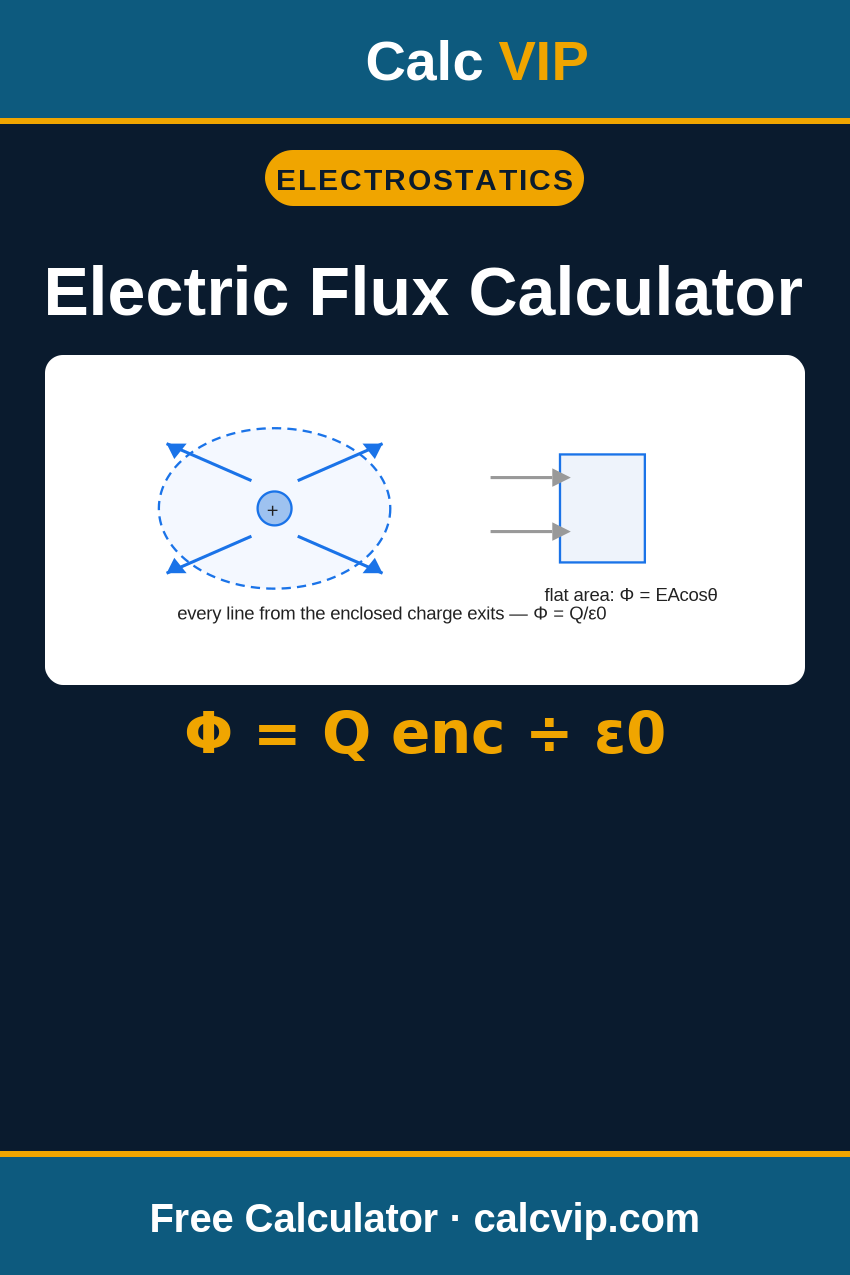
The law's indifference to shape is what makes it a calculating engine rather than a curiosity. Choose a surface clever enough — a sphere around a point charge, a cylinder around a line, a pillbox straddling a sheet — and Gauss's law hands you the field itself on a plate, which is how the field formulas on this site's other electrostatics pages are born. This calculator works both ends of the subject: the direct EAcosθ flux through a flat area, and the Gauss's-law flux from an enclosed charge.
Formula
Gauss's law: Φ = Qenc ÷ ε0 • Φ in N·m²/C, Q in coulombs (C), ε0 = 8.854 × 10⁻¹² C²/(N·m²)
Flat area in a uniform field: Φ = E × A × cos θ • E in N/C, A in m², θ the angle between the field and the perpendicular (the normal) to the surface
The two formulas are one idea at two scales: the EAcosθ rule applied patch by patch and summed over a closed surface is Gauss's law. Rearrangements: Qenc = Φ × ε0 (read the charge inside from a measured flux), E = Φ ÷ (A cos θ), and A = Φ ÷ (E cos θ). The sign convention matters: flux out of a closed surface is positive, so a negative enclosed charge gives negative flux — field lines flowing net inwards. For a flat area, θ is measured from the normal, not from the surface itself; θ = 0° is face-on (maximum flux) and θ = 90° is edge-on (zero flux). Confusing those two angle conventions is the single most common error in flux problems.
| Symbol | Meaning | Units |
|---|---|---|
| Φ | electric flux — field passing through a surface | N·m²/C |
| Qenc | net charge enclosed by a closed surface | coulombs (C) |
| ε0 | permittivity of free space, 8.854 × 10⁻¹² | C²/(N·m²) |
| E, A, θ | field strength, area, angle from the normal | N/C, m², degrees |
Why shape cannot matter: the field-line argument
Picture the field lines of the enclosed charge radiating outward like spokes. Any closed surface around the charge — sphere, cube, crumpled bag — must be pierced by every spoke exactly once on its way to infinity. Stretch the surface and the same spokes pierce it farther out, where they are more spread out: the field is weaker there (1/r²), but the surface is proportionally larger and more oblique, and the two effects cancel exactly, because flux is precisely the quantity built to make them cancel. Charges outside the surface send lines that enter and leave in pairs, contributing nothing net. What survives is only the enclosed charge's budget — hence Φ = Qenc/ε0, with ε0 setting the exchange rate between charge and line-count.
This is also why Gauss's law is secretly a statement about the inverse-square law. Only for a force falling exactly as 1/r² does the "spreading" of field lines over growing spheres keep the flux constant; measure flux carefully enough and you have measured the exponent of Coulomb's law. Experiments doing exactly this confirm the exponent is 2 to extraordinary precision — a null result (no flux through a shell around external charge) that ranks among the most accurate in physics.
One more consequence deserves emphasis, because it overturns a natural guess: the flux through a surface does not depend on what the surface is made of, or whether it exists at all. The surface is imaginary — a mathematical net thrown over the field. Double the charge and the flux doubles; move the same charge outside the net and its contribution vanishes, even if it sits a hair's breadth from the boundary. This all-or-nothing bookkeeping at an imaginary border is what makes the law so powerful for conductors: the surface can be drawn exactly at a metal skin, where the field's behaviour is known, and the enclosed charge read off like a meter reading.
How to use
- Pick Gauss's law mode if you know the charge inside a closed surface — the shape and size of the surface do not matter, and neither does the charge's position inside it.
- Pick the E·A·cosθ mode for a flat area in a steady field, and enter the angle in degrees, measured from the perpendicular to the area (0° means the field goes straight through it).
- Enter the values — scientific notation like 8.854e-9 works fine, and a negative enclosed charge is allowed and meaningful.
- Click "Calculate" to get the flux in N·m²/C.
- Interpret the sign: positive flux means net flow outwards (net positive charge enclosed); negative means net inflow (net negative charge); zero means the books balance.
Worked examples
Example 1 — Gauss's law, the clean thousand. A closed surface encloses a charge of 8.854 × 10⁻⁹ C.
Φ = Q ÷ ε0 = 8.854 × 10⁻⁹ ÷ 8.854 × 10⁻¹² = 1000 N·m²/C — the same whatever the surface looks like.
In the second mode: a field of 500 N/C through 0.02 m² at θ = 60° gives Φ = 500 × 0.02 × cos 60° = 500 × 0.02 × 0.5 = 5 N·m²/C.
Example 2 — a microcoulomb's budget. Enclose Q = 1 × 10⁻⁶ C: Φ = 10⁻⁶ ÷ 8.854 × 10⁻¹² = 112,943 N·m²/C. Whether the surface is a 1 cm marble or a warehouse, over a hundred thousand units of flux stream out of it — flux measures the charge, not the container.
Example 3 — face-on. A uniform field of 1,000 N/C meets a 0.05 m² panel squarely (θ = 0°): Φ = 1,000 × 0.05 × cos 0° = 1,000 × 0.05 × 1 = 50 N·m²/C — the maximum that field and area can produce.
Example 4 — negative charge, negative flux. Enclose −8.854 × 10⁻⁹ C: Φ = −1,000 N·m²/C. The minus sign reports direction: field lines converge on negative charge, so the net flow through the surface is inwards. Flux keeps the sign of the charge it counts.
Example 5 — the invisible dipole. Enclose both a +5 nC charge and a −5 nC charge: Qenc = 0, so Φ = 0. Locally the fields are fierce — lines pour from one charge to the other — but a closed surface around both sees every line that leaves also return. Gauss's law counts net charge only, and is blind to the drama inside.
Example 6 — a tilted panel. A 0.1 m² solar-panel-sized plate sits in a 2,000 N/C field at θ = 30° from the normal: Φ = 2,000 × 0.1 × cos 30° = 2,000 × 0.1 × 0.866 = 173.2 N·m²/C. Tilt it to 60° and the flux falls to 100; to 90°, zero — the cosine is the price of turning away.
Electric flux in real life
Finding fields with Gauss's law. The formulas E = kQ/r² (sphere), E = λ/(2πε0r) (line) and E = σ/(2ε0) (sheet) are all derived by choosing a Gaussian surface and dividing the flux by its area — this page's law is the factory where the other pages' field formulas are made.
Faraday cages. A closed conducting shell has no enclosed charge in its cavity wall's inner surface, so the flux — and hence the field — inside an empty cavity is zero. Cars, aircraft and screened rooms are Gauss's law with upholstery.
Atmospheric electricity. Field mills measure the flux of the Earth's fair-weather field (about 100–150 N/C downward) through known areas; balloon and rocket soundings integrate flux over shells to profile the charge stored in thunderclouds.
Electrostatic shielding in electronics. Sensitive amplifiers live in metal enclosures because any external charge's lines terminate on the box's outer surface; the enclosed net charge stays zero and the interior stays quiet.
Particle and radiation detectors. Ionisation chambers infer deposited charge from field changes across their volume — flux bookkeeping, run continuously, is how radiation dose is measured.
Lightning protection design. The "rolling sphere" method for placing lightning rods is applied Gauss thinking: it maps where field lines from a descending leader will terminate, and puts metal there first.
Semiconductor device physics. Inside transistors, engineers solve Gauss's law in its local form — the field's divergence equals ρ/ε0 — to find how fields thread the doped regions. Every chip ever made was designed by running this page's law, point by point, billions of times.
Gauss's law as a field-finding machine
Here is the machine at work once, in full. Take a point charge Q and draw a sphere of radius r around it. The field at the sphere is radial and, by symmetry, has the same strength E everywhere on it, so the flux is simply E × 4πr². Gauss's law says this equals Q/ε0, so E = Q ÷ (4πε0r²) = kQ/r² — Coulomb's field, recovered in three lines (with the numbers of Example 2 at r = 0.5 m: E = 112,943 ÷ (4π × 0.25) ≈ 3.6 × 10⁴ N/C, matching kQ/r²). The trick only works when symmetry lets E step outside the sum — spheres, infinite lines, infinite sheets — which is why those three shapes own electrostatics. For lopsided charge arrangements Gauss's law remains true but stops being a shortcut; the flux is still Q/ε0, it just no longer tells you E point by point.
The pillbox in the diagram runs the same play for a charged sheet: a small cylinder straddling the surface catches flux only through its two end caps, and dividing Q/ε0 by the caps' combined area yields E = σ/(2ε0) — the distance-independent field of the Charge Density page. Three shapes, one law, and the whole of electrostatics' field catalogue falls out. When you use those formulas elsewhere on this site, you are spending what Gauss's law earned here.
Quick reference: flux and tilt
| Enclosed charge | Flux Φ = Q/ε0 |
|---|---|
| 1 nC (10⁻⁹ C) | 112.9 N·m²/C |
| 8.854 nC | 1,000 N·m²/C |
| 1 µC (10⁻⁶ C) | 112,943 N·m²/C |
| 1 C | 1.13 × 10¹¹ N·m²/C |
| Tilt θ from normal | cos θ — fraction of maximum flux |
|---|---|
| 0° | 1.000 — full flux |
| 30° | 0.866 |
| 45° | 0.707 |
| 60° | 0.500 |
| 90° | 0 — edge-on, nothing passes |
The two tables are the calculator in miniature: the first converts any charge into its flux budget at the fixed exchange rate 1/ε0, and the second prices the tilt of any flat area. Between them they cover both modes — pick the row that matches your problem and you have a check on the calculator's answer before you click.
Common mistakes
- Measuring θ from the surface instead of the normal. The cosine uses the angle between the field and the perpendicular. A field skimming 10° above a surface is at 80° from its normal — nearly zero flux, not nearly maximum.
- Counting charges outside the surface. Gauss's law ignores them entirely, however close they sit. Only the net enclosed charge sets the total flux.
- Expecting zero flux to mean zero field. Example 5's dipole has zero total flux and strong fields everywhere inside the surface. Flux is a net count, not a local strength.
- Using EAcosθ on a curved or closed surface directly. That formula is for one flat patch in a uniform field. Curved surfaces must be summed patch by patch — which is exactly what Gauss's law does for you in closed cases.
- Dropping the sign of the enclosed charge. Negative charge gives negative flux (net inflow). Losing the minus sign turns a sink into a source.
FAQ
FAQ
What is electric flux, in plain words?
It is a measure of how much electric field "flows" through a surface. Picture field lines: flux counts how many lines pass through the area, allowing for the area's size and tilt.
Why doesn't the shape of the closed surface matter in Gauss's law?
Every field line from the enclosed charge must cross the surface exactly once on its way out, however lumpy the surface is. Charges outside contribute lines that enter and leave again, adding nothing.
When is the flux zero?
When no net charge is enclosed, or when a flat area is edge-on to the field (θ = 90°, so cos θ = 0) — the field skims along the surface instead of passing through it.
What are the units N·m²/C in plain terms?
Field strength (N/C) times area (m²). Flux is "field × area, corrected for tilt", so its unit is the product of the two — a measure of total field throughput rather than strength at a point.
Does the charge's position inside the surface matter?
Not for the total flux — centre or corner, Φ = Q/ε0. Position changes how the flux is distributed over the surface (strong near the charge, weak far away), never the total.
What is a Gaussian surface — is it a real object?
No, it is an imaginary surface you choose for the calculation. Nature does not contain it; the flux through it is nonetheless real, and choosing it cleverly (with symmetry) is the art of using Gauss's law.
Can flux be negative for a flat area?
Yes: tilt past 90° (θ between 90° and 180°) and cos θ goes negative — the field passes through the back of the area rather than the front. The sign records which face the field entered by.
How is flux related to field lines?
Proportionally, by the drawing convention: if you draw field lines so that their density (lines per square metre) equals E numerically, then the number of lines through a surface is the flux. Gauss's law then says each coulomb is the source of a fixed number of lines.
Does Gauss's law work inside materials?
Yes, with care: in a dielectric the flux of E counts only the free charge, with ε0 replaced by the material's permittivity for the bound-charge effects. The vacuum form on this page is the foundation either way.
Why is ε0 in the denominator — shouldn't more charge mean more flux?
It does: Φ grows in direct proportion to Q. ε0 is small (8.854 × 10⁻¹²), so dividing by it makes the flux per coulomb huge — 1.13 × 10¹¹ N·m²/C per coulomb. ε0 measures how weak the electric field of a given charge is in vacuum; a smaller ε0 would mean stronger fields and more flux per coulomb. In the modern SI, ε0 is a measured constant whose value ties the coulomb to the newton and the metre.