 Calc
Electric Force in a Field Calculator – F = qE Solve for Force, Charge or Field
 Created by Thomas Becker · Physics Writer · Electricity & Magnetism · Last updated: November 2026
Use this free Electric Force in a Field Calculator to solve F = qE in any direction: find the force on a charge in an electric field, the charge from a measured force and field, or the field strength from a force and a known charge. This is the defining equation of electric field strength. Scientific notation works for charges — for example 2e-6.
If the electric field is a promise — "place a charge here and it will be pushed" — then F = qE is the promise kept. It is less a formula to derive than the definition of field strength itself: E is whatever number makes qE give the force. That is why the relation runs so cleanly in all three directions. Know any two of force, charge and field, and the third is a single multiplication or division away — and this solver's three modes are exactly those three arrangements.
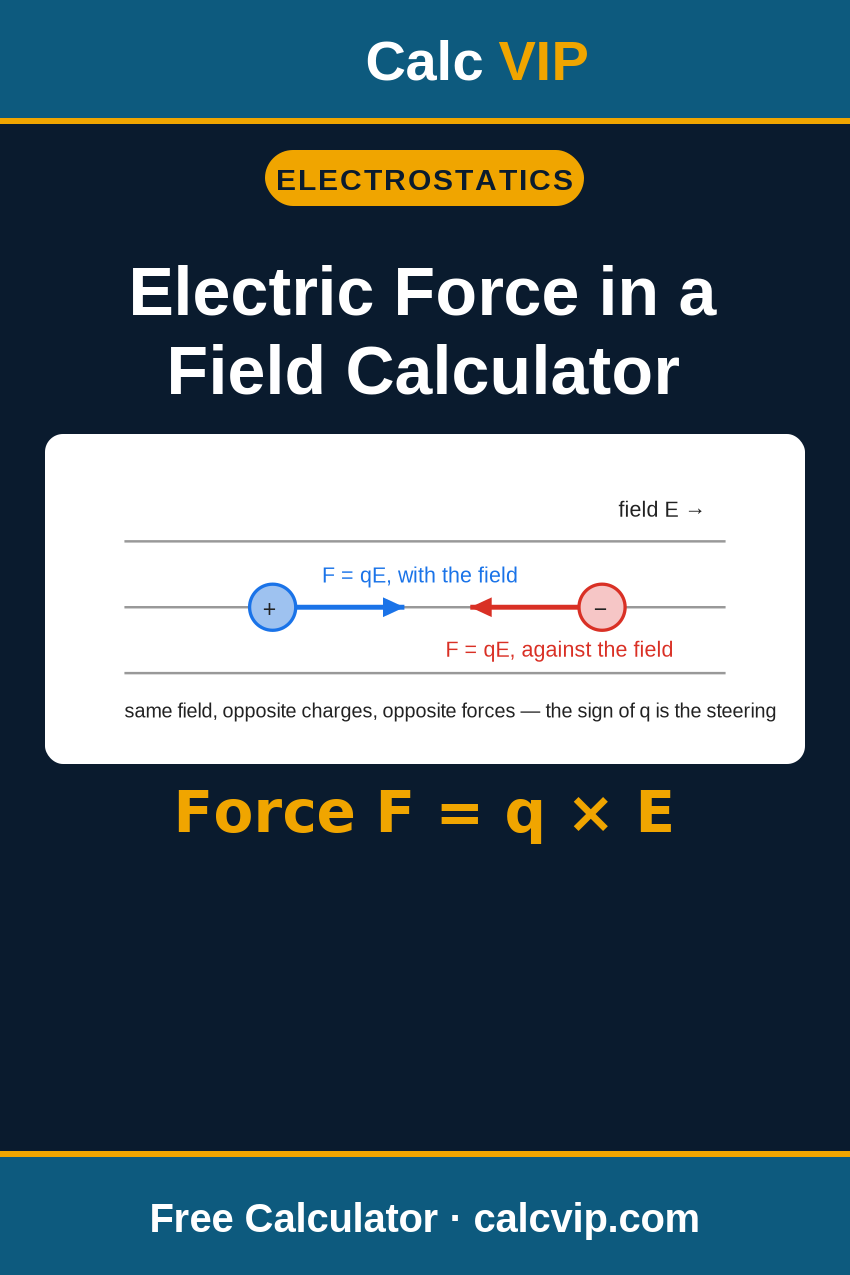
The scale of the answers deserves a moment. On human-sized charges the forces are gentle: the reference example below puts 0.006 N on two microcoulombs in a 3,000 N/C field, about the weight of a 0.6 g mass. But divide that force by a particle's mass and the picture explodes — the same equation, applied to an electron, yields accelerations of 10¹⁴ m/s². F = qE is simultaneously a bench-top triviality and the engine of every cathode-ray tube, mass spectrometer and particle accelerator ever built. The charge's sign is the only subtlety: positive charges are pushed along the field, negative charges against it, and the solver reports that direction for you in the force mode.
One more discipline matters: the E in this formula is the field at the charge's location due to everything else. A charge does not push itself. Whether the field comes from plates, point charges or a charged cloud, F = qE does not care — which is what makes it the natural partner of the field calculators on this site: compute the field by whatever geometry applies, then let qE turn it into a force.
Formula
Force F = q × E • Charge q = F ÷ E • Field E = F ÷ q • F in newtons (N), q in coulombs (C), E in newtons per coulomb (N/C)
Because E is defined by this relation, the rearrangements are not approximations but identities — if you measure the force on a known charge, you have measured the field, which is precisely how field probes are calibrated. Two consequences are worth internalising. First, the force is proportional to both factors: double the field or double the charge and the force doubles, with no squares or roots anywhere — this is the simplest scaling law in electrostatics. Second, the sign of q carries the direction: F and E are parallel for positive q, antiparallel for negative q. The solver's strength figures are magnitudes; its direction note in force mode is the sign, spelled out.
| Symbol | Meaning | Units |
|---|---|---|
| F | force on the charge | newtons (N) |
| q | the charge placed in the field (sign matters) | coulombs (C) |
| E | field strength at the charge's position, due to other charges | N/C (= V/m) |
The test charge: how fields are actually measured
Every field value in physics ultimately comes from this formula run in reverse. The procedure is conceptually simple: place a small known charge at the point of interest, measure the force on it, divide. The charge must be small — a "test charge" — so that its own presence does not shove the source charges around and change the field being measured. Real instruments honour the idea in different costumes: a field mill infers E from the charge induced on a spinning vane, an electrostatic force probe balances qE against a spring, and in Millikan's oil-drop experiment the "spring" was gravity itself, with qE tuned until a droplet hung motionless and the balance F = qE = mg read out the droplet's charge.
Notice what the definition quietly achieves: it separates the world into sources (which make fields) and test objects (which feel them), and lets us map the field once, then predict the force on anything. A field map of a room, a capacitor or a thundercloud is a reusable asset — measure E at each point once, and F = qE answers for an electron, a dust grain or a charged aircraft without further experiment. That separation is the entire reason the field concept exists.
How to use
- Choose the mode: find the force F, the charge q, or the field E.
- Enter the two known values — charges in coulombs, using scientific notation like 2e-6 for microcoulombs.
- In force mode, enter a negative charge if yours is negative; the result will state that the force points opposite to the field.
- Click "Calculate" and read the answer. In "find E" mode you have effectively calibrated the field from a force measurement — the test-charge procedure in calculator form.
- Remember the E you enter must be the field from other charges at that point. If you computed it with the point-charge or plates calculators, you are using the toolkit exactly as intended.
Worked examples
Example 1 — the reference force. q = 2 × 10⁻⁶ C in a field E = 3,000 N/C.
F = qE = 2 × 10⁻⁶ × 3,000 = 0.006 N, in the field's direction. The reverse modes close the loop: F = 0.006 N at E = 3,000 gives q = 2 × 10⁻⁶ C, and F = 0.006 N on q = 2 × 10⁻⁶ C gives E = 3,000 N/C.
Example 2 — the force on an electron. An electron sits in a field of 1 × 10⁵ N/C (thunderstorm strength).
F = 1.602 × 10⁻¹⁹ × 1 × 10⁵ = 1.602 × 10⁻¹⁴ N, directed against the field. Trivial as a force — but on a mass of 9.11 × 10⁻³¹ kg it is an acceleration of 1.76 × 10¹⁶ m/s², which is why electrons are so easy to steer.
Example 3 — finding a charge from a force. A test body experiences F = 0.01 N in a calibrated field of 2,000 N/C. Its charge is q = F ÷ E = 0.01 ÷ 2,000 = 5 × 10⁻⁶ C. This is the working method of charge measurement on everything from droplets to dust grains: known field, measured force, charge revealed.
Example 4 — finding a field from a force. A known charge q = 1.5 × 10⁻⁶ C feels F = 3 × 10⁻⁴ N. The field at that spot is E = F ÷ q = 3 × 10⁻⁴ ÷ 1.5 × 10⁻⁶ = 200 N/C — about twice the fair-weather atmospheric field, a plausible reading near charged equipment.
Example 5 — Millikan's droplet. An oil drop of mass 1 × 10⁻¹⁴ kg (weight mg = 9.81 × 10⁻¹⁴ N) carries five electrons' charge, q = 5 × 1.602 × 10⁻¹⁹ C. The field that suspends it satisfies qE = mg, so E = 9.81 × 10⁻¹⁴ ÷ 8.01 × 10⁻¹⁹ = 1.22 × 10⁵ N/C. Millikan varied E, watched drops hang, and found every charge a whole multiple of e — the experiment this calculator re-enacts in one line.
Example 6 — steering an inkjet droplet. A droplet carrying q = 1 × 10⁻¹³ C crosses deflection plates with E = 1.5 × 10⁶ N/C.
F = 1 × 10⁻¹³ × 1.5 × 10⁶ = 1.5 × 10⁻⁷ N. On a droplet mass of 1 × 10⁻¹² kg that is a = F/m = 1.5 × 10⁵ m/s² sideways — enough, in the droplet's brief flight, to choose which pixel row it lands on. Your printer's text is F = qE, typeset.
Force in a field, in real life
Inkjet and electrostatic printing. Beyond Example 6, the same physics places toner in laser printers: charged toner particles are pulled by patterned fields on the drum and paper, force by force, qE by qE.
Electrostatic precipitators. Ash particles charged in a corona drift to collector plates under qE forces that must beat the gas drag. The force calculation sets the field the plant must maintain — too little and ash escapes, too much and the air sparks.
Cathode-ray tubes and oscilloscopes. The electron beam of a CRT is drawn across the screen by plate fields; the deflection is F = qE integrated over the flight. Every analogue oscilloscope trace ever drawn is this formula made visible.
Mass spectrometers. Ions are sorted by how fields push them: force, hence acceleration, depends on q while inertia depends on m, so the trajectory encodes the charge-to-mass ratio. The instrument is F = qE plus bookkeeping.
Electrostatic spray painting and crop spraying. Charged droplets are pulled onto earthed targets — car bodies, leaves — including around the back faces, because the field lines themselves curve to the target. The force on each droplet is this calculator's, repeated a billion times per second.
Air ionisers and electrostatic filters. Charged dust and pollen are drawn out of the air onto plates. The forces are piconewtons, but the particles are micrograms — F = qE on small masses moves them decisively, which is the recurring bargain of this whole subject.
From force to motion: the bridge to acceleration
A force is only half a prediction — divide by mass and it becomes a motion. This is why F = qE and the acceleration formula a = qE/m are really one calculator viewed from two ends, and why the same numbers keep reappearing in both. Take a charged dust grain, q = 1 × 10⁻¹² C, in a precipitator field of 5,000 N/C: the force is F = 5 × 10⁻⁹ N, five nanonewtons, beneath any balance's notice. But the grain's mass is about 1 × 10⁻¹² kg, so the acceleration is 5 × 10⁻⁹ ÷ 1 × 10⁻¹² = 5,000 m/s² — five hundred gravities, quite enough to sweep it onto a collector plate in a fraction of a second. Whenever a problem gives you a field and asks about movement, the route is always this page then that one: qE for the push, ÷m for the response. The two calculators are chained in the toolkit for exactly that reason, and most of applied electrostatics — printing, precipitating, beam steering, ion propulsion — is that chain, run over and over at different scales.
Why gravity loses: the proton-weight comparison
Students often ask whether gravity belongs in these calculations. For particles, almost never — and the numbers show why. A proton weighs mg = 1.673 × 10⁻²⁷ × 9.81 = 1.64 × 10⁻²⁶ N. The field needed merely to levitate it is E = mg/e = 1.02 × 10⁻⁷ N/C — a ten-millionth of the field a battery makes across a centimetre. Any laboratory field overwhelms gravity for electrons and ions by ten or more orders of magnitude, so beam physics ignores weight entirely. Gravity returns to the story only for macroscopic charged objects — Millikan's droplets, dust, droplets in printers — whose charge-to-mass ratios are tiny. The dividing line is exactly q/m, and F = qE versus F = mg is the comparison that locates it.
Quick reference: forces on two standard charges
| Field E | Force on 1 µC | Force on one electron |
|---|---|---|
| 100 N/C | 1 × 10⁻⁴ N | 1.602 × 10⁻¹⁷ N |
| 1,000 N/C | 1 × 10⁻³ N | 1.602 × 10⁻¹⁶ N |
| 10,000 N/C | 0.01 N | 1.602 × 10⁻¹⁵ N |
| 100,000 N/C | 0.1 N | 1.602 × 10⁻¹⁴ N |
| 1,000,000 N/C | 1 N | 1.602 × 10⁻¹³ N |
Strict proportionality everywhere: read across for the field's effect, read down for its scaling. A whole newton on a microcoulomb needs a million N/C — macroscopic forces demand either big charges or breakdown-level fields.
Common mistakes
- Feeding the charge its own field. E must come from other charges. Putting a point charge's own kQ/r² (at its own location!) into F = qE is meaningless — a charge exerts no force on itself, and its self-field at its centre is not even defined.
- Dropping the sign and losing the direction. For electrons and negative ions the force is opposite to E. Half of beam-steering intuition is this sign; the calculator states it, but sketches should too.
- Confusing F = qE with Coulomb's law. Coulomb's law, F = kq₁q₂/r², is the special case where the field comes from one point charge. F = qE is the general statement — use it whenever the field is already known, from any source.
- Prefix slips on q. 2 µC is 2e-6. Entered as 2, the force inflates a millionfold. If the answer could lift a truck, check the exponent first.
- Expecting the force to depend on velocity. The electric force does not care how fast the charge moves — unlike the magnetic force, which is proportional to velocity and perpendicular to it. A stationary charge in an electric field feels the full qE; that is the whole point of the definition.
FAQ
What is the unit of electric field strength?
Newtons per coulomb (N/C) — the force each coulomb of charge would feel. It is the same thing as volts per metre (V/m).
Does the field push on the charge that made it?
No. F = qE uses the field made by other charges. A charge does not exert a force on itself.
How big is 0.006 N in everyday terms?
About the weight of a small paperclip's worth of mass (roughly 0.6 g under gravity) — small, but on a tiny charged particle it can produce a huge acceleration because the mass is so small too.
Does a neutral object feel a force in a field?
In a uniform field, essentially no net force — its positive and negative charges are pulled equally opposite ways. In a non-uniform field the pulls differ slightly and a small net force appears (dielectrophoresis), which is how neutral dust and cells can still be herded by shaped fields.
What force does the Earth's field put on me?
Your body is a conductor and nearly neutral overall, so the net force is negligible — surface charges rearrange until the interior field vanishes. A hypothetical free 1 C charge in the 100 N/C fair-weather field would feel 100 N, which is one more reason macroscopic coulombs do not occur.
Why don't I feel electric fields the way I feel pushes?
Because the charges inside your body are bound in atoms and locked in a conducting fluid that cancels internal fields. The forces exist — on electrons and ions individually — but they cancel internally and never sum to a bodily shove at ordinary field strengths.
Is F = qE exact for big charges too?
The formula is exact; the difficulty is knowing E. A large test charge redistributes the source charges (especially on conductors), so the field it experiences is not the field that was there before it arrived. Small test charges are not a pedantic preference — they keep the measurement honest.
How is this different from the force between two charges?
It isn't, underneath: the force between charges q and Q is q times Q's field, kQ/r². Coulomb's law is F = qE with the field written out. Learning to see the two-step version — source makes field, field pushes charge — is what unlocks multi-charge and continuous problems.
Can the force be zero in a strong field?
Only if q = 0 or the charge sits where contributions cancel to zero net field — at a zero point of the kind the field-at-a-point calculator finds. The strength of nearby fields is irrelevant if their vector sum at the charge's position is zero.
What is the strongest force this formula ever produces?
Inside atoms: the proton's field at the hydrogen electron's orbit is about 5.13 × 10¹¹ N/C, so the force on the electron is roughly 8.2 × 10⁻⁸ N — small in newtons, but on an electron's mass it sustains the centripetal acceleration of the entire Bohr orbit. Scale is relative; qE rules at every one of them.