 Calc
Kinetic Energy Solver – Find Mass or Velocity from KE = ½mv²
 Created by Priya Sharma · Physics Editor · Energy & Gravity · Last updated: November 2026
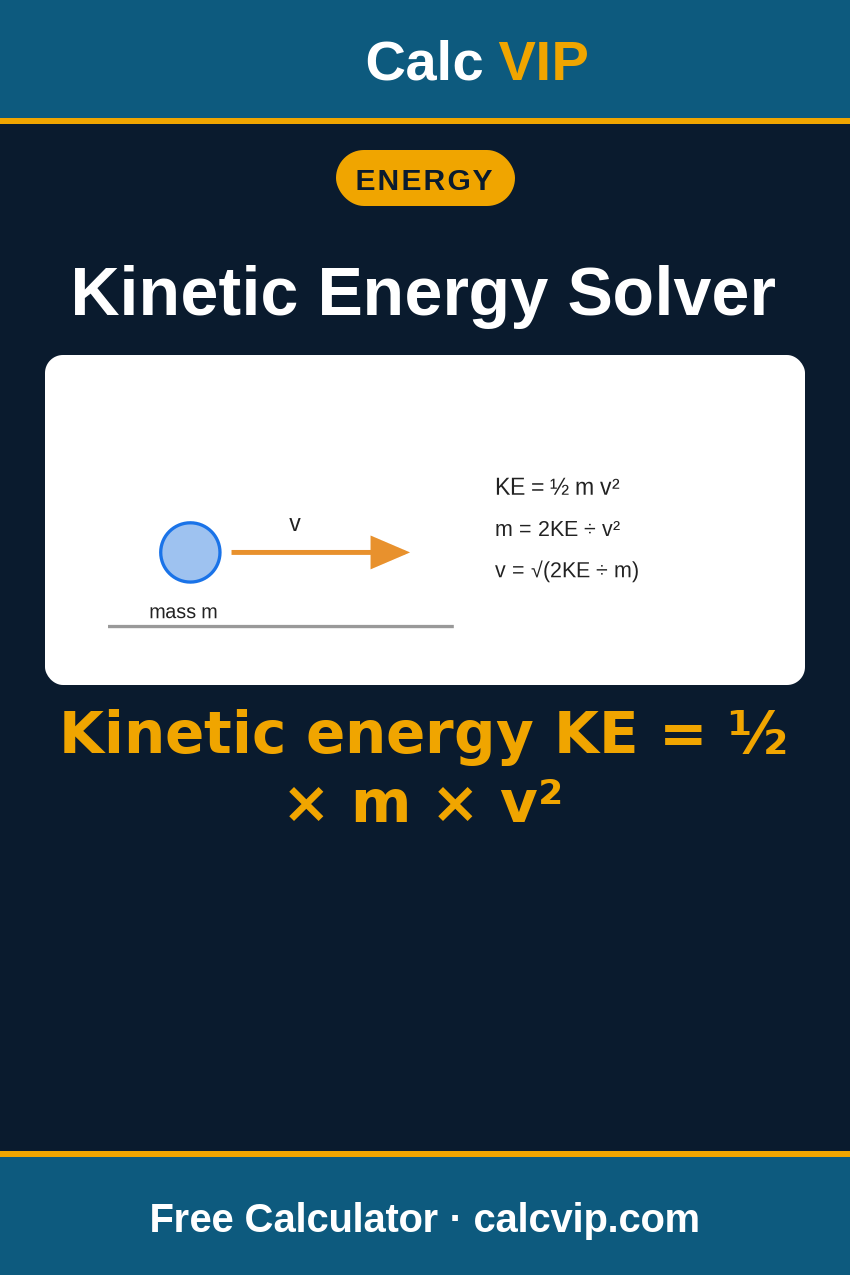
Use this free Kinetic Energy Solver Calculator when you already know the kinetic energy and need the missing mass or speed. Rearranging KE = ½mv² gives m = 2KE ÷ v² and v = √(2KE ÷ m) — just pick a mode and enter the two values you know.
Most kinetic energy problems run forwards: given a mass and a speed, find the energy. Real investigations often run backwards. A crash analyst measures the energy absorbed by a crumpled barrier and wants the car's speed. A sports scientist knows the energy a hammer thrower delivered and wants the release velocity. A ballistics report gives the muzzle energy and the bullet's mass, and the speed is the unknown. In each case the energy is the measured quantity and the mass or the speed is the mystery — exactly the direction this solver works, using the two rearrangements of KE = ½mv².
The rearrangements look simple, but the square on the velocity makes them behave differently from most school formulas. Finding the mass is a plain division: m = 2KE ÷ v². Finding the velocity needs a square root, v = √(2KE ÷ m), because the operation that built v² must be undone. That square is also the physical heart of the subject: kinetic energy grows with the square of speed, so doubling the speed quadruples the energy, and recovering a speed from an energy always involves the gentler mathematics of roots rather than proportions.
Units, as ever, police the calculation. Kinetic energy in joules, mass in kilograms, velocity in metres per second — enter those and the answers come out in kilograms and metres per second. Speeds quoted in kilometres per hour must be divided by 3.6 first. The solver also quietly enforces physics: a stationary object has no kinetic energy to solve from, so a zero velocity in mass mode is rejected — there is no mass whose zero-speed motion carries 50 J.
Formula
Kinetic energy KE = ½ × m × v² • KE in joules (J), m in kilograms (kg), v in metres per second (m/s)
The solver uses the two rearrangements: m = 2 × KE ÷ v² to recover the mass from the energy and speed, and v = √(2 × KE ÷ m) to recover the speed from the energy and mass. Both come from the same algebra: double both sides of KE = ½mv² to get 2KE = mv², then divide by whichever of m or v² you know — taking the square root when v is the unknown, because v was squared. Note the asymmetry this creates: mass is directly proportional to energy (double the KE at fixed speed, double the mass), while speed grows only with the square root of energy (double the KE at fixed mass, and the speed rises by a factor of √2 ≈ 1.41, not 2). The calculator reports mass in kilograms and velocity in metres per second, rounded to two decimal places.
| Symbol | Meaning | Units |
|---|---|---|
| KE | kinetic energy — energy of motion | joules (J) |
| m | mass of the moving object | kilograms (kg) |
| v | velocity (speed) of the object | metres per second (m/s) |
The square law: why speed dominates everything
Ask which matters more to kinetic energy, mass or speed, and the equation answers brutally: speed, squared. Double the mass and the energy doubles. Double the speed and the energy quadruples. Triple the speed and the energy grows ninefold. This is not a mathematical curiosity — it is the reason road safety campaigns obsess over modest speed reductions, why a fast light object can out-damage a slow heavy one, and why the velocity mode of this solver needs its square root: recovering a speed from an energy means compressing the energy's big square-law swings back into modest speed changes. An energy measurement that is out by a factor of four corresponds to a speed that is out by only a factor of two.
There is a second consequence worth internalising: at fixed kinetic energy, mass and speed trade against each other along a curve, not a line. Halve the mass and the object does not go twice as fast on the same energy — it goes √2 ≈ 1.41 times as fast. Quarter the mass and the speed only doubles. This is why lightening a vehicle yields disappointing top-speed gains for the energy invested, and why the very fastest projectiles — railgun slugs, meteoroids — pair modest masses with absurd velocities rather than the other way round. When you experiment with this solver, watch the trade-off happen: feed in a fixed energy, walk the mass down by factors of four, and the speed climbs by steady factors of two.
The square law also explains the strange economy of projectiles. A 10 g bullet at 400 m/s carries 800 J — as much as a 100 kg person sprinting would if they could reach 4 m/s many times over — because its speed is enormous even though its mass is trivial. Conversely, the kinetic energy of slow massive things stays surprisingly small: a walking person carries under 100 J. When you solve backwards with this calculator, keep the square law in mind as a sanity check: if the energy is large and the mass is small, expect a startling speed; if the speed is modest and the energy huge, expect a startling mass.
How to use
- Choose what you want to find from the dropdown: mass or velocity. The input row you need appears automatically.
- Enter the kinetic energy in joules, then the value you know — velocity in metres per second (divide km/h by 3.6) for mass mode, or mass in kilograms for velocity mode.
- Click "Solve" to get the missing quantity.
- Check the answer against the square law: at a given energy, a faster object must be lighter, and a heavier object must be slower. If your result breaks that trade-off, an input is probably in the wrong unit.
Worked examples
Example 1 — the manifest check, both directions. An object has kinetic energy 50 J and moves at 5 m/s.
m = 2KE ÷ v² = 100 ÷ 25 = 4 kg. Reverse it: v = √(2KE ÷ m) = √(100 ÷ 4) = √25 = 5 m/s. The two modes are exact inverses — feed either answer back and you recover the starting value.
Example 2 — weighing a moving load from its energy. A conveyor sensor reports a package's kinetic energy as 12,500 J at 25 m/s.
m = 2 × 12,500 ÷ 625 = 40 kg. Heavy luggage indeed — the energy figure alone, paired with the speed, has effectively weighed it without a scale.
Example 3 — a bullet's speed from its energy. A projectile of mass 0.05 kg (50 g) carries 800 J.
v = √(2 × 800 ÷ 0.05) = √32,000 = 178.89 m/s — about 644 km/h. Small masses with hundreds of joules always turn out to be moving at startling speeds; that is the square law speaking.
Example 4 — a falling toolbox. Just before impact, a dropped toolbox has 2,000 J of kinetic energy and is falling at 20 m/s.
m = 2 × 2,000 ÷ 400 = 10 kg. (Its energy came from gravitational potential energy, mgh — a neat cross-check: 10 kg × 9.81 × about 20.4 m ≈ 2,000 J.)
Example 5 — a light, fast ball. A ball of mass 0.01 kg (10 g) is measured carrying 4.5 J.
v = √(2 × 4.5 ÷ 0.01) = √900 = 30 m/s — 108 km/h, a serious throw for so light a ball, and a clean illustration of how little energy a light object needs to be moving fast.
Example 6 — a playground swing. A child-plus-swing system of 5 kg equivalent moving mass carries 90 J at the bottom of the arc.
v = √(2 × 90 ÷ 5) = √36 = 6 m/s — brisk but plausible, and a reminder that everyday energies of tens of joules pair with everyday speeds of a few metres per second.
Kinetic energy in real life
Crash investigation. Deformation of barriers and vehicles absorbs kinetic energy; measuring the absorbed energy and the vehicle's mass lets investigators run this solver backwards to estimate impact speed — one of the most common real uses of the velocity mode.
Ballistics and safety ratings. Ammunition is specified by muzzle energy in joules. Given the bullet's mass, the velocity mode recovers the muzzle velocity; given the velocity, the mass mode checks the projectile's weight.
Sports science. The energy delivered to a hammer, javelin or shot is measured or estimated, and the release speed follows from the implement's known mass — coaching feedback straight from v = √(2KE/m).
Wind and hydro power. Moving air and water carry kinetic energy; the energy flux through a turbine is a kinetic-energy calculation, and solving backwards gives the flow speed needed for a target power.
Asteroid risk assessment. Impact energy estimates (often quoted in megatons) combined with an asteroid's speed give its mass — and hence its size and the scale of the threat — through the mass mode of this very equation.
Regenerative braking. An electric car recovers part of its kinetic energy when slowing. Knowing the car's mass and speed change tells engineers the energy on offer; the solver's forward twin sizes the battery's intake.
Why the ½? A short, honest answer
Students often accept the ½ in ½mv² as a arbitrary tax. It comes from calculus — or, without calculus, from averaging. An object accelerating uniformly from rest to speed v has an average speed of v/2 over the journey; the work done on it is force × distance, and working that through gives energy = m × (v/2) × v = ½mv². The half is the fingerprint of "starting from rest": the object spent the early part of its acceleration moving slowly, so it collected less energy per second then. This is also why the solver's mass formula carries a 2 in the numerator — the ½, inverted. If you ever forget whether the 2 belongs in m = 2KE/v², rebuild it from KE = ½mv² in two lines: double both sides, then divide by v².
Kinetic energy is frame-dependent
A related pair worth keeping apart is kinetic energy and momentum. Momentum, p = mv, grows only linearly with speed and carries direction; kinetic energy grows with the square and does not. Collisions conserve momentum always, but kinetic energy only in perfectly elastic collisions — in a car crash most of it converts to deformation, sound and heat, which is precisely the conversion crash analysts measure. When a problem gives you an energy, reach for this solver; when it gives you a push or an impulse over time, momentum is the tool. Confusing the two — especially their different speed dependence — is the most common conceptual error in this whole topic.
Here is a subtlety the solver cannot show you but every user should know: kinetic energy depends on who is watching. A passenger sitting in a train has zero kinetic energy relative to the train and hundreds of thousands of joules relative to the platform. The mass and speed you enter are measured in one chosen frame — usually the ground — and the recovered quantity belongs to that same frame. This is not a flaw; collisions and braking are analysed in the ground's frame because that is where the consequences happen. But it explains apparent paradoxes, such as why a fly hitting a windscreen is analysed with the car's speed, and why spacecraft velocities are quoted relative to a specified body — the Sun, the Earth, the target asteroid.
Quick reference: kinetic energies of familiar things
| Object | Mass | Speed | Kinetic energy |
|---|---|---|---|
| walking person | 70 kg | 1.4 m/s | 68.6 J |
| cricket ball, bowled | 0.15 kg | 30 m/s | 67.5 J |
| cyclist | 80 kg | 8 m/s | 2,560 J |
| sprinter | 70 kg | 10 m/s | 3,500 J |
| bullet | 0.01 kg | 400 m/s | 800 J |
| family car | 1,000 kg | 20 m/s | 200,000 J |
| same car, faster | 1,000 kg | 30 m/s | 450,000 J |
The last two rows are the square law in a single glance: a 50% speed increase — 20 to 30 m/s — raises the energy by 125%, from 200,000 J to 450,000 J. Everything a braking system, a crumple zone or a safety barrier must handle scales the same unforgiving way. It is also why speed limits bite hardest exactly where the energies involved are largest and the margins smallest.
Common mistakes
- Forgetting the square root in velocity mode. v = 2KE/m is wrong; v = √(2KE/m). Skipping the root wildly overstates speeds — Example 1 would give 25 m/s instead of the correct 5 m/s.
- Entering speed in km/h. The formula wants metres per second. 72 km/h is 20 m/s; entering "72" makes v² nearly thirteen times too big and the recovered mass thirteen times too small.
- Dropping the factor of 2. The mass is 2KE ÷ v², not KE ÷ v² — the 2 is the inverted ½ from the original formula. Omitting it halves every mass answer.
- Expecting proportional behaviour from speed. Doubling KE does not double v; it multiplies v by √2 ≈ 1.41. Intuition trained on linear formulas misleads here — trust the square law, and sanity-check with it.
- Trying to solve from a stationary object. At v = 0 the kinetic energy is zero whatever the mass, so no mass can be recovered from "0 m/s and some joules". The solver rejects it because the information genuinely is not there.
FAQ
Why do I need a square root to find velocity?
Kinetic energy depends on v², so undoing the square needs a square root: v = √(2KE/m). This is also why speed has such a big effect on kinetic energy.
How much kinetic energy does a car have?
A 1000 kg car travelling at 20 m/s (72 km/h) has KE = ½ × 1000 × 20² = 200,000 J (200 kJ).
Can this solver find the kinetic energy itself?
For that, use a standard kinetic energy calculator: enter the mass and speed into KE = ½mv². This solver is for the reverse problems, when KE is already known.
Where does the ½ in ½mv² come from?
From the acceleration process: an object speeding up uniformly from rest averages half its final speed over the journey, and the work done on it works out to m × (v/2) × v = ½mv². The half is real physics, not a fudge factor.
What happens to the answer if the speed doubles?
In mass mode, the same energy at twice the speed means a quarter of the mass (v² quadruples, so m = 2KE/v² quarters). In velocity mode, reaching twice the speed requires four times the energy at the same mass.
Is kinetic energy a vector or a scalar?
A scalar — it has size but no direction. Two objects moving oppositely each carry positive kinetic energy; their momenta may cancel, but their energies add. That is why the solver needs only the speed, not the direction of travel.
Can kinetic energy be negative?
No. Mass is positive and v² is never negative, so KE is zero (at rest) or positive. If a calculation produces a negative kinetic energy, a sign error has crept in somewhere upstream.
How is kinetic energy measured in practice?
Rarely directly. It is inferred — from speed traps and masses, from the height something fell (mgh becomes KE), from deformation in a crash, or from the heat produced when the motion is stopped. This solver exists precisely because KE is usually the inferred, known quantity.
Does a rotating object have kinetic energy too?
Yes — rotational kinetic energy, ½Iω², where I is the moment of inertia and ω the angular speed. A rolling wheel has both kinds at once. This solver covers the translational part only.
What speed would a 1 kg object need to carry 1 kWh of kinetic energy?
1 kWh is 3,600,000 J, so v = √(2 × 3,600,000 ÷ 1) = √7,200,000 ≈ 2,683 m/s — nearly eight times the speed of sound. A vivid measure of how much energy a humble unit of electricity really is.