 Calc
Mechanical Advantage Calculator – MA & Ideal Effort Solver
 Created by Priya Sharma · Physics Editor · Energy & Gravity · Last updated: November 2026
Use this free Mechanical Advantage Calculator to see how much a machine multiplies your force. Find the mechanical advantage (MA) from the load and effort, or work out the ideal effort needed to lift a load with a machine of known MA.
A machine, in the physicist's sense, is anything that changes a force — and the simplest ones have no engine, no battery and no moving part more complicated than a plank. A crowbar that lets you lift a paving slab with one hand, a pulley that lets a builder hoist a beam alone, a ramp that lets a mover roll a piano into a truck: all of them are doing the same trick, multiplying your effort into a larger force at the load. Mechanical advantage is the score of that trick — the load force divided by the effort force — and this calculator finds it, or turns it around to tell you the effort a given load will need.
The number is a pure multiplier with no units. An MA of 4 means the machine hands back four newtons of load force for every newton you put in: 150 N of push balances a 600 N load. An MA below 1 is not a broken machine but a different bargain — fishing rods and bicycle top gears multiply distance and speed instead of force. Either way, MA is fixed by the machine's geometry: the lengths of the lever arms, the number of rope strands, the teeth on the gears. Measure the geometry and you have predicted the machine.
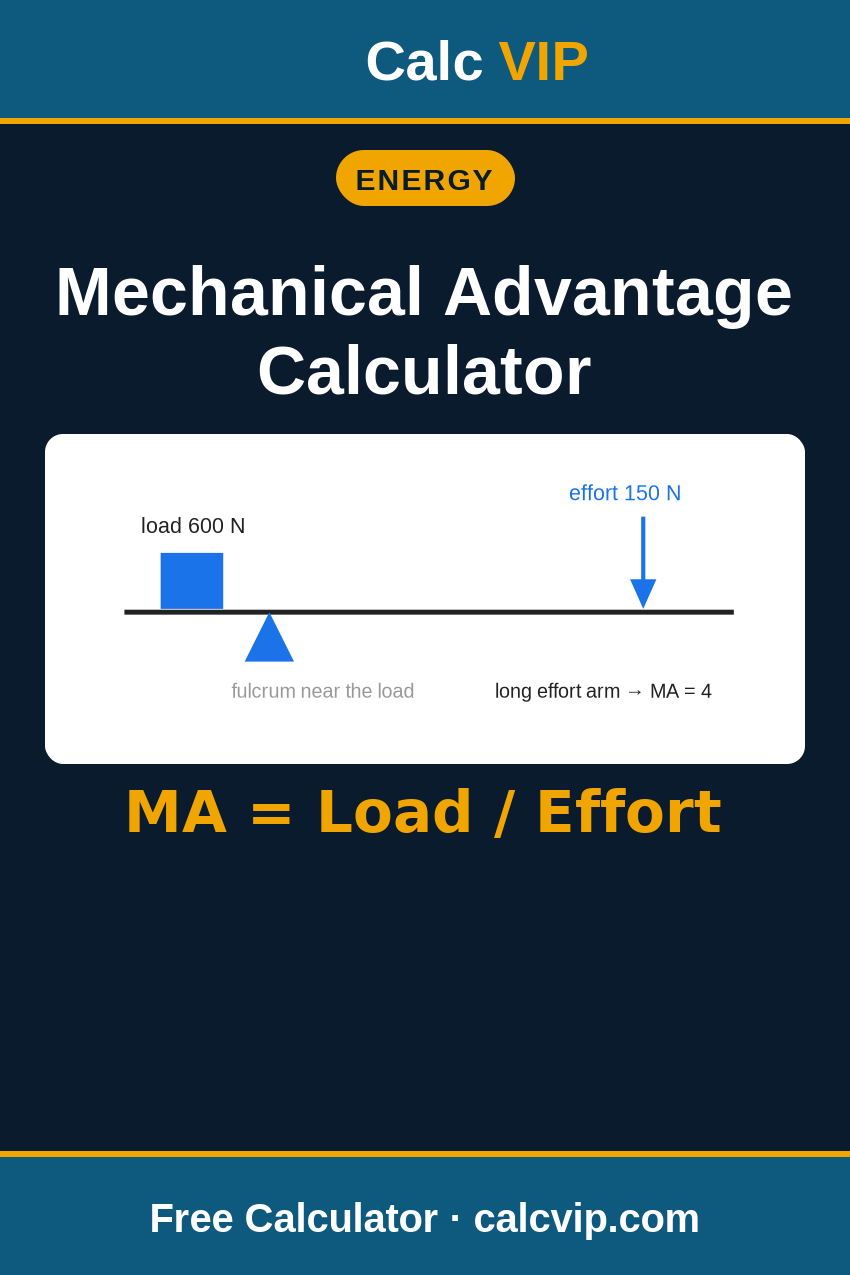
There is, however, no free lunch, and the price is always distance. The golden rule of mechanics says that whatever a machine gains in force it loses in movement: the effort must travel proportionally further than the load. A lever with MA 4 lifts its load one metre only if the effort end sweeps down four metres. That is not a design flaw — it is conservation of energy wearing overalls, because in an ideal machine the work in (effort × its distance) exactly equals the work out (load × its distance). Keep that trade in mind and every simple machine on this page, from scissors to hydraulic presses, becomes one idea in different costumes.
Formula
Mechanical Advantage = Load ÷ Effort → MA = Load / Effort
Rearranged, the ideal effort for a given load is Effort = Load ÷ MA, and the load a machine can handle for a given effort is Load = MA × Effort. There is a second, equivalent way to see the same number: in an ideal machine, MA = distance the effort moves ÷ distance the load moves, because the work in must equal the work out. The two definitions are a useful cross-check — count the supporting rope strands on a pulley system and you have both its force ratio and the ratio of rope pulled to height lifted. MA has no unit: it is a "how many times" number. Forces must both be in newtons (convert a mass in kilograms to a weight by multiplying by 9.81), and real machines need somewhat more effort than the ideal value because friction skims off its share — the calculator gives the ideal figure, the floor below which no real effort can go.
| Symbol | Meaning | Units |
|---|---|---|
| MA | mechanical advantage — force multiplication factor | no unit (a ratio) |
| Load | the force the machine overcomes (often a weight, mg) | newtons (N) |
| Effort | the force you apply to the machine | newtons (N) |
| IMA | ideal MA — from geometry/distances, ignoring friction | no unit |
| AMA | actual MA — from measured forces, friction included | no unit |
Trading distance for force: the golden rule
Every simple machine is a currency exchange between force and distance, and the exchange rate is the mechanical advantage. The lever is the clearest case: place the fulcrum close to the load and far from your hand, and your hand's long sweep becomes the load's short, powerful rise. A pulley system performs the same exchange with rope — each extra supporting strand shares the load, and you pay by pulling that many times more rope than the height gained. An inclined plane spreads a lift over a long slope; a screw is a plane wrapped around a cylinder, which is why a car jack's many turns raise a car with a child's effort; gears exchange force between shafts according to their teeth; a hydraulic press exchanges it between pistons of different areas, letting a small force on a narrow piston balance a huge force on a wide one.
Why must the trade balance so exactly? Because energy is conserved. Work is force × distance, and a machine with no energy source of its own cannot output more work than you input. If the load force is four times the effort, the load's distance must be a quarter of the effort's — the products match, and the books balance. This is why there will never be a machine, however ingenious, that multiplies both force and distance at once: that would be creating energy, and it is the one trick physics does not allow. When a machine seems to give something for nothing — a long wrench freeing a rusted bolt — look for the distance you paid: your hand travelled a long arc so the bolt could turn a stubborn fraction of one.
Real machines pay a second price on top: friction. The effort you actually need is always more than Load ÷ MA, and the shortfall is measured by comparing the actual mechanical advantage (AMA, from real forces) with the ideal (IMA, from geometry). Their ratio is the machine's efficiency — the same efficiency scored on the Efficiency Calculator page. A well-greased pulley system might reach 85%; a rusty screw jack far less. So one honest way to read this calculator's answer is as a promise no real machine quite keeps: the ideal effort, before friction takes its cut.
How to use
- To find MA: choose the first mode, then enter the load force and the effort force, both in newtons (N). If you know a mass instead, multiply its kilograms by 9.81 to get its weight in newtons.
- To find the ideal effort: switch the mode, then enter the load and the machine's MA.
- Click "Calculate" to see the result.
- Treat the effort figure as the ideal minimum — budget roughly 10–25% more effort for a real machine with friction, more still for old or dry mechanisms.
Worked examples
Example 1 — the lever, both ways. A lever lifts a load of 600 N with an effort of only 150 N. MA = 600 ÷ 150 = 4 — the lever multiplies your force 4 times. With the same MA of 4, lifting an 800 N load would need an ideal effort of 800 ÷ 4 = 200 N. Same machine, two questions, one ratio.
Example 2 — a six-strand pulley system. A block and tackle with MA 6 hoists scaffolding weighing 1,200 N. Ideal effort = 1,200 ÷ 6 = 200 N — one worker's comfortable pull. The price appears in the rope: to raise the load 2 m, the worker must haul 6 × 2 = 12 m of rope through their hands. Force was bought with distance, at exactly the golden-rule exchange rate.
Example 3 — the loading ramp. A ramp 5 m long rises 1 m, so its ideal MA is 5 ÷ 1 = 5. Rolling a crate weighing 2,000 N up it needs an ideal effort of 2,000 ÷ 5 = 400 N along the slope, instead of a dead lift of 2,000 N. Wheels and a smooth surface keep friction low, so a real ramp comes respectably close to this ideal — which is why removal firms reach for ramps before they reach for their backs.
Example 4 — the wheelbarrow. A loaded wheelbarrow's weight of 900 N sits close to the wheel, while your hands lift at the long handles with 300 N. MA = 900 ÷ 300 = 3. The wheelbarrow is a second-class lever — load between fulcrum (the wheel) and effort — and its modest MA of about 3, combined with rolling instead of carrying, is what makes it the gardener's oldest friend.
Example 5 — a fishing rod: MA below 1. An angler's hand applies 40 N near the butt of the rod while the line pulls with 10 N at the tip: MA = 10 ÷ 40 = 0.25. The rod "wastes" force on purpose — in exchange, the tip sweeps four times further and faster than the hand, which is what casts a light lure across a river. Machines with MA below 1 are speed multipliers, and they obey the same golden rule in reverse.
Example 6 — the hydraulic press. A workshop press has MA 20. A mechanic leaning on the pump handle with 50 N produces a load force of 20 × 50 = 1,000 N at the pressing plate — enough to push bearings into housings. The handle pumps many small strokes, each moving the plate a fraction of a millimetre: force 20 times larger, distance 20 times smaller, work unchanged.
Mechanical advantage in real life
Car jacks. A scissor or bottle jack must lift a corner of a car — roughly 3,000 N — with a force a driver can supply by hand or a small pump. Screw and hydraulic mechanisms with MA of 20 or more do it, paid for in dozens of handle turns or pump strokes per centimetre of lift.
Bicycle gears. Gears are rotating levers. A small chainring driving a large rear cog gives MA above 1 for hills — legs spin fast, wheel turns slowly and strongly. A large chainring and small cog give MA below 1 for speed. The gear lever is an MA selector, and choosing it is choosing where you sit on the force–distance trade.
Door handles and steering wheels. A handle turns a latch from the rim of a disc — a wheel-and-axle machine. The longer the handle or the bigger the wheel, the greater the MA, which is why heavy doors get long handles and old trucks, lacking power steering, had enormous steering wheels.
Ramps, stairs and accessibility. A wheelchair ramp is an inclined plane whose MA is set by building codes: a gentler slope (bigger length-to-height ratio) means less effort per metre travelled. Stairs are the same machine folded — each step trades a small vertical lift for horizontal travel.
Scissors, pliers and nail clippers. Two levers joined at a pivot. Long handles and short jaws (scissors for metal, bolt cutters) give high MA for cutting; long blades and short handles (paper scissors) trade force for a fast, sweeping cut. Your fingers choose the exchange rate every time you pick the tool up.
Rescue and recovery. Firefighters' spreaders ("jaws of life") are hydraulic machines with MA high enough to peel a car door open, and sailors have used block and tackle for centuries to let small crews tension sails against the wind. Wherever a human must out-pull a load far beyond muscle, an MA device is doing the quiet arithmetic.
Ideal vs actual: where friction takes its cut
Two mechanical advantages live side by side in engineering. The ideal mechanical advantage (IMA) comes from geometry alone — arm lengths, rope strands, teeth, slope ratios — and assumes a frictionless world. The actual mechanical advantage (AMA) is what you measure: real load divided by real effort. Take the ramp from Example 3: its IMA is 5, but suppose the 2,000 N crate actually needs 500 N of push because of friction in the wheels and slope. Then AMA = 2,000 ÷ 500 = 4, and the machine's efficiency is AMA ÷ IMA = 4 ÷ 5 = 80%. That single comparison — geometry's promise versus measurement's reality — tells an engineer both how good the machine is and how much room lubrication, bearings or a smoother surface could win back. This calculator works in the ideal world; treat its efforts as targets that good design approaches but never quite reaches.
Quick reference: everyday machines and their MA
| Machine | Typical MA | What you pay in distance |
|---|---|---|
| Crowbar / pry bar | ≈ 5 | hand sweeps 5 cm per 1 cm the load rises |
| Wheelbarrow | 2–3 | handles lift further than the load |
| Block and tackle (4 strands) | 4 | 4 m of rope per 1 m of lift |
| Loading ramp (5:1 slope) | 5 | 5 m of travel per 1 m of height |
| Bicycle low gear | ≈ 2–3 | legs spin faster than the wheel |
| Screw car jack | 20+ | many turns per centimetre of lift |
| Hydraulic press | 10–100 | many small pump strokes |
The pattern across the table is the golden rule again: the MA column and the distance column are the same number read from opposite ends. Choose a machine by asking which currency you can afford — force or distance — and the table tells you the exchange rate on offer.
Common mistakes
- Believing MA creates energy. A machine multiplies force, never work. If your numbers show more work coming out than going in, the distance trade has been forgotten somewhere.
- Entering mass where force belongs. MA divides forces. A 60 kg load weighs 60 × 9.81 = 589 N; typing "60" as the load understates it almost tenfold and wrecks every figure downstream.
- Confusing MA with efficiency. MA compares forces; efficiency compares energies and can never exceed 100%. A machine can have MA of 20 and an efficiency of 60% at the same time — they answer different questions.
- Expecting the real effort to equal the ideal effort. Friction always adds to the bill. If a real machine seems to need less effort than Load ÷ MA, a measurement is wrong — the ideal is a floor, not an average.
- Counting pulleys instead of rope strands. A pulley system's MA equals the number of rope strands supporting the moving block — which is not always the number of pulley wheels. Count the strands pulling up on the load, including one attached to the top support.
FAQ
What does a mechanical advantage of 4 mean?
It means the machine multiplies your effort 4 times: a 150 N push can balance a 600 N load. The trade-off is that the effort moves 4 times further than the load.
Can mechanical advantage be less than 1?
Yes. Some machines, like a fishing rod or bicycle gears at high speed, sacrifice force to gain distance or speed — their MA is below 1.
Why is the real effort bigger than the ideal effort?
Friction inside the machine wastes some of your input force, so the actual MA is always a little less than the ideal MA calculated here.
How do gears produce mechanical advantage?
By teeth ratio. If a 12-tooth gear drives a 36-tooth gear, the large gear turns at a third of the speed with three times the turning force — MA = 36 ÷ 12 = 3. Reverse the pair and the same gears give MA of 1/3, trading force for speed. Every gearbox, from bicycles to trucks, is this one ratio stacked in stages.
What is the difference between IMA and AMA?
IMA (ideal mechanical advantage) is calculated from the machine's geometry — distances, strands, teeth — assuming no friction. AMA (actual mechanical advantage) is measured from real forces: load ÷ actual effort. AMA is always the smaller of the two, and their ratio, AMA ÷ IMA, is the machine's efficiency.
How many pulleys do I need for an MA of 6?
What matters is supporting rope strands, not wheels. Six strands sharing the load give MA 6 — commonly arranged as two blocks of three pulleys each, or a gun tackle arrangement. You will pull 6 m of rope for every 1 m the load rises, and friction in each wheel trims the real figure slightly below 6.
Why are stairs and ramps both classed as machines?
Both are inclined planes: they let you gain height gradually, paying in horizontal distance instead of a single vertical heave. A ramp's MA is its length divided by its height. Stairs simply fold that slope into steps, with each step a small plane — the principle, and the trade, are identical.
What MA do I need to lift a car with a jack?
A 1,200 kg car weighs 1,200 × 9.81 = 11,772 N, and a jack under one corner carries roughly a quarter of that — about 2,943 N. If you can comfortably apply 150 N, you need MA ≈ 2,943 ÷ 150 ≈ 20. That is exactly the range screw and hydraulic jacks are built to, which is why they feel slow but effortless.
Does MA depend on how heavy the load is?
No — for a given machine the ratio is set by geometry and stays the same for light and heavy loads alike. Double the load and the required effort doubles too; the multiplier does not change. (Very light loads can seem different in practice, because the machine's own friction then looms larger by comparison.)
Can a machine have MA exactly equal to its distance ratio?
Only the ideal, frictionless machine. In that world work in equals work out exactly, so Load ÷ Effort and effort-distance ÷ load-distance are forced to be the same number. Every real machine falls a little short on the force side — the gap between the two ratios is precisely its friction loss.