 Calc
Nuclear Radius Calculator – R = 1.2 A^(1/3) fm & Density
 Created by Anna Kowalski · Physics Editor · Heat & Atoms · Last updated: November 2026
Use this free Nuclear Radius Calculator to estimate the size of an atomic nucleus from its mass number, using R = 1.2 × A(1/3) femtometres. It also shows the (almost constant) density of nuclear matter — the densest material in everyday physics.
One formula runs all of nuclear matter: R = r₀ × A1/3, with r₀ ≈ 1.2 femtometres. It says the nucleus is a droplet of nearly incompressible fluid — double the nucleons and the volume doubles, so the radius grows only by the cube root of two. The consequences are startling when you first meet them. A uranium nucleus, with 238 nucleons, is barely twice the radius of carbon-12. Every nucleus in the universe, from hydrogen to the heaviest synthetic element, packs its mass at essentially the same density: about 2.3 × 10¹⁷ kilograms per cubic metre, a hundred trillion times denser than lead. A teaspoon of it would mass over a billion tonnes.
The formula was not guessed; it was measured, twice over, by two very different probes. Scattering high-energy electrons off nuclei in the 1950s (the work that won Robert Hofstadter a Nobel Prize) mapped where the charge sits and found a sphere with a fairly sharp edge whose size follows A1/3. Alpha particles scattered decades earlier had hinted at the same scale. That two probes — one electromagnetic, one nuclear — agree on r₀ ≈ 1.2 fm is why the simple droplet picture survives: whatever the nucleus's internal complexity, its boundary behaves like the surface of a liquid drop of constant density.
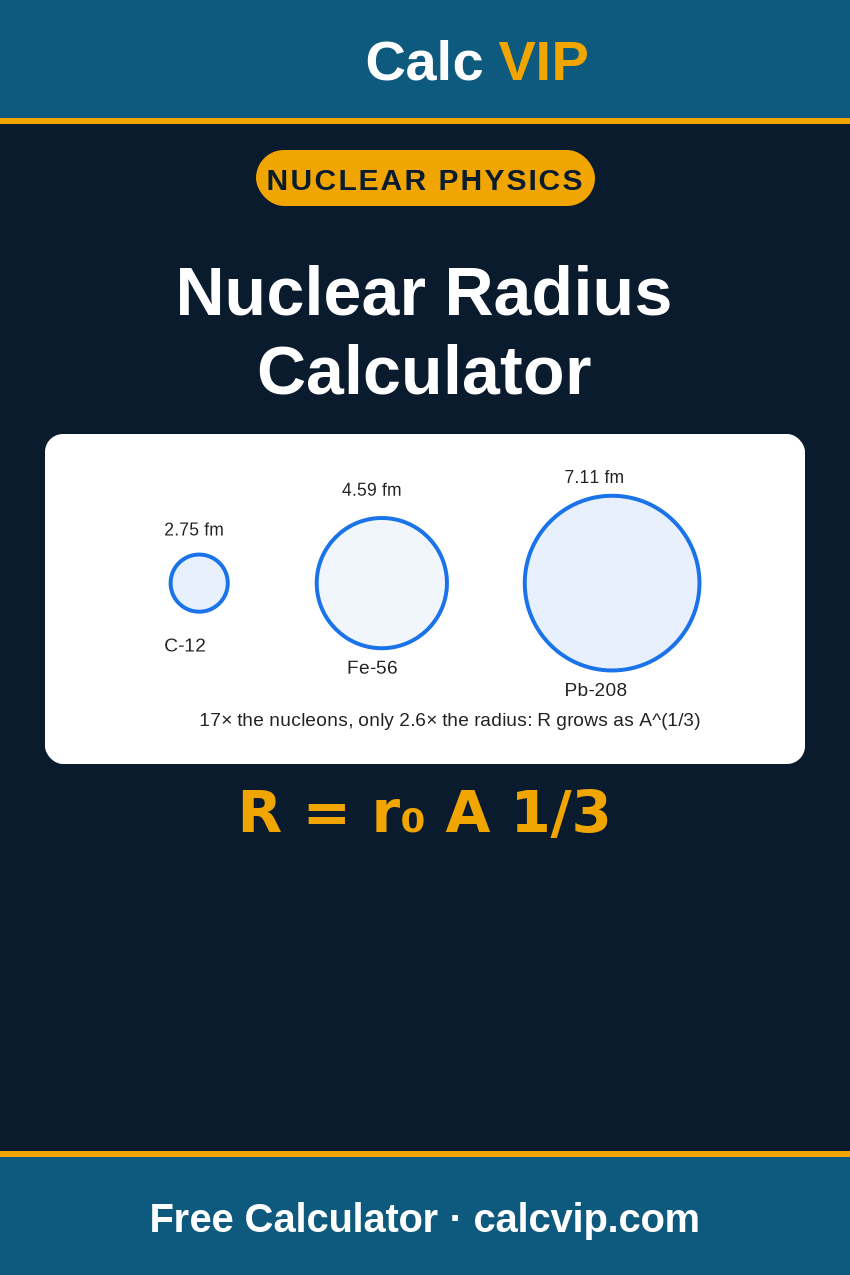
This calculator returns the radius in femtometres (1 fm = 10−15 m, the natural yardstick of the nucleus) and, on request, the density that follows from packing A nucleons into that sphere. Enter a mass number — the A of any isotope — and you have the size of its nucleus, whether that nucleus is a proton's single femtometre or the 7.4 fm span of uranium-238.
Formula
R = r₀ A1/3, with r₀ = 1.2 fm. Density: ρ = (A × u) / ((4/3)πR³) ≈ 2.3 × 10¹⁷ kg/m³ — the same for (nearly) all nuclei, which is exactly why the radius law works.
The cube root is geometry, not nuclear physics: it is what any constant-density sphere must do. If every nucleon claims the same volume v, then A nucleons fill (4/3)πR³ = A·v, so R = (3v/4π)1/3 × A1/3 — and r₀ is just that prefactor, the radius a single nucleon would have. The density calculation makes the point from the other side: substitute R = r₀A1/3 into ρ = mass/volume and the A's cancel exactly, leaving ρ = u / ((4/3)π r₀³) = 1.6605e-27 / 7.24e-45 ≈ 2.29 × 10¹⁷ kg/m³ for every nucleus. Treat the 1.2 fm as approximate: fits to electron scattering give 1.2–1.25 fm depending on how the fuzzy nuclear edge is defined, and light or halo nuclei stray from the law entirely — honest limitations the concept section explores.
| Symbol | Meaning | Units |
|---|---|---|
| R | nuclear radius | femtometres (fm) = 10−15 m |
| r₀ | empirical constant, ≈ 1.2 | fm |
| A | mass number — protons + neutrons | — |
| ρ | nuclear density | kg/m³ |
A droplet, not a gas — and why it matters
Constant density is the nucleus's deepest everyday fact. Atoms are mostly emptiness — the nucleus occupies a trillionth of the atomic volume — but the nucleus itself is full: nucleons packed shoulder to shoulder, each interacting mainly with its nearest neighbours, exactly as molecules do in a liquid. That single picture, the liquid-drop model, explains a remarkable amount: why binding energy per nucleon saturates (interior nucleons are fully surrounded; only surface ones are short-changed, the origin of the surface term in the binding-energy formula), why heavy nuclei fission (a charged drop stretched past stability splits, like a raindrop in an electric field), and why the radius law on this page holds across two hundred mass units.
The edges of the picture are as instructive as its centre. Real nuclei have a skin, not a surface: the density fades over about half a femtometre, so "the radius" depends on whether you measure where the density halves (the convention behind r₀) or where the matter effectively ends. Neutron-rich nuclei grow a neutron skin, slightly inflating the matter radius beyond the charge radius that electrons see. And a few halo nuclei — lithium-11 is the famous case — sport one or two neutrons orbiting so far out that the A1/3 law underestimates their size grossly. The calculator's clean number is the right first approximation for nearly every nucleus you will ever meet; the exceptions are a research field of their own.
How to use
- Enter the mass number A of the isotope (protons + neutrons, e.g. 56 for iron-56, 238 for uranium-238).
- Read the radius in femtometres from R = 1.2 × A^(1/3).
- If you need the density, use the density option or divide the nuclear mass (A × 1.6605 × 10⁻²⁷ kg) by the sphere volume (4/3)πR³ with R in metres.
- Sanity-check with the ladder: A = 1 → 1.2 fm; A = 8 → 2.4 fm; A = 27 → 3.6 fm; A = 64 → 4.8 fm; A = 216 → 7.2 fm. Perfect cubes make mental checks free.
- For a molecule- or atom-scale comparison, remember the nucleus is about 1/100,000 of the atom's diameter — the radius here is the tiny core, not the atom.
Worked examples
Example 1 — iron-56. A = 56, so A1/3 = 3.826.
R = 1.2 × 3.826 = 4.59 fm. Density: the mass is 56 × 1.6605 × 10−27 = 9.30 × 10⁻²⁶ kg in a sphere of volume (4/3)π(4.59 × 10−15)³ = 4.05 × 10−43 m³, giving ρ ≈ 2.3 × 10¹⁷ kg/m³. The most tightly bound nucleus in nature is also a fair sample of universal nuclear stuff: same density as everything else, arranged at the binding curve's peak.
Example 2 — the proton itself. A = 1: R = 1.2 × 1 = 1.2 fm. Treat this as the law's anchor rather than a precision measurement — the proton's measured charge radius is about 0.84 fm, and r₀ is fitted across all nuclei rather than to hydrogen alone. The discrepancy is your reminder that 1.2 is a one-parameter summary of hundreds of nuclei, not a law of nature at the single-nucleon scale.
Example 3 — helium-4 and carbon-12. Helium: A1/3 = 1.587, R = 1.90 fm. Carbon: A1/3 = 2.289, R = 2.75 fm. Tripling the nucleons from helium to carbon buys only 45% more radius — the cube root's stinginess in action, and the reason the whole periodic table's nuclei fit within a factor of about six in size.
Example 4 — silver-108 and lead-208. Silver: A1/3 = 4.762, R = 5.71 fm. Lead: A1/3 = 5.925, R = 7.11 fm. Lead-208, doubly magic and the heaviest stable nucleus, is the standard candle of nuclear size measurements — Hofstadter-style scattering mapped its charge distribution in exquisite detail, skin and all, and the droplet law still lands within a few percent.
Example 5 — uranium-238 and the teaspoon test. A1/3 = 6.197, so R = 7.44 fm — the largest common nucleus is only 1.6× iron's radius despite 4.25× the mass. Now the density: a 5 cm³ teaspoon of nuclear matter at 2.29 × 10¹⁷ kg/m³ masses 5e-6 × 2.29e17 ≈ 1.15 × 10¹² kg — over a billion tonnes, roughly the mass of a small mountain, in a spoon. (No spoon survives; the matter would explode outward the instant the nuclear forces confining it were removed — which is why such densities exist only inside nuclei and neutron stars.)
Example 6 — checking the density really is constant. Repeat the Example 1 density calculation for carbon-12: mass 12 × 1.6605e-27 = 1.99 × 10⁻²⁶ kg; volume (4/3)π(2.75e-15)³ = 8.68 × 10−44 m³; ρ = 2.29 × 10¹⁷ kg/m³. And for lead-208: 3.45 × 10⁻²⁵ kg in 1.51 × 10−42 m³ gives the same 2.29 × 10¹⁷. Three nuclei spanning the table, one density — the A-cancellation in the formula section, verified by hand.
Nuclear size in real life
Neutron stars. A neutron star is, to a first approximation, this calculator's density written across 20 kilometres: matter at ~10¹⁷–10¹⁸ kg/m³, a solar mass in a city-sized sphere. The radius law's constant-density lesson is the entry point to the whole astrophysics of these objects — including why a teaspoon of their material is the standard (and accurate) popular comparison.
Scattering experiments and the femtometre scale. Every measurement of nuclear size — electron scattering, muonic atoms (whose spectra shift measurably with the nuclear radius), isotope shifts in atomic spectra — calibrates against this formula. The proton-radius puzzle, a decade-long discrepancy between measurement methods, mattered precisely because this corner of physics is normally so well behaved.
Reaction cross-sections. The probability of a nuclear reaction scales with the target's geometric area, πR² — for iron-56, π × (4.59 fm)² ≈ 6.6 × 10⁻²⁹ m². Reactor physicists, shielding designers and astrophysicists estimating reaction rates in stars all start from the radius this page computes.
Fission's geometry. The liquid-drop picture behind the radius law also predicts when a nucleus splits: stretch the drop until surface tension loses to electric repulsion. The same model that sizes the nucleus explains why uranium fissions and iron never will — size and stability are one story.
Alpha decay tunnelling. An alpha particle escaping a heavy nucleus must tunnel through the Coulomb barrier that begins at the nuclear surface — R sets where the barrier starts and hence, through the tunnelling probability, the half-life. Geiger–Nuttall's law, linking half-lives to energies, is quietly built on this radius.
Medical isotope targeting. When alpha-emitting isotopes are used against cancer, the alpha's range in tissue (tens of micrometres) versus the nucleus it came from (femtometres) spans ten orders of magnitude — treatment planning lives on the cellular end, but the decay energies and rates are set at the femtometre end this page describes.
Radius ladder for common nuclei
| Nucleus | A | A1/3 | R = 1.2 A1/3 |
|---|---|---|---|
| Hydrogen-1 (proton) | 1 | 1.000 | 1.20 fm |
| Helium-4 | 4 | 1.587 | 1.90 fm |
| Carbon-12 | 12 | 2.289 | 2.75 fm |
| Oxygen-16 | 16 | 2.520 | 3.02 fm |
| Iron-56 | 56 | 3.826 | 4.59 fm |
| Silver-108 | 108 | 4.762 | 5.71 fm |
| Lead-208 | 208 | 5.925 | 7.11 fm |
| Uranium-238 | 238 | 6.197 | 7.44 fm |
Keep the endpoints in mind: the entire span of nuclear matter, hydrogen to uranium, fits between 1.2 and 7.4 femtometres — less than one order of magnitude — while the atoms containing them vary far more and the chemistry built on them varies beyond counting. Nuclear physics happens in a remarkably small room.
Charge radius versus matter radius
Electrons scatter off charge, so electron experiments measure the distribution of the protons — the charge radius. Hadronic probes (protons, alpha particles, pions) feel neutrons too and report the matter radius. In stable nuclei the two nearly coincide, which is why one r₀ serves both. Toward the neutron-rich frontier they part company: extra neutrons puff the matter distribution outward (the neutron skin of lead-208, a few tenths of a femtometre thick, was measured precisely because it constrains the physics of neutron stars). When a problem specifies one radius or the other, it is asking which probe's view you need — for Coulomb barriers and atomic physics, charge; for reaction cross-sections and collisions, matter.
Common mistakes
- Using the atomic number Z instead of the mass number A. Size counts all nucleons, neutrons included. Lead with Z = 82 but A = 208 has R = 7.11 fm; feeding 82 returns 5.21 fm — a nucleus missing more than half its substance.
- Expecting radius to scale with A. Doubling the nucleons multiplies R by 21/3 ≈ 1.26, not by 2. Intuition trained on balloons fails here; the cube root is the whole content of the formula.
- Confusing the nuclear radius with the atomic radius. They differ by a factor of about 100,000. A femtometre answer describes the core; the atom's electron cloud is measured in ångströms (10−10 m), a different universe of scale.
- Botching the density units. R comes out in femtometres; the volume needs metres (× 10−15, cubed: × 10−45). Forgetting the conversion inflates or deflates the density by 45 orders of magnitude — the most spectacular error available on this page.
- Taking 1.2 fm as exact. r₀ is an empirical fit (1.2–1.25 fm by convention and probe), and halo nuclei, very light nuclei and deformed nuclei deviate. Quote radii from this law to two significant figures and treat the third as fiction.
FAQ
Why the cube root of A?
Each nucleon takes up roughly the same volume, so the nuclear volume is proportional to A. Volume goes as R³, therefore R grows with the cube root of A.
How big is a nucleus compared with its atom?
An atom is about 10⁵ times wider than its nucleus. If the nucleus were a marble in the centre of a stadium, the atom would be the whole stadium — atoms are almost entirely empty space.
Is nuclear density really the same for all nuclei?
Very nearly — that is the big surprise of the formula. Light and heavy nuclei all pack nucleons at about 2.3 × 10¹⁷ kg/m³, like an incompressible liquid drop.
Why a cube root and not some other power?
Because volume is what accumulates. Each nucleon adds a fixed volume of nuclear matter, so total volume ∝ A, and the radius of a sphere scales as the cube root of its volume. Any other exponent would mean the density changes systematically with size — which the measurements, and Example 6's three-way check, show it does not.
How was the size of the nucleus first measured?
Rutherford's alpha-scattering experiments (1909–1911) showed the atom's mass concentrated in a minute core, and the closest-approach distances of the alphas bounded its size at the femtometre scale. Precise charge distributions came in the 1950s with Hofstadter's electron scattering — electrons, interacting only electromagnetically, are clean rulers that do not disturb what they measure.
Is the density really the same inside every nucleus?
To within about 10–20%, yes, for medium and heavy nuclei — that is the empirical fact the radius law encodes. The centres of heavy nuclei sit near 2.3 × 10¹⁷ kg/m³, light nuclei run slightly less dense (more of their volume is skin), and the skin region fades from full density to zero over roughly half a femtometre in all of them.
What is the largest nucleus, and how big?
The heaviest confirmed elements reach A ≈ 294 (oganesson), giving R ≈ 1.2 × 6.65 ≈ 8.0 fm by this law — though such nuclei live for milliseconds and their sizes are inferred, not measured. Among stable nuclei, lead-208 (7.11 fm) and bismuth-209 share the top of the ladder.
How does nuclear density compare with a neutron star?
They are the same order of magnitude: a neutron star's average density is a few × 10¹⁷ kg/m³, rising toward 10¹⁸ at the centre. A neutron star can be pictured as a single nucleus with A ≈ 10⁵⁷ — the radius law extrapolated (with gravity replacing the strong force as the binder) lands within a factor of a few of the observed ~10–12 km radii.
Why does the nucleus not collapse under its own forces, or explode from proton repulsion?
It balances two giants: the strong force binds nearest neighbours (saturating, which gives constant density), while the Coulomb repulsion of the protons pushes outward and grows with Z². Light nuclei are strong-force winners; beyond lead the repulsion wins slowly (alpha decay), and beyond Z ≈ 100 or so it wins quickly — the radius law describes the arena in which that contest plays out.
Does the radius change when a nucleus is excited or spinning?
Slightly, and measurably: excited nuclei can vibrate, rotate into football shapes, and in extreme cases form elongated or clustered configurations — the Hoyle state of carbon-12, vital to carbon's existence in stars, is a loose triangle of three alpha particles, noticeably larger than the ground-state sphere. The calculator gives the ground-state droplet; spectroscopy maps the exceptions.