 Calc
Q Value Calculator – Nuclear Reaction Energy in MeV
 Created by Anna Kowalski · Physics Editor · Heat & Atoms · Last updated: November 2026
Use this free Q Value Calculator to find the energy released or absorbed by a nuclear reaction. Q is the mass lost in the reaction converted to energy: positive Q means the reaction releases energy, negative Q means it needs energy to happen.
The Q value is the price tag of a nuclear reaction, printed in MeV. Add up the masses of everything going in, add up the masses of everything coming out, and multiply the difference by 931.5: if the products are lighter, Q is positive and the reaction releases that much energy — it can power a star, a reactor, a bomb. If the products are heavier, Q is negative and the reaction costs energy — it will not run at all until someone pays the difference in kinetic energy. Before any reactor is designed or any accelerator beam is tuned, this one subtraction is performed, because it decides what is possible.
The arithmetic rests on a lucky convention: the masses used are atomic masses — nucleus plus its electrons — and the electrons cancel. In D–T fusion, the deuterium and tritium atoms bring two electrons between them, and the helium-4 atom among the products holds exactly two, the neutron none — the books balance because the reaction's electron count is conserved. (In beta-decay calculations the same convention is what makes the arithmetic work at all — the emitted electron's mass is silently supplied by the atomic tables.) Use atomic masses consistently, for every species including neutrons and free protons (hydrogen atoms), and Q comes out right to the precision of the tables.
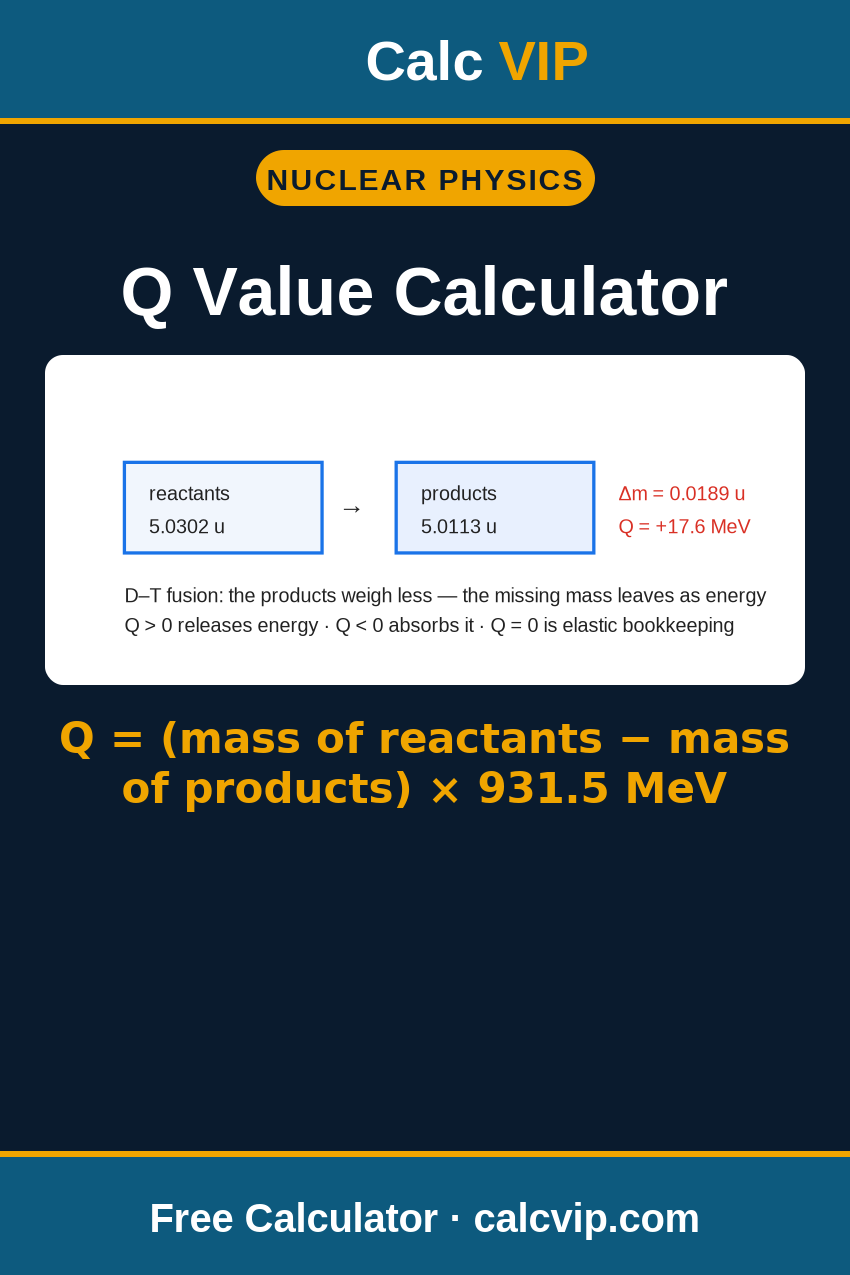
The calculator asks only for the two sums — total mass before, total mass after, in atomic mass units — and returns Q in MeV. Everything else on this page is about reading that number like a physicist: its sign, its size relative to the masses involved, and the threshold it implies when it comes out negative.
Formula
Q = (mass of reactants − mass of products) × 931.5 MeV/u. Q > 0: the reaction releases energy (exothermic). Q < 0: it absorbs energy (endothermic) and needs at least |Q| of input kinetic energy — in practice more, as the threshold note below explains.
Because the electron masses cancel when atomic masses are used, the working procedure is mechanical: look up each species in an atomic-mass table, sum each side, subtract. For a decay, the same formula applies with the parent atom alone on the left. When Q is negative, conservation of momentum sets the true price: the projectile must also keep the products moving, so the laboratory threshold energy is Ethreshold ≈ |Q| × (1 + mprojectile/mtarget) for a stationary target — for an alpha particle striking nitrogen-14, a factor of 1 + 4/14 ≈ 1.29 (worked in Example 4). And the released Q does not split evenly: in a two-body final state, momentum conservation hands the lighter product the larger share, in inverse proportion to the masses — the reason fusion's neutron takes 14.1 of the 17.6 MeV.
| Symbol | Meaning | Units |
|---|---|---|
| Q | energy released (+) or absorbed (−) | MeV |
| Σm (reactants) | total atomic mass before | u |
| Σm (products) | total atomic mass after | u |
| 931.5 | energy equivalent of 1 u | MeV/u |
Reading a Q value like a physicist
Three habits separate a quoted Q from an understood one. First, compare Q with the masses involved: 17.6 MeV from 5.03 u of fuel is 3.5 MeV per unit mass, whereas fission's 173–200 MeV from 236 u is under 1 MeV per unit — the per-mass comparison that ranks fusion fuel above fission fuel before any engineering enters. Second, ask where Q goes: it reappears as kinetic energy of the products (plus any gamma rays), shared by momentum conservation, so the charged products can be confined and harvested while neutrons escape with their share — the central design fact of fusion reactors. Third, respect the sign's finality: a negative Q is not a small obstacle but a wall — no catalyst, pressure or cleverness makes an endothermic reaction run below threshold, in stars any more than in laboratories; stellar burning steps are chosen by nature from the positive-Q menu only.
Q also quietly governs decays. A parent atom heavier than its decay products (Q > 0) may decay spontaneously — alpha decay of radium-226 releases 4.87 MeV this way — while a negative decay Q means absolute stability against that channel, forever. The whole chart of the nuclides, which isotopes exist and which vanish, is a vast table of Q signs computed exactly as this page computes them. Even the proton–proton chain that powers the Sun is a sequence of Q values, beginning with a step so feeble (two protons to deuterium, Q = +1.44 MeV after the positron annihilates) that the Sun burns slowly enough to last ten billion years — cosmology itself, scheduled by a subtraction.
How to use
- Look up the atomic masses of every reactant and product (atomic-mass tables give them to 6+ decimals — use all of them; Q lives in the fourth decimal).
- Sum the reactant masses and the product masses separately, in u.
- Enter the two sums. Q = (reactants − products) × 931.5 comes back in MeV.
- Read the sign: positive releases energy; negative absorbs it. For a negative Q, multiply |Q| by (1 + projectile mass / target mass) to get the true beam threshold against a stationary target.
- Distribute a positive Q between two products by momentum: each takes a share inversely proportional to its mass (the neutron's 14.1 MeV of fusion's 17.6 is the classic check: 17.6 × 4/5).
Worked examples
Example 1 — D–T fusion, the benchmark. Deuterium + tritium → helium-4 + neutron. Reactants: 2.014102 + 3.016049 = 5.0302 u. Products: 4.002603 + 1.008665 = 5.0113 u.
Δm = 0.0189 u, so Q = 0.0189 × 931.5 = +17.6 MeV released per fusion. Split by momentum: the neutron (mass 1 of the 5 total) takes 4/5 × 17.6 = 14.1 MeV; the helium nucleus takes 3.5 MeV. Every fusion reactor design on Earth is built around those two numbers — the neutron's share escapes the magnetic bottle and must be caught in a blanket; the helium's share heats the plasma.
Example 2 — fission's prompt Q. U-235 + neutron → barium-141 + krypton-92 + 3 neutrons. Reactants: 235.043930 + 1.008665 = 236.0526 u. Products: 140.914411 + 91.926156 + 3 × 1.008665 = 235.8666 u. Δm = 0.1860 u, Q = +173.3 MeV promptly. The famous "about 200 MeV per fission" adds the fragments' subsequent beta decays (≈25 MeV more, released over time) — the Q of the split itself is 173 MeV, and the Fission Energy Calculator's 0.215 u defect is this example's 0.186 u plus the decay chain's contribution.
Example 3 — the Sun's second step. Proton + deuterium → helium-3. Reactants: 1.007825 + 2.014102 = 3.0219 u. Product: 3.016029 u. Δm = 0.0059 u, Q = +5.49 MeV, carried off by a gamma ray. Small beside fusion's headline number, yet this reaction runs in every main-sequence star — a reminder that Q decides possibility, while rates, set by tunnelling probabilities, decide pace.
Example 4 — an endothermic classic, with threshold. Nitrogen-14 + alpha → oxygen-17 + proton (Rutherford's 1919 transmutation). Reactants: 14.003074 + 4.002603 = 18.0057 u. Products: 16.999132 + 1.007825 = 18.0070 u. Δm = −0.0013 u, Q = −1.19 MeV: the reaction absorbs energy. The alpha's laboratory threshold is |Q| × (1 + 4.0026/14.0031) = 1.19 × 1.286 = 1.53 MeV — comfortably below the ~7.7 MeV alphas of Rutherford's radium source, which is why the first artificial transmutation in history could happen on a benchtop in 1919.
Example 5 — radium-226 alpha decay. Radium-226 → radon-222 + helium-4. Reactant: 226.025410 u. Products: 222.017578 + 4.002603 = 226.020181 u. Δm = 0.0052 u, Q = +4.87 MeV. The alpha particle takes 222/226 of it — 4.78 MeV — matching the alpha energy actually measured from radium sources, and the recoil of the radon takes the rest. A positive decay Q is a loaded spring: radium needs no trigger, only time (T½ = 1,600 years).
Example 6 — carbon-14's own decay. Carbon-14 → nitrogen-14 + electron. Using atomic masses, reactant 14.003242 u, product nitrogen atom 14.003074 u (the atomic convention supplies the emitted electron automatically). Δm = 0.000168 u, Q = +0.156 MeV — the 156 keV endpoint of carbon-14's beta spectrum, measured in laboratories daily. Tiny Q, enormous consequence: it is the ticking that dates the ancient world.
Q values in real life
Fusion reactor design. The D–T reaction was chosen from thousands of candidates almost entirely on this page's arithmetic: the largest Q per unit fuel mass at the lowest ignition temperature. Its neutron's 14.1 MeV dictates the blanket materials, the shielding thickness and the breeding of replacement tritium — a power station specified by one subtraction.
Accelerator and beam experiments. Every proposed nuclear reaction is screened by Q before beam time is granted: negative Q sets the minimum beam energy (with the threshold factor), positive Q predicts the product energies the detectors must be built to catch. Nuclear astrophysics measures the Q values of stellar reactions to keV precision because star models inherit their errors.
Medical isotope production. Isotopes like fluorine-18 are made by reactions such as oxygen-18 + proton → fluorine-18 + neutron, chosen and tuned by Q: cyclotron energies are set just above threshold to maximise yield while staying below the thresholds of contaminating side-reactions — Q-value bookkeeping as industrial process control.
Decay heat and waste. The heat leaking from spent fuel is the sum of thousands of decay Q values, each paid out on its own half-life's schedule. Repository safety cases integrate exactly these numbers over ten thousand years; a sign error in the underlying tables would be a safety-case error.
Why some elements exist at all. The proton–proton chain, helium burning, and the neutron-capture paths that build the heavy elements are all sequences gated by Q signs. Elements heavier than iron can only be assembled through neutron captures (whose Q values stay positive because the neutron is free) — fusion's Q turns negative beyond iron-56, which is why stars die there.
Particle physics bookkeeping. The same mass-difference logic, with E = mc², decides which particles may decay into which: a particle's decay Q is its mass minus its products', and negative-Q channels are simply absent from nature's repertoire — the rule that stabilises the proton in most theories and the electron in all of them.
Reference Q values worth knowing
| Reaction | Q (MeV) | Note |
|---|---|---|
| D + T → He-4 + n | +17.59 | fusion's benchmark; n takes 14.1 |
| D + D → He-3 + n | +3.27 | one of the two D–D branches |
| p + D → He-3 | +5.49 | solar pp-chain step |
| U-235 + n → Ba-141 + Kr-92 + 3n | +173.3 | prompt only; ≈200 with decays |
| Ra-226 → Rn-222 + α | +4.87 | α takes 4.78 |
| C-14 → N-14 + e⁻ | +0.156 | the radiocarbon clock's tick |
| N-14 + α → O-17 + p | −1.19 | threshold 1.53 MeV (lab) |
One row invites a second look: D + D → He-3 + n at +3.27 MeV is a real fusion reaction with no rare tritium involved — yet reactors chase D–T, because Q is only the payout; the rate (set by the Coulomb barrier and cross-section) is the other half of the decision, and there D–T wins by a hundredfold at achievable temperatures.
Q and the binding-energy curve — the same coin
Q is the binding-energy curve read between two points. A reaction's Q equals the total binding energy of the products minus that of the reactants: products more tightly bound → mass lower → Q positive. Fission pays because fragments sit higher on the curve than uranium; fusion pays because helium-4 sits far above deuterium and tritium per nucleon; iron-56, at the summit, can pay in neither direction, and its Q against every rearrangement is zero or negative — the ash of the universe. If you have used the Binding Energy Calculator, you already own both halves of this identity; Q is merely the difference, cashed.
Common mistakes
- Using nuclear masses on one side and atomic masses on the other. The electron-cancellation trick works only when every species is treated the same way. Mixing conventions injects errors of 0.511 MeV per stray electron — larger than many Q values themselves.
- Rounding the masses too early. Q lives in the third and fourth decimal places of masses near 200 u. Tables quoted to two decimals (236.05 − 235.87) throw away the answer; carry at least five decimals until the final subtraction.
- Forgetting emitted neutrons and particles in the products. Fission's three neutrons, fusion's neutron, a decay's alpha — omit one and Δm errs by its whole mass (a neutron: 1.008665 u ≈ 940 MeV of phantom Q). Balance the reaction equation first; sum second.
- Reversing the subtraction. Q = reactants − products. Products − reactants flips every sign, turning fusion into an energy sink on paper. The mnemonic: you profit by what the products lost.
- Taking |Q| as the beam threshold. Momentum conservation keeps some kinetic energy locked in the products' motion, so the true threshold is |Q| × (1 + m_projectile/m_target). Beams set exactly at |Q| produce nothing at all — an expensive null result (Example 4 shows the 29% correction for alphas on nitrogen).
FAQ
What does a negative Q mean?
The products are heavier than the reactants, so mass must be created from energy — the reaction can only run if at least |Q| of kinetic energy is supplied, e.g. by a particle accelerator.
Which masses should I use — atoms or nuclei?
Use atomic masses consistently on both sides (electrons included on both sides). As long as the electron count balances, atomic masses give the correct Q for most reactions.
Why is Q quoted in MeV?
A single reaction involves one nucleus, so its energy is tiny in joules (17.6 MeV ≈ 2.8 × 10⁻¹² J). MeV keeps the numbers readable.
Is Q the same as the mass defect?
They are siblings, not twins. The mass defect of a single nucleus is its parts-minus-whole difference, cashed as its binding energy. Q is the mass difference across a whole reaction — reactants minus products — and equals the change in total binding energy between the two sides. Same exchange rate (931.5 MeV/u), different ledger.
Why do atomic masses work when reactions happen between nuclei?
Because electrons are conserved in nearly every nuclear reaction: the reactants' atoms bring as many electrons as the products' atoms keep, so the electron masses cancel in the subtraction. Beta decay is the elegant exception that proves the rule — the emitted electron is exactly balanced by the daughter atom's extra electron, so atomic masses still work, as Example 6 exploits.
Can Q be zero?
Yes — elastic scattering is the Q = 0 reaction: same species out as in, kinetic energy merely redistributed. Inelastic scattering to an excited state has Q equal to minus the excitation energy. A computed Q of exactly zero for a claimed new reaction usually means the equation was balanced to an identity by mistake.
How is the released Q shared between two products?
By momentum conservation: the products fly apart with equal and opposite momenta, so kinetic energy divides in inverse proportion to mass. The lighter product takes the larger share — fusion's neutron (1 u against helium's 4) takes 4/5 of 17.6 MeV = 14.1 MeV, and radium's alpha takes 222/226 of its decay Q. With three or more products the sharing becomes a spectrum rather than fixed shares.
What precision do the mass tables reach?
Modern atomic-mass evaluations quote masses to about 10⁻⁷ u — a tenth of a keV in Q terms — for stable and near-stable species, degrading toward the exotic edges of the chart. That precision is why Q values can be trusted to plan experiments, and why new mass measurements of exotic nuclei still make news: they rewrite the Q tables, and with them the predicted pathways of stellar element-building.
Does a positive Q guarantee the reaction will happen?
No — Q grants permission, not occurrence. Charged reactants must still tunnel through their mutual Coulomb repulsion, which is why the Sun's positive-Q proton–proton step takes billions of years per proton, and why fusion needs stellar or reactor temperatures. Rates come from cross-sections; Q merely strikes the impossible reactions from the list.
How does Q relate to the Fission Energy Calculator?
That calculator converts a mass loss you supply into joules or MeV — E = mc² in bulk. This one computes the mass loss itself from a reaction's bookkeeping. Chain them: balance a reaction here to get Δm in u, then scale it there (or by Avogadro's number) to price a kilogram of fuel.