 Calc
Power Torque Speed Calculator – P = τ·ω for Motors & Shafts (rpm or rad/s)
 Created by Rachel Novak · Senior Editor · All Topics · Last updated: November 2026
Use this free Power, Torque and Speed Calculator to explore the rotating-machinery equation P = τ × ω. Find the power of a motor from its torque and speed, the torque needed for a given power, or the speed a shaft must reach — with speed entered in rad/s or rpm.
Every rotating machine — electric motor, car engine, wind turbine, desk fan — is governed by one compact bargain: power equals torque multiplied by angular speed. Torque says how hard the shaft twists; angular speed says how fast it turns; their product is the rate at which the machine does work, its power. The equation explains a puzzle everyone notices: a small motor spinning at 10,000 rpm can out-power a huge slow engine, and a truck engine with enormous torque can still be modest in power if it turns slowly. Neither quantity alone rates a machine. Only the product does.
The formula is not a definition by decree; it falls out of the work a torque does. One full revolution against a steady torque τ does 2πτ joules of work (the force's point of application travels the circumference 2πr, and τ already contains the r). Divide that work by the time one revolution takes and the 2π cancels into ω, leaving P = τω. This is also why ω must be in radians per second: the radian is the natural unit in which "angle turned per second" converts torque directly into watts, with no leftover factors.
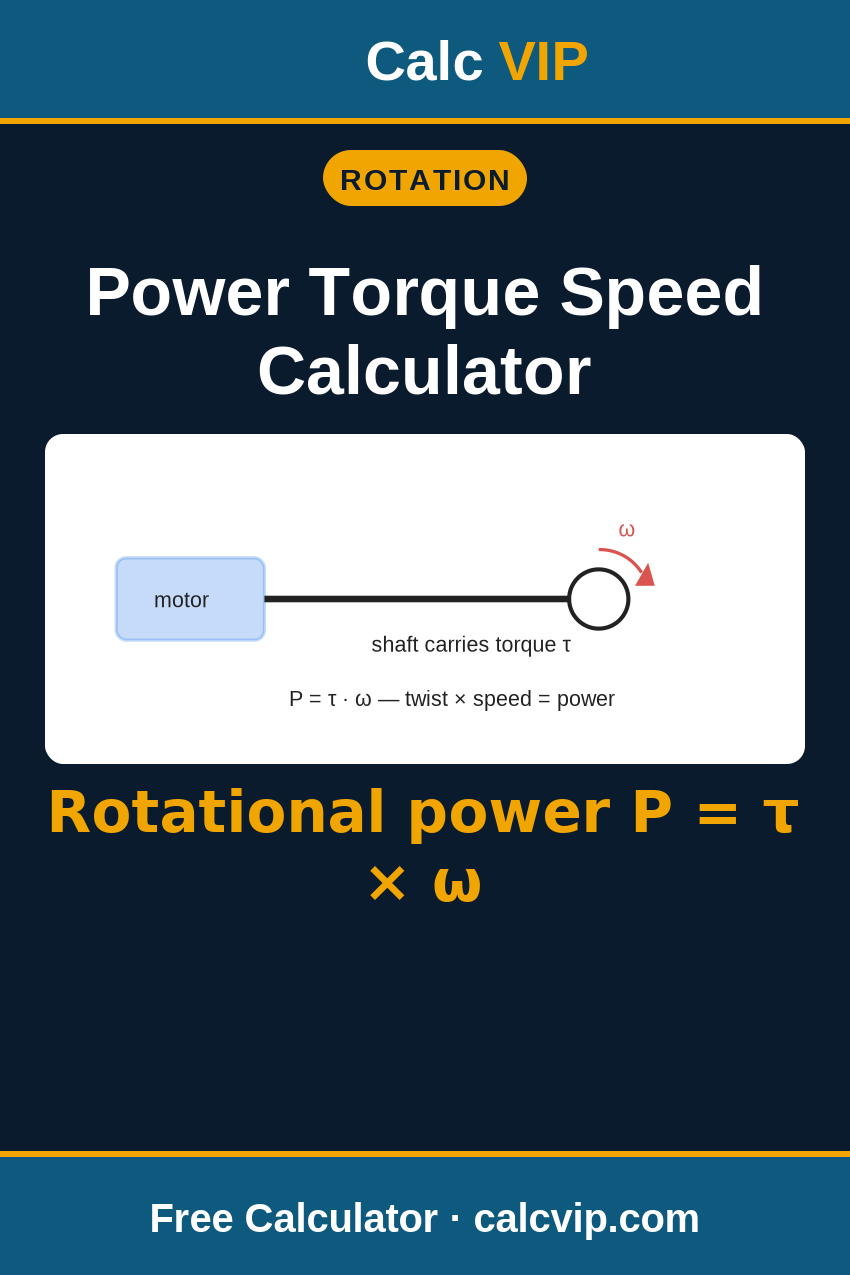
This calculator works the equation in all three directions and handles the rpm conversion for you. Find the power a motor delivers, the torque a job demands at a given speed, or the speed a shaft must reach to transmit a target power with the torque available. Those three questions are, between them, nearly every sizing decision in rotating machinery — choosing a motor for a pump, a gearbox for a conveyor, or an engine for a hill.
Formula
Rotational power P = τ × ω • P in watts (W), τ in newton-metres (N·m), ω in radians per second (rad/s)
The rearrangements are τ = P / ω (the torque a given power can sustain at a given speed) and ω = P / τ (the speed needed to transmit a power with a given torque). Speed conversion is where most errors breed, so it is worth fixing in memory: ω = rpm × 2π / 60, and back again, rpm = ω × 60 / 2π. One revolution per second is 60 rpm and 2π ≈ 6.2832 rad/s. The calculator accepts either unit and always reports power in both watts and kilowatts, and a solved speed in both rad/s and rpm, so you can sanity-check against whichever figure a nameplate or datasheet quotes.
| Symbol | Meaning | Units |
|---|---|---|
| P | power — rate of doing work | watts (W), kilowatts (kW) |
| τ | torque on the shaft | newton-metres (N·m) |
| ω | angular speed | rad/s (or rpm, converted) |
Gearing: trading torque for speed at fixed power
Put a gearbox between a motor and its load and the two factors of P = τω trade against each other. An ideal 5:1 reduction gearbox takes a shaft at 1500 rpm carrying 40 N·m and delivers 300 rpm carrying 200 N·m — torque multiplied by five, speed divided by five, and the power, 6,283.19 W, exactly unchanged (check: 200 × 31.4159 = 6,283.19 W). Real gearboxes keep 90–98% of the power per stage and lose the rest to friction and heat, but the principle stands: gears cannot create power, only re-package it. This is why a car's low gears climb hills — the engine's power arrives at the wheels as large torque at low speed — and why the same car cruises in top gear with the trade reversed.
It also explains the great divide between engine types. A steam engine or electric motor makes strong torque from rest, suiting direct drive. A small petrol engine makes its torque high in the rev range and little power at low speed, so it needs many gears to keep ω where the torque lives. When you read that an electric car needs no gearbox, P = τω is the reason: its motor's τ is available from ω = 0 upward, so a single fixed ratio covers the whole road.
How to use
- Choose what you want to find from the drop-down menu — power, torque or angular speed. The input box for that quantity disappears.
- Enter the other two values. For speed, pick the unit you are working in — rpm or rad/s — from the unit menu inside the speed box.
- Click "Calculate". Power is shown in watts and kilowatts; a solved speed is shown in rad/s and rpm.
- Sanity-check with the trade-off: at fixed power, halving the speed must double the torque. If your numbers do not behave that way, a unit has slipped.
Worked examples
Example 1 — the benchmark motor. A motor produces a torque of τ = 40 N·m at 1500 rpm:
ω = 1500 × 2π / 60 = 157.0796 rad/s
P = 40 × 157.0796 = 6283.1853 W ≈ 6.2832 kW — about 8.43 horsepower, a fair size for a workshop machine or a small pump.
Example 2 — a car engine at cruise power. An engine making 250 N·m at 3000 rpm:
ω = 3000 × 2π / 60 = 314.1593 rad/s
P = 250 × 314.1593 = 78,539.82 W ≈ 78.5398 kW (about 105.32 hp). Note how a family-car power figure emerges from a torque number that sounds modest — the speed does the heavy lifting.
Example 3 — solving for torque. A conveyor needs P = 11 kW delivered by a motor running at 1440 rpm (a standard four-pole motor speed):
ω = 1440 × 2π / 60 = 150.7964 rad/s
τ = P / ω = 11,000 / 150.7964 = 72.946 N·m. That is the continuous torque rating to specify when ordering the motor — before adding any safety margin.
Example 4 — solving for speed. A small winch motor can sustain τ = 2 N·m and must deliver P = 500 W:
ω = P / τ = 500 / 2 = 250 rad/s = 250 × 60 / 2π = 2387.3241 rpm. If the motor's top speed is below that, the specification is impossible at this torque — a bigger motor, not a faster spin of the same one, is required.
Example 5 — the cyclist. A rider pushes the pedals with an effective torque of 30 N·m at a cadence of 90 rpm:
ω = 90 × 2π / 60 = 9.4248 rad/s
P = 30 × 9.4248 = 282.7433 W — a strong amateur effort, and exactly the quantity a crank-based power meter reports. Human legs are torque-rich and speed-poor; the bicycle's gears exist to re-package this power for the wheel.
Example 6 — a wind turbine. A turbine rotor turns slowly — just 12 rpm — but with a colossal torque of 120,000 N·m:
ω = 12 × 2π / 60 = 1.2566 rad/s
P = 120,000 × 1.2566 = 150,796.45 W ≈ 150.7964 kW. The mirror image of the cyclist: enormous τ, tiny ω, and a thoroughly respectable power where they meet.
Power, torque and speed in real life
Motor nameplates. The plate on an industrial motor states power and speed, never torque — because torque is the derived quantity: τ = P/ω. Example 3's division is performed daily by every engineer who bolts a motor to a load and needs to know whether the shaft and coupling can take the twist.
Car brochures. Manufacturers quote both peak torque and peak power because they peak at different speeds, and P = τω connects them: power keeps rising past the torque peak as long as revs climb faster than torque falls. A dyno chart is literally a plot of τ, with P computed from it point by point using this calculator's formula.
Cordless drills. A drill's two gear settings are P = τω made physical: the low gear trades speed for torque (driving big screws), the high gear trades back (spinning small bits fast). A 500 W drill at 1000 rpm can only offer τ = 500 / 104.7198 = 4.7746 N·m — which is why the low gear exists.
Cycling power meters. Strain gauges in the crank measure τ, a sensor measures cadence (ω), and the head unit multiplies: Example 5's 282.74 W. Training by power transformed cycling precisely because this product, unlike speed or heart rate, measures the rider's actual output.
Elevators and hoists. Lifting a load at a steady speed demands a set power; the drum's radius turns the cable tension into a torque, and the motor must supply τ = P/ω at the drum's ω. Undersize the torque and the lift stalls at start, when it must also accelerate the load.
Hydroelectric and wind plant. Slow, huge rotors (Example 6) are geared up to spin compact generators at 1500 rpm, trading their mountain of torque down to a manageable figure at the same power — the gearbox bargain of the concept section, run in reverse.
Quick reference: rpm in rad/s
| Speed (rpm) | ω (rad/s) | Typical machine |
|---|---|---|
| 60 | 6.2832 | clock minute hand ×60; slow stirrer |
| 300 | 31.4159 | geared-down conveyor drive |
| 750 | 78.5398 | eight-pole motor |
| 1500 | 157.0796 | four-pole motor (Example 1) |
| 3000 | 314.1593 | two-pole motor; engine cruise |
| 3600 | 376.9911 | 60 Hz two-pole motor |
| 6000 | 628.3185 | engine redline region |
| 10,000 | 1047.1976 | router, dentist's drill territory |
The conversion factor is worth memorising in one direction: multiply rpm by roughly 0.1047 (that is 2π/60) to get rad/s. A motor at "about 1500 rpm" is at "about 157 rad/s", and every power estimate you do in your head gets easier from there.
One more conversion earns its place beside it: kilowatts to horsepower. Divide kW by 0.7457 — so the table's 1500 rpm benchmark motor at 6.2832 kW is 8.43 hp, and a 100 hp engine is 74.57 kW. Specifications cross the Atlantic in both directions daily, and P = τω does not care which unit the answer wears, provided τ and ω were honest on the way in.
The straight-line twin: P = F × v
Rotational power has an exact straight-line analogue, P = F × v — force times velocity — and the two are the same statement wearing different clothes. A car's engine ultimately pushes the car with a force F at speed v; the wheels are where the rotational version (τ, ω) is converted into the linear one, through F = τ/r and v = ωr, and the r's cancel in the product. Keeping both forms in mind lets you cross-check specifications instantly: a car needing 20 kW to cruise at 30 m/s is being pushed by 20,000 / 30 ≈ 667 N of force at the contact patches, however many gears and shafts delivered it. When a problem gives you a force and a speed, use Fv; when it gives a torque and a spin, use τω; when it gives both, use the agreement between them as your error detector.
Starting torque: the ω = 0 problem
At standstill, P = τω returns zero no matter how large the torque — a stalled motor delivers no power, yet it may be twisting with everything it has. This is why motors carry a separate starting (locked-rotor) torque rating, and why it, not the power figure, decides whether a loaded conveyor, compressor or hoist will move at all from rest. The start is also the electrical worst case: a direct-on-line induction motor draws five to eight times its rated current while ω is near zero, producing its starting torque at miserable efficiency. Variable-frequency drives exist largely to manage this corner of the map — feeding the motor low frequency so that useful torque appears at low ω without the current surge. Whenever a specification involves starting under load, solve this calculator's equation at the starting condition, not the running one: the running point can be perfect while the machine never reaches it.
Common mistakes
- Putting rpm straight into P = τω. The commonest error in the whole topic: it inflates the answer by 60/2π ≈ 9.55 times. 40 N·m at "1500" gives a fantasy 60,000 W instead of 6,283 W. Always convert to rad/s first — or let this calculator's unit menu do it.
- Confusing horsepower definitions. The imperial horsepower is 745.7 W; the metric PS is 735.5 W. The difference is only 1.4%, but it matters when comparing specifications across markets — know which one a brochure is using.
- Assuming a motor's torque is the same at every speed. P = τω describes an instant, not a personality. Real motors have torque curves: an induction motor's torque collapses near synchronous speed, a DC motor's falls linearly from its stall value. The calculator connects the three quantities at one operating point; choosing the right operating point is your job.
- Forgetting gearbox losses. The ideal trade (×5 torque, ÷5 speed) keeps power unchanged; a real gearbox returns 90–98% per stage. Chain two stages carelessly and a tenth of your power has become warm oil.
- Mixing up engine torque and wheel torque. Brochure torque is at the crankshaft. At the wheels it has been multiplied by the gear and final-drive ratios (and the power, minus losses, is the same). Comparing a wheel-torque figure with a crank-torque figure makes one car look absurdly stronger than another.
FAQ
Why must ω be in rad/s in P = τω?
The formula comes from work done per revolution (2πτ) divided by the time per revolution. Using rpm directly would give the wrong answer — always convert with ω = rpm × 2π/60 first. This calculator does the conversion for you.
How do I convert watts to horsepower?
Divide watts by 745.7. The example motor's 6283 W is about 8.43 hp.
If a motor's torque doubles at the same speed, what happens to power?
Power doubles too, because P is directly proportional to τ when ω is fixed.
Can a high-torque, low-power motor exist?
Yes — a slow, mighty winch or a geared stepper motor can twist enormously while delivering only tens of watts, because its ω is tiny. Torque tells you what it can hold or start moving; power tells you how fast it can keep doing it. Confusing the two is how undersized motors get bought.
What torque does a 1 kW motor give at 1500 rpm?
ω = 157.0796 rad/s, so τ = 1000 / 157.0796 ≈ 6.37 N·m. Small motors are speed machines: their modest power arrives as modest torque at high rpm, and gearboxes do the rest.
Why do electric cars accelerate so well with modest power figures?
Because their motors deliver near-maximum torque from zero rpm. At low road speed the power is still small (ω is small), but the wheel torque — power's partner — is huge from a standstill, and acceleration follows torque at the wheels.
Does P = τω work for a bicycle?
Perfectly — it is how power meters work. Torque at the cranks times cadence in rad/s gives the rider's power (Example 5). The chain and gears then re-package it for the rear wheel, at the same power minus a few percent of friction.
What is the difference between rated power and peak power?
Rated (continuous) power is what a motor can deliver indefinitely without overheating; peak power is a short burst, often 2–3 times higher, limited by temperature. P = τω applies to both — but a torque solved from the peak figure cannot be sustained, which matters for hoists and climbs.
How do I find the power if I only know force and rim speed?
Use the twin formula P = F × v at the rim, or convert: τ = F × r and ω = v / r, whose product is the same number. Both routes must agree — a built-in check this page's examples rely on.
Why is 1500 rpm such a common motor speed?
On a 50 Hz supply, a four-pole induction motor's synchronous speed is exactly 1500 rpm (it runs slightly below, ~1440–1460 rpm, under load). The grid frequency and pole count fix the menu of natural speeds — 3000, 1500, 1000, 750 — which is why the quick-reference table is full of them.