 Calc
Impulse Force Calculator – Solve J = F × t for Force, Time or Impulse
 Created by James Carter · Physics Writer · Forces & Motion · Last updated: November 2026
Use this free Impulse–Force Calculator to move between impulse, force and time with J = F × t. Choose what you want to solve for: the average force from an impulse and its duration, the contact time from an impulse and force, or the impulse itself.
Impulse, Force & Time (J = F × t)
Impulse is the currency of every push, hit and collision: a force, applied for a time, delivering a definite change in momentum. The relation J = F × t is only three symbols long, but it has three faces, and real problems arrive wearing each of them. A crash investigator knows the impulse (from the wreck's momentum change) and the duration, and needs the force. A designer knows the impulse and the force a structure can bear, and needs to know how long the event must be stretched to last. A coach knows the force an athlete can apply and for how long, and wants the impulse — the momentum the ball will gain. This calculator is built around that triangle: pick the unknown in the dropdown and the two input boxes relabel themselves to ask for the knowns.
The middle quantity, impulse, is the bridge to the rest of mechanics: J is exactly the change in momentum, Δp = m(v − u). So this tool rarely works alone. Chain it after a momentum calculation and it converts "the car changed momentum by 15,000 kg·m/s" into "the average force was 100,000 N over 0.15 s" — the form in which the answer can be compared against what seats, belts and bones can withstand. Most textbook problems that mention a collision time are quietly asking for exactly this two-step: momentum first, then divide by time.
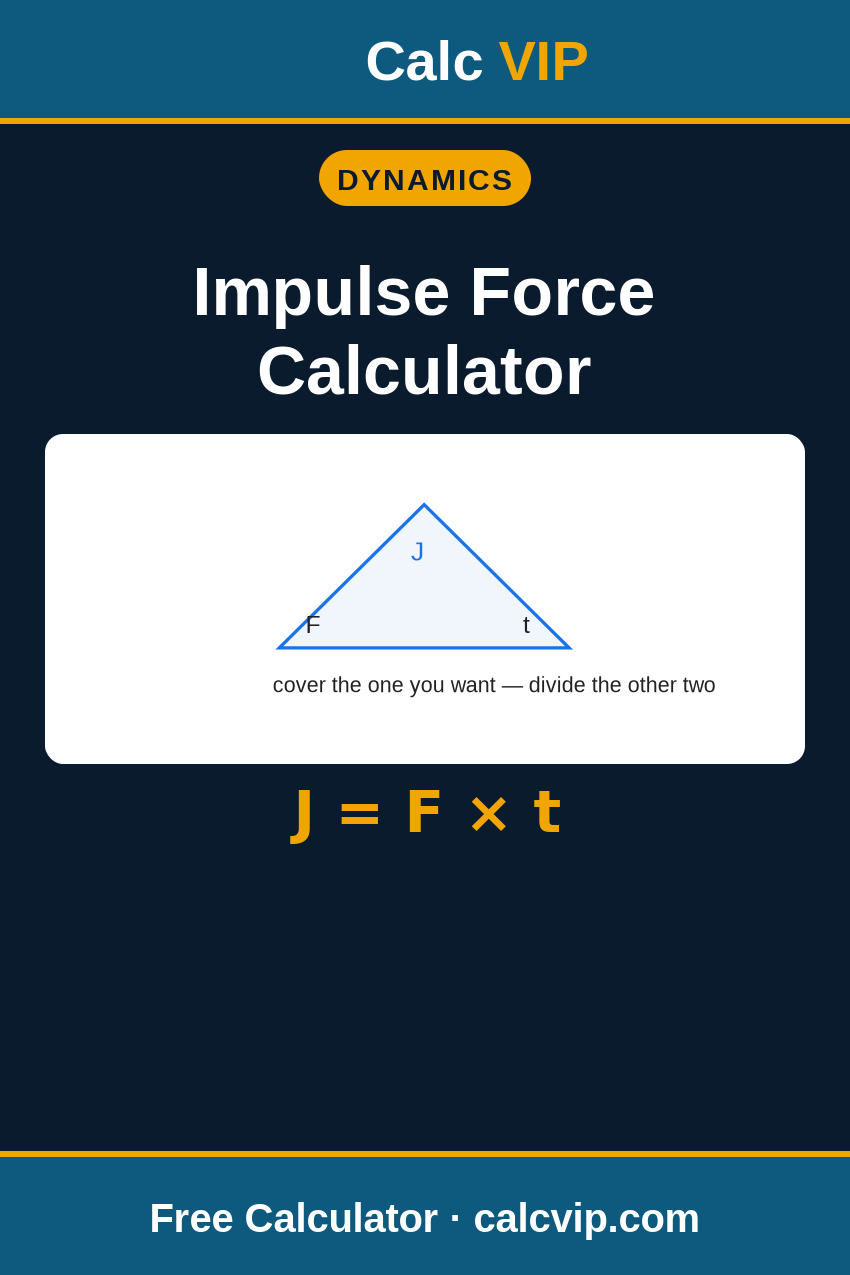
One warning belongs at the top, because everything else on the page depends on it: the force in J = F × t is an average. Real impact forces are hills, not plateaus — they rise to a peak and fall away. The average is the honest summary the impulse guarantees, and it is the right number for comparing designs, but the peak a material must survive is typically about twice the average for a smooth impact. Keep that factor in mind whenever a calculated force is set against a breaking strength.
Formula
J = F × t • F = J / t • t = J / F — one relationship, three unknowns. Impulse J is measured in N·s and equals the change in momentum, Δp.
The three forms are one equation read three ways, and the triangle diagram above is the classic memory aid: cover the quantity you want, and the arrangement of the other two tells you the operation — side by side means multiply, stacked means divide. Behind the algebra sits the impulse–momentum theorem, J = Δp, which is what gives J its physical meaning and its units: a newton-second is a kilogram-metre-per-second, the unit of momentum itself. The equation assumes a constant force; for a varying force, J is the area under the force–time curve and F in the formula is the time-average, F = J / t. That is not a weakness but the design: whatever the force profile, the average is pinned by the impulse, and the impulse is pinned by the momentum change — so the average force of even the messiest real impact is knowable from clean before-and-after measurements.
| Symbol | Meaning | Units |
|---|---|---|
| J | impulse — force accumulated over time; equals Δp | N·s (= kg·m/s) |
| F | average force during the interaction | newtons (N) |
| t | duration of the interaction | seconds (s) |
| Δp | change in momentum the impulse produces | kg·m/s |
Average force, peak force, and the shape of an impact
Hold the impulse fixed and imagine the force–time graph redrawing itself. Compress the event and the graph becomes a tall, narrow spike: same area, terrifying peak. Stretch it and the graph flattens into a long, low swell. Everything in impact engineering is the art of choosing where on that trade a design should sit. A hammer driving a nail chooses the spike — it wants a peak force that overwhelms the wood's resistance in two milliseconds. A helmet chooses the swell — it wants the head's fixed Δp delivered at the lowest peak foam can arrange. Neither changes the impulse; the momentum change was decided by the masses and velocities before the event began. They change only the delivery schedule, and J = F × t is the schedule's arithmetic.
Because the calculator reports the average, one conversion is worth memorising: for a roughly triangular force pulse, the peak is about twice the average; for a half-sine pulse, about 1.6 times. When Example 2 below finds an average airbag force of about 6,500 N, the peak the body actually feels is nearer 10,000–13,000 N. Averages compare designs honestly; peaks break things. Report both, design for the peak.
In practice, impulses are measured more often than they are calculated. Force plates under athletes record F(t) thousands of times per second and integrate it to give the impulse of a jump or a sprint start; accelerometers in crash-test dummies and instrumented helmets do the same for impacts, reconstructing Δp from the recorded curve; and ballistic chronographs infer a bullet's momentum — hence the impulse its firing delivered — from velocities alone. In every case the workflow is the theorem run in whichever direction the instruments allow: measure any two corners of the J–F–t triangle, or the Δp it equals, and the rest of the event is determined. That interchangeability is what makes impulse such a durable engineering quantity.
How to use
- Pick what to solve for in the dropdown — force, time or impulse. The two input boxes relabel themselves to match.
- Enter the two values you know (impulse in N·s, force in N, time in seconds — milliseconds must be converted: 5 ms = 0.005 s).
- Click the button to get the missing value.
- If your problem starts from masses and velocities rather than an impulse, get J first: J = Δp = m(v − u), using our Momentum Change Calculator — then return here for the force or the time.
Worked examples
Example 1 — one impulse, all three modes. A crash delivers an impulse of 50 N·s over 0.25 s. Solving for force:
F = J / t = 50 / 0.25 = 200 N.
Check with the time mode: t = J / F = 50 / 200 = 0.25 s — consistent. And the impulse mode closes the triangle: J = F × t = 200 × 0.25 = 50 N·s. Three modes, one fact: any two of the values regenerate the third, which is the fastest self-check this calculator offers.
Example 2 — the airbag's bargain. A 70 kg driver's velocity changes by 14 m/s in a crash, so the impulse that must be delivered is J = Δp = 70 × 14 = 980 N·s. Against a hard dashboard the stop might take 0.01 s: F = 980 / 0.01 = 98,000 N — unsurvivable. The airbag stretches the delivery to 0.15 s: F = 980 / 0.15 ≈ 6,533 N. The impulse never changed; the bag bought fifteen times the time and sold the force down by the same factor. Every safety device in the car is a variation on this single division.
Example 3 — the bat's millisecond. A bat exerts an average force of about 4,000 N on a ball for 0.0012 s (just over a millisecond of contact). Impulse mode: J = 4,000 × 0.0012 = 4.8 N·s. Applied to a 0.145 kg baseball, that impulse is a momentum change of 4.8 kg·m/s — a velocity change of about 33 m/s. Enormous force, trivial duration, modest impulse: the three quantities keep each other honest.
Example 4 — landing a jump. A gymnast arrives at the mat carrying an impulse of 350 N·s to cancel. Landing stiff-legged, the stop takes 0.05 s: F = 350 / 0.05 = 7,000 N through the joints. Landing with deeply bent knees and a roll, the stop stretches to 0.4 s: F = 350 / 0.4 = 875 N. Eight times the time, an eighth of the force — the entire technique of falling safely, from parachute rolls to parkour, is this example rehearsed.
Example 5 — the rocket's long push. A launcher engine produces 1,000,000 N of thrust sustained for 150 s. J = 1,000,000 × 150 = 150,000,000 N·s — one hundred and fifty million newton-seconds of impulse. No chemical explosion could apply a comparable force for even a second; the rocket wins its momentum the other way, with a merely large force granted an enormous time. Impulse does not care which of its two factors did the work.
Example 6 — solving for time. A packaging engineer needs a foam insert to deliver an impulse of 12 N·s while never averaging more than 300 N. Time mode: t = J / F = 12 / 300 = 0.04 s — the foam must keep the product decelerating for at least 40 milliseconds, which sets the foam's thickness and softness. This is the mode designers live in: force is the constraint, impulse is the requirement, and time is the deliverable.
Impulse and force in real life
Airbags, belts and crumple zones. The holy trinity of crash safety is one idea in three costumes: stretch t. Each device surrenders distance and milliseconds so that F = J / t stays survivable — Example 2 with sheet metal and nylon.
Boxing gloves and riding a punch. Gloves pad the contact, adding milliseconds; a skilled boxer also moves with the blow, adding more. Both attack the same variable. The impulse of the punch is largely fixed at launch — its force is negotiable until the moment it lands.
Hammer versus press. A nail can be driven by a hammer's 2-millisecond spike or a press's slow squeeze delivering the same impulse. The hammer wins because the wood's resistance must be exceeded, not merely matched over time — a case where the peak, not the average, does the work.
Jumping and landing technique. Bent knees, rolling landings, sand pits: every falling discipline is a scheme for buying time. Example 4's eightfold force reduction is available to anyone who lands like a gymnast instead of a statue.
Ion propulsion. Deep-space probes use thrusts of a fraction of a newton — less than the weight of a sheet of paper — applied for years. The impulse accumulates relentlessly: 0.1 N for three years is about 9.5 million N·s, enough to change a probe's velocity by kilometres per second. Time is the ion engine's fuel multiplier.
Docking and berthing. When massive spacecraft meet, capture mechanisms are tuned to make the contact long and soft. The momentum that must be exchanged is fixed by the approach speed; spreading it over seconds keeps the forces within what docking rings — and crews — can take.
Designing with the equation: force is bought with time
Read the three modes as three professions. Force mode is the investigator's: the event happened, its impulse and duration are measurable, and the force explains the damage. Time mode is the designer's: the impulse is required and the force is capped by what people or products survive, so the equation outputs a minimum duration that padding, crumple or cord-stretch must provide. Impulse mode is the performer's: force and contact time are what a body or engine can actually produce, and the product is the momentum change on offer — the serve's speed, the probe's Δv. Students often meet the equation as a formula to rearrange; practitioners meet it as a budget to negotiate. The negotiation never includes J itself once the masses and velocities are set — that is the theorem's stern little gift.
Quick reference: impulses of familiar events
| Event | Impulse J | How it is delivered |
|---|---|---|
| golf drive (ball leaves at ~70 m/s) | ≈ 3.2 N·s | thousands of N for ~0.5 ms |
| catching a baseball at 40 m/s | ≈ 5.8 N·s | glove and arm giving over ~0.1 s |
| bat on a baseball | ≈ 4.8 N·s | ~4,000 N for ~1.2 ms |
| car occupant in a 14 m/s crash | ≈ 980 N·s | airbag over ~0.15 s, ≈ 6,500 N average |
| rocket first-stage burn | ≈ 1.5 × 10⁸ N·s | ~10⁶ N sustained for ~150 s |
Five orders of magnitude separate the golf drive from the rocket burn, yet one three-symbol equation prices them all. That is the mark of a real law of physics: it does not care about the scale of the stage it is performed on.
Common mistakes
- Entering milliseconds as seconds. A 5 ms contact is 0.005 s. Skip the conversion and the computed force shrinks a thousandfold — the most common impulse error by a wide margin, and the reason so many first attempts "prove" that a bat pushes with the force of a handshake.
- Solving for the wrong variable. The triangle is symmetric and unforgiving: F = J / t, not J × t. If your force comes out suspiciously round and huge, you probably multiplied. The dropdown exists to prevent exactly this — pick the unknown first, then type.
- Using the peak force as F. J = F × t holds for the average force. Feed in a measured peak and the impulse is overstated — for a triangular pulse, by a factor of two.
- Forgetting that impulse needs a momentum change. Given masses and velocities, there is no impulse until Δp is computed. Students sometimes insert a velocity where J belongs; the units give it away — N·s is not m/s.
- Assuming a longer time always means a smaller effect. Longer time at the same force means a larger impulse. The force only falls when the impulse is held fixed. Which quantity is fixed is the first question to ask of any impulse problem.
FAQ
Is this the peak force or the average force?
The average force. Real forces during a collision rise and fall; J = F × t with a single F gives the constant force that would deliver the same impulse in the same time.
How do I get the impulse if I only know the motion?
Impulse equals the change in momentum, J = Δp = m(v − u). Work that out first (our Momentum Change Calculator does it), then use this tool to find the force or time.
Why do boxers "ride" a punch?
Moving the head back stretches the contact time t. The impulse is the same, but F = J/t is smaller, so the punch hurts less.
How much bigger is the peak force than the average?
For a smooth, roughly triangular impact pulse, about twice; for a half-sine pulse, about 1.6 times. The average from this calculator is the right basis for comparing designs, but structures and safety limits should be checked against the estimated peak.
Can impulse be negative?
Impulse is a vector, so it carries the force's direction: an impulse opposing the motion is negative in that coordinate. Most practical questions ask for the magnitude, and the calculator works with the values as entered — consistent signs give consistent answers.
Why can a tiny force move a spacecraft?
Because time multiplies it. A 0.1 N ion thruster firing for three years delivers roughly 9.5 million N·s of impulse. Given years, even a whisper of force accumulates into kilometres per second of velocity change — there is no friction in space to spend it against.
Is a newton-second really the same as a kg·m/s?
Yes: a newton is kg·m/s², so N·s = kg·m/s exactly. The identity is the impulse–momentum theorem wearing unit clothes, and a handy audit — if your J and Δp disagree in these units, the arithmetic is wrong somewhere.
What if the force is not constant?
Then J is the area under the force–time curve, and F in the formula is the average over the contact. The calculator's answers remain exactly right for that average; only the peak needs the pulse-shape correction described above.
Does a longer contact time always reduce the force?
Only when the impulse is fixed — the crash case. If instead the force is fixed (an engine, a shove), a longer time increases the impulse and the momentum change. Ask which quantity the situation holds constant before predicting anything.
Why does a hammer drive a nail better than a slow press with the same impulse?
Because driving is about exceeding the wood's resistive force, not just matching its impulse budget. The hammer concentrates the impulse into a peak that overwhelms the resistance instantly; the press spreads it below the threshold. Same J, different delivery — the theme of this entire page.