 Calc
Incline Plane Calculator – Force Components, Friction & Acceleration
 Created by James Carter · Physics Writer · Forces & Motion · Last updated: November 2026
Use this free Incline Plane Calculator to analyse a mass on a slope: it splits the weight into its along-slope and into-slope components, works out the normal force and kinetic friction, and finds the net force and acceleration down the slope. Enter the mass, the slope angle and the coefficient of kinetic friction (zero for a frictionless ramp).
The inclined plane is the oldest machine in the world — the ramp that raised pyramid stones and still raises wheelchairs, lorries and luggage. Its physics is a single move, endlessly reused: tilt the world, and gravity, which normally points helpfully downwards, divides into two parts with different jobs. One part presses the object into the slope, where the surface's normal force cancels it. The other part points along the slope, uncancelled, and it is this part that drags objects downhill. Everything on this page is arithmetic hung on that split.
The split follows the angle with trigonometric precision. The along-slope component is mg sin θ; the into-slope component is mg cos θ. Double the angle and you do not double the slide — sin θ curves, slowly at first, then steeply, which is why a 10° driveway feels tame and a 30° one feels like a ski jump. Friction then takes its cut of what remains: kinetic friction μk × N opposes the slide, and whatever force survives both gravity's geometry and friction's tax becomes the net force that accelerates the object downhill.
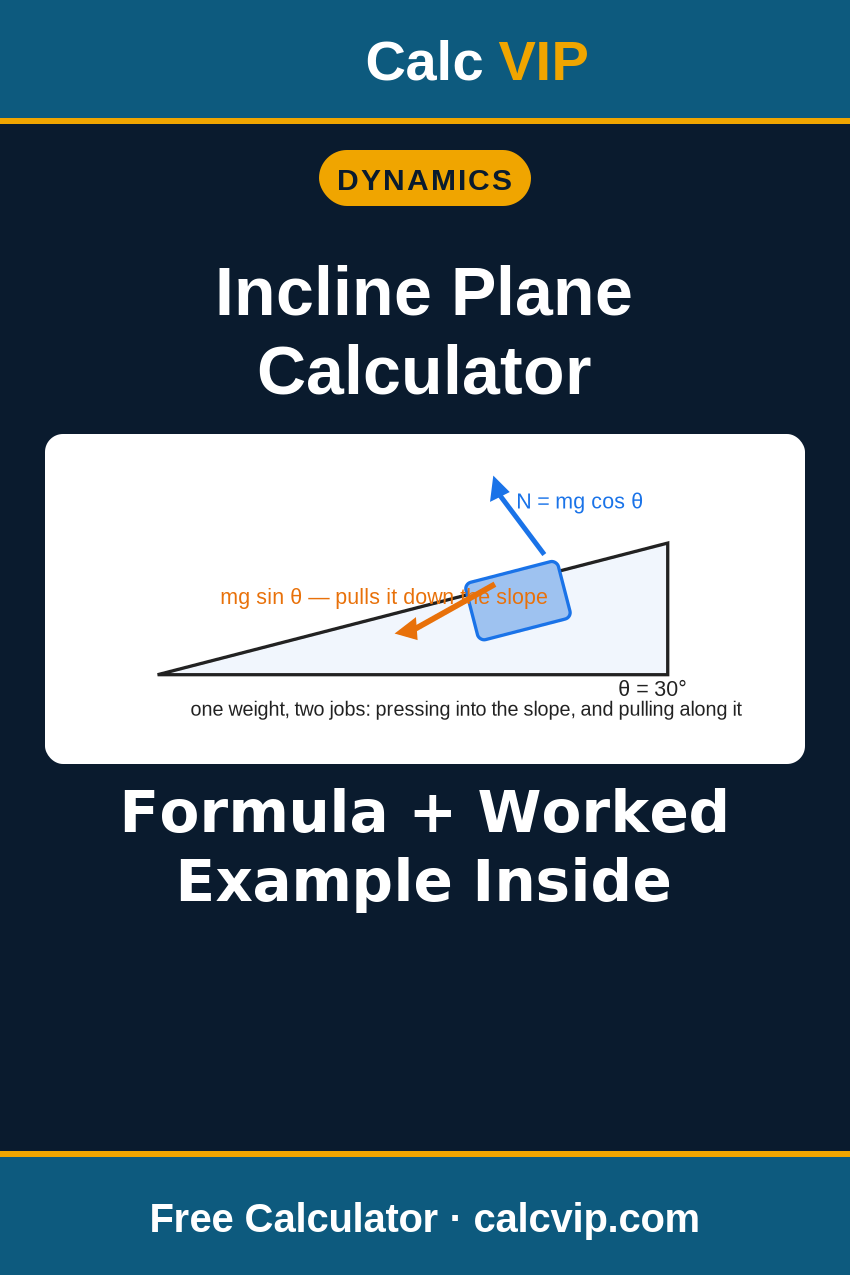
Enter mass, angle and μk and the calculator returns the full breakdown — both components, the normal force, friction, net force and acceleration — including the honest verdict when friction wins and the object does not slide at all. It is the complete one-page story of every ramp, hill, roof and slide.
Formula
Along-slope pull: mg sin θ • Normal force: N = mg cos θ • Kinetic friction: f = μk × N • Net force: mg sin θ − f • Acceleration: a = g (sin θ − μk cos θ)
Read the acceleration formula as a contest in one line: sin θ is gravity's share working for the slide, μk cos θ is friction's share working against it, and g scales both. The mass cancels — divide net force by m and m disappears — which is why the formula has no m in it, and why (as the FAQ repeats) heavy and light objects accelerate down the same slope at the same rate. The formula also contains its own stopping condition: if μk cos θ ≥ sin θ — equivalently μk ≥ tan θ — the bracket is zero or negative and there is no slide; friction can hold the object, and this calculator reports that case rather than inventing a negative acceleration. Rearranged for design, the friction needed to hold a slope is simply μ ≥ tan θ, a rule used from conveyor belts to hiking boots.
| Symbol | Meaning | Units |
|---|---|---|
| m, g | mass; gravitational field strength (9.81 on Earth) | kg; m/s² |
| θ | slope angle above the horizontal | degrees (°) |
| N | normal force, mg cos θ | newtons (N) |
| μk | coefficient of kinetic friction (0 = frictionless) | dimensionless |
| a | acceleration down the slope | m/s² |
Why the weight splits — and why the mass cancels
A force pointing one way can always be described as two forces pointing other ways, provided the pair would add back to the original. Gravity points straight down; on a slope the two directions that matter are "into the surface" and "along the surface", because those are the directions in which things can happen — the object can press, and it can slide. Splitting mg into mg cos θ (into) and mg sin θ (along) is choosing the description that matches the slope's possibilities. The into part is annihilated by the normal force; the along part is free to act. Nothing is created or lost: the two components square-and-add back to mg exactly.
The mass cancellation deserves a slower look, because it surprises everyone the first time. A heavier block has proportionally more along-slope pull — but proportionally more friction too, and proportionally more inertia to accelerate. All three effects scale with m, so m drops out of a = Fnet ÷ m entirely. A laden lorry and an empty one, on the same icy hill with the same μk, accelerate downhill identically (their brakes and tyres face very different problems, but gravity's arithmetic does not care). Galileo's insight that falling is mass-blind survives intact on the slope; the incline merely dilutes g by the factor (sin θ − μk cos θ).
That dilution is the ramp's whole purpose as a machine. A frictionless 30° slope halves the effective pull (sin 30° = 0.5): a load can be raised along it with half the force needed to lift it vertically, paid for by travelling twice the distance. Every ramp, switchback road and screw thread (an incline wrapped around a cylinder) is this trade — force for distance — and the component formulas are its exchange rates.
How to use
- Enter the mass of the object in kilograms.
- Enter the slope angle θ in degrees above the horizontal.
- Enter the coefficient of kinetic friction μk — 0 for a frictionless ramp, about 0.1 for a waxed ski slope, 0.3 or more for rough surfaces.
- Click "Calculate" to see both weight components, the normal force, friction, the net force and the acceleration — or the message that the object does not slide.
Worked examples
Example 1 — the full breakdown. A 5 kg block on a 30° slope with μk = 0.2. Its weight is 49.05 N.
Along-slope pull: mg sin θ = 49.05 × 0.5 = 24.53 N.
Normal force: N = mg cos θ = 49.05 × 0.866 = 42.48 N.
Friction: f = 0.2 × 42.48 = 8.50 N.
Net force: 24.53 − 8.50 = 16.03 N, so a = 16.03 ÷ 5 = 3.21 m/s² down the slope. Every number in the chain is on display — change any input and the whole chain re-derives itself.
Example 2 — the frictionless ideal. A 10 kg block on a frictionless 30° ramp (μk = 0): a = g sin θ = 9.81 × 0.5 = 4.905 m/s², exactly half of free fall. The along-slope pull is 98.1 × 0.5 = 49.05 N with nothing subtracted. This is Galileo's diluted gravity in its purest form — the experiment he could actually time with water clocks and pulse beats.
Example 3 — a skier. A 70 kg skier on a 25° slope with μk = 0.1 (waxed skis on snow). Along-slope pull: 686.7 × sin 25° = 290.21 N. Normal force: 686.7 × cos 25° = 622.36 N, so friction is 0.1 × 622.36 = 62.24 N. Net force: 290.21 − 62.24 = 227.97 N, and a = 227.97 ÷ 70 = 3.26 m/s². Friction cost the skier barely a fifth of the pull — on snow, the slope's angle, not its surface, is the throttle.
Example 4 — the slope that holds. A crate on a 15° ramp with μk = 0.3: tan 15° = 0.268 < 0.3, so the friction ceiling μN exceeds the along-slope pull mg sin θ, and the crate does not slide. In practice static friction (stronger still) is what holds it; the lesson is the comparison itself — tan θ versus μ is the two-second test for any ramp, roof load or parked slope.
Example 5 — steep and slippery. A 2 kg puck on a 45° slope with μk = 0.15: a = 9.81 × (sin 45° − 0.15 × cos 45°) = 9.81 × (0.7071 − 0.1061) = 9.81 × 0.6010 = 5.90 m/s². At 45° the two components are equal, so friction's bite is μ times the full along-slope pull — and still the puck accelerates at 60% of g.
Example 6 — the parked car. A 1,200 kg car parked on a 10° hill: the along-slope component of its weight is 11,772 × sin 10° = 2,044 N — over two thousand newtons trying to roll the car backwards, held entirely by the handbrake's friction and the gearbox's park pawl. "Gentle hill" is a visual judgement; the component formula disagrees, and it is right.
Incline planes in real life
Roads and switchbacks. Mountain roads zig-zag to keep θ small: a lorry's engine and brakes can handle a sin θ of perhaps 0.1 (about 6°) sustained. The gradient signs on hills — "1 in 10" — are sin θ wearing a costume.
Roofs and snow load. Roof pitch is chosen partly by this page's tan θ test: steep enough that snow's along-slope component beats friction and sheds, shallow enough that tiles and workers stay put. Avalanche forecasting is the same comparison, run on a mountainside with the snowpack's μ in the starring role.
Playground slides. A slide is an incline tuned so that tan θ comfortably exceeds the μk of clothing on metal or plastic — with the acceleration capped by keeping θ moderate and the run short. A slide that "doesn't work" in wet weather is a μ that changed its mind.
Conveyors and chutes. Bulk materials — grain, gravel, ore — have characteristic angles of repose set by tan θ = μ between grains. Hopper and chute angles are designed around those numbers, a few degrees past the slip point so the material flows but does not avalanche.
Ramps for access and loading. The force to push a load up a ramp is mg sin θ plus friction; halving the angle roughly halves the push. Loading-dock and wheelchair-ramp standards are this formula translated into maximum permitted gradients.
Escape chutes and emergency slides. Aircraft evacuation slides deploy at angles steep enough to guarantee sliding for every passenger weight — possible precisely because the acceleration does not depend on mass — while friction in the slide material caps the arrival speed.
The angle of repose: the slope that builds itself
Pour a pile of sand, grain or gravel and the heap settles at a characteristic steepness — the angle of repose — the same for a bucketful or a lorry load. That angle is the slip condition made visible: at the surface of the pile, grains rest exactly at the point where tan θ = μ between them; any steeper and the surface layer slides down until the angle is restored. Sand piles sit near 34°, gravel near 40°, and the number is a material property as real as density. The angle of repose also quietly governs landscapes: scree slopes under cliffs rest at it, sand dunes' slip faces hold it, and an hourglass is a machine for displaying it twice a minute. Whenever a granular material chooses its own slope, it is solving this page's equation with itself.
The ramp as a machine: trading force for distance
Stand the problem on its head — instead of sliding down, haul the load up. To raise a 100 kg load (weight 981 N) vertically you must pull with the full 981 N. Drag it up a frictionless 20° ramp instead and the required steady pull is just the along-slope component, mg sin 20° = 981 × 0.342 = 335.5 N — a third of the force. The bill arrives as distance: to gain a metre of height along a 20° ramp you travel 1 ÷ sin 20° = 2.92 m of slope. Force divided by about three, distance multiplied by about three, and the product — the work — unchanged. That exact trade is why ramps were worth building temples with, why luggage wheels up a long shallow ramp instead of being carried up stairs, and why the screw, the wedge and the switchback road are all this one machine in different costumes.
Quick reference: frictionless acceleration by angle
| Angle θ | sin θ | a = g sin θ (frictionless) |
|---|---|---|
| 10° | 0.174 | 1.70 m/s² |
| 20° | 0.342 | 3.36 m/s² |
| 30° | 0.500 | 4.91 m/s² |
| 45° | 0.707 | 6.94 m/s² |
| 60° | 0.866 | 8.50 m/s² |
| 90° (vertical) | 1.000 | 9.81 m/s² — free fall |
The table's last row is the sanity check for the whole topic: a 90° "slope" is a cliff, and the formula correctly returns free fall. Friction subtracts μk cos θ from every row — at 90° friction vanishes with the normal force, exactly as it should.
Common mistakes
- Swapping sin and cos. The along-slope component is mg sin θ, the into-slope is mg cos θ. Check with θ = 0: the along-slope pull must vanish (sin 0° = 0 ✓) and N must equal mg (cos 0° = 1 ✓).
- Computing friction as μ × mg. Friction multiplies the normal force, and on a slope that is mg cos θ. Using mg overstates friction on every slope and can flip a "slides" verdict to "stays".
- Expecting heavier objects to slide faster. The mass cancels in a = g(sin θ − μk cos θ). Heavy and light objects accelerate together; only the forces, not the acceleration, scale with m.
- Reporting a negative acceleration when friction wins. If μ ≥ tan θ the object does not slide — the answer is zero acceleration (held by friction), not a negative slide uphill. Friction cannot push an object up a slope it was resting on.
- Measuring θ from the vertical. All formulas here take θ from the horizontal. A diagram drawn from the vertical swaps every sin for a cos — convert the angle before calculating.
FAQ
Why split the weight into components?
On a slope, gravity pulls partly into the surface (which the normal force cancels) and partly along it (which makes the object slide). The components mg cos θ and mg sin θ capture those two effects.
Does a heavier block accelerate faster down the slope?
No. The mass cancels out: a = g (sin θ − μk cos θ). A heavier block has proportionally more pull and more friction, so the acceleration is the same.
What if friction is bigger than the down-slope pull?
Then the block cannot slide on kinetic friction alone — in practice static friction holds it still, and the acceleration is zero. This calculator reports that case as no sliding.
What happens on a frictionless 90° slope?
The object free-falls: sin 90° = 1 gives a = g, and cos 90° = 0 gives N = 0 and therefore no friction. The incline formulas contain vertical fall as their limiting case.
Why did Galileo use inclines?
To dilute gravity. On a shallow slope the acceleration is a small, measurable fraction of g, slow enough to time with the instruments of 1600 — letting him establish that distance grows with time squared long before anyone could time a true free fall.
Does the object slide at constant speed ever?
Only if some other force grows to cancel the net force — air drag at high speed, for instance — or on the special slope where an opposing push is applied. With gravity and friction alone, a sliding object on a uniform slope accelerates uniformly.
What angle makes the acceleration half of g?
Frictionless, sin θ = 0.5 gives θ = 30°. With friction the angle must be steeper: solve sin θ − μk cos θ = 0.5 — for μk = 0.2 that is about 40°.
Is the normal force on a slope ever equal to mg?
Only at θ = 0. For any real slope cos θ < 1, so N < mg — the shortfall being exactly the weight share redirected along the slope.
How do I push something up the slope?
Your push must beat the along-slope pull plus friction, which now points downhill too: F = mg sin θ + μk mg cos θ to move at steady speed. This is why ramps are pushed up slowly and slid down never.
Why do roads use gradient percentages instead of angles?
Gradient is rise ÷ run × 100 ≈ tan θ × 100 for small angles — a 10% gradient is about 5.7°. It is the builder's version of the same number, measured with a level and a tape rather than a protractor.