 Calc
Inclined Plane Mechanical Advantage Calculator – MA = Length/Height
 Created by James Carter · Physics Writer · Forces & Motion · Last updated: November 2026
Use this free Inclined Plane Mechanical Advantage Calculator to find the MA of a ramp from its length and height, plus the effort needed to push a load up a frictionless slope.
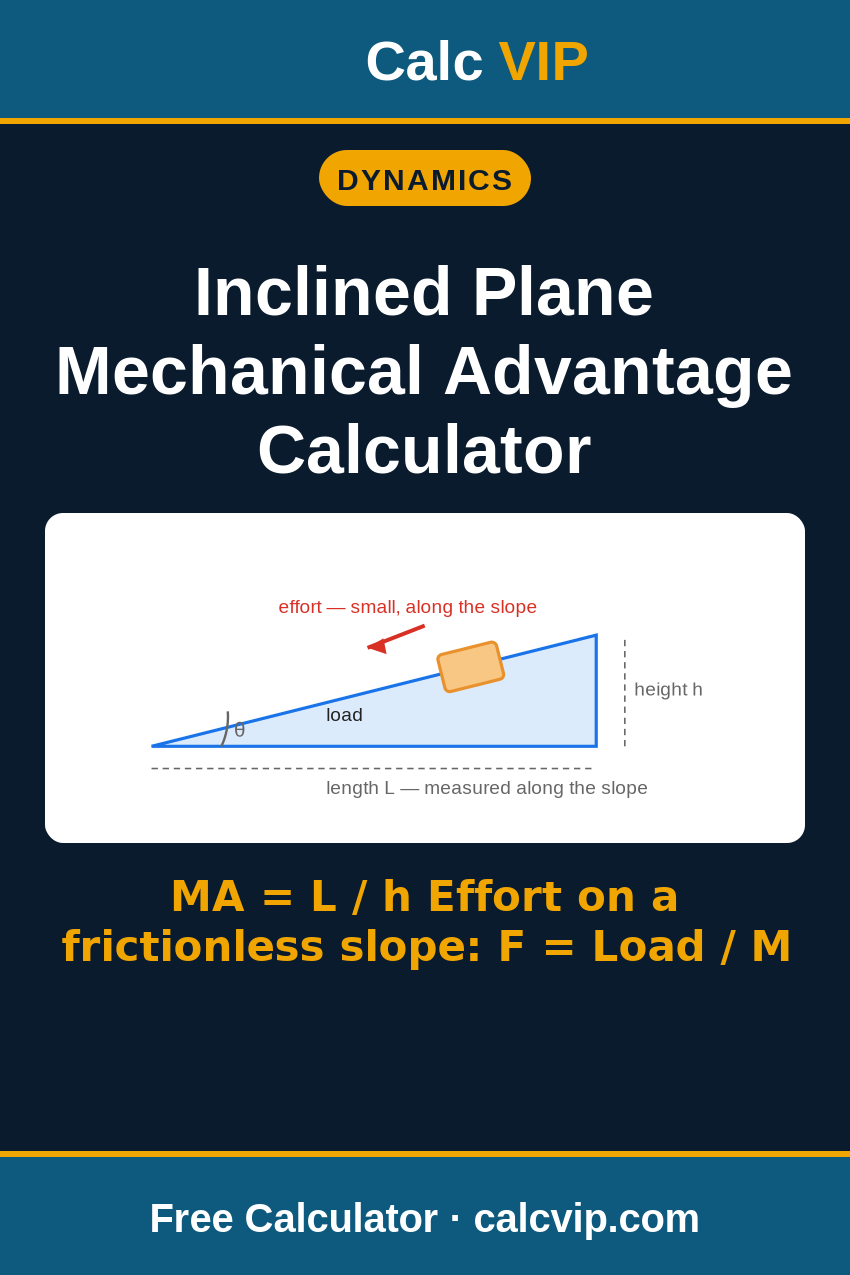
The inclined plane is the oldest machine in the world and still the most quietly indispensable. Long before wheels were common, a ramp let a crew drag a two-tonne stone block with a force a fraction of its weight; today the same geometry moves wheelchairs into buildings, lorries onto ferries and cars up multi-storey car parks. The trick is always the same: spread a lift over a longer distance. Raise a load by height h along a ramp of length L and the effort shrinks in the ratio h/L — the mechanical advantage is L/h, and this calculator finds it, the ideal effort and the slope angle from just the ramp's two dimensions and the load's weight.
The exchange is governed by the golden rule of machines: what you gain in force you pay in distance. The work done pushing along the ramp equals the work of lifting straight up — effort × L = load × h in the ideal, frictionless case — so the force advantage L/h is exactly repaid by travelling L instead of h. No machine creates energy; the ramp merely lets a small force, applied patiently over a long path, do the work of a large one. That is why the formula contains no materials, no masses beyond the load's weight and no magic: two lengths decide everything.
Reality adds one character the ideal formula omits: friction. Friction raises the effort needed to push a load up (and is the reason real ramps need more than the ideal push), yet it is also what stops the load sliding back down the moment you rest, and what lets wheeled loads be parked mid-slope. This page computes the ideal numbers — the benchmark against which real ramps are compared — and the discussion below shows how friction moves the answer, and why a gentler slope is not always the practical winner once length, space and grip enter the design.
Formula
Mechanical advantage: MA = L / h
Effort on a frictionless slope: F = Load / MA = Load × h / L
Slope angle: θ = sin⁻¹( h / L )
The three lines are one idea in three outfits. The effort formula can be read as Load × sin θ, because h/L is sin θ — the component of the load's weight acting down the slope is W sin θ, and the effort must match exactly that component on a frictionless ramp. The rearrangements answer the designer's other questions: L = MA × h (how long a ramp a chosen advantage demands), h = L / MA (how much lift a given ramp and advantage deliver), and Load = F × MA (the heaviest load a given effort can raise). Keep L and h in the same unit — metres with metres — since MA is a pure ratio; the load enters in newtons (mass in kg × 9.81 if you are given kilograms).
| Symbol | Meaning | Units |
|---|---|---|
| MA | mechanical advantage — load ÷ effort | none (a ratio) |
| L | length of the slope, measured along the ramp | m |
| h | vertical height the load is raised | m |
| F | effort force, applied parallel to the slope | N |
| θ | slope angle above the horizontal | degrees (°) |
Why the effort is W sin θ: the weight splits in two
Stand a load on a slope and its weight, which points straight down, stops being a single-purpose force. Resolved against the slope's geometry it becomes two components: W cos θ pressing the load into the surface (which the surface's normal force cancels) and W sin θ pulling it down along the slope. Only the second component needs fighting. On a frictionless ramp your effort must equal W sin θ exactly — no more, or the load accelerates up; no less, or it slides back. Since sin θ = h/L, the effort is W × h/L and the mechanical advantage is L/h: the two derivations, one from energy and one from force components, arrive at the same answer, as they must. The component picture also explains the extremes. On the flat (θ = 0) the downhill component vanishes and no effort is needed to hold the load; stood vertical (θ = 90°) the ramp is a wall and the "effort" is the full weight — the machine has become a straight lift and the advantage has drained to 1.
Friction inserts itself into this picture as a third force along the slope, opposing whichever way the load would move. Pushing up, it adds to W sin θ, so the real effort is W(sin θ + μ cos θ); resting, it subtracts, holding the load whenever μ ≥ tan θ — the same angle-of-repose condition as the friction page's. The efficiency of a real ramp is the ratio of ideal to actual effort, sin θ / (sin θ + μ cos θ), and it carries a design lesson: on a very gentle slope the sin θ term shrinks towards the friction term and efficiency collapses — a long, nearly flat ramp can waste most of your push on friction, which is why real ramps are designed no gentler than the job requires.
How to use
- Enter the length of the ramp measured along the slope, in metres.
- Enter the vertical height the load is raised, and the load's weight in newtons.
- Click "Calculate" to get the MA, the ideal effort and the slope angle.
- Treat the effort as the frictionless minimum: budget a real push noticeably larger, especially on rough or dirty surfaces.
Worked examples
Example 1 — the standard ramp. A ramp is 5 m long and raises a 1000 N load by 1 m.
MA = 5 / 1 = 5.
Effort = 1000 / 5 = 200 N, and the slope angle is sin⁻¹(1/5) = 11.54°.
A longer, gentler ramp would need even less effort — but a longer push.
Example 2 — a wheelchair access ramp. A ramp 6 m long lifts an 800 N chair-and-user by 0.5 m: MA = 6 / 0.5 = 12, effort = 800 / 12 = 66.67 N, angle = sin⁻¹(0.5/6) = 4.78°. Building codes specify maximum gradients for exactly this reason — at MA 12 the push is gentle enough for most users to self-propel; halve the ramp's length and the effort doubles past many people's strength.
Example 3 — a loading dock. A dock ramp 3 m long rises 1.2 m to the lorry bed, moving a 2500 N pallet: MA = 3 / 1.2 = 2.5, effort = 2500 / 2.5 = 1000 N, angle = 23.58°. A steep, short ramp — which is why dock work uses forklifts and pallet trucks rather than shoulders: 1000 N is the weight of a 100 kg mass, demanded continuously up the slope.
Example 4 — a pyramid builder's ramp. A construction ramp 60 m long rises 10 m, hauling a stone block weighing 25,000 N: MA = 6, effort = 25,000 / 6 = 4166.67 N, angle = 9.59°. Shared among a hauling gang — say twenty people — that is about 208 N each: hard, sustainable work. This arithmetic, with friction added, is the core of every serious theory of how the pyramids were built.
Example 5 — moving a fridge. Planks 4 m long bridge a 1.5 m rise into a van for a fridge weighing 900 N: MA = 4 / 1.5 = 2.67, effort = 900 / 2.67 = 337.5 N, angle = 22.02°. Two movers pushing together supply about 170 N each — the difference between a controlled slide and a dropped appliance is written in these numbers.
Example 6 — a mountain road. A pass road climbs 100 m over 2000 m of road for a vehicle weighing 15,000 N: MA = 20, effort = 15,000 / 20 = 750 N of steady tractive force, angle = 2.87°. The road is an inclined plane the engine works against for kilometres — which is why the same climb on a direct 20% slope would defeat the car entirely.
Inclined planes in real life
Accessibility ramps. Building regulations cap ramp gradients (commonly 1:12 or gentler — MA 12) so that the effort stays within human capability. Every compliant ramp is this page's formula turned into law, with landings added where the distance cost of the advantage becomes exhausting.
Mountain roads and switchbacks. Hairpin bends stretch L while h stays fixed, buying mechanical advantage for engines and brakes alike. The pass road of Example 6 is a machine two kilometres long, and its gradient sign at the summit is an MA rating in disguise.
Screws, wedges and axes. Wrap an inclined plane around a cylinder and it becomes a screw thread, whose tiny h per turn yields enormous MA; drive a thin plane into wood and it is a wedge or an axe blade, splitting with a force multiplication set by its length-to-thickness ratio. The family is one geometry in three costumes.
Loading and logistics. Tail lifts, dock boards, ferry ramps and aircraft cargo loaders are inclined planes specified by this calculation: the effort figure decides whether the job needs one worker, two, or a powered winch.
Escalators and travelators. A moving ramp trades the passenger's effort for the motor's, but the physics is unchanged: the motor supplies W sin θ per passenger, continuously, which is why a crowded escalator's power draw is dominated by the simple product of weight and vertical speed.
Landslides and avalanches. A slope is an inclined plane waiting for its friction to fail: when the angle exceeds the material's angle of repose — or rain lowers the effective μ — the "load" accelerates down with nothing supplying the effort but its own W sin θ. Slope-stability engineering is this page read in reverse.
The screw: an inclined plane in disguise
Cut a paper right triangle and wrap it around a pencil: the hypotenuse becomes a helix — a screw thread. The screw is an inclined plane wound into a cylinder, and its mechanical advantage follows the same rule with L now the circumference travelled in one turn and h the pitch, the distance the screw advances per turn. A screw jack with a handle sweeping a 2 m circumference and a thread pitch of 4 mm has an ideal MA of 2 / 0.004 = 500, enough for one person to lift a car — paying for it, as the golden rule demands, with hundreds of turns. Friction, the villain of the ramp, becomes the hero here: it is what stops the screw unwinding under load, making the jack self-locking. Vices, clamps, bottle openers' worm gears and the Archimedes screw that lifts water are all the same wrapped ramp, which is why this humble formula reaches so far.
Quick reference: slope angle, MA and effort for a 1000 N load
| Slope angle θ | MA = 1 / sin θ | Ideal effort (1000 N load) |
|---|---|---|
| 2.87° (mountain road) | 20 | 50 N |
| 4.78° (access ramp) | 12 | 83 N |
| 11.54° | 5 | 200 N |
| 23.58° | 2.5 | 400 N |
| 30° | 2 | 500 N |
| 90° (straight lift) | 1 | 1000 N |
The bottom row is the sanity anchor: stand the ramp on end and the advantage vanishes — you are lifting the whole weight again, exactly as the formula insists.
Rolling changes everything: wheels on the plane
Put the load on wheels and the friction term collapses from sliding values (μ of 0.2–0.5) to rolling values (μ of 0.01–0.05), which is why the same ramp that defeats a dragged crate surrenders to a wheeled trolley. The ideal effort W sin θ barely changes — gravity's component is untouched — but the friction surcharge nearly vanishes, and with it most of the gap between this calculator's ideal and the real push. This is also why ramp design distinguishes its users: a gradient that a wheeled hospital bed climbs easily can be impassable to a dragged load, and why the pyramid builders, if they used rollers or sledges on prepared tracks, were really friction engineers as much as ramp builders.
Common mistakes
- Measuring L along the ground instead of along the slope. L is the ramp's own length — the hypotenuse. Using the horizontal run understates L, understates MA and overstates the effort.
- Entering mass where weight belongs. The load must be in newtons. A 100 kg load weighs 981 N; entering "100" shrinks the effort tenfold on paper and surprises everyone on the day.
- Expecting the ideal effort on a real ramp. Friction always adds to the push uphill. The calculator gives the floor, not the forecast — real efforts run 10–50% higher depending on the surface and whether the load rolls or slides.
- Assuming gentler is always better. A very gentle ramp wastes proportionally more of the push on friction and demands great length. Codes and good designs balance effort, efficiency and space rather than maximising MA blindly.
- Setting h greater than L. Impossible geometry — the height can never exceed the slope length (that would be steeper than vertical). The calculator refuses it; a tape measure applied carelessly is the usual culprit.
FAQ
Why do mountain roads zig-zag?
Switchbacks make the road much longer than the height gained, giving a large MA so engines need far less force to climb — the same inclined-plane idea.
Does friction change the answer?
Yes. This calculator gives the ideal (frictionless) effort. Real friction on the slope means a bigger push is needed, though friction also stops the load sliding back down.
Is a screw an inclined plane?
Yes — a screw thread is an inclined plane wrapped around a cylinder, which is why screws give such a large mechanical advantage.
What gradient is 1:12, in the language of this page?
A rise of 1 over a run of 12 means sin θ ≈ 1/12.04, so MA ≈ 12 and the angle is about 4.76° — the classic maximum for wheelchair ramps, as Example 2 shows.
Why does the load not slide back down when I stop pushing?
Static friction. As long as the slope's angle is below the surfaces' angle of repose (tan θ < μs), friction holds the load with no effort at all. On a frictionless ramp — this calculator's idealisation — it would slide back immediately.
Can MA be less than 1?
Not for a ramp used this way — L always exceeds h, so MA exceeds 1. A "ramp" steeper than 45° still has MA above 1 until it becomes a vertical lift at exactly 1. Machines with MA below 1 exist (they trade force for speed), but they are levers and gears arranged the other way, not planes.
How much extra effort does friction add?
The real effort is W(sin θ + μ cos θ) instead of W sin θ. For Example 1 (θ = 11.54°) with μ = 0.1, that is 1000 × (0.2 + 0.098) ≈ 298 N instead of 200 N — friction added half again. On gentle slopes the friction term can exceed the gravity term entirely.
Is it easier to pull a load up at an angle?
Sometimes. Pulling slightly upward reduces the normal force and hence friction, at the cost of aiming part of your force away from the slope. The ideal model here assumes the effort runs parallel to the surface, which is the cleanest comparison — and what ropes over the ramp's edge naturally approximate.
What is the steepest practical ramp?
For wheeled loads, around 15–20° before traction and control suffer; for sliding loads, the angle of repose of the pair is the hard ceiling for resting, and pushing grows punishing well before it. Vehicle ramps for servicing sit near 15°, a compromise between lift height and effort.
Did the Egyptians really use ramps for the pyramids?
Ramps of some form are the leading explanation, and the arithmetic of Example 4 shows why they work: a 1-in-6 ramp cuts a 25,000 N block's drag to a gang-sized force. The debated details are the ramps' shape and the friction of sledges — possibly reduced with water poured on sand, a trick modern experiments confirm halves the pull.