 Calc
Radiation Distance Calculator – Inverse Square Law Intensity
 Created by Anna Kowalski · Physics Editor · Heat & Atoms · Last updated: November 2026
Use this free Radiation Distance Calculator to find how radiation intensity drops as you move away from a source. Intensity follows the inverse-square law: double the distance, quarter the intensity.
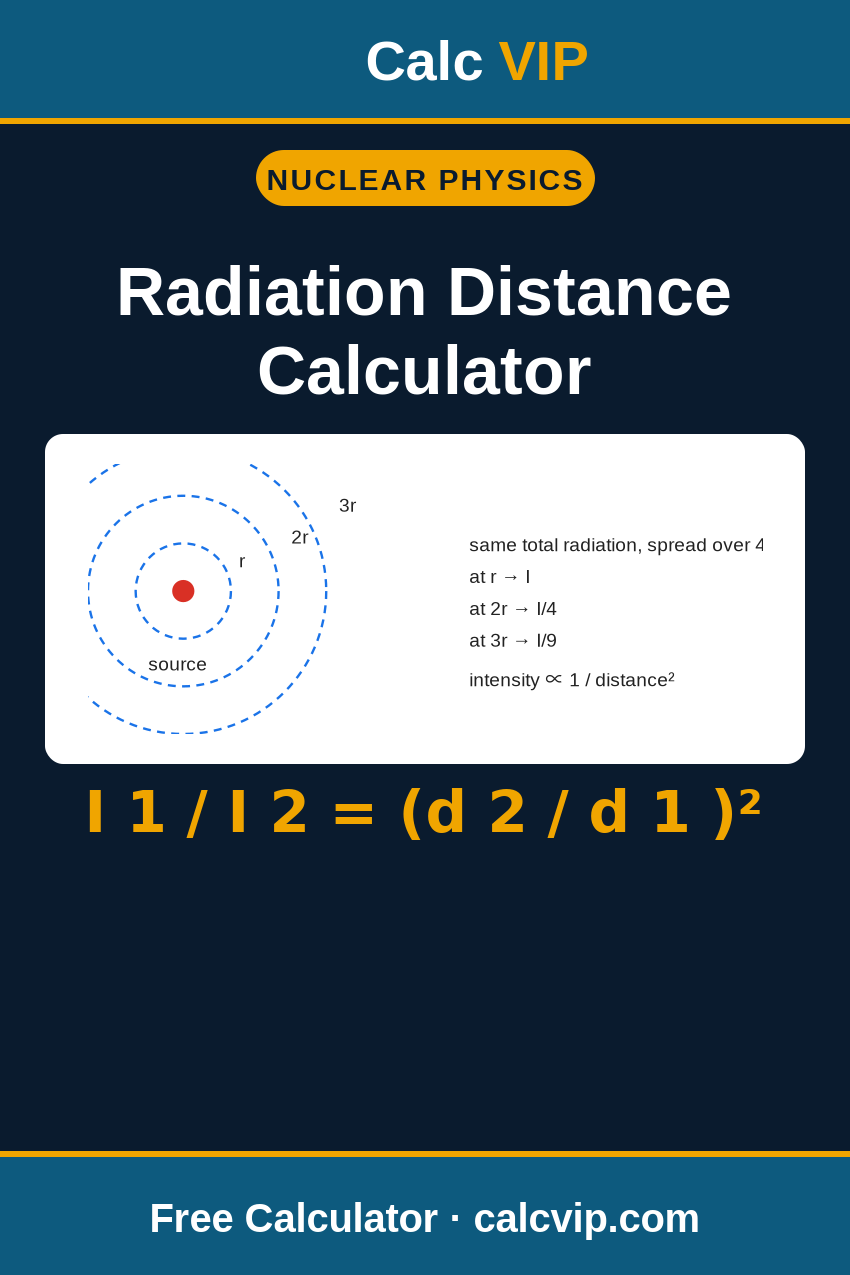
Of all the tools in radiation protection, the cheapest is a step backwards. Radiation streaming from a small source spreads over the surface of an expanding sphere, so its intensity falls with the square of the distance: double the distance and the dose rate quarters; move ten times farther away and it drops a hundredfold. No shielding, no cost, no maintenance — geometry itself does the work. This is the inverse-square law, and this calculator applies it in the form protection officers actually use: measure (or look up) the dose rate at one distance, then ask what it becomes at another.
The law's conditions deserve the same respect as the law. It assumes a point source — a source small compared with the distances involved — radiating into open space with nothing absorbing or scattering along the way. A radioactive capsule, a sealed check source, an X-ray tube's focal spot: all qualify at working distances. A contaminated floor, a long pipe run, a patient who has swallowed a radiopharmaceutical: these are extended sources, and at close range they fade far more gently than 1/r² (a line source falls like 1/r, a large plane barely falls at all until you are far from it). The calculator's answers are exact for points and a useful first estimate — always in the safe direction at large distances — for everything else.
The practical currency is dose rate: microsieverts per hour at your hands, your eyes, your chair. Enter the known rate and its distance, then the distance you are considering, and the calculator returns the new rate. Run it backwards just as easily — a limit at the fence line and a source strength in the store solve for the fence's minimum radius, which is how controlled areas get their dimensions.
Formula
I1 / I2 = (d2 / d1)² — intensity times distance squared is constant. Triple the distance, get one ninth the intensity.
The derivation is pure geometry: a source emitting isotropically pours a fixed total power through every sphere around it, and the sphere's area, 4πd², grows with the square of the radius — so the power per unit area (the intensity, and with it the dose rate) must fall as 1/d². Rearranged for planning, the formula inverts cleanly: the distance needed to reach a target rate is d2 = d1 × √(I1/I2) — to cut a dose rate by 100, multiply the distance by 10; by 1,000, by about 31.6. The same square law governs light from a bulb, sound in open air, and gravity's and the Coulomb force's strengths, which is why the pattern recurs across this whole site. Its limits are equally geometric: near an extended source the "sphere" argument fails, and in air over long distances, absorption quietly adds its own exponential fall on top.
| Symbol | Meaning | Units |
|---|---|---|
| I₁ | dose rate (intensity) at distance d₁ | µSv/h, mSv/h — any rate unit |
| I₂ | dose rate at distance d₂ — the answer | same unit as I₁ |
| d₁, d₂ | distances from the source | m (or any unit, used consistently) |
Time, distance, shielding — the protection triad
Radiation protection rests on three levers, and this calculator prices the middle one. Time: dose is dose rate × time, so halving a task's duration halves its dose — linear, honest, limited by how fast hands can work. Distance: the square law makes it the strongest lever per unit effort at small scales — stepping from 1 m to 3 m outperforms any plausible speed-up, which is why handling tools, tongs and remote manipulators are designed around metres, not minutes. Shielding: material absorbs exponentially, each half-value layer halving what passes — powerful, but heavy, costly, and useless until someone computes the thickness. Professionals combine all three, but they reach for distance first: it is free, instant, and cannot be installed wrong.
Distance also quietly defines the geography of every facility that holds sources. The controlled-area boundary is drawn where this formula brings the dose rate down to the regulatory line; the radiographer's barrier tape unrolls to the distance where bystanders fall to background-ish levels; the nuclear-medicine patient's family is told a number of metres for a number of days — the same arithmetic, balancing the source's decay (the activity calculators) against geometry (this one). Internalise the square law's feel — violent near the source, gentle far away — and most radiation-safety rules stop being rules and become obvious.
How to use
- Enter the known dose rate I₁ and the distance d₁ at which it applies (a measurement, a source certificate, or a previous calculation).
- Enter the new distance d₂ — where you, a worker, or the public will actually be.
- Read I₂, the dose rate there, in the same unit you entered.
- To find a required distance instead, work the rearranged formula: d₂ = d₁ × √(I₁ / I_target). The examples show the pattern; a boundary problem is just this calculator read backwards.
- Before trusting the answer, check the point-source condition: d₂ should be at least several times the source's largest dimension, and the path should be open air — walls scatter, and shielding changes the problem entirely.
Worked examples
Example 1 — the textbook step back. A source gives 800 µSv/h at 1 m. At 4 m:
I2 = 800 × (1/4)² = 800/16 = 50 µSv/h. Four metres bought a sixteenfold reduction — the cheapest factor of 16 in all of health physics. At 2 m the same source gives 200 µSv/h; at 10 m, just 8 µSv/h. Memorise the ladder: ×2 distance → ÷4, ×3 → ÷9, ×10 → ÷100.
Example 2 — the radiographer's boundary. An industrial radiography source reads 2,000 µSv/h at 1 m. The public boundary is set where the rate falls to 7.5 µSv/h. Required distance: d = 1 × √(2000/7.5) = √266.7 = 16.3 m. That is why radiography barriers stand tens of metres out and why the shot is fired from behind cover at the end of a long cable — the square law, paced off in metres of tape.
Example 3 — moving closer is the dangerous direction. A technician's bench reads 12 µSv/h at 50 cm from a small source. Leaning in to 25 cm: I = 12 × (50/25)² = 12 × 4 = 48 µSv/h. Halving the distance quadruples the rate — and hands, which work closer than the body's trunk where the dosimeter sits, take the steepest part of the curve. Tongs exist because of this example.
Example 4 — a hospital waiting-room wall. A patient treated with iodine-131 measures 45 µSv/h at 1 m on discharge day. At the 3 m of a neighbouring bed: 45 × (1/3)² = 5 µSv/h; at the 0.5 m of a cuddle from a grandchild: 45 × (1/0.5)² = 180 µSv/h. Same patient, same hour — a factor of 36 set purely by geometry, which is why discharge instructions are written in metres and days, not in warnings.
Example 5 — checking a store's fence line. A source store's reference rate is 320 µSv/h at 0.5 m (just outside the shielding). The site fence stands at 8 m: I = 320 × (0.5/8)² = 320/256 = 1.25 µSv/h — comparable to a few times natural background, comfortably public territory. Run the same numbers with the fence at 4 m and the rate quadruples to 5 µSv/h: fence placement is a dose decision, made with this formula.
Example 6 — why survey meters plunge. Walking toward a lost source, a meter reads 3 µSv/h at 6 m, then 75 µSv/h at 1.2 m... check: 3 × (6/1.2)² = 3 × 25 = 75 ✓. Search teams exploit the steepness deliberately: the rate's growth factor between two paced steps reports the distance ratio, letting a trained searcher home in on a source they cannot see, triangulating with the square law alone.
Distance in real life
Industrial radiography. Every pipeline weld inspected at night happens inside a boundary computed exactly as in Example 2. The radiographer's craft is equal parts imaging and geometry: collimators narrow the beam, but the tape line — the square law made visible — is what protects the public.
Nuclear medicine wards and home care. Example 4's arithmetic becomes discharge paperwork: sleep apart for so many nights (distance + the isotope's decay), hold children briefly rather than long (time), at arm's length rather than against the body (distance again). Two calculators from this batch — activity decay and this one — jointly write those instructions.
Emergency response. First responders approach an unknown source with a meter and the square law as their shield: establish the cordon where the rate meets the guideline, approach only as far as the task demands, and let the plunging readings (Example 6) map the scene before anyone commits. Distance is the protection that works before anything is known about the source.
Space radiation. Astronauts cannot distance themselves from the Sun, but mission planners use the same geometry on the solar wind's other sources: a water tank or equipment rack between crew and a storm shelter's walls buys attenuation, and during a solar particle event the crew retreats to the most surrounded spot in the station — distance and shielding combined, triaged by inverse-square thinking.
Everyday perspective. The law also calibrates fears. A chest X-ray's scatter at the radiographer's booth, the dose from a seatmate's recent scan, sleeping beside a partner after their thyroid treatment — each is a square-law sum, and most come out at or below the variations in natural background that geography hands out for free. Knowing the numbers beats fearing the words.
Photography's flash and lighting. Not radiation protection at all — but the photographer's guide number is the identical law: double the flash-to-subject distance, quarter the light, open up two stops. The geometry of spreading spheres does not care whether what spreads is gamma rays or visible light.
The distance ladder — commit it to memory
| Distance change | Dose-rate factor | Distance change | Dose-rate factor |
|---|---|---|---|
| × 1.5 farther | ÷ 2.25 | half as far | × 4 |
| × 2 farther | ÷ 4 | one third as far | × 9 |
| × 3 farther | ÷ 9 | to reach ÷ 10 | × 3.16 the distance |
| × 5 farther | ÷ 25 | to reach ÷ 100 | × 10 the distance |
| × 10 farther | ÷ 100 | to reach ÷ 1000 | × 31.6 the distance |
The asymmetry in the table is the law's personality: moving away gives diminishing returns (the second ten metres help far less than the first), while moving closer escalates frighteningly fast. Nearly all distance-based safety practice is about defending the first metre.
When the square law overpromises
Three real-world effects bend the clean 1/r². Extended sources: near a contaminated area or a long active pipe, only part of the source is at distance r — the rest is closer and farther — and the fall softens toward 1/r (line) or near-constancy (plane) until you back off to several times the source's size, where it becomes point-like again. Scatter: walls, ground and air bounce radiation around corners and add a "skyshine" component that ignores your straight-line distance; outdoors near big sources, scatter can dominate at long range precisely because the direct beam has squared itself away. Absorption: over tens of metres, air itself attenuates, steepening the fall beyond 1/r² (a rare case of reality being kinder than the formula). The professional habit: use this calculator for the direct component, measure at the location whenever the answer matters, and treat surprises as information about which effect you forgot.
Common mistakes
- Applying 1/r² to an extended source up close. A contaminated floor or a patient is not a point. Inside a few source-diameters the fall is far gentler, and the calculator's rosy numbers understate the dose — the most consequential error available here.
- Measuring distance from the wrong place. Distances run from the source itself — the capsule, the focal spot — not from the container wall, the bench edge or the room door. Thirty centimetres of sloppy origin, at close range, is a factor of two of sloppy dose.
- Forgetting the square on the way in. Halving distance doubles exposure in the untrained intuition; it quadruples it in fact (Example 3). Every “just reaching in quickly” decision should be priced at 4×, not 2×.
- Mixing distance units. d₁ in centimetres against d₂ in metres poisons the ratio by 100 — squared, 10,000. Convert both to the same unit before the ratio, every time.
- Assuming distance fixes everything. Distance does nothing for a source you carry (internal contamination), nothing against the scatter component, and nothing retroactively — dose already accumulated stays accumulated. It is the best first lever, not the only one: time and shielding still have their sections in the safety case.
FAQ
Does the inverse-square law work for all radiation?
It works for gamma and X-rays from a small (point) source in open space. It is approximate for large sources, and alpha/beta radiation is also stopped by air itself over short distances.
How much does doubling the distance help?
Intensity falls to (1/2)² = one quarter. Tripling the distance gives one ninth — distance is extremely effective protection.
What are the three classic protection rules?
Time (less exposure time), distance (this calculator) and shielding (absorbing material between you and the source).
Does the inverse-square law apply to alpha and beta radiation?
Geometry applies to everything that spreads, but alpha and beta particles also stop in matter — alphas within centimetres of air, betas within metres — so their dose falls far faster than 1/r² and reaches exactly zero at their range. The law in its pure form belongs to penetrating radiation: gamma rays, X-rays and neutrons, which air barely touches over working distances.
Why does my survey meter not fall exactly as 1/r² near a source?
Because near a real source, the point-source assumption fails twice over: the source has size, and the detector has size — different parts of each are at different distances, and the measured rate averages over all of them. Back off to several times the larger dimension and the readings settle onto the square law, as Example 6's tidy factor of 25 shows.
How far away is 'safe'?
There is no universal distance — there is a target dose rate and a formula. Decide the acceptable rate (public areas are often managed toward a few µSv/h or less, against a natural background of roughly 0.1–0.3 µSv/h), then solve d = d₁√(I₁/I_target) as in Example 2. Safety is a number agreed in advance, delivered by geometry.
Does distance protect against neutron radiation the same way?
Geometrically yes — neutrons from a point source thin out as 1/r² like anything else. But neutrons also scatter efficiently off walls, floors and especially hydrogenous material, building a diffuse background that distance alone does not remove, and shielding for neutrons means moderation plus capture rather than dense metal. Use the calculator for the direct component; expect the room to add its share.
What if the source is moving, like a patient walking around?
Then dose becomes a time-integral over a changing distance — which is why discharge advice pairs distances with durations ('1 metre, brief contact fine; prolonged cuddling, wait three days'). The decay calculators shrink the source term day by day while this one prices each distance; real guidance multiplies the two together.
Can I use this for light or sound instead?
Yes, with the same point-source caveat: a bulb's illuminance and a small speaker's intensity in open space both follow 1/r² (photographers and acousticians rely on it daily). Sound pressure, being an amplitude rather than an intensity, falls as 1/r — a classic trap — but intensity and dose-like quantities square-law cleanly.
How does this combine with shielding?
Multiplicatively. Distance sets the unshielded rate at the shield's location; the shield then multiplies by its transmission factor (halving per half-value layer). A barrier at 2 m from the source faces a quarter of the 1-metre rate and can be four times thinner than one hugging the source — which is why shielding is placed as far from the source as the room allows, and why the two calculations are always done together.