 Calc
Hawking Temperature Calculator – Black Hole Radiation Temperature
 Created by Priya Sharma · Physics Editor · Energy & Gravity · Last updated: November 2026
Use this free Hawking Temperature Calculator to find the temperature of the radiation a black hole emits. Stephen Hawking showed black holes are not perfectly black — they glow faintly, and the smaller they are, the hotter they shine.
In 1974 Stephen Hawking applied quantum mechanics to the edge of a black hole and reached the conclusion that made him famous: black holes radiate. The event horizon, where gravity is so strong that nothing escapes, nevertheless glows with a perfect thermal spectrum, as if the horizon were the surface of an object at a definite temperature. That temperature — computed here from nothing but the black hole's mass and four constants of nature — is one of the most extraordinary formulas in physics, stitching together quantum theory (ħ), relativity (c and G) and thermodynamics (kB) in a single line. Every one of those constants had to exist for the result to be possible; the formula is a postcard from the quantum-gravity frontier.
The headline behaviour is upside-down by everyday standards: the temperature is inversely proportional to the mass. A black hole of one solar mass glows at 6.17 × 10⁻⁸ K — sixty nanokelvin, far colder than deep space — while a black hole with the mass of a mountain, about 10¹² kg, blazes at over 10¹¹ K, hotter than the centre of any star. Small black holes are hot, violent and short-lived; giant ones are cold, dark and effectively eternal. There is no stable middle: a black hole that loses mass heats up as it shrinks, radiating ever faster, in a runaway that ends, theory suggests, in a final flash of gamma rays.
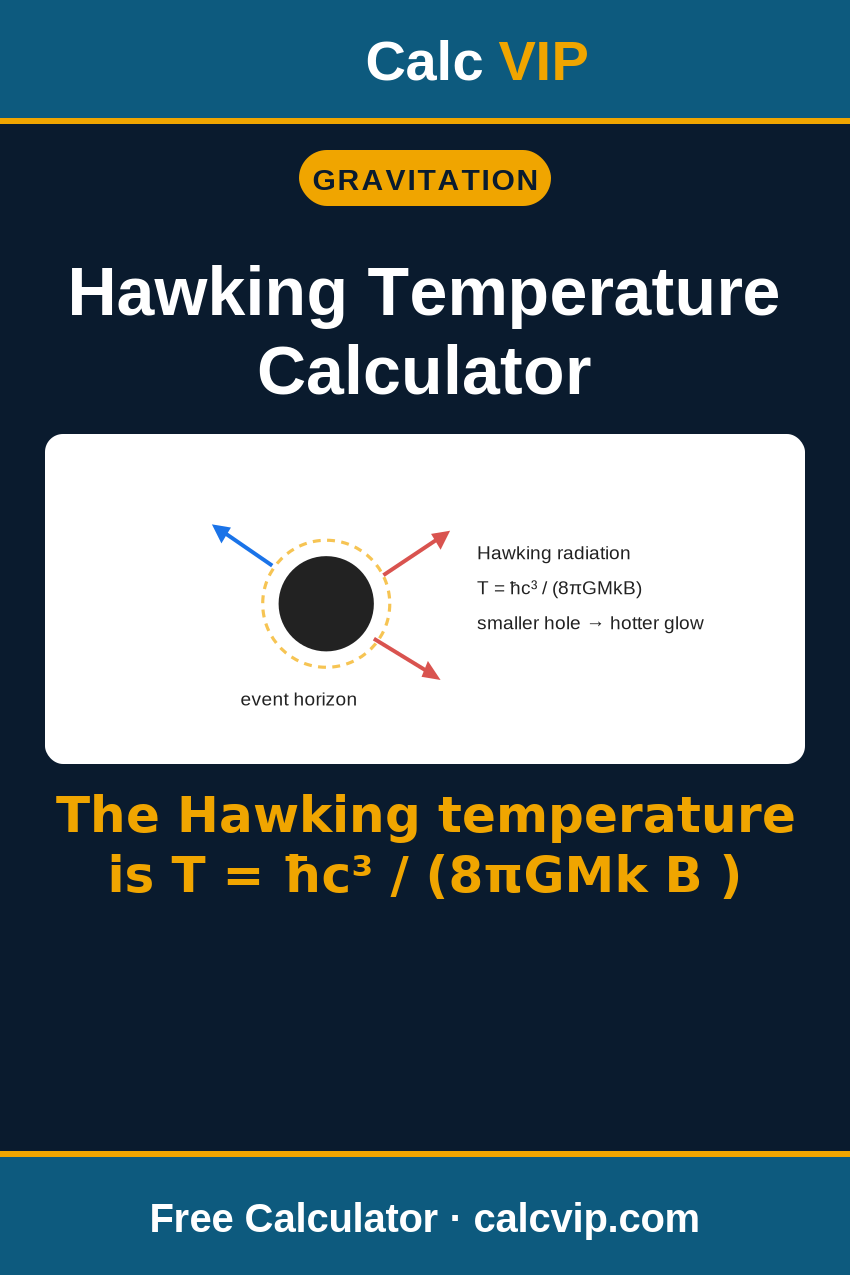
Choose solar masses for the black holes astronomers actually observe, or kilograms for hypothetical small ones, and the calculator returns the Hawking temperature in kelvin. Set it against the 2.725 K of the cosmic microwave background and you can immediately judge a black hole's fate in today's universe: hotter than the background, it net-evaporates; colder, it net-grows by absorbing more energy than it emits — which is the current condition of every astrophysical black hole known.
Formula
The Hawking temperature is T = ħc³ / (8πGMkB) • T in kelvin, M in kg, with ħ = 1.055 × 10⁻³⁴ J·s, c = 2.998 × 10⁸ m/s, G = 6.674 × 10⁻¹¹ N·m²/kg², kB = 1.381 × 10⁻²³ J/K.
Temperature is inversely proportional to mass: halve the mass and the black hole glows twice as hot. The rearrangements are just as telling. The mass of a black hole glowing at a chosen temperature is M = ħc³ / (8πGkBT) — set T to the 2.725 K of the cosmic background and out falls the break-even mass, about 4.5 × 10²² kg, roughly 60% of the Moon's mass. Because the horizon radius grows in proportion to M while the temperature falls as 1/M, the two are locked together: a black hole's temperature in kelvin times its Schwarzschild radius in metres always equals the same constant of nature, ħc/(4πkB) ≈ 1.82 × 10⁻⁴ K·m. The radiated power follows from the temperature through the Stefan–Boltzmann law applied to the horizon's area, and it scales as 1/M² — the mathematical engine of the evaporation runaway described below.
| Symbol | Meaning | Units |
|---|---|---|
| T | Hawking temperature of the horizon | K |
| M | mass of the black hole | kg (or solar masses) |
| ħ | reduced Planck constant | 1.055 × 10⁻³⁴ J·s |
| c, G, kB | speed of light; gravitational constant; Boltzmann constant | SI units |
Negative heat capacity: the strangest thermostat in physics
Ordinary objects cool down when they lose energy. A black hole does the opposite, and the reason is written in the 1/M of this formula. Radiating energy means losing mass; losing mass means a higher temperature; a higher temperature means radiating faster. A black hole has negative heat capacity — it heats up by losing heat — a property it shares with stars and star clusters (which also warm as they radiate, by contracting) but carries to the ultimate extreme. Left alone in a cold universe, an evaporating black hole does not fade gently: it spends almost all of its life large, cold and dim, then runs away in its final moments, the last second releasing some 10²² joules — millions of megaton bombs' worth — whatever the hole's original mass. Conversely, a black hole in a hot environment cools as it feeds — growing colder as it grows — which is why the giants at galactic centres are the coldest objects in nature, at 10⁻¹⁴ K and below.
The same calculation that yields the temperature also yields the black hole's entropy, and there the numbers become philosophical. Entropy — normally proportional to volume — for a black hole is proportional to the horizon's area, and it is enormous: a solar-mass hole carries about 10⁷⁷ Boltzmann units of entropy, vastly more than the star that formed it. That area law became the holographic principle, the clue that the information content of any region of space is written on its boundary — arguably the deepest idea to fall out of a temperature formula, and the root of the still-unresolved information paradox: if the hole evaporates completely, where does the information about everything that fell in go?
How to use
- Choose the mass unit — solar masses for astrophysical black holes, kilograms for small hypothetical ones.
- Enter the mass (scientific notation like 1.989e30 works in kg mode).
- Click "Calculate Hawking Temperature" to get T in kelvin.
- Compare the answer with 2.725 K, the temperature of the cosmic microwave background: above it, the black hole loses net energy to the universe; below it, the universe is currently feeding the black hole faster than it can radiate.
- For a quick estimate in solar units, remember the anchor: T ≈ 6.17 × 10⁻⁸ K × (M☉/M). A ten-solar-mass hole is ten times colder; a hole of a million solar masses, a million times colder.
Worked examples
Example 1 — a black hole with the mass of the Sun. M = 1 solar mass (1.989 × 10³⁰ kg):
T = ħc³ / (8πGMkB) ≈ 6.17 × 10⁻⁸ K.
That is far colder than the 2.725 K cosmic microwave background, so real stellar black holes today absorb more heat than they radiate and cannot shrink. An Earth-mass black hole, by contrast, would glow at about 0.021 K.
Example 2 — a ten-solar-mass black hole. M = 10 M☉.
T = 6.17 × 10⁻⁸ / 10 ≈ 6.17 × 10⁻⁹ K.
The black holes whose mergers LIGO and Virgo hear — tens of solar masses each — are the coldest class of object in the present universe, glowing at a few billionths of a degree while weighing as much as a city of suns. Their Hawking glow is undetectable by any conceivable instrument; their gravitational waves are not.
Example 3 — an Earth-mass black hole. M = 5.972 × 10²⁴ kg.
T ≈ 0.0206 K — about twenty millikelvin.
Such a hole would have a Schwarzschild radius of 8.87 mm — the size of a marble — and would sit in a laboratory cryostat's temperature range while containing a planet's mass. It would still be colder than the cosmic background, so even it would (very slowly) grow today rather than shrink.
Example 4 — a Moon-mass black hole. M = 7.348 × 10²² kg.
T ≈ 1.67 K.
Just below the cosmic background temperature. A black hole needs to be lighter than about 4.5 × 10²² kg — roughly 0.61 of the Moon's mass — before its Hawking temperature exceeds 2.725 K and true evaporation, in today's universe, can begin.
Example 5 — a mountain-mass black hole. M = 1 × 10¹² kg — about the mass of a cubic kilometre of rock.
T ≈ 1.23 × 10¹¹ K, and its horizon is about 1.5 × 10⁻¹⁵ m across — the size of a proton.
At this temperature the radiation is not light but a violent spray of gamma rays and particles, and the hole radiates about 3.6 × 10⁸ watts — the output of a respectable power station, from an object smaller than an atomic nucleus.
Example 6 — Sagittarius A*, our galaxy's centre. M = 4.3 × 10⁶ solar masses.
T = 6.17 × 10⁻⁸ / 4.3 × 10⁶ ≈ 1.43 × 10⁻¹⁴ K.
The four-million-sun black hole photographed by the Event Horizon Telescope in 2022 is, by Hawking's measure, the coldest thing in the Milky Way — fourteen quadrillionths of a degree above absolute zero, and destined to remain essentially unchanged for some 10⁸⁷ years.
Hawking temperature in real life
It sets the plot of the far future. In the standard cosmological forecast, stars burn out, galaxies evaporate their stars, and eventually only black holes remain — whereupon Hawking evaporation becomes the universe's main event. A solar-mass hole needs about 2 × 10⁶⁷ years to evaporate; the largest, near 10¹⁰⁰ years. This formula is, quite literally, the timetable for the end of everything.
It hunts primordial black holes. If the Big Bang forged small black holes, those of around 10¹¹–10¹² kg would be in their final, hot stages now, shining in gamma rays at 10¹¹ K. Telescopes have searched for their flashes and found none — a null result that already rules out primordial holes in some mass ranges as the universe's dark matter, a constraint bought entirely with this equation.
It is tested in analogue. Hawking's mathematics also applies to "dumb holes" — horizons for sound in flowing fluids, or for light in optical fibres. Experiments with ultracold atoms and flowing water have observed the analogue radiation with the predicted thermal character, giving the theory experimental support of a kind, even though the astrophysical original remains far too faint to detect.
It corrected Einstein's era intuition. Classically, a black hole could only grow, and its horizon area could never shrink — Hawking himself proved that theorem. The temperature formula broke it: because the hole radiates, area and mass can fall, and the two results were reconciled only by recognising horizon area as entropy, merging thermodynamics with gravity permanently.
It frames the information paradox. Thermal radiation carries no information about what formed it — a perfect blackbody spectrum is the same for every history. If black holes evaporate completely into such radiation, the information about everything that fell in seems destroyed, violating quantum mechanics. Fifty years of theoretical physics — firewalls, holography, replica wormholes — have been spent wrestling with the paradox this temperature created; recent calculations suggest the information does leak out, encoded impossibly subtly in the radiation.
It prices black-hole power plants (in fiction and in earnest). A small black hole is a nearly perfect mass-to-energy converter: feed it waste, harvest Hawking radiation. A 10¹² kg hole outputs hundreds of megawatts at 10¹¹ K — engineering fantasy today, but the physics is this page's, and serious papers have examined starships driven by exactly such a radiator.
Evaporation: how long has a black hole got?
Combine the temperature with the Stefan–Boltzmann law and the horizon's area, and the power radiated scales as 1/M², which integrates to a lifetime proportional to M³: roughly t ≈ 2.1 × 10⁶⁷ years × (M/M☉)³. The cube is merciless in both directions. A ten-solar-mass hole gets a thousand times the solar lifetime; a mountain-mass hole of 10¹² kg gets about 2.7 × 10¹² years — still longer than the universe has existed, which is why the holes finishing today must be lighter still, and why anything stellar is, for all practical purposes, forever. The endpoint is the theory's open edge: as M approaches the Planck mass (2.2 × 10⁻⁸ kg) the temperature approaches the Planck temperature and the semiclassical formula this page uses dissolves — what remains, complete evaporation or a stable remnant, is a question only a full theory of quantum gravity can answer, and it is one of the strongest reasons physicists keep looking for one.
Quick reference: black holes by mass
| Mass | Hawking temperature | Horizon radius | Character |
|---|---|---|---|
| 10¹² kg | 1.23 × 10¹¹ K | 1.5 × 10⁻¹⁵ m | gamma-ray furnace, proton-sized |
| 10¹⁵ kg | 1.23 × 10⁸ K | 1.5 × 10⁻¹² m | hotter than any star's core |
| 10¹⁸ kg | 1.23 × 10⁵ K | 1.5 × 10⁻⁹ m | glows like a hot star, atom-sized |
| 10²¹ kg | 123 K | 1.5 × 10⁻⁶ m | colder than dry ice |
| Earth mass | 0.0206 K | 8.87 mm | a marble colder than space |
| 1 solar mass | 6.17 × 10⁻⁸ K | 2.95 km | effectively eternal today |
| Sagittarius A* | 1.43 × 10⁻¹⁴ K | 12.7M km | coldest object in the galaxy |
| M87* | 9.49 × 10⁻¹⁸ K | 19.2 billion km | the first black hole ever imaged |
The cosmic microwave background, at 2.725 K, cuts this table between the 10²¹ kg row and the Earth-mass row: everything heavier than about 4.5 × 10²² kg is currently a net absorber. Only when the universe has expanded and cooled far below today's background — hundreds of billions of years from now — will the stellar black holes' turn to evaporate arrive.
Common mistakes
- Expecting big black holes to be hot. The relation is inverse: the giants are the coldest. A student who reports a billion-solar-mass hole at billions of degrees has almost certainly multiplied where the formula divides — M87* sits at 10⁻¹⁷ K.
- Forgetting the background comparison. A Hawking temperature below 2.725 K does not mean the hole is shrinking slowly; it means it is not shrinking at all today, because it drinks in more cosmic-background energy than it emits. Evaporation requires T above the environment's temperature.
- Using h instead of ħ, or dropping the 8π. The formula's constant is ħc³/(8πGkB) ≈ 1.23 × 10²³ K·kg — worth memorising as a check: temperature times mass in kilograms should always come out near 1.23 × 10²³.
- Entering solar masses in kg mode. The unit selector matters by thirty orders of magnitude. "1" in solar mode is a stellar black hole; "1" in kg mode is a subatomic fantasy with a temperature near 10²³ K, outside the formula's validity entirely.
- Assuming the radiation comes from inside the hole. Nothing crosses the horizon outward. The radiation is generated in the space just outside it, where quantum fluctuations and the horizon's presence conspire to let one partner of a virtual particle pair escape while the other falls in, carrying negative energy that reduces the hole's mass.
FAQ
Do black holes really evaporate?
In theory yes — emitting Hawking radiation slowly carries away mass. But a solar-mass black hole would take about 10⁶⁷ years to evaporate, vastly longer than the current age of the universe.
What temperature would a mountain-mass black hole have?
At about 10¹² kg it would glow at roughly 10¹¹ K and radiate intensely — such tiny primordial black holes, if they exist, could be ending their lives in bursts of gamma rays today.
Has Hawking radiation been observed?
Not directly from an astrophysical black hole — the signal is far too faint. Analogue experiments with sound waves in fluids and light in fibres show the same mathematics at work, supporting the theory.
Why does the temperature rise as the black hole shrinks?
Because the horizon's curvature — the steepness of gravity at the edge, which sets the temperature — grows as the hole gets smaller. A small horizon is a sharply curved one, and sharply curved horizons are hot. The 1/M in the formula is that geometry in algebraic form.
What is the hottest possible black hole?
The formula diverges as M → 0, but physics intervenes at the Planck mass, 2.2 × 10⁻⁸ kg, where the predicted temperature reaches about 10³² K and quantum gravity takes over. A black hole in its final instants passes through every temperature below that — briefly becoming the hottest object in the universe.
Do spinning or charged black holes have the same temperature?
No — rotation and charge lower the temperature at fixed mass, and a maximally spinning (extremal) black hole has, in the idealised mathematics, a temperature of exactly zero: it cannot radiate, though it also cannot quite be formed. Real astrophysical holes spin, so their true temperatures sit somewhat below this calculator's non-spinning values.
Where does the energy of the radiation come from?
From the black hole's mass. The escaping particle carries positive energy away; its partner, falling in, carries negative energy (as measured from outside), so the hole's mass drops by exactly the radiated amount. Einstein's E = mc² keeps the books balanced — the hole quite literally shines itself away.
Could a black hole be used to see Hawking radiation in a lab?
Not a real one — no laboratory can make or hold a black hole, and a small one would be a bomb, not an instrument. The analogue systems (fluid horizons, optical fibres, ultracold atoms) are the laboratory route, and they test the same equations that predict the temperature on this page.
What happens in the very final second?
By the standard calculation, the last ~10⁶ kg vanishes in a flash releasing about 10²²–10²³ joules — comparable to a large nuclear arsenal — in gamma rays. Astronomers have searched the sky for such terminal bursts; none has been confirmed, which itself constrains how many small primordial black holes can exist.
Why is this formula considered so important?
It is the only widely accepted result that requires quantum mechanics, general relativity and thermodynamics to be true simultaneously. Any future theory of quantum gravity must reproduce it, the way any new mechanics must reproduce Newton at low speeds. It is less a calculator result than a checkpoint every deeper theory must pass.