 Calc
Hill Sphere Calculator – How Far a Planet's Gravity Reaches
 Created by Priya Sharma · Physics Editor · Energy & Gravity · Last updated: November 2026
Use this free Hill Sphere Calculator to find the region around a planet or moon where its own gravity wins over the pull of the bigger body it orbits. Inside this sphere, a moon or satellite can stay in a stable orbit.
Every planet travels with an entourage — moons, rings, dust, captured asteroids, and these days a growing fleet of spacecraft — and every member of that entourage is there on borrowed gravity. The planet pulls it one way; the star the planet orbits pulls it another. The Hill sphere, named after the American astronomer George William Hill, who worked out the mathematics in 1878, is the boundary where the contest is decided: inside it, the planet's gravity organises the motion and moons can circle for billions of years; outside it, the star's tidal pull wins, and objects drift away to become independent orbiters in their own right.
The formula carries a cube root, and that cube root is the whole personality of the quantity. A Hill sphere grows only with the cube root of the planet's mass, so brute size buys surprisingly little territory: make a planet eight times heavier and its gravitational domain merely doubles. Distance is the generous variable instead — the same planet placed twice as far from its star gets a Hill sphere twice as wide, because the star's tides weaken with distance faster than the planet's own grip does. This is why the outer planets, remote and weakly tugged, command enormous spheres, while Mercury, huddled close to the Sun, rules a bubble barely ninety times its own radius.
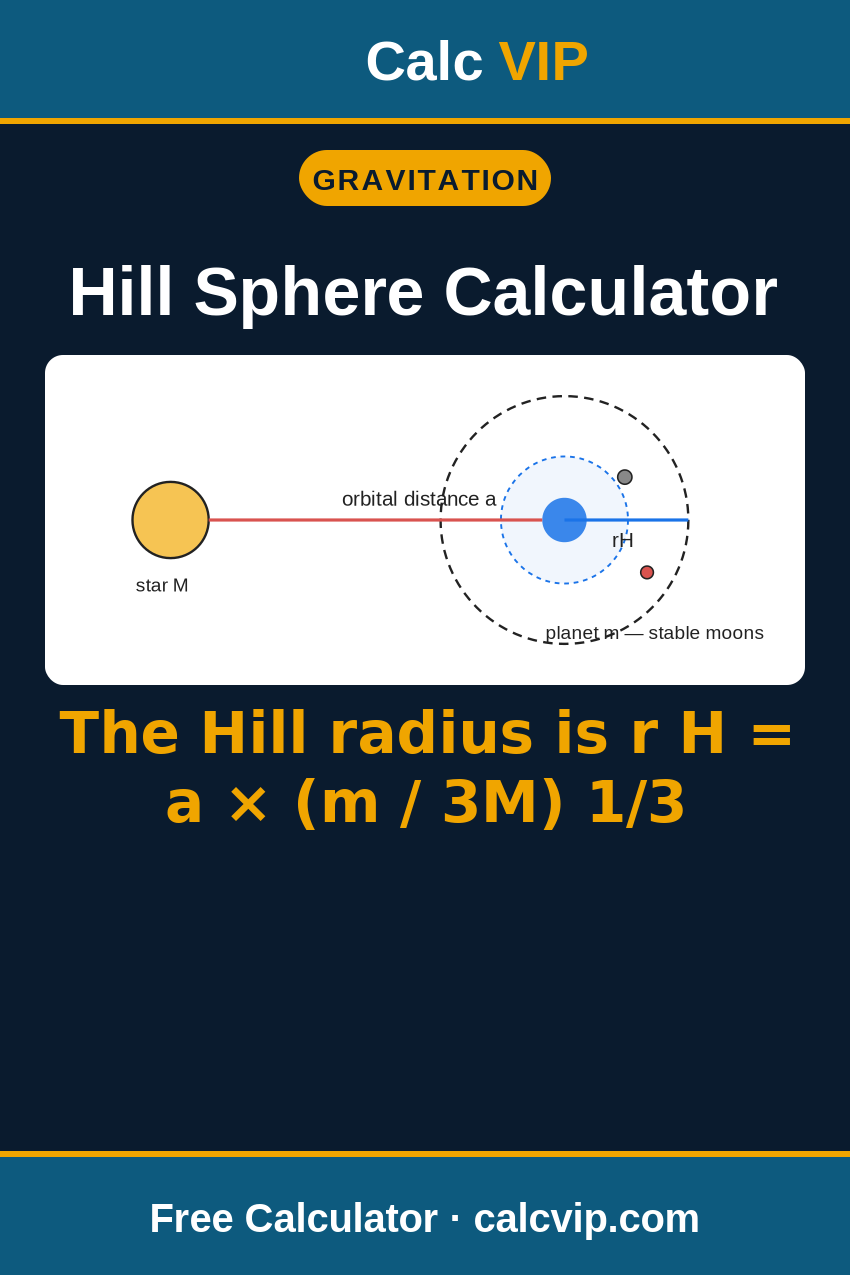
This calculator needs just three numbers — the orbital distance between the two bodies and both masses — and returns the Hill radius in kilometres, millions of kilometres and astronomical units, together with the "half-radius" inside which long-lived moons realistically live. Try the presets to feel the pattern: Earth's sphere is about 1.5 million kilometres across in radius, the Moon's a modest 61,500 km, and Jupiter's a cavernous 53 million km that shelters more than ninety known moons.
Formula
The Hill radius is rH = a × (m / 3M)1/3 • rH and a in the same length unit, m and M in the same mass unit.
The formula rearranges to answer the other two questions it hides. Want the mass a body needs to hold a moon at a given distance? Solve for m: m = 3M × (rH/a)³. Want to know how far from its star a planet must sit for its Hill sphere to reach a chosen size? Solve for a: a = rH × (3M/m)1/3. For planets on noticeably eccentric orbits the sphere breathes in and out with the seasons of the orbit, and the safe estimate uses the closest approach: replace a by a(1 − e), where e is the orbital eccentricity — the sphere is at its smallest, and moons at their most vulnerable, at perihelion. The factor 3 in the denominator is not decoration: it falls out of balancing the star's tidal pull plus the centrifugal effect in the frame that rotates with the planet, as the deep-dive section below explains.
| Symbol | Meaning | Units |
|---|---|---|
| rH | Hill radius — edge of the planet's gravitational domain | km (or any length unit) |
| a | orbital distance between the smaller and bigger body | km (same unit as rH) |
| m | mass of the smaller body (planet or moon) | kg |
| M | mass of the bigger body (star or planet) | kg |
A tug of war with three players: where the formula comes from
Imagine standing on the line between a planet and its star, at a distance r from the planet, and asking who owns a pebble placed there. The planet pulls the pebble inward with acceleration Gm/r². The star pulls it too, but what matters is not the star's raw pull — the planet feels almost the same pull, and both fall around the star together. What matters is the difference between the star's pull on the pebble and its pull on the planet: the tidal acceleration, which grows linearly with r and works out to about 2GMr/a³ on the star-facing side. Set the two equal, Gm/r² = 2GMr/a³, and you get r³ = a³m/(2M) — nearly the Hill formula, but with a 2 where the real answer has a 3.
The missing third comes from the rotation of the whole arrangement. In the frame that turns with the planet as it orbits, a stationary pebble also feels a centrifugal acceleration, and along the star–planet line that contributes one more unit of GMr/a³, turning the 2 into a 3 and giving rH = a(m/3M)1/3 exactly. The two points where the balance is exact, one on each side of the planet, are the famous Lagrange points L1 and L2 — the Hill sphere's boundary passes through them. The sphere is therefore not an arbitrary convention: it is the surface on which the combined gravity-plus-rotation potential of the three-body problem opens up, letting anything that crosses it leak away to the star.
How to use
- Pick a preset system — Earth, Moon, Jupiter or Mars orbiting their parent body — or choose Custom and type your own values.
- Enter the orbital distance a in kilometres: the distance between the smaller body and the bigger one (for a moon, its distance from its planet; for a planet, its distance from its star).
- Enter both masses in kilograms. Scientific notation such as 5.972e24 is accepted and is the sane way to type planetary masses.
- Click "Calculate Hill Sphere" to get the Hill radius in kilometres, millions of kilometres and AU, plus the half-radius figure inside which moons are realistically stable.
- To judge a particular moon, compare its orbital distance with the answer: well inside half the Hill radius means safely held; beyond about 70% of it, the orbit is living on borrowed time.
Worked examples
Example 1 — Earth orbiting the Sun. a = 1.496 × 10⁸ km, m = 5.972 × 10²⁴ kg, M = 1.989 × 10³⁰ kg.
m / 3M = 5.972 × 10²⁴ / (3 × 1.989 × 10³⁰) ≈ 1.0008 × 10⁻⁶, and its cube root is ≈ 0.010003.
rH = 1.496 × 10⁸ × 0.010003 ≈ 1,496,418 km ≈ 1.50 million km ≈ 0.0100 AU.
The Moon orbits at only 384,400 km — about 25.7% of the way out — comfortably inside Earth's Hill sphere.
Example 2 — the Moon orbiting Earth. a = 384,400 km, m = 7.348 × 10²² kg, M = 5.972 × 10²⁴ kg.
m / 3M = 7.348 × 10²² / (3 × 5.972 × 10²⁴) ≈ 4.102 × 10⁻³, whose cube root is ≈ 0.16006.
rH = 384,400 × 0.16006 ≈ 61,531 km — just 35.4 lunar radii. The Moon's gravitational estate is tiny, which is why anything orbiting the Moon itself is quickly stripped away by Earth's tides.
Example 3 — Jupiter orbiting the Sun. a = 7.785 × 10⁸ km, m = 1.898 × 10²⁷ kg, M = 1.989 × 10³⁰ kg.
m / 3M ≈ 3.181 × 10⁻⁴, cube root ≈ 0.06827.
rH = 7.785 × 10⁸ × 0.06827 ≈ 53,142,095 km ≈ 0.355 AU. Even Jupiter's most distant known irregular moons, captured asteroids orbiting tens of millions of kilometres out, sit well within this vast sphere — the Himalia group at about 11.5 million km uses only 21.6% of it.
Example 4 — Mars orbiting the Sun. a = 2.279 × 10⁸ km, m = 6.417 × 10²³ kg, M = 1.989 × 10³⁰ kg.
m / 3M ≈ 1.076 × 10⁻⁷, cube root ≈ 0.004756.
rH ≈ 1,083,768 km — slightly smaller than Earth's sphere despite Mars being farther from the Sun, because Mars has barely a ninth of Earth's mass and the cube root cannot make that up. Phobos and Deimos, at 9,376 km and 23,463 km, are buried deep inside it.
Example 5 — Mercury orbiting the Sun. a = 5.79 × 10⁷ km, m = 3.301 × 10²³ kg, M = 1.989 × 10³⁰ kg.
m / 3M ≈ 5.531 × 10⁻⁸, cube root ≈ 0.003810.
rH ≈ 220,618 km — only about 90 Mercury radii, the smallest Hill sphere of any planet. Combined with the fierce solar tides at that distance, it is a major reason Mercury holds no moon.
Example 6 — Pluto orbiting the Sun. a = 5.906 × 10⁹ km, m = 1.303 × 10²² kg, M = 1.989 × 10³⁰ kg.
m / 3M ≈ 2.184 × 10⁻⁹, cube root ≈ 0.001297.
rH ≈ 7,662,249 km. Pluto's mass is a mere 0.2% of Earth's, yet its Hill sphere is five times wider than Earth's — distance from the star beats mass, because the star's tides fade with distance. Charon orbits at 19,596 km, deep inside; Pluto's four small moons share the same generous estate.
The Hill sphere in real life
Why the Moon is still here. The Moon sits at 25.7% of Earth's Hill radius — inside the prograde stability zone with room to spare — and even though tides are pushing it outward by 3.8 cm a year, it would take far longer than the Sun's remaining lifetime for it to wander anywhere near the boundary. Earth's ownership of its moon is not in doubt.
Observatories parked at the boundary. The Sun–Earth L1 point, about 1.5 million km sunward, sits essentially on Earth's Hill sphere boundary, and solar observatories like SOHO and DSCOVR hold station there with regular small corrections. JWST does the same at L2 on the night side. These are not stable orbits in the moon sense — they are balancing points, chosen precisely because the three-body balance there gives an unchanging view of the Sun or of deep space.
Captured moons of the giant planets. Jupiter's and Saturn's swarms of small irregular moons are asteroids the planets caught — captures that only stick if the asteroid slows down inside the Hill sphere. Their orbits, huge, tilted and often retrograde, map out the sphere's usable volume; the retrograde ones survive farthest out, some beyond 60% of the Hill radius, because retrograde orbits are noticeably more stable against the star's tides.
Mini-moons and temporary captures. Earth occasionally steals an asteroid for a few months — the car-sized 2020 CD3 orbited us for about three years before drifting off again. Such temporary satellites are objects that slipped inside the Hill sphere with barely less than escape energy; the same physics, run in reverse, is how departing spacecraft and lost rocket stages sometimes return for one last visit years later.
Gateway's orbit around the Moon. The planned lunar Gateway station uses a near-rectilinear halo orbit that swings from about 3,000 km to 70,000 km from the Moon — reaching right out to the scale of the Moon's 61,531 km Hill sphere, where Earth, Moon and spacecraft gravity all compete. Mission designers chose it because that three-body borderland offers stable-enough parking with constant communication and easy escape routes — a working address on the edge of a Hill sphere.
Where exomoons can exist. The search for moons around exoplanets starts with this formula: a planet in the habitable zone of a small red dwarf orbits so close to its star that its Hill sphere shrinks dramatically, and any moon must huddle within a few planetary radii to survive — one reason astronomers expect exomoons to be common around gas giants of Sun-like stars but rare around close-in planets of dim ones.
Hill sphere, Roche limit and sphere of influence: three different bubbles
Three similar-sounding radii are easily confused, and they answer three different questions. The Hill sphere (this page) asks "whose moon is it?" — it is set by the star's tides and concerns orbital ownership. The Roche limit asks "will it be torn apart?" — it is set by the planet's tides acting across the moon itself, lies only a few planetary radii out, and governs rings and disruption, not ownership. The sphere of influence, used by mission planners when patching together trajectory calculations, asks "which body's gravity should I compute with?" and follows a different power law: rSOI = a × (m/M)2/5. For Earth that gives about 924,000 km — noticeably smaller than the Hill radius of 1,496,418 km. A spacecraft crossing the sphere of influence merely changes which equation the navigators use; crossing the Hill sphere boundary changes which body it belongs to.
Quick reference: Hill spheres of the planets
| Planet | Distance from Sun | Hill radius | In planet radii |
|---|---|---|---|
| Mercury | 57.9M km | 220,618 km | 90 |
| Venus | 108.2M km | 1,010,948 km | 167 |
| Earth | 149.6M km | 1,496,418 km | 235 |
| Mars | 227.9M km | 1,083,768 km | 320 |
| Jupiter | 778.5M km | 53,142,095 km | 760 |
| Saturn | 1,434M km | 65,487,190 km | 1,125 |
| Neptune | 4,495M km | 115,942,947 km | 4,709 |
Read the last column as elbow room. Neptune's moons can wander thousands of planetary radii from home and still belong to Neptune; Mercury's hypothetical moon would have been confined to a shell so thin that collisions and tides made its survival hopeless from the start.
Common mistakes
- Skipping the cube root. The mass ratio m/3M for Earth is about a millionth — using it directly instead of its cube root (about a hundredth) shrinks the answer a hundredfold and puts the "Hill sphere" inside the Moon's orbit.
- Expecting moons to be stable right out to rH. The Hill radius is where balance is possible, not where it is durable. Long-lived prograde moons stay within roughly half of it; the calculator prints that half-radius for exactly this reason.
- Mixing up which mass is which. m is the body whose sphere you want (the planet), M is the body it orbits (the star). Swapping them produces a sphere larger than the orbit itself — an obvious nonsense result worth recognising.
- Entering the orbit diameter, or the distance from the surface. a is centre-to-centre distance between the two bodies. For planets the surface correction is negligible, but for close moons it matters: use the moon's orbital radius from the planet's centre.
- Thinking gravity switches off at the boundary. The planet's gravity extends to infinity, weakening as 1/r². The Hill sphere is a stability boundary set by the competition of two gravities, not a wall where one force ends.
FAQ
What is the Hill sphere in simple words?
It is the bubble around a planet inside which the planet's gravity, not the star's, controls the motion of nearby objects. Moons live inside it; objects outside it drift away into their own orbit around the star.
How big is the Moon's Hill sphere around Earth?
About 61,531 km. That is why no natural satellite of the Moon can survive for long — Earth's tides strip it away.
Can a spacecraft orbit at the edge of the Hill sphere?
Orbits near the edge are unstable over time. Stable prograde orbits usually stay within about half the Hill radius, which is why distant satellites like those at the Sun–Earth L1 point (about 1.5 million km away) need regular station-keeping.
How is the Hill sphere different from the Roche limit?
They guard against different dangers. The Hill sphere, millions of kilometres wide, is where a moon risks being stolen by the star's tides. The Roche limit, only a few planet radii out, is where a moon risks being shredded by the planet's tides. A healthy moon lives between the two: outside the Roche limit, well inside the Hill sphere.
Why can retrograde moons orbit farther out than prograde ones?
A moon orbiting backwards, against its planet's orbital motion, meets the star's tidal tugging in a rhythm that largely cancels over each orbit, while a prograde moon gets pulled in a repeating pattern that pumps its orbit until it escapes. In practice retrograde moons survive out to nearly the full Hill radius, prograde ones only to about half.
Does the Sun have a Hill sphere?
Yes — against the gravity of the Galaxy itself. The Sun's Hill sphere is roughly one to two light-years in radius, and that is believed to be what trims the Oort cloud of comets at about that distance: beyond it, the Galaxy's tides and passing stars peel comets away.
Can two planets' Hill spheres overlap?
In a stable planetary system, effectively no — planets that survive for billions of years are spaced many Hill radii apart, and astronomers use the "mutual Hill radius" of neighbouring planets as the yardstick for whether a system is packed dangerously or comfortably. Systems found with planets only a few mutual Hill radii apart are expected to be young or doomed to rearrange themselves.
What happens to an object that crosses the Hill sphere boundary?
Nothing dramatic at the moment of crossing — no force changes suddenly. But its orbit is no longer organised by the planet: over the following orbits the star's tides reshape its path into an independent orbit around the star, typically a similar but slightly different one, which is why escaped moons and lost asteroids often linger near their former planet's orbit as co-orbital companions.
How far out does Earth's Hill sphere reach compared with the Moon?
The Moon orbits at 384,400 km; Earth's Hill radius is 1,496,418 km. The Moon is therefore only about a quarter of the way to the boundary — Earth could in principle hold moons nearly four times farther out, and indeed it occasionally does hold temporary captured asteroids on wide, looping paths near that limit.
Who was Hill, and is the sphere really a sphere?
George William Hill was a 19th-century American astronomer who derived the boundary while studying the Moon's motion. The true region is not a perfect sphere — it is a teardrop-ish surface stretched along the star–planet line, pinched at the L1 and L2 points where escape happens. "Hill radius" is the honest term; "Hill sphere" survives because the region is round enough, and the name stuck.