 Calc
Pendulum Speed Calculator – Speed at the Bottom of the Swing
 Created by Priya Sharma · Physics Editor · Energy & Gravity · Last updated: November 2026
Use this free Pendulum Speed Calculator to find how fast a pendulum bob is moving as it passes the bottom of its swing. Enter the pendulum length and the release angle, and the calculator uses energy conservation to find the speed.
A pendulum is the conservation of energy made visible. Lift the bob and let go, and it trades height for speed all the way down, flashes through the bottom at its fastest, then trades the speed back for height on the far side — rising, in a perfect world, to exactly the height it started from. This calculator answers the sharpest question about that motion: how fast is the bob moving at the very bottom of the swing? Give it the pendulum's length and the angle from which the bob is released, and energy conservation does the rest.
The key insight is that the string contributes nothing. The tension in the string always pulls along the string, exactly sideways to the bob's motion along its arc, and a force sideways to the motion does no work. So the only energy trade in play is gravity's: the bob's speed at the bottom is decided entirely by how far it has fallen, which the geometry of the swing fixes as h = L(1 − cos θ). A longer pendulum released at the same angle drops its bob further, and a wider release angle drops it further too — both feed the same account.
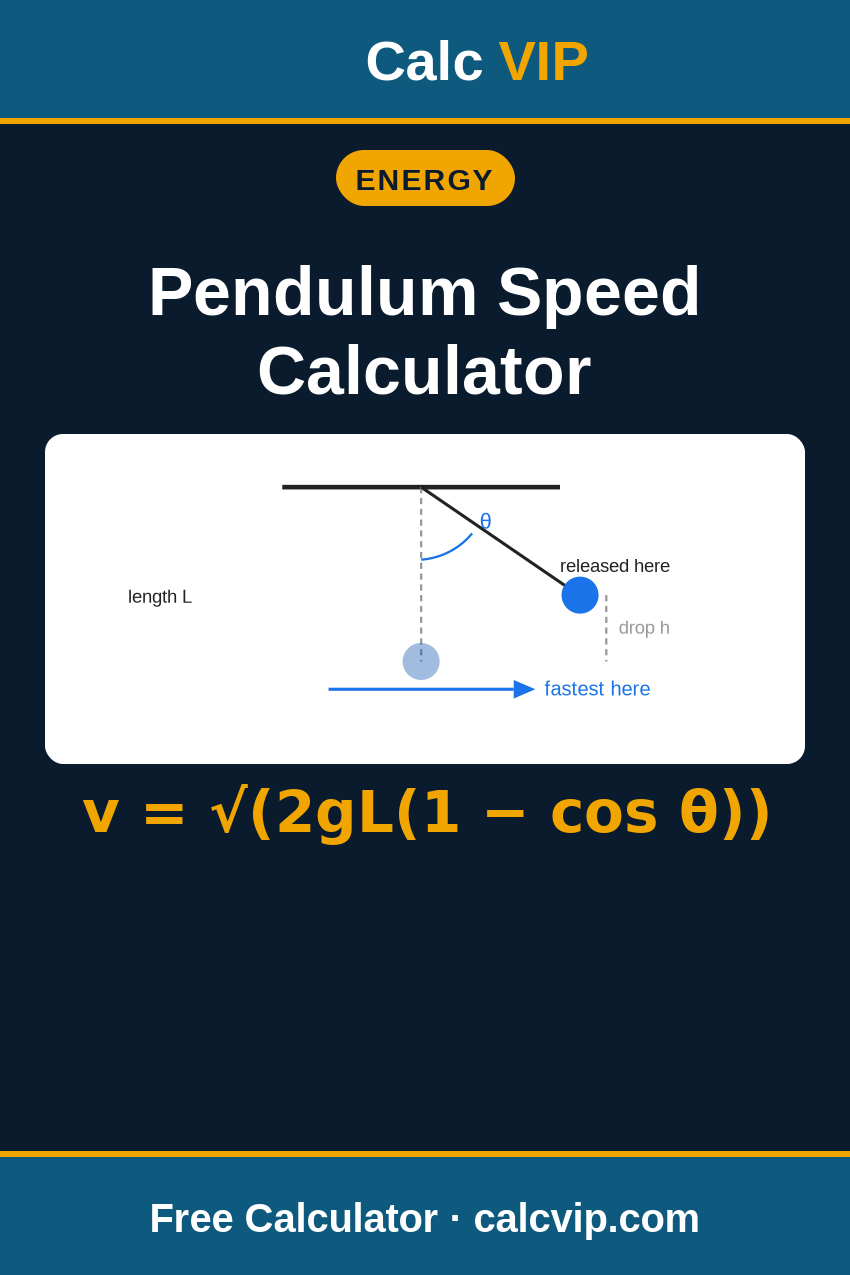
As with every falling-body calculation, the mass cancels: a lead bob and a wooden bob on identical strings, released together, sweep through the bottom in perfect step. And as with every idealisation, the real swing falls slightly short — air resistance and friction at the pivot tax each pass, which is why real pendulums wind down unless a clock's escapement tops them up. The calculator gives the ideal bottom speed: the standard the real swing is measured against, and the starting point for everything from playground swings to wrecking balls.
Formula
v = √(2gL(1 − cos θ))
The bob drops through a height h = L(1 − cos θ), so mgh = ½mv² gives the speed at the bottom. g = 9.81 m/s². The mass of the bob cancels out, so it does not affect the speed. The formula rearranges to run the question backwards: from a measured bottom speed, the release angle was cos θ = 1 − v² ÷ (2gL). Two features reward attention. The angle enters only through (1 − cos θ), which grows slowly at first — releasing from 20° drops the bob far less than a fifth of the way to its 90° drop — and then steepens, which is why wide swings feel disproportionately faster. And the length enters as a simple multiplier of the drop: at a fixed angle, doubling L doubles h and multiplies the bottom speed by √2 ≈ 1.41. Angles must be measured from the vertical — straight down is 0° — and your calculator's cosine expects degrees here, not radians.
| Symbol | Meaning | Units |
|---|---|---|
| v | speed at the bottom of the swing | m/s |
| L | pendulum length — pivot to the centre of the bob | metres (m) |
| θ | release angle from the vertical | degrees (°) |
| h | vertical drop of the bob, L(1 − cos θ) | metres (m) |
| g | gravitational field strength | 9.81 m/s² |
A roller coaster on a string
Strip away the string and a pendulum is a roller coaster whose track is an arc. The bob begins with height and no speed, accelerates as the arc falls away beneath it, peaks in speed at the lowest point, and coasts up the far side until the account is spent. Every formula from the roller-coaster page applies unchanged, because the physics is identical: the speed at any point depends only on the vertical distance fallen from the release point. The string's only job is choreography — it constrains the bob to its arc and provides the centripetal force that keeps it turning, while doing no work and so never entering the energy ledger.
That last point deserves a pause, because it confuses many students: the tension is often the largest force in the problem, yet it contributes nothing to the speed. Work is force multiplied by distance moved along the force. The bob moves along its arc; the tension points along the string, perpendicular to the arc at every instant; so the tension's work is zero at every instant. It is the same reason the Moon's speed never changes under Earth's gravity in a circular orbit. Whenever a force acts purely as a guide, energy ignores it — which is what makes energy methods so powerful: the biggest force in the diagram may be the least important one in the calculation.
The drop formula h = L(1 − cos θ) is where the geometry lives, and it has a personality. For small angles, 1 − cos θ is approximately θ²/2 (with θ in radians), so the drop — and the square of the speed — grows with the square of the angle: double a small release angle and the bottom speed roughly doubles. For large angles the growth softens, because cos θ flattens as θ approaches 180°. The bob released from horizontal (90°) has dropped its full length L; released from a full 180° — balanced above the pivot, possible only with a rigid rod — it would drop 2L, the most any pendulum of that length can ever offer.
How to use
- Enter the pendulum length (pivot to the centre of the bob) in metres (m).
- Enter the release angle from the vertical, in degrees — 0° is hanging straight down, 90° is level with the pivot.
- Click "Calculate Speed at the Bottom" to see the drop height and the speed at the bottom.
- For a swing or a rope, measure L to the centre of mass of the rider or load, not to the seat or hook — the formula follows the mass, not the hardware.
Worked examples
Example 1 — the headline case. A pendulum of length 2 m is released from 60°. The bob drops h = 2 × (1 − cos 60°) = 2 × 0.5 = 1 m. Its speed at the bottom is v = √(2 × 9.81 × 2 × (1 − 0.5)) = √19.62 = 4.43 m/s — a running pace, reached silently, with no motor, from nothing but a metre of height.
Example 2 — the playground swing. A swing's chains are 2.5 m long (to the rider's centre of mass) and the swing is pulled back to 45°. The drop is h = 2.5 × (1 − cos 45°) = 2.5 × 0.2929 = 0.73 m, and the speed through the bottom is v = √(2 × 9.81 × 0.7322) = 3.79 m/s — about 14 km/h, which is why the bottom of a good swing feels like flying and the ends feel like floating.
Example 3 — released from horizontal. A 1.5 m pendulum let go at 90° — bob level with the pivot. The bob drops its full length, h = 1.5 m, and reaches v = √(2 × 9.81 × 1.5) = √29.43 = 5.42 m/s at the bottom. This is the fastest bottom speed any release up to horizontal can give this pendulum, and the reference case for the table below.
Example 4 — a gentle sway. A 1 m pendulum released from only 10°: h = 1 × (1 − cos 10°) = 0.0152 m — a drop of a centimetre and a half. Bottom speed: v = √(2 × 9.81 × 0.0152) = 0.55 m/s. Small angles are feeble in speed, which is precisely why clock pendulums sip energy: their tiny swings need tiny top-ups from the escapement.
Example 5 — the wrecking ball. A demolition ball hangs from a 10 m cable and is pulled back to 30°. Drop: h = 10 × (1 − cos 30°) = 10 × 0.1340 = 1.34 m. Speed at the bottom: v = √(2 × 9.81 × 1.3397) = 5.13 m/s. That sounds gentle until you multiply by a 5,000 kg ball: the kinetic energy at impact is ½ × 5,000 × 5.13² ≈ 65,800 J — the energy of a car at motorway speed, delivered to one point of a wall.
Example 6 — the theoretical limit. A rigid-rod pendulum of 0.8 m released from 180° — balanced upside down and tipped. The bob drops 2L = 1.6 m and reaches v = √(2 × 9.81 × 1.6) = √31.39 = 5.60 m/s. No pendulum of this length can ever do better: 2L is the deepest drop its geometry contains. (A string pendulum cannot be released from 180° at all — the string would go slack — which is why this case belongs to rods and theory.)
Pendulum speed in real life
Newton's cradle. The clicking desk toy is five pendulums in a row. The raised ball arrives at the bottom at exactly this page's speed — for its short strings and typical release, a gentle metre per second or so — and the collision transfers the energy through the line almost perfectly, which is why the far ball leaves at the same speed the first one arrived with.
Playground and rope swings. Every swing is a pendulum whose length runs to the rider's centre of mass. Pumping works by raising that centre of mass at the right moment — adding height, hence drop, hence bottom speed. The formula explains the felt rhythm: speed lives at the bottom, stillness at the ends, and the whole ride is the trade between them.
Demolition wrecking balls. The operator's skill is energy management: pull back far enough (angle and cable length set the drop) to deliver the required impact speed, but not so far that the ball overshoots into the crane's own structure. Example 5's arithmetic — modest speed, enormous mass, devastating energy — is the whole trade in one line.
Trapeze and circus swings. A trapeze artist's timing is this formula performed by feel. The catch must happen near the ends of the swing, where the speed is near zero; the release for a somersault is timed off the bottom, where the speed — and therefore the height the somersault can win — is greatest. A mistimed release is an energy miscalculation.
Pendulum clocks. A clock's pendulum is kept at a small, constant angle, so its bottom speed is small and constant too — Example 4's gentle sway, repeated for years. The escapement replaces exactly the energy friction steals each swing, neither more nor less, which is why a well-regulated clock's tick is an energy audit you can hear.
Foucault's pendulum. The museum pendulum that "proves the Earth rotates" is a very long pendulum (the Paris original was 67 m) swinging at a tiny angle. Its bottom speed is unremarkable — the spectacle is in its plane of swing slowly rotating as the Earth turns beneath it. Length, in that exhibit, buys endurance and drama rather than speed.
Speed is only half the pendulum's story: the period
This page calculates how fast the bob moves; the pendulum's other famous property is how often it swings. For small angles the period — the time for one complete to-and-fro — is T = 2π√(L/g), depending on length and gravity alone: not on the mass, and (to a good approximation) not on the angle. A 1 m pendulum has a period of almost exactly 2 seconds, ticking its bottom crossing once per second, which is why it ruled clockmaking for three centuries. The two properties divide the world between them: the period governs clocks, metronomes and timing; the bottom speed governs impacts, swings and rides. At large angles the period stretches slightly — a 60° swing takes about 7% longer than the small-angle formula says — one of the first places the tidy approximation honestly admits its limits, and a reminder that this page's speed formula, being pure energy, has no such approximation in it at all.
Quick reference: bottom speed for a 1 m pendulum
| Release angle θ | Drop h | Speed at the bottom |
|---|---|---|
| 15° | 0.034 m | 0.82 m/s |
| 30° | 0.134 m | 1.62 m/s |
| 45° | 0.293 m | 2.40 m/s |
| 60° | 0.500 m | 3.13 m/s |
| 90° | 1.000 m | 4.43 m/s |
Scale the table to any pendulum by multiplying the speeds by √(L ÷ 1 m): a 4 m pendulum doubles every figure, a 0.25 m pendulum halves them. And notice the 60° row: the drop is exactly half the length, a coincidence of cos 60° = 0.5 that makes it the friendliest angle for mental arithmetic.
Common mistakes
- Measuring the angle from the horizontal. θ on this page is measured from the vertical — hanging straight down is 0°, level with the pivot is 90°. If you measure 30° above the horizontal instead, you have described a 60° release and your answer will be wrong by the whole difference between the two drops.
- Measuring L to the top of the bob. The length runs from the pivot to the bob's centre. On a large bob or a swing with a rider, that distinction is worth several percent — and the rider's centre of mass, not the seat, is the point the formula follows.
- Feeding degrees into a radian-mode calculator. cos(60°) = 0.5, but cos(60 radians) is a different number entirely. If your drop comes out negative or absurd, a mode mismatch is the prime suspect — this page's calculator handles the conversion for you.
- Expecting a heavier bob to swing faster. Mass cancels. A heavier bob carries more energy at the same speed — which is why the wrecking ball is heavy — but the speed itself is set by length and angle alone.
- Expecting the speed to double when the angle doubles. Speed follows √(1 − cos θ). From 30° to 60° the bottom speed of a 2 m pendulum rises from 2.29 to 4.43 m/s — close to double, by luck of the small-angle square law; from 60° to 120° it would rise far less than double, because the drop cannot exceed 2L however wide the release.
FAQ
Why is the bob fastest at the bottom?
At the bottom the bob is at its lowest point, so the most potential energy has been converted into kinetic energy. At the ends of the swing it momentarily stops.
Does a heavier bob swing faster?
No. Mass cancels out of the energy equation, so heavy and light bobs on the same length released from the same angle reach the same bottom speed.
What is the biggest angle I can use?
The formula works for any angle up to 180° in theory. Just enter the angle from the vertical (straight down = 0°).
Does the length or the angle matter more?
They multiply together, so it depends where you start. The drop is L × (1 − cos θ): doubling the length doubles the drop outright, while widening the angle has a ceiling — (1 − cos θ) can never exceed 2. For a short pendulum, angle is the cheap dial; for maximum speed at any angle, length always wins in the end, which is why fairground swings are built tall.
What is the bob's speed halfway down?
Halfway down in height — having fallen h/2 — the bob has converted half the energy, so its speed is the bottom speed divided by √2. For Example 1 (bottom speed 4.43 m/s), the speed after falling 0.5 m is √(2 × 9.81 × 0.5) = 3.13 m/s. Halfway in height is not halfway in time or in angle — the bob covers the lower half of its drop much faster than the upper half.
Why does a real pendulum eventually stop?
Because the ideal ledger has two small leaks: air resistance on the bob and string, and friction at the pivot. Each swing pays a little energy to both, so each return reaches a slightly smaller angle than the last. Clock escapements exist to refund exactly that loss, one small push per swing; an unrefunded pendulum is a countdown of its own stored energy.
Does this formula work for a playground swing with a person on it?
Yes — treat the person and seat together as the bob. The length is measured from the pivot to the rider's centre of mass (roughly the seated hip height above the seat), and the mass cancels as always. Example 2 is exactly this calculation, and its 3.79 m/s is the speed a child feels rushing through the bottom of a well-pumped swing.
What happens if the bob is released above 90°?
With a rigid rod, the formula keeps working up to 180°, and the drop approaches 2L. With a string, releasing above horizontal is impossible in the usual way — the string goes slack and the bob falls freely until the string catches again. The calculator accepts angles to 180° because the mathematics is sound; the hardware decides whether the motion is.
How can I find the release angle from a measured speed?
Rearrange the formula: cos θ = 1 − v² ÷ (2gL). Suppose a 2 m pendulum's bob is timed through the bottom at 4.43 m/s: cos θ = 1 − 19.62 ÷ 39.24 = 0.5, so θ = 60°. This backwards use — measuring speed to recover geometry — is how sports scientists and crash investigators audit swings and swinging loads from video.
Why doesn't the string's tension affect the speed?
Because tension always acts along the string while the bob moves along its arc — the two are perpendicular at every instant, and a force perpendicular to the motion does no work. Tension is essential (without it there is no pendulum, only a falling bob), but it guides without paying: all of the speed is bought by gravity, through the drop.