 Calc
Photon Energy Calculator – E = hf and E = hc/λ in J & eV
 Created by Yuki Tanaka · Physics Editor · Modern Physics · Last updated: November 2026
Use this free Photon Energy Calculator to find the energy of a single photon from its frequency (E = hf) or its wavelength (E = hc/λ). The result is given in joules and in electron-volts (eV), the unit most often used for light and atomic physics.
Light does not arrive as a smooth, continuous stream of energy. It arrives in packets — photons — and each packet carries a fixed amount of energy that depends on one thing only: the light's frequency. Double the frequency and each photon carries exactly twice as much energy; the brightness of the beam makes no difference to the individual packets, only to how many of them arrive each second. This calculator finds the energy of one packet, the smallest possible portion of light of a given colour, and it is the starting point for almost everything in modern physics, from solar cells to X-ray machines.
The energies involved span an almost absurd range. A photon of FM radio carries about 10−25 joules — so feeble that a radio receiver needs billions of billions of them to make a sound. A green photon carries about 4 × 10⁻¹⁹ J, still tiny, but roughly a million times more. An X-ray photon carries thousands of times more again, and a gamma-ray photon from a nuclear reaction can carry a million times the energy of visible light. One formula, E = hf, covers the whole sweep, because Planck's constant h is the fixed exchange rate between frequency and energy: 6.626 × 10⁻³⁴ joules for every hertz.
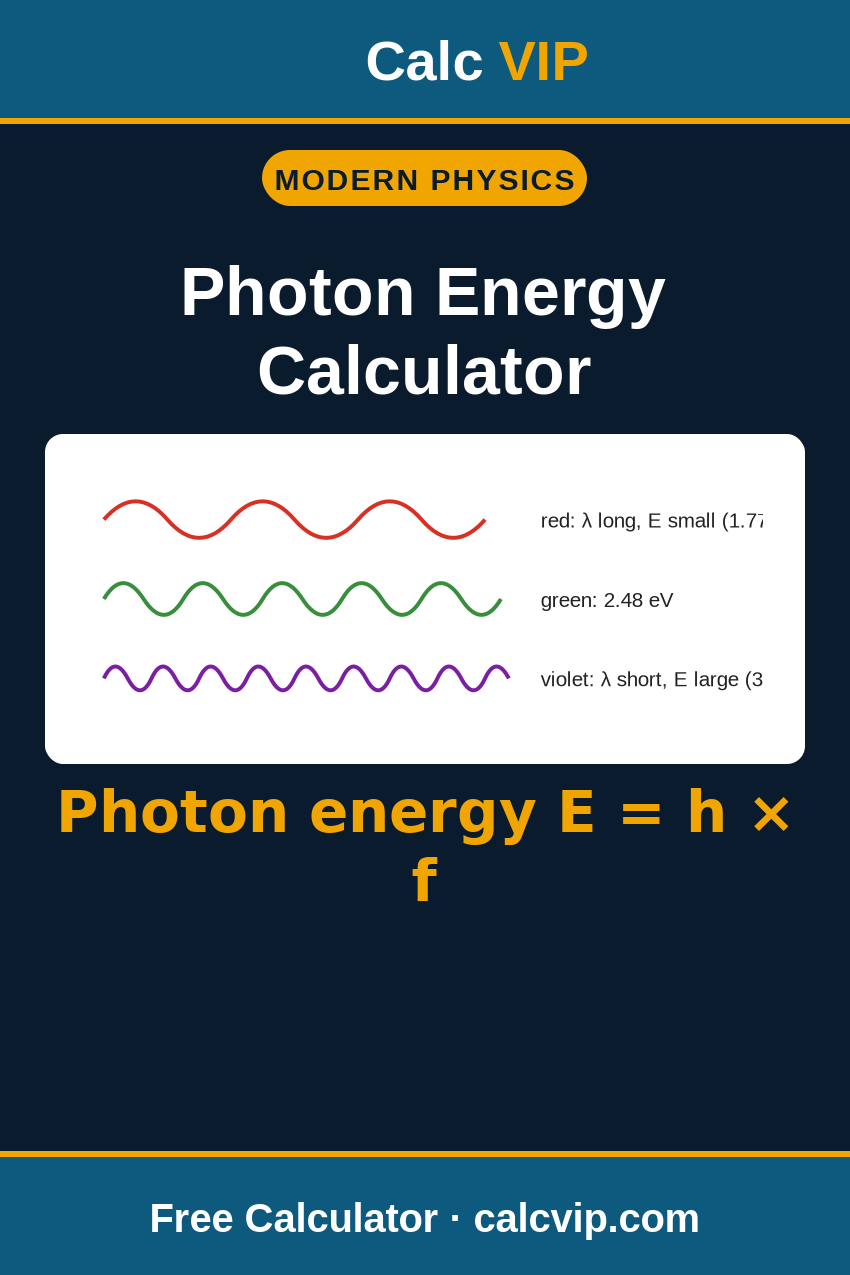
Because frequency and wavelength are linked by f = c/λ, photon energy can equally be written E = hc/λ, and this form hides a shortcut worth memorising: with λ in nanometres, E (in eV) ≈ 1240 ÷ λ (in nm). Red light at 620 nm? About 2 eV. Ultraviolet at 310 nm? About 4 eV. The shortcut works because hc/e is a constant of nature, 1240.8 eV·nm with the constants used here. It also makes the central fact visual: energy is inversely proportional to wavelength, so the spectrum's short-wave end is where the dangerous, chemistry-changing photons live.
Formula
Photon energy E = h × f • E in joules (J), h = Planck's constant = 6.626 × 10⁻³⁴ J·s, f in hertz (Hz)
Since f = c/λ, the same energy is E = h × c / λ, with c = 3 × 10⁸ m/s and λ in metres. The formulas rearrange cleanly: f = E / h if you know the energy and want the frequency, and λ = h × c / E if you know the energy and want the wavelength. To convert the answer into electron-volts, divide joules by the elementary charge, 1.602 × 10⁻¹⁹: E (eV) = E (J) ÷ 1.602 × 10⁻¹⁹. Combining the constants gives the nanometre shortcut, E (eV) ≈ 1240.8 ÷ λ (nm), which is exact enough for nearly all everyday work. One warning governs most errors: the SI formulas demand λ in metres and f in plain hertz — prefixes like nano and giga must be converted before, not after, the calculation.
| Symbol | Meaning | Units |
|---|---|---|
| E | energy of one photon | J (or eV) |
| h | Planck's constant, 6.626 × 10⁻³⁴ | J·s |
| f | frequency of the light | hertz (Hz) |
| λ | wavelength | m (often quoted in nm) |
| c | speed of light, 3 × 10⁸ | m/s |
| eV | electron-volt, 1.602 × 10⁻¹⁹ J | unit of energy |
Why light's energy comes in lumps
The packet idea was forced on physics, not chosen. In 1900 Max Planck found he could only explain the glow of hot objects if energy was emitted in multiples of hf, and in 1905 Einstein took the bolder step: light itself travels in such packets, later named photons. The evidence was the photoelectric effect — light below a certain frequency ejects no electrons from a metal however bright it is, while faint light above that frequency ejects them instantly. A wave spreading its energy smoothly cannot explain a hard threshold; a stream of packets, each carrying hf, explains it at once. This calculator is, in effect, Einstein's 1905 idea reduced to arithmetic.
The packet picture splits two ideas that everyday language merges. Energy per photon is set by frequency alone and governs what one photon can do: eject an electron, break a bond, trigger a chemical change. Intensity is photon energy multiplied by photon flow — how many packets land per second — and governs how much happens. Sunburn is the everyday proof: hours of bright visible light (photons near 2 eV) never burn skin, while weaker ultraviolet (4 eV and above) does, because only the individual UV photon carries enough energy to damage a molecule. Brightness cannot substitute for per-photon energy, any more than a thousand thrown table-tennis balls can do the work of one bullet.
Counting photons makes the graininess vivid. A green laser pointer emitting 1 milliwatt of 532 nm light produces photons of 3.73 × 10⁻¹⁹ J each (run 532 through the calculator), so it pours out 10−3 ÷ 3.73 × 10⁻¹⁹ ≈ 2.7 × 10¹⁵ photons every second — quadrillions, which is why the beam looks perfectly smooth. Turn the power down far enough, though, and the smoothness fails: sensitive detectors in dark laboratories register photons one click at a time, and a sufficiently dim source produces a patter of individual arrivals, like rain beginning on a roof. Every light source is raining; bright ones just rain too fast to hear the drops. Photon flux — power divided by the per-photon energy from this page — is the conversion engineers use whenever a detector, a solar cell or an eye is specified in counts rather than watts.
How to use
- Choose whether you know the frequency or the wavelength, using the "Calculate from" menu.
- Enter the frequency in hertz — scientific notation such as 6e14 is accepted — or the wavelength in nanometres.
- Click "Calculate Photon Energy" to see the energy of one photon in joules and electron-volts, together with the matching wavelength or frequency.
- Sanity-check the answer against the spectrum: visible light should give roughly 1.6–3.3 eV; far outside that range, a misplaced prefix (nm entered as metres, GHz as hertz) is the usual culprit.
Worked examples
Example 1 — green light. Green light has a wavelength of about 500 nm. Its frequency is f = c/λ = 3 × 10⁸ ÷ (500 × 10−9) = 6 × 10¹⁴ Hz.
E = hc/λ = (6.626 × 10−34 × 3 × 108) ÷ (500 × 10−9) = 3.976 × 10⁻¹⁹ J = 2.482 eV. This is the typical energy scale of a chemistry-relevant photon: comparable to the energy of a chemical bond per molecule, which is why sunlight can drive photosynthesis and fade dyes.
Example 2 — red light. At 650 nm, the shortcut gives E = 1240.8 ÷ 650 = 1.909 eV = 3.058 × 10⁻¹⁹ J, with f = 4.615 × 10¹⁴ Hz. Red photons are the weakest of the visible set — too weak to trigger most photochemistry, which is why photographic darkrooms could be lit in red, and why red light is used to preserve night vision.
Example 3 — germicidal ultraviolet. Sterilising lamps emit at 254 nm: E = 1240.8 ÷ 254 = 4.885 eV = 7.826 × 10⁻¹⁹ J per photon, at f = 1.181 × 10¹⁵ Hz. That comfortably exceeds the energy needed to damage DNA bonds, which is precisely why this wavelength sterilises — and why it must never shine on skin or eyes.
Example 4 — an X-ray photon. A dental X-ray photon of wavelength 0.1 nm carries E = 1240.8 ÷ 0.1 = 12,408 eV ≈ 12.4 keV = 1.988 × 10⁻¹⁵ J. One photon holds thousands of times a visible photon's energy — enough to ionise many atoms along its path, which is both why X-rays image bones and why their dose is carefully limited.
Example 5 — the microwave oven. Oven radiation runs at 2.45 GHz: E = hf = 6.626 × 10−34 × 2.45 × 109 = 1.623 × 10⁻²⁴ J = 1.013 × 10⁻⁵ eV, with λ = 12.24 cm. A single microwave photon is a hundred thousand times too weak to break any bond; the oven works by sheer numbers, pouring out roughly 6 × 1026 photons per second at 1000 W, each merely jiggling water molecules.
Example 6 — counting a laser's photons. A red laser pointer emits 1 mW (0.001 J/s) at 650 nm, where each photon carries 3.058 × 10⁻¹⁹ J. The photon flow is 0.001 ÷ 3.058 × 10−19 = 3.27 × 10¹⁵ photons per second — over three million billion, every second, from a pocket device. Photon energies are tiny; photon counts are astronomical. Almost every light calculation is a negotiation between those two facts.
Photon energy in real life
Sunlight's photon rain. Full sunlight delivers about 1000 W to each square metre. Taking 550 nm as a typical photon (3.614 × 10⁻¹⁹ J), that is 1000 ÷ 3.614 × 10⁻¹⁹ ≈ 2.8 × 10²¹ photons per second on every sunlit square metre — the raw material solar panels and leaves compete to harvest.
Photosynthesis runs on red photons. Chlorophyll absorbs most strongly in the red and blue; the chemistry of splitting water needs photons of roughly 1.8 eV and up, which is why plants use visible light at all and ignore the infrared that makes up half of sunlight's power. The green we see is the light the leaf could not use.
Fibre-optic signals. Internet traffic rides infrared photons at 1550 nm, each carrying 1240.8 ÷ 1550 = 0.80 eV. The wavelength is chosen because glass fibre is most transparent there — the photon energy is a by-product of an engineering optimum, and detectors must be sensitive to packets of less than one electron-volt.
Radiotherapy. Cancer treatment beams use photons of around a million electron-volts (MeV) — half a million times a visible photon's energy. At that energy each photon can ionise thousands of molecules, depositing its energy inside the tumour.
Photography and exposure. A camera sensor is a photon counter: each pixel collects photons and reports how many arrived. Dim scenes are grainy because the photon count itself is noisy — with few packets, the statistics of their arrival (shot noise) becomes visible in the picture.
The Sun's colour. A hot object's photons peak at an energy set by its temperature. The Sun's surface, at about 5800 K, peaks near 500 nm (2.48 eV) — squarely in the visible band our eyes evolved to use. A cooler red dwarf peaks in the infrared; a hotter blue star in the ultraviolet.
A mole of photons: the einstein
Chemists scale this calculator up by Avogadro's number. One mole of photons — a unit photochemists call an einstein — at 500 nm carries 3.976 × 10−19 × 6.022 × 1023 ≈ 239 kJ per mole. Set that beside chemistry: a carbon–carbon bond costs about 350 kJ/mol to break, a carbon–hydrogen bond about 410 kJ/mol. Green light, mole for mole, falls just short — but at 254 nm the same calculation gives 7.826 × 10−19 × 6.022 × 1023 ≈ 471 kJ/mol, more than enough to snap either bond. This is the quantitative reason ultraviolet degrades plastics, fades paint and damages skin while visible light mostly cannot: the per-photon energy, multiplied up to chemical scale, crosses the bond-energy threshold.
Quick reference: photon energies across the spectrum
| Radiation | Wavelength | Energy per photon |
|---|---|---|
| FM radio | 3 m | 4.14 × 10⁻⁷ eV |
| microwave oven | 12.24 cm | 1.01 × 10⁻⁵ eV |
| infrared (heat lamp) | 10,000 nm | 0.124 eV |
| red light | 700 nm | 1.77 eV |
| green light | 500 nm | 2.48 eV |
| violet light | 400 nm | 3.10 eV |
| ultraviolet | 254 nm | 4.89 eV |
| X-ray | 0.1 nm | 12.4 keV |
| gamma ray | 0.01 nm | 124 keV |
Read the table as a danger scale: somewhere between the ultraviolet rows and the X-ray rows, photons stop merely warming matter and start ionising it — stripping electrons from atoms — which is where biological damage begins.
Common mistakes
- Confusing brightness with photon energy. A brighter beam has more photons per second, not stronger ones. Doubling a lamp's power doubles the photon count; the energy of each photon stays exactly where the frequency put it.
- Feeding nanometres into the SI formula. E = hc/λ needs λ in metres. Entering 500 instead of 500 × 10−9 shrinks the answer by a billion. (Or use the 1240.8 ÷ λ(nm) shortcut, which is built for nanometres.)
- Leaving frequency in GHz or MHz. E = hf needs plain hertz. A 2.45 GHz oven photon computed with f = 2.45 comes out a billion times too small.
- Treating the electron-volt as a voltage. The eV is a unit of energy — the energy an electron gains crossing 1 volt. A 2.48 eV photon is not "2.48 volts of light".
- Expecting the energy to change inside glass or water. Entering a medium slows light and shortens its wavelength, but the frequency — and therefore the photon energy — is unchanged. A photon that was 2.48 eV in air is 2.48 eV in the sea.
FAQ
Why is photon energy quoted in eV?
A single photon carries a tiny amount of energy in joules, so atomic and optical physicists use the electron-volt: 1 eV = 1.602 × 10⁻¹⁹ J. Visible-light photons are roughly 1.6–3.3 eV.
Which colour of light has the most energetic photons?
Violet light — it has the shortest wavelength and highest frequency of visible light, and E grows with frequency. Ultraviolet and X-ray photons carry even more.
Does a brighter light mean more energetic photons?
No. Brightness means MORE photons per second. Each individual photon's energy depends only on the frequency (or wavelength) of the light.
How many photons does an LED bulb emit each second?
A 10 W LED converting most of its power to greenish light near 550 nm (3.614 × 10⁻¹⁹ J per photon) emits about 10 ÷ 3.614 × 10⁻¹⁹ ≈ 2.8 × 10¹⁹ photons per second — tens of billions of billions, which is why light feels continuous even though it is granular.
What is the energy of a gamma-ray photon?
Typically hundreds of keV to several MeV. A 1 MeV photon has a wavelength of only 1240.8 ÷ 1,000,000 ≈ 0.00124 nm — about a hundred times smaller than an atom — and can ionise thousands of atoms before it is absorbed.
Why don't radio waves harm us?
Their photons carry around a millionth of an electron-volt, millions of times too little to break a chemical bond or ionise an atom. Radio can warm tissue when absorbed in enormous quantity (that is how microwave ovens work), but it cannot do the per-photon damage that makes ultraviolet and X-rays hazardous.
Does a photon's energy change when light enters water or glass?
No. The light slows and its wavelength shortens by the refractive index, but its frequency is fixed at the source, and E = hf follows the frequency. Divers see the same colours as people above the surface for this reason.
What exactly is Planck's constant?
It is the conversion factor between a photon's frequency and its energy: h = 6.626 × 10⁻³⁴ J·s. Its smallness is why light's graininess hides at everyday scales — and since 2019 it has been an exact, defined constant that fixes the size of the kilogram itself.
Can the human eye detect a single photon?
Almost: the rod cells of the retina respond to individual photons, and experiments show people can sometimes report flashes produced by just a few photons. The eye is a remarkably good photon counter operating near the physical limit.
How is photon energy related to the temperature of a glowing object?
Hotter objects emit photons of higher typical energy: the emission peaks at λ ≈ 2.9 × 10⁻³ ÷ T metres. At the Sun's 5800 K the peak is 500 nm (2.48 eV, visible); a 1000 K heating element peaks at 2900 nm (0.43 eV, infrared) — which is why it glows only dull red while pouring out invisible heat radiation.