 Calc
Photoelectric Effect Calculator – KE = hf − φ & Stopping Potential
 Created by Yuki Tanaka · Physics Editor · Modern Physics · Last updated: November 2026
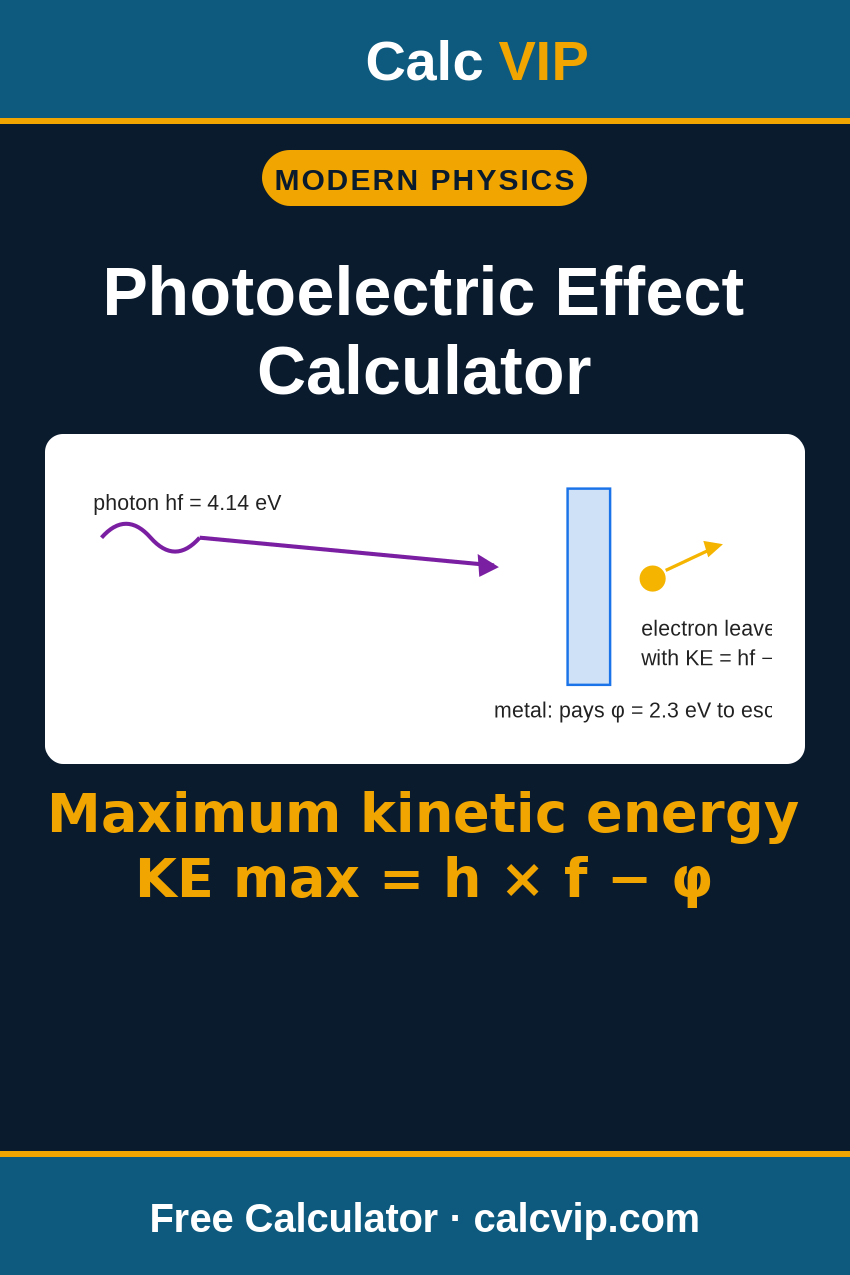
Use this free Photoelectric Effect Calculator to find the maximum kinetic energy of electrons knocked out of a metal by light, using Einstein's equation KEmax = hf − φ. It also gives the stopping potential and the threshold (cut-off) wavelength of the metal.
The photoelectric effect is the experiment that proved light comes in particles. Shine light on a clean metal surface and, under the right conditions, electrons fly off it. But the "right conditions" baffled nineteenth-century physics: red light, however intense, ejected nothing at all, while the faintest ultraviolet ejected electrons instantly, and the electrons' energy grew with the light's frequency rather than its brightness. Einstein's 1905 explanation — each photon hands its whole energy hf to one electron, which pays the metal's work function φ as an exit fee and keeps the change as kinetic energy — is exactly the arithmetic this calculator performs, and it won him the Nobel Prize.
The work function is the metal's personality in this story. It is the minimum energy an electron needs to escape the surface, and it varies from about 2.1 eV for caesium to 5.6 eV for platinum. Everything follows from comparing the photon's energy with that fee. A photon below φ is turned away empty-handed; a photon above it frees an electron with KEmax = hf − φ to spare. The boundary case defines the threshold frequency f₀ = φ/h and the threshold wavelength λ₀ = hc/φ — for sodium, 539.5 nm, meaning even green light can just barely eject its electrons, while most metals demand ultraviolet.
Notice what the equation does not contain: intensity. Brightness buys more photons, hence more electrons, but never faster ones. That single stubborn fact demolished the wave-only picture of light, and it still runs the modern world quietly — every solar panel, camera sensor, light meter and automatic door sensor is the photoelectric effect at work, converting photons above a threshold into electrons on demand. This calculator handles the external effect (electrons leaving a surface); the same physics inside a semiconductor, where electrons are promoted rather than ejected, is the internal effect behind photovoltaic cells.
Formula
Maximum kinetic energy KEmax = h × f − φ • h = 6.626 × 10⁻³⁴ J·s, f in hertz (Hz), φ the work function
The equation is an energy budget: the photon pays in hf, the surface charges φ, and the electron leaves with the difference. Working in electron-volts keeps it simple — convert the photon with E (eV) = hf ÷ 1.602 × 10⁻¹⁹, then subtract φ directly. Three companion results complete the picture: the stopping potential Vs = KEmax ÷ e, which in volts is numerically equal to KEmax in eV; the threshold frequency f₀ = φ ÷ h, below which nothing is emitted; and the threshold wavelength λ₀ = h × c ÷ φ ≈ 1240.8 ÷ φ (nm, with φ in eV), the longest wavelength that can still free an electron. If hf ≤ φ the calculator reports no emission — the electron's change would be zero or negative, and nature does not allow the debt.
| Symbol | Meaning | Units |
|---|---|---|
| KEmax | fastest emitted electron's kinetic energy | J (or eV) |
| h | Planck's constant, 6.626 × 10⁻³⁴ | J·s |
| f | frequency of the incoming light | hertz (Hz) |
| φ | work function of the metal | eV (or J) |
| Vs | stopping potential | volts (V) |
| λ₀, f₀ | threshold wavelength and frequency | nm, Hz |
Why KEmax — the fastest electron, not the average
The subscript matters. Electrons inside a metal are not all equally placed: one sitting right at the surface, struck cleanly, escapes having paid exactly φ and keeps the full hf − φ. Others start deeper, collide on the way out, or glance off atoms, and emerge with less — some with almost nothing. The emitted electrons therefore have a spread of energies from zero up to a sharp ceiling, and it is the ceiling, KEmax, that Einstein's equation predicts and that the stopping potential measures. This is also why the effect is such a clean test of the photon idea: the ceiling depends only on f and φ, so plotting KEmax against frequency gives a straight line whose slope is Planck's constant itself — the experiment (performed precisely by Millikan, who set out to disprove Einstein) measures h from a tabletop.
There is a second, quieter consequence. Because one photon serves one electron, the effect has no delay and no accumulation: a single above-threshold photon can free an electron within a billionth of a second of arriving, even if the light is so feeble that photons land one at a time. Dim light does not charge up the surface until it can afford an electron — it either pays in full, photon by photon, or not at all. Detectors exploit this ruthlessly: photomultiplier tubes count individual photons by catching their individual electrons and amplifying the result a millionfold.
The verification of all this is itself a famous story. Robert Millikan set out to disprove Einstein's equation, spent a decade on precision photoelectric measurements, and by 1916 had confirmed it to half a percent — concluding, honestly and reluctantly, that the equation was right whatever he thought of the theory behind it. His data gave h from the slope of KE versus frequency (the same slope in Example 4's method), matching Planck's value from blackbody radiation by an entirely independent route. When two unrelated experiments yield the same new constant of nature, the constant — and the photon picture carrying it — stops being a hypothesis. Millikan received the Nobel Prize in 1923, partly for this work; Einstein's 1921 prize citation, pointedly, named the photoelectric law rather than relativity. The effect this calculator computes was, for a generation, the most precisely tested statement in quantum physics.
How to use
- Enter the frequency of the incoming light in hertz — scientific notation such as 1e15 is accepted.
- Enter the metal's work function in electron-volts (sodium 2.3, zinc 4.3 and platinum 5.6 are common textbook values; the table below gives more).
- Click "Calculate Photoelectron Energy" to see the photon energy, KEmax in eV and joules, the stopping potential, and the metal's threshold wavelength and frequency.
- If the photon energy is at or below the work function, the tool reports that no electrons are emitted — raise the frequency (shorten the wavelength) until it clears the threshold.
Worked examples
Example 1 — ultraviolet on sodium. Light of frequency 1 × 10¹⁵ Hz shines on sodium (φ = 2.3 eV).
Photon energy = hf = 6.626 × 10−34 × 1 × 1015 = 6.626 × 10⁻¹⁹ J = 4.136 eV
KEmax = 4.136 − 2.3 = 1.836 eV = 2.941 × 10⁻¹⁹ J; stopping potential = 1.836 V; threshold wavelength λ₀ = 1240.8 ÷ 2.3 = 539.5 nm (threshold frequency 5.56 × 10¹⁴ Hz).
Example 2 — a germicidal lamp on zinc. Zinc has φ = 4.3 eV and its threshold is 289 nm, so visible light does nothing. A 254 nm sterilising lamp sends photons of 1240.8 ÷ 254 = 4.885 eV: KEmax = 4.885 − 4.3 = 0.585 eV, a stopping potential of 0.585 V, and a fastest-electron speed of √(2 × 0.585 × 1.602 × 10−19 ÷ 9.11 × 10⁻³¹) ≈ 4.54 × 10⁵ m/s.
Example 3 — red light on caesium: nothing happens. Caesium has the friendliest common work function, φ = 2.1 eV, with threshold λ₀ = 1240.8 ÷ 2.1 = 590.9 nm. Red light at 650 nm carries only 1.909 eV per photon — below the fee — so no electrons are emitted, whether the beam is a candle's glow or a stadium floodlight's. Shift to 550 nm green (2.256 eV) and emission begins, with KEmax = 0.156 eV.
Example 4 — violet light on potassium. Potassium (φ = 2.29 eV) under 400 nm violet light (3.102 eV): KEmax = 3.102 − 2.29 = 0.812 eV, stopping potential 0.812 V, and the fastest electrons move at √(2 × 0.812 × 1.602 × 10−19 ÷ 9.11 × 10⁻³¹) ≈ 5.34 × 10⁵ m/s — about Mach 1500, from nothing but light.
Example 5 — copper's threshold. Copper (φ = 4.7 eV) needs f₀ = φ ÷ h = 4.7 × 1.602 × 10−19 ÷ 6.626 × 10−34 = 1.136 × 10¹⁵ Hz, i.e. λ₀ = 264 nm — deep ultraviolet. That stubbornness is useful: copper components sit in full sunlight for decades without shedding electrons, because sunlight at sea level contains almost nothing below 300 nm.
Example 6 — working backwards from a stopping potential. In a lab, light on a metal with φ = 2.9 eV is just stopped by 1.2 V. Then KEmax = 1.2 eV, so the photons carried 2.9 + 1.2 = 4.1 eV, and their wavelength was 1240.8 ÷ 4.1 = 302.6 nm. This backwards route — voltage in, wavelength out — is how the effect is actually used to measure both work functions and Planck's constant.
The photoelectric effect in real life
Solar panels. A silicon cell is the internal cousin of this effect: photons above silicon's 1.1 eV band gap (λ shorter than about 1130 nm) free electrons inside the material. Photons below the gap pass through uselessly and photons far above it waste their excess as heat — the same threshold-and-change logic as KEmax = hf − φ, and the reason single-junction cells cap out near 33% efficiency.
Camera sensors and light meters. Every digital photograph is a photoelectric census: photons free charges in proportion to their number, never their individual energy. That is why doubling exposure time and doubling brightness are interchangeable — the sensor counts photons either way.
Photomultiplier tubes. Night-vision devices and particle detectors use a low-φ surface (often a caesium compound, chosen with this calculator's table in mind) so that even a single visible photon frees an electron, which is then multiplied into a measurable pulse.
Automatic doors and burglar alarms. A beam of infrared or visible light holds a photoelectric switch on; a person interrupting the beam stops the electron flow and triggers the circuit. The threshold physics guarantees the switch ignores stray heat radiation whose photons are too weak.
Spacecraft charging. Sunlight's ultraviolet ejects electrons from satellite surfaces, leaving them positively charged — a real engineering hazard that can spark discharges. Designers compute emission with exactly this equation, using the work functions of the hull materials.
Smoke detectors. Optical smoke alarms shine light into a chamber watched by a photocell; smoke particles scatter photons into the sensor, and the resulting photoelectric current sounds the alarm.
Work functions of common metals
| Metal | Work function φ | Threshold λ₀ | Responds to |
|---|---|---|---|
| caesium | 2.1 eV | 591 nm | most visible light |
| potassium | 2.29 eV | 542 nm | green and bluer |
| sodium | 2.3 eV | 539 nm | green and bluer |
| magnesium | 3.66 eV | 339 nm | near ultraviolet |
| zinc | 4.3 eV | 289 nm | ultraviolet only |
| copper | 4.7 eV | 264 nm | ultraviolet only |
| platinum | 5.6 eV | 222 nm | far ultraviolet only |
Values vary slightly with surface condition — a fingerprint or oxide layer can shift φ by tenths of an electron-volt — which is why laboratory photocathodes are prepared and kept in vacuum.
Measuring Planck's constant with a battery
Reverse this calculator and it becomes one of the great tabletop experiments. Illuminate a metal with several known frequencies, measure each stopping potential, and plot Vs against f. Einstein's equation predicts a straight line, Vs = (h/e) f − φ/e: its slope is h/e, so multiplying by the electron charge gives h itself, and its intercept gives the work function. Millikan spent a decade performing this measurement to extraordinary precision, expecting to refute Einstein — and instead confirmed the equation to half a percent, remarking that the result left him no choice. School laboratories still repeat the experiment with LEDs and a voltmeter; the numbers students extract are this page's constants, measured rather than looked up.
The effect also operates where nobody invited it: spacecraft charging. Sunlight's ultraviolet photons eject electrons from a satellite's sunlit surfaces exactly as in Example 1, leaving the craft positively charged while its shadowed side collects electrons from the surrounding plasma — potential differences of hundreds or thousands of volts across one vehicle, enough to spark discharges through insulation and upset electronics. Spacecraft engineers model photoemission currents with this page's threshold logic (which surface materials have work functions low enough for solar UV to strip?) as a routine part of design, and anomalous satellite failures have repeatedly been traced to it. Einstein's patent-office-era effect is, among its other jobs, a space-weather hazard.
Common mistakes
- Expecting brighter light to make faster electrons. Intensity raises the number of electrons, never their maximum energy. If a question says the lamp was made brighter, KEmax does not move.
- Mixing joules and electron-volts mid-equation. hf naturally comes out in joules while φ is usually quoted in eV. Convert one side before subtracting — subtracting 2.3 from 6.626 × 10⁻¹⁹ is the classic disaster.
- Forgetting the threshold entirely. If hf < φ the answer is not a negative kinetic energy; it is no emission at all. Negative KEmax is nature's way of saying the photon was refused.
- Assuming all electrons get KEmax. Only the luckiest surface electrons reach the maximum; the rest emerge slower after collisions inside the metal. KEmax is a ceiling, not a uniform wage.
- Confusing threshold wavelength direction. λ₀ is the longest wavelength that works. Shorter wavelengths are fine (more energy); longer ones fail. Students routinely reverse it because "threshold" sounds like a minimum.
FAQ
Why doesn't brighter light give faster electrons?
Brightness adds more photons, so more electrons are released — but each photon still carries hf, so the maximum electron energy depends only on frequency, not intensity. This was the key evidence that light comes in photons.
What happens below the threshold frequency?
Nothing — no electrons are emitted at all, however bright or long you shine the light, because each photon has less energy than the work function.
What is the stopping potential used for?
It is the reverse voltage needed to just stop the fastest photoelectrons reaching the collector. Measuring it in the lab gives KEmax directly, in electron-volts.
How fast do the emitted electrons actually travel?
For a typical KEmax of 1 eV, v = √(2 × 1.602 × 10−19 ÷ 9.11 × 10⁻³¹) ≈ 5.9 × 10⁵ m/s — about 0.2% of light speed, fast enough that classical (non-relativistic) kinetic energy is perfectly accurate here.
Why do solar panels ignore infrared light?
Silicon's effective "work function" — its band gap — is 1.1 eV, so photons longer than about 1130 nm cannot free an electron-hole pair at all. Roughly a fifth of sunlight's energy sits beyond that threshold and is simply unavailable to a silicon cell, whatever the panel's size.
Can one photon free two electrons?
Essentially never in this effect: the photon's energy goes to a single electron in a single interaction. Only at much higher (X-ray) energies do secondary processes let one photon's energy cascade into several ionisations.
Is there a time delay while the electron "saves up" energy?
No — emission is effectively instantaneous (within a billionth of a second) even for light so dim that photons arrive seconds apart. That absence of delay was some of the strongest early evidence against the smooth-wave picture.
Why are photocathodes made of caesium compounds?
Because caesium has one of the lowest work functions of any element (2.1 eV, threshold 591 nm), so ordinary visible light can eject its electrons. Detector design is largely a search for surfaces with a φ matched to the light they must catch.
Did Einstein really win the Nobel Prize for this?
Yes — his 1921 prize citation honours "the discovery of the law of the photoelectric effect", not relativity. The equation on this page, published in 1905, is the law referred to.
What is the difference between the photoelectric and photovoltaic effects?
Location of the freed electron. In the photoelectric effect it leaves the material entirely, into vacuum or air. In the photovoltaic effect it stays inside a semiconductor, promoted across the band gap, and is collected as current — the same threshold arithmetic, a different exit door.