 Calc
Magnetic Energy Density Calculator – Energy Stored per Cubic Metre of Field
 Created by Thomas Becker · Physics Writer · Electricity & Magnetism · Last updated: November 2026
Use this free Magnetic Energy Density Calculator to find how much energy is stored in each cubic metre of a magnetic field, u = B² ÷ (2μ0), and the total energy stored in a given volume of the field.
A magnetic field is not just a pattern of forces — it is a reservoir of energy, stored in empty space itself. Every cubic metre of a field of strength B holds u = B²/(2μ0) joules, put there by whatever power supply built the field and recoverable, in full, when the field collapses. This calculator finds that density, and, if you give it the volume the field occupies, the total stored energy U = u × V.
The square in the formula is the whole story. Double the field and the same volume stores four times the energy; triple it and the energy rises ninefold. That is why the numbers escalate so startlingly fast as fields grow: the Earth's gentle 50 µT stores about a thousandth of a joule per cubic metre, a strong laboratory magnet at 1.5 T stores nearly 900,000 J/m³, and the 10 T class magnets of research laboratories hold some 40 million joules in every cubic metre of their bores. Energy density is also why strong magnets are dangerous in a way that has nothing to do with attraction: all that stored energy can come back out in milliseconds if the field collapses suddenly.
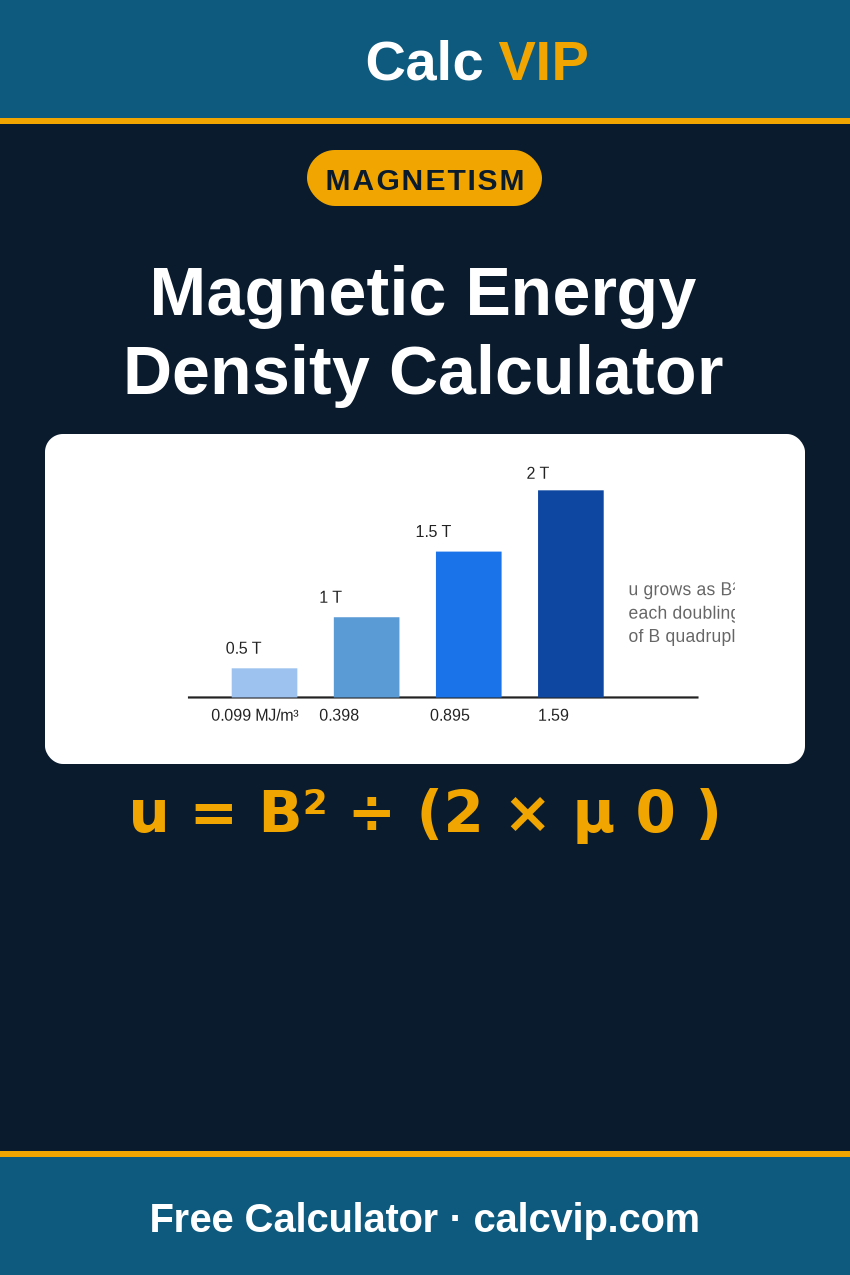
Energy density doubles as something else engineers care about: pressure. A magnetic field pushes outward on whatever confines it with a pressure numerically equal to u — a fact written into the design of every high-field magnet, whose windings must be braced like pressure vessels, and into astrophysics, where the pressure of a star's magnetic field can rival the pressure of its gas. One formula, B²/(2μ0), thus prices a field three ways: as stored energy per volume, as the work needed to create it, and as the push it exerts on its container.
Formula
u = B² ÷ (2 × μ0) • u in joules per cubic metre (J/m³), with μ0 = 4π × 10⁻⁷. Because u grows with the square of B, doubling the field stores four times as much energy in the same volume. Multiply u by the volume to get the total stored energy U.
Run the formula backwards and it becomes a design tool: B = √(2 × μ0 × u) tells you the field whose energy density matches a target — useful because the same u is also the magnetic pressure in pascals, so a mechanical limit in pascals converts straight into a field limit in tesla. Inside a material of relative permeability μr the density at given B becomes u = B²/(2μrμ0); in the air gaps and bores where strong fields actually live, μr = 1 and the plain formula applies. The calculator also reports u in kJ/m³, often the handiest scale for magnet work.
| Symbol | Meaning | Units |
|---|---|---|
| u | magnetic energy density — energy per unit volume of field | J/m³ |
| B | magnetic field strength | tesla (T) |
| μ0 | permeability of free space, 4π × 10⁻⁷ | H/m |
| V | volume occupied by the field | m³ |
| U | total stored energy, U = u × V | joules (J) |
Two ways to count the same joules: field energy and ½LI²
Students meet magnetic energy twice and rarely notice it is the same energy. Circuit theory says an inductor stores U = ½LI². Field theory says the energy lives in the space the inductor's field fills, at density B²/(2μ0). Both are right, and checking one against the other is the fastest way to believe both. Take the air-cored solenoid from our Solenoid Inductance Calculator — 500 turns, 10 cm² cross-section, 0.2 m long, L = 1.571 mH — and drive 2 A through it. Circuit counting: U = ½ × 1.571 × 10⁻³ × 2² = 3.14 × 10⁻³ J. Field counting: the interior field is B = μ0NI/l = 6.28 mT, so u = B²/(2μ0) = 15.7 J/m³, and the field fills V = A × l = 0.001 × 0.2 = 2 × 10⁻⁴ m³, giving U = 15.7 × 2 × 10⁻⁴ = 3.14 × 10⁻³ J. Identical to the last digit — the inductance L is just the field energy wearing circuit clothes.
The field picture is the more honest one, and the more general. It works where no circuit exists — in the field of a permanent magnet, in interplanetary space, inside a star — and it explains things the circuit picture cannot, such as why the energy returns so violently when a superconducting magnet quenches: the joules were never in the wires, they were in the field, and the field does not care what path they take home.
How to use
- Enter the field strength in tesla — for a solenoid, B = μ0NI/l; for a magnet's gap, use its rated or measured field.
- Optionally enter the volume the field fills, in cubic metres, if you want the total energy as well (1 litre = 0.001 m³).
- Click "Calculate" to get the energy density in J/m³ and kJ/m³.
- If you supplied a volume, read off the total stored energy U = u × V — the number that matters for quench safety and switch-off sparks.
Worked examples
Example 1 — an MRI magnet. An MRI magnet produces a field of B = 1.5 T.
u = B² ÷ (2μ0) = 2.25 ÷ (2 × 4π × 10⁻⁷) = 2.25 ÷ 2.513 × 10⁻⁶ = 895,200 J/m³ (about 8.95 × 10⁵ J/m³).
In just V = 0.002 m³ (two litres) of that field, the stored energy is U = u × V = 895,200 × 0.002 ≈ 1,790 J ≈ 1.79 kJ — roughly the kinetic energy of a running adult, packed invisibly into a two-litre volume. This is why quenching a superconducting magnet is such a violent event.
Example 2 — a one-tesla benchmark. At B = 1 T, u = 1 ÷ (2 × 4π × 10⁻⁷) = 397,887 J/m³ ≈ 3.98 × 10⁵ J/m³. Memorise this one figure and every other density follows by squaring: at 2 T it is four times this, at 0.5 T a quarter of it.
Example 3 — a modest electromagnet. At B = 0.5 T, u = 0.25 ÷ 2.513 × 10⁻⁶ = 99,472 J/m³ ≈ 99.5 kJ/m³. A bench magnet's gap of, say, 100 cm³ (10⁻⁴ m³) then stores about 9.9 J — enough to make a respectable spark and a sharp crack when the circuit is broken, but nothing dangerous.
Example 4 — a 3 T research MRI. At B = 3 T, u = 9 ÷ 2.513 × 10⁻⁶ = 3.581 × 10⁶ J/m³. If the high-field region totals about 0.1 m³, the stored energy is U = 3.581 × 10⁶ × 0.1 ≈ 358 kJ — comparable to a car at motorway speed, held in check only by the persistence of superconducting current, and the reason such magnets carry elaborate quench-protection systems.
Example 5 — the Earth's field. At B = 50 µT, u = (50 × 10⁻⁶)² ÷ 2.513 × 10⁻⁶ = 9.95 × 10⁻⁴ J/m³, about a millijoule per cubic metre. The entire field filling a house stores less energy than a falling apple — planetary fields are vast but exceedingly dilute.
Example 6 — a 10 T high-field magnet. At B = 10 T, u = 100 ÷ 2.513 × 10⁻⁶ = 3.98 × 10⁷ J/m³, nearly 40 MJ in each cubic metre — and the same figure read as pressure is 39.8 MPa, about 390 atmospheres, trying to burst the winding apart. High-field magnet engineering is, to a first approximation, structural engineering against this number.
Magnetic energy density in real life
Quench protection. When part of a superconducting magnet warms and turns resistive, the field's stored energy — hundreds of kilojoules to megajoules in big magnets — dumps into the winding as heat. Protection systems exist to spread that energy before it can melt a hole; their design starts from u × V.
The switch-off spark. Break the circuit of any hefty inductor and the field collapses in microseconds, returning its energy as a voltage spike that strikes an arc across the opening contacts. Snubbers and flyback diodes are fitted precisely to give u × V somewhere safe to go.
Magnet design and bracing. Because magnetic pressure equals u, a 1.5 T field presses outward at about 8.8 atmospheres and a 10 T field at nearly 400. Coil windings are wound under tension, potted in resin and banded in steel against a load this formula predicts.
Railguns and pulsed power. Pulsed magnets for research deliberately charge a field with megajoules and release it in milliseconds, reaching 50–100 T briefly. The energy density formula sets both the power supply's size and the mechanical reinforcement the coil needs to survive its own shot.
Maglev and magnetic bearings. The lift of a maglev vehicle is magnetic pressure at work: the force per unit area available to support the train is u in the air gap, which is why practical systems run gap fields around 1 T — roughly 400 kPa, or 40 tonnes per square metre, of available pressure.
Stars and space weather. In the Sun's corona, magnetic energy density competes with the gas's thermal energy; where u wins, the field dictates the plasma's motion, and the sudden release of stored magnetic energy is a solar flare. The same bookkeeping, at interplanetary densities, governs space weather.
Magnetic pressure: the same number wearing overalls
It is worth pausing on the identity between energy density and pressure, because it converts this calculator into a structural engineer's tool. Imagine a field confined in a cylinder with a movable piston as one wall. Push the piston in by a whisker and you shrink the volume, so the field's total energy u × V falls — the field does work on you as it expands back, exactly as a gas would, and the force per unit area works out to precisely u. No new constant appears; J/m³ and N/m² are the same unit in disguise (a joule is a newton-metre, so J/m³ = N/m²). At 1 T the pressure is 397,887 Pa, about 3.9 atmospheres — already enough to demand respect in a magnet's mechanical design, and the deep reason that fields much beyond 50 T are reached only in pulses, in coils expected to be damaged or destroyed by their own pressure.
When the energy comes back out: magnet quenches
Stored magnetic energy is patient, but it does not forgive. In a superconducting magnet the field's energy sits in the winding's volume at densities that dwarf chemistry: at 5 T, u ≈ 9.95 × 10⁶ J/m³, and in the LHC's 8.3 T dipoles about 2.74 × 10⁷ J/m³ — some 10 MJ stored in each 15-metre magnet. If any small section of the winding warms past its critical temperature and turns resistive, that energy begins dumping as heat exactly where the cooling has already failed: a quench. Quench protection — heaters that spread the normal zone, diodes and dump resistors that extract the energy into external loads — is a whole engineering discipline whose input numbers are precisely this page's: how many joules per cubic metre, and how fast they can be allowed to come out. The humble u = B²/2μ0, evaluated honestly, is what stands between a magnet and a very expensive kettle.
Quick reference: energy density at common fields
| B | u = B²/(2μ₀) | Where you meet it |
|---|---|---|
| 50 µT | ≈ 0.001 J/m³ | Earth's field |
| 0.1 T | 3,979 J/m³ | strong fridge magnet's surface |
| 0.5 T | 99,472 J/m³ | bench electromagnet |
| 1 T | 397,887 J/m³ | the benchmark — scale by B² |
| 1.5 T | ≈ 8.95 × 10⁵ J/m³ | clinical MRI |
| 3 T | 3.58 × 10⁶ J/m³ | research MRI |
| 10 T | 3.98 × 10⁷ J/m³ | high-field laboratory magnet |
Notice the leverage the square law gives: going from a bench magnet's 0.5 T to a research magnet's 3 T is a factor of six in field, but a factor of thirty-six in stored energy density — and in the forces trying to tear the magnet apart.
Common mistakes
- Scaling linearly. The most common error: assuming twice the field means twice the energy. It means four times — and half the field means a quarter, not a half.
- Confusing density with total energy. u is per cubic metre. A huge weak field and a tiny strong one can hold the same total energy; multiply by the actual volume before drawing conclusions about sparks or quenches.
- Guessing the volume as the whole magnet. The field fills the bore and gap strongly but fades outside; using the magnet's whole casing volume overstates U. Use the volume where B is near its full value, or integrate region by region.
- Applying the vacuum formula inside iron. Inside a core material the density at given B is u = B²/(2μrμ0), far smaller — but almost all the energy of a practical magnet lives in its air gap anyway, where the plain formula holds.
- Forgetting the energy must go somewhere. Designs that switch inductors without a flyback path do not make the energy vanish; they nominate the switch contacts, or the insulation, to absorb it — briefly and destructively.
FAQ
Where does this energy come from?
From the power supply that built the field up. While the current in a coil is rising, the supply does work against the back-EMF; that work is stored in the field and is returned when the field collapses — which is why switching off a big inductor makes a spark.
Is there an electric version of this formula?
Yes — an electric field stores u = ½ε0E² per cubic metre. In an electromagnetic wave the energy is shared equally between the electric and magnetic parts.
How does this relate to an inductor's stored energy?
They are the same energy counted two ways: U = ½LI² for the circuit, or U = u × V = B²V/(2μ0) for the field inside the coil. Both give the same joules.
What is the energy density of a typical fridge magnet?
Near its surface the field is around 0.1 T in the gap, giving u ≈ 3,979 J/m³ — but the field hugs the surface in a layer millimetres thin, so the total stored energy is a small fraction of a joule. Density impresses; volume decides.
Why do superconducting magnets store so much energy if their wires have no resistance?
Resistance is irrelevant to storage — the energy is in the field, and a persistent superconducting current maintains a large field indefinitely. The stored megajoules are exactly what quench protection must dispose of when superconductivity fails.
Does a permanent magnet's field store energy too?
Yes — the same u = B²/(2μ0) fills the space around it, paid for once during manufacture when the magnet was magnetised. It is why two strong magnets snapping together can pinch, spark and shatter: the field's energy converts to motion as the gap volume shrinks.
Can magnetic energy density be compared with fuels?
Only humbly. Even 40 MJ/m³ at 10 T is the chemical energy in about a litre of petrol — and the petrol needs no cryogenics. Magnetic storage wins on speed of release and cleanliness of cycling, never on density.
What happens to the energy when a field is switched off slowly?
It returns politely to the supply or to a discharge resistor as the current ramps down — the inductor acts as a source while its field collapses. Speed is the difference between a controlled return and a spark: the joules are the same either way.
Is the energy really in the empty space, even in a vacuum?
Yes — that is the modern view and it is forced by the physics: fields carry energy (and momentum) through vacuum, as sunlight proves every day. The formula assigns the energy to the field wherever the field exists.
Why does the formula have μ₀ underneath rather than on top?
Because a given B in a high-permeability world is "cheaper" to make — the material does most of the magnetising. In free space there is no help, so each tesla costs the full B²/(2μ0); the smallness of μ0 is what makes that cost large.