 Calc
Magnetic Flux Calculator – Φ = BA cosθ & Flux Linkage NΦ
 Created by Thomas Becker · Physics Writer · Electricity & Magnetism · Last updated: November 2026
Use this free Magnetic Flux Calculator to find how much magnetic field passes through a loop or coil, using Φ = BA cosθ — and the flux linkage NΦ for a coil with N turns. Flux is the quantity that matters in electromagnetic induction.
Magnetic flux is a measure of flow that involves no actual flowing. It answers a bookkeeping question: how much magnetic field passes through a given surface? Count it by imagining the field as a bundle of lines, like rain falling through a window. A big window square to the rain catches a lot; the same window edge-on catches none. Flux is that count made precise — field strength B multiplied by area A, corrected by the cosine of the tilt. It sounds like an accountant's quantity, and it is; but it happens to be the quantity nature herself keeps accounts with, because flux is what induction responds to: change the flux through a circuit and a voltage appears, sized exactly by how fast the flux changed.
The angle deserves its reputation as the trap in this formula. θ is measured between the field and the normal to the surface — the line sticking straight out of the loop — not between the field and the surface itself. Square-on field, θ = 0°, cosθ = 1, maximum flux. Field skimming along the surface, θ = 90°, cosθ = 0, no flux at all, even if the field is strong and the loop is huge. Whole exam questions, and some real engineering miscalculations, turn on that one definition. This calculator takes θ from the normal, as the formula demands.
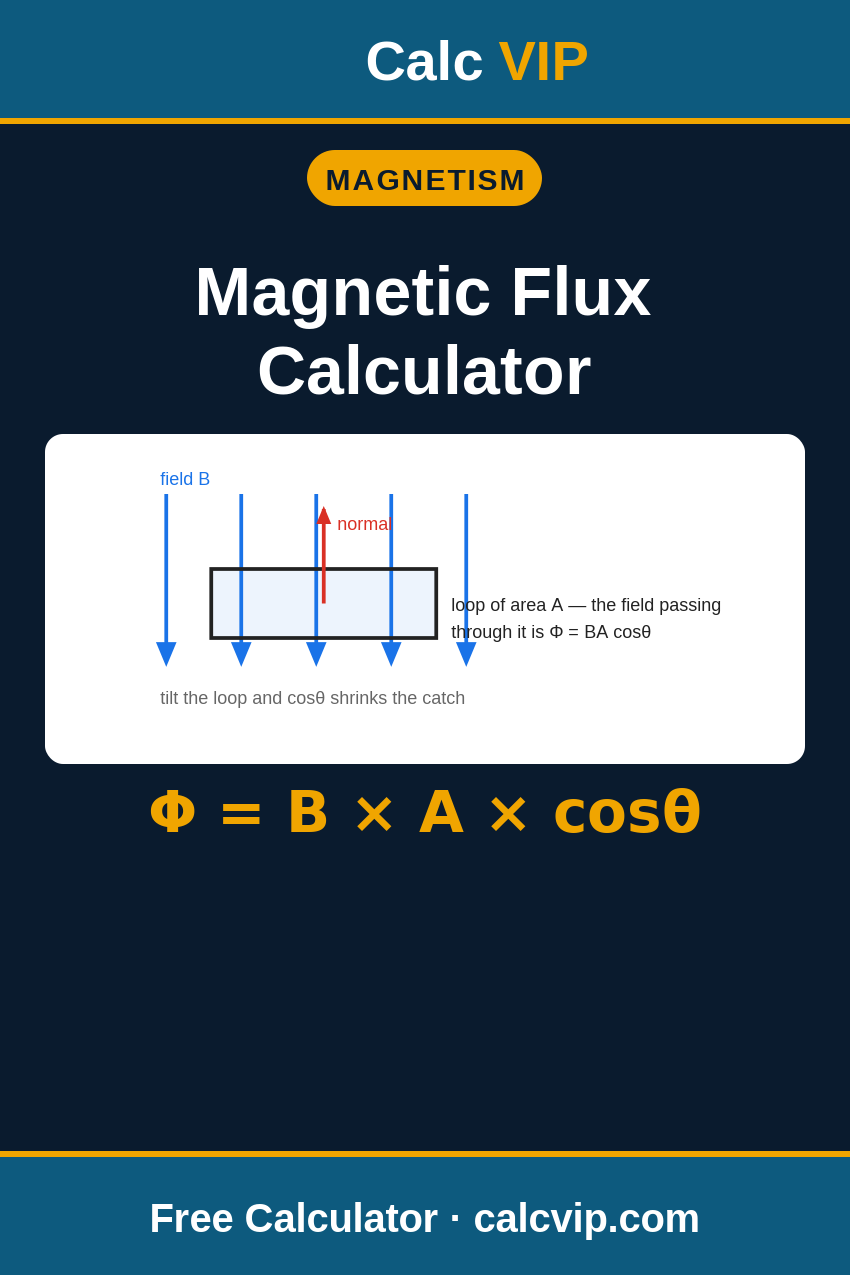
The unit, the weber, is sized for human convenience: a flux of one weber, changing completely in one second through a single loop, induces exactly one volt. That definition threads this page directly into the induced-EMF calculator next door: multiply a coil's turns by its flux and you have flux linkage; divide a change in linkage by the time it took and you have the voltage. Almost everything in electrical power engineering — generators, transformers, motors — is flux being counted, linked and changed at industrial scale, and it all starts with the three quantities multiplied together here.
Formula
Φ = B × A × cosθ • Φ in webers (Wb), B in tesla (T), A in square metres (m²), θ the angle between the field and the normal to the surface. For a coil of N turns, the flux linkage is NΦ.
The rearrangements each isolate a design variable: B = Φ ÷ (A cosθ) infers a field from a measured flux (how fluxmeters and search coils work — a small coil of known area and turns is flipped or withdrawn, and the flux change is measured); A = Φ ÷ (B cosθ) sizes a loop or core for a flux budget, the daily calculation of transformer-core design; and cosθ = Φ ÷ (BA) finds the tilt at which a loop catches a given fraction of the maximum. Two assumptions ride along: the field is uniform over the surface, and it has a single direction. Where the field varies across the area — near a magnet's pole, say — the honest definition is a sum (an integral) of B cosθ over small patches, and this formula applies patch by patch.
| Symbol | Meaning | Units |
|---|---|---|
| Φ | magnetic flux through the surface | webers (Wb) |
| B | magnetic field strength (flux density) | tesla (T) |
| A | area of the loop or surface | m² |
| θ | angle between B and the normal to the surface | degrees (°) |
| NΦ | flux linkage of an N-turn coil | weber-turns (Wb) |
Flux is a surface's-eye view of the field
B and Φ answer different questions, and confusing them is the deepest common error in this topic. B is a property of a point: how strong the field is, and which way it points, right there. Φ is a property of a surface: the total field threaded through it. The same field gives different fluxes through different surfaces; the same flux can come from a strong field on a small loop or a weak field on a large one. B's other name — flux density — says it plainly: B is flux per unit area, for a surface held square to the field. Tesla and weber per square metre are the same unit wearing two hats.
That distinction is why induction listens to flux, not field. A loop cannot respond to the field "at a point" — it encloses an area, and every part of the field threading that area contributes to the EMF around its rim. Faraday's law, ε = N ΔΦ/Δt, is the loop's-eye view of electromagnetism, and Φ is its currency. It is also why the sign and the cosine matter physically rather than pedantically: flux through a surface has a direction (which face you call the front), tilting a loop in a generator is how its output rises and falls, and a coil rotating in a field lives on Φ = BA cos(ωt) — the cosine of a steadily turning angle, which is where AC's sine wave is born.
How to use
- Enter the field strength B in tesla — the field at the loop's location, assumed uniform across it.
- Enter the area A in square metres: a 10 cm × 5 cm loop is 0.1 × 0.05 = 0.005 m²; a circular loop of radius r has A = πr².
- Enter θ in degrees, measured between the field and the loop's normal (the line perpendicular to the loop's face): 0° if the field spears straight through, 90° if it skims along the face.
- If the loop is a coil, enter N, the number of turns, to get the flux linkage NΦ as well.
- Click "Calculate" for Φ in webers (and milliwebers). A negative angle or an angle past 90° simply flips the sign convention — the magnitude is the catch.
Worked examples
Example 1 — a tilted coil. A field of 0.2 T passes through a loop of area 0.05 m² whose normal sits at θ = 30° to the field.
Φ = BA cosθ = 0.2 × 0.05 × cos 30° = 0.00866 Wb = 8.66 mWb.
For a coil of 100 turns, the flux linkage is NΦ = 100 × 0.00866 = 0.866 Wb.
Example 2 — square-on. A 0.5 T field meets a loop of 0.02 m² face-on (θ = 0°, cosθ = 1).
Φ = 0.5 × 0.02 × 1 = 0.01 Wb = 10 mWb — the maximum this field and loop can manage, and a usefully round benchmark: strong-ish field, postcard-sized loop, ten milliwebers.
Example 3 — the 60° tilt. A 0.3 T field crosses a larger loop of 0.1 m² at θ = 60° (cosθ = 0.5).
Φ = 0.3 × 0.1 × 0.5 = 0.015 Wb = 15 mWb. Despite the tilt halving the catch, the bigger area wins — this loop threads more flux than Example 2's.
Example 4 — the Earth's field through a door-sized loop. Take B = 5 × 10⁻⁵ T square-on through 1 m².
Φ = 5 × 10⁻⁵ × 1 = 5 × 10⁻⁵ Wb = 50 µWb. The entire planetary field through a square metre is a twentieth of a milliweber — a calibration of how feeble natural fluxes are, and why induction instruments need many turns.
Example 5 — inside an MRI scanner. A small coil of area 0.001 m² (10 cm²) sits square-on in the scanner's 1.5 T field.
Φ = 1.5 × 0.001 = 0.0015 Wb = 1.5 mWb per turn; a 1,000-turn coil links NΦ = 1.5 Wb. Withdrawing that coil in a second would induce about 1.5 V — flux measurement by search coil, exactly as MRI field-mapping probes work.
Example 6 — the 45° case. A 0.8 T field meets a loop of 0.04 m² at θ = 45° (cosθ = 0.707).
Φ = 0.8 × 0.04 × 0.707 = 0.0226 Wb = 22.6 mWb — the largest flux in this set, because the strongest field was paired with a decent area and a moderate tilt. Flux rewards the product, not any single factor.
Magnetic flux in real life
Transformers. A transformer's core exists to carry flux: the primary's alternating flux, threaded through the core and linked by both windings, is the entire mechanism. Core cross-sections are sized by A in Φ = BA, with B capped near iron's saturation around 1.5–2 T.
Generators. A rotating coil's flux varies as BA cos(ωt) — maximum when the coil faces the field, zero a quarter-turn later. Differentiate that cosine and the output voltage is a sine wave: the shape of mains electricity is the shape of flux through a spinning loop.
Fluxmeters and search coils. To map an unknown field, technicians use a small coil of known N and A, flip it or pull it out of the field, and measure the induced charge, which is proportional to ΔΦ. Example 5 is that instrument in miniature.
Earth-leakage and current sensors. A residual-current device threads household live and neutral wires through one magnetic ring; their fluxes normally cancel. Any imbalance — current leaking to earth — leaves a net flux change that trips the switch. Safety by flux accounting.
Magnetic recording and pickups. A guitar pickup is a coil around a magnet; the vibrating steel string perturbs the flux through the coil, and the induced signal is the music. Tape heads and hard-drive readers are the same flux-to-voltage conversion at smaller scales.
Geomagnetic monitoring. Observatories track the Earth's field with fluxgate magnetometers, whose cores are driven in and out of saturation so that the external flux unbalances them measurably — Example 4's tiny planetary flux, resolved to nanotesla.
From flux to voltage: the one-step bridge
Flux earns its keep when it changes, and it is worth seeing the size of the step. Take Example 1's coil — 100 turns linking 0.866 Wb — and imagine the field switched off so the flux vanishes in 0.01 s. Faraday's law gives ε = NΔΦ ÷ Δt = 0.866 ÷ 0.01 = 86.6 V. A hand-sized coil and a modest field, collapsing in a hundredth of a second, produce a mains-class voltage. Slow the collapse to a full second and the same coil gives 0.866 V. Nothing about the coil or the field changed — only the rate. That is why the induced-EMF calculator takes ΔΦ and Δt as its inputs, and why flux, this page's static bookkeeping, is really a voltage waiting for a schedule.
Flux when the field is not uniform: a loop beside a wire
The BA cosθ formula presumes one field value for the whole surface. When B varies across the loop, flux is the patch-by-patch sum — and sometimes that sum can still be done exactly. Lay a rectangular loop of length L = 0.1 m beside a long straight wire carrying 10 A, its near edge 0.02 m from the wire and its far edge 0.06 m. The wire's field, μ₀I/(2πr), is strong at the near edge and weaker at the far one; integrating strip by strip gives Φ = (μ₀IL ÷ 2π) × ln(b/a) = (4π × 10⁻⁷ × 10 × 0.1 ÷ 2π) × ln(0.06 ÷ 0.02) = 2 × 10⁻⁷ × 1.099 = 2.2 × 10⁻⁷ Wb = 0.22 µWb. Small — but if the wire's current alternates at mains frequency, that flux reverses a hundred times a second, and a many-turned loop there becomes a pickup: this is precisely how clamp-on current probes and the signal transformers in audio equipment sample a conductor's field without touching it. The lesson generalises: for non-uniform fields, flux is an integral, and BA cosθ is the uniform-field shortcut to it.
Quick reference: how the tilt eats the flux (B = 0.2 T, A = 0.05 m²)
| θ (from normal) | cosθ | Flux Φ |
|---|---|---|
| 0° | 1 | 0.01 Wb (10 mWb) |
| 30° | 0.866 | 0.00866 Wb (8.66 mWb) |
| 45° | 0.707 | 0.00707 Wb (7.07 mWb) |
| 60° | 0.5 | 0.005 Wb (5 mWb) |
| 90° | 0 | 0 |
The cosine's character is visible: the catch falls slowly at first (15° of tilt costs barely 3%) and then ever faster — which is why generator coils produce a smooth sine-like variation as they turn at constant speed.
Common mistakes
- Measuring θ from the surface. The formula's angle is from the normal. A field "30° to the loop's face" is 60° from the normal, and cos 60° = 0.5, not cos 30° = 0.866. This single slip is the commonest flux error in exams and in practice.
- Leaving the area in cm². A must be in m²: 100 cm² is 0.01 m². Using 100 inflates the flux ten-thousandfold.
- Confusing flux with flux density. Φ (webers) belongs to a whole surface; B (tesla = Wb/m²) belongs to a point. Asking for "the flux at a point" is meaningless — a surface must be specified.
- Forgetting the turns when a coil is involved. Induction responds to linkage NΦ. Computing Φ for one turn and stopping there understates a 500-turn coil's EMF five-hundredfold.
- Assuming uniform B over a large loop. Φ = BA cosθ presumes one B for the whole area. Near a pole piece or a wire, B varies across the loop and the true flux is the patch-by-patch sum — the single-value answer can mislead badly.
FAQ
What is a weber?
The weber (Wb) is the unit of magnetic flux: 1 Wb = 1 T × 1 m². A flux of 1 weber changing completely in 1 second induces an EMF of exactly 1 volt in a single loop — the weber is defined to make induction sums come out neatly.
Why is the angle measured from the normal, not the surface?
Because what matters is how much field passes through the loop. Field along the normal goes straight through (maximum flux); field lying in the plane of the loop skims past it (θ = 90°, cosθ = 0, zero flux) even though the field itself is strong.
What is the difference between flux and flux linkage?
Flux Φ is for one loop. A coil of N turns links the flux N times over, so induction formulas for coils use the flux linkage NΦ. Double the turns and you double the linkage — and the induced EMF.
Can flux be negative?
Yes — the sign records direction through the surface. If the field threads the loop opposite to the chosen normal direction (θ > 90°), cosθ and hence Φ are negative. For induction only changes matter, and a swing from +Φ to −Φ is a change of 2Φ — which is why flipping a coil induces twice the signal of withdrawing it.
Does flux "flow" like a current?
No. Nothing travels along the field lines. Flux is a static count of field through a surface, like counting the rain through a window frame — the window catches more or less as it tilts, but the count itself is not a flow of anything material.
What is the flux through a closed surface, like a box?
Always zero. Magnetic field lines never end (there are no magnetic monopoles), so every line entering a closed surface leaves it: the net flux cancels exactly. This is Gauss's law for magnetism, and it is why "flux" questions always concern open surfaces bounded by loops.
How is flux measured in practice?
With a search coil and a fluxmeter: a coil of known turns and area is placed in the field and then flipped or withdrawn, and the instrument integrates the induced EMF over time, which returns ΔΦ directly. Modern versions use Hall probes for B and compute Φ = BA cosθ for a defined area.
Why do transformer cores have a hole-free, closed shape?
Flux prefers to travel in iron, and a closed ring lets the same flux link both windings with minimal leakage into the air. The core's cross-section is chosen so that Φ = BA keeps B below saturation at the transformer's rated voltage and frequency.
What happens to flux in a superconductor?
It is expelled (the Meissner effect) or, in type-II superconductors, admitted only in tiny quantised tubes. Flux through a superconducting ring is quantised in units of about 2.07 × 10⁻¹⁵ Wb — flux is so fundamental that nature rations it.
If B doubles and the loop's area halves, what happens to Φ?
Nothing: Φ = BA cosθ is unchanged, since the factors cancel. Flux is a product, and trade-offs between field strength and area at fixed product are exactly the freedom transformer designers exploit.