Calc
Manning Flow Calculator – Open Channel Velocity & Discharge
 Created by Elena Petrova · Physics Editor · Fluids & Rotation · Last updated: November 2026
Use this free Manning Flow Calculator to find the flow speed and discharge in an open channel such as a ditch, canal or stream. Enter the channel width and water depth, Manning's roughness n and the slope — the calculator works out the hydraulic radius and applies Manning's equation.
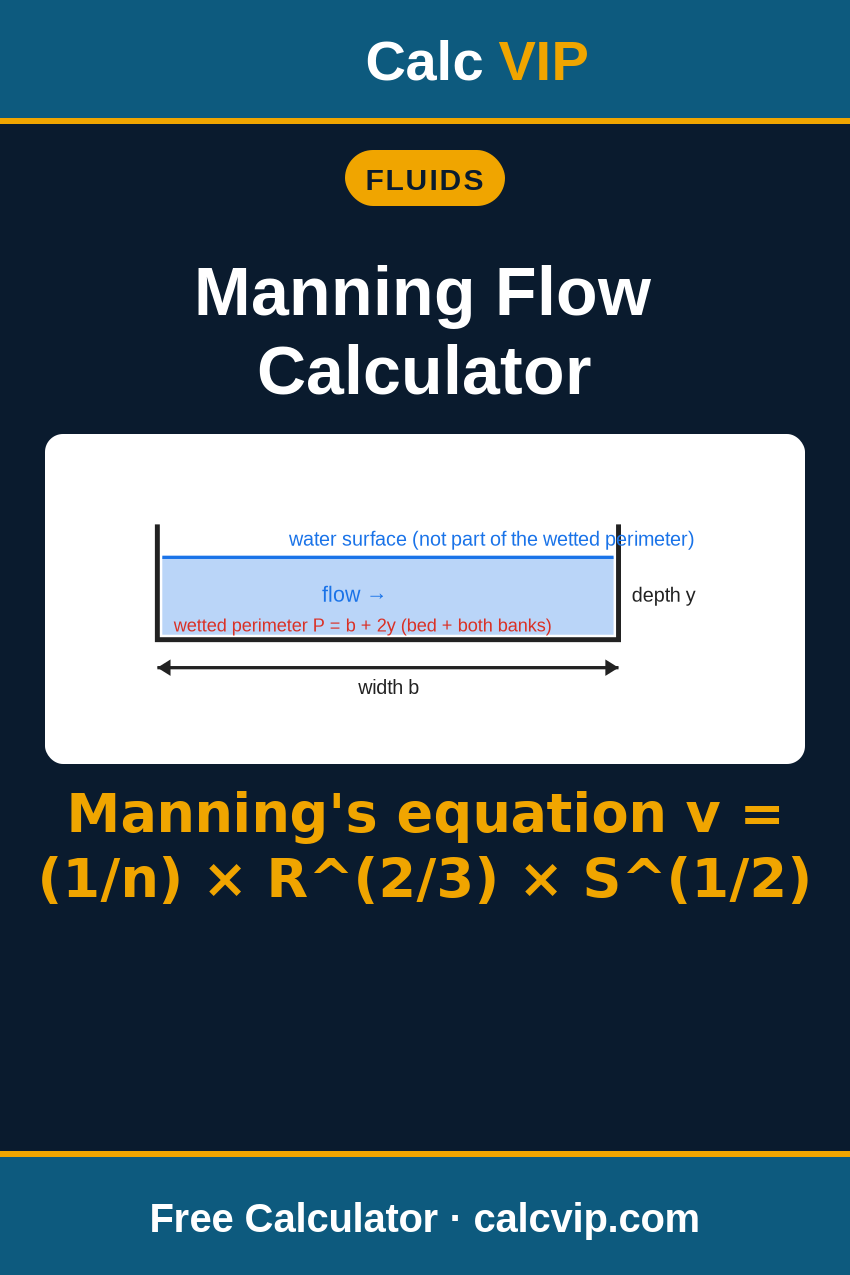
Every ditch, canal, river and storm drain on Earth is sized with one empirical equation from 1889. Robert Manning, an Irish engineer who reportedly disliked the algebraic form that bears his name, gave hydraulics a formula of beautiful practicality: v = (1/n) × R^(2/3) × √S. Feed it the channel's roughness, its hydraulic radius and its slope, and it returns the flow speed; multiply by the area and you have the discharge. This calculator applies it to a rectangular channel — enter width, depth, roughness and slope, and it returns the area, wetted perimeter, hydraulic radius, speed and discharge in one pass.
The equation's three ingredients each carry a world of judgement. The slope S is the water's energy gradient — for a uniform channel, simply the bed's fall per unit length. The hydraulic radius R measures how much of the flow is in friction's reach: it is the area divided by the wetted perimeter, the length of bed and bank the water actually touches. And n, Manning's roughness coefficient, compresses the entire character of the channel — glassy concrete, weedy earth, boulder-strewn mountain bed — into a single number between about 0.011 and 0.15. Choosing n well is the craft; the calculator does the rest.
Why has an empirical formula with a dimensionally awkward constant outlived a century of fluid mechanics? Because open-channel flow is turbulent, rough and three-dimensional in ways that theory still cannot price from first principles, while Manning's equation, calibrated against thousands of real channels, lands within engineering accuracy almost every time. It is the working language of drainage design, flood mapping, irrigation and river engineering — and the rectangular channel it is applied to here is the shape of canals, flumes, gutters and drainage ditches everywhere.
Formula
Manning's equation v = (1/n) × R^(2/3) × S^(1/2), then Q = A × v • for a rectangular channel A = b × y, P = b + 2y, R = A ÷ P
Each piece has a physical voice: √S is gravity's pull along the slope; R^(2/3) is how effectively the cross-section escapes its own boundary friction; 1/n is the surface's permission to flow. Rearrangements used in design: S = (vn ÷ R^(2/3))² finds the slope a channel needs to carry a target speed (the form that grades canals), and n = R^(2/3)√S ÷ v backs roughness out of a measured flow — the standard way n values were originally catalogued, from gauged rivers. One unit warning: the equation in this form is SI. In US customary units a factor of 1.486 multiplies the right-hand side — the commonest Manning error on Earth is using the wrong version for the units in hand.
| Symbol | Meaning | Units |
|---|---|---|
| v, Q | mean flow speed and discharge | m/s, m³/s |
| n | Manning's roughness coefficient | dimensionless (tabulated) |
| R | hydraulic radius A ÷ P | m |
| A, P | flow area and wetted perimeter | m², m |
| S | slope — fall per unit length | m/m (decimal) |
The hydraulic radius: why shape is speed
Friction in a channel acts only where water touches solid — the wetted perimeter. The bulk of the flow, farther from the boundary, is dragged only indirectly. R = A/P is therefore the flow's "elbow room": the volume of water each metre of rubbing surface must hold back. Deep, narrow channels concentrate their water away from the boundary and earn a large R; wide, shallow ones spread it thinly against the bed and earn a small one. The worked examples make it concrete: Example 4's channel carries five times Example 1's area but, being a shallow sheet, has a smaller hydraulic radius (0.476 m against 0.5 m) and nearly the same speed — its extra water is almost all in friction's reach.
The extreme case teaches the rule: for a very wide channel, P ≈ b and R ≈ A/b = y — the hydraulic radius simply becomes the depth, which is why river engineers speak of depth where channel engineers speak of R. And a full circular pipe, the other shape everyone meets, has R = D/4 — a quarter of its diameter — a result worth having when Manning's equation is borrowed for culverts and sewers flowing full.
How to use
- Enter Manning's n for the channel surface: smooth finished concrete 0.013, straight earth channel about 0.025, natural stream with stones and weeds 0.035–0.05, rough flood plain 0.1 or more.
- Enter the channel width b and the water depth y in metres (the depth of water, not the depth of the ditch).
- Enter the slope S as a decimal: a fall of 1 m in 1000 m is 0.001; 1 in 100 is 0.01. Percent grade divided by 100 gives S.
- Click "Calculate Flow" to see the area, wetted perimeter, hydraulic radius, flow speed and discharge.
Worked examples
Example 1 — a concrete drainage channel. n = 0.013, b = 2 m, y = 1 m, S = 0.001.
A = 2 × 1 = 2 m², P = 2 + 2 = 4 m, so R = 0.5 m. Then v = (1 ÷ 0.013) × 0.5^(2/3) × √0.001 = 76.92 × 0.63 × 0.0316 = 1.53 m/s, and Q = 2 × 1.53 = 3.06 m³/s — a serious ditch, carrying three tonnes of water a second at a brisk walking pace.
Example 2 — an earth irrigation channel. n = 0.025, b = 3 m, y = 1.5 m, S = 0.002: A = 4.5 m², P = 6 m, R = 0.75 m. v = 40 × 0.826 × 0.0447 = 1.48 m/s; Q = 4.5 × 1.48 = 6.65 m³/s. Double Example 1's slope could not quite double its speed — the rougher earth surface (n nearly doubled) spent the difference.
Example 3 — a natural stream. n = 0.04, b = 10 m, y = 2 m, S = 0.0005: A = 20 m², P = 14 m, R = 1.43 m. v = 25 × 1.268 × 0.0224 = 0.71 m/s; Q = 20 × 0.71 = 14.18 m³/s. A gentle speed but a river's discharge — area, not velocity, is how big flows happen.
Example 4 — a wide, shallow sheet. n = 0.013, b = 20 m, y = 0.5 m, S = 0.001: A = 10 m², P = 21 m, R = 0.476 m. v = 76.92 × 0.610 × 0.0316 = 1.48 m/s; Q = 14.83 m³/s. Five times Example 1's area at almost the same speed — its shallowness kept R small, and R is what speed is made of.
Example 5 — a steep mountain channel. n = 0.03, b = 1.5 m, y = 0.8 m, S = 0.02: A = 1.2 m², P = 3.1 m, R = 0.387 m. v = 33.33 × 0.531 × 0.1414 = 2.50 m/s; Q = 3.0 m³/s. A 1-in-50 slope is a torrent's gradient: the √S term overwhelms the modest size.
Example 6 — a broad irrigation canal. n = 0.02, b = 5 m, y = 2 m, S = 0.0004: A = 10 m², P = 9 m, R = 1.11 m. v = 50 × 1.073 × 0.02 = 1.07 m/s; Q = 10.73 m³/s. Canals are graded astonishingly flat — 0.4 m of fall per kilometre — because water delivered gently does not erode the banks that carry it.
Manning's equation in real life
Drainage and storm sewers. Every roadside ditch, culvert and storm drain is checked with Manning's equation against the design storm: the question "will it fit?" is Q = Av with v from this page.
Irrigation canals. Canal networks are graded and sized by Manning's equation end to end; the gentle slopes of Example 6, the lining choices that set n, and the delivery schedules all descend from it.
Flood mapping. Flood models chain thousands of channel and flood-plain slices, each with its own n, to predict how high a river will rise for a given discharge — insurance maps and building lines are drawn from the results.
River restoration. Re-meandering a straightened river is, hydraulically, raising its n and lengthening its path to slow the water; designers verify the new channel with the same equation that condemned the old one.
Hydroelectric flumes and spillways. Headraces and chutes are steep, smooth Manning problems (Example 5's family), where the check runs the other way: not "will it carry enough?" but "will the speed erode or overtop?"
Highway and airport drainage. Pavement drainage is designed so the water film on the surface — a very wide, very shallow Manning channel — stays thin enough to prevent aquaplaning at the design speed and storm.
Choosing n: the honest uncertainty
Every other input to Manning's equation can be measured with a tape and a level; n must be judged. Reference tables (Chow's 1959 catalogue remains the standard) list ranges for hundreds of surfaces, and experienced engineers calibrate against photographs of gauged channels. The sensitivity is unforgiving: v and Q are proportional to 1/n, so choosing 0.03 where 0.04 was true overstates the flow by a third. Vegetation makes n a season, not a constant — a channel gauged clean in spring may run at double the roughness under summer weed growth — and flood work therefore brackets the answer with a low-n and a high-n run rather than trusting one. When a Manning result matters, the professional habit is to ask not "what is n?" but "what range of n can I defend?" — the calculator will happily evaluate both ends of it.
Quick reference: Manning's n for common surfaces
| Channel surface | Typical n | Notes |
|---|---|---|
| finished concrete / smooth flume | 0.011–0.015 | the smooth end of practice |
| earth channel, straight and clean | 0.02–0.025 | rises with age and silt |
| gravel-bed channel | 0.025–0.035 | stones begin to stir the flow |
| natural stream, some stones and weeds | 0.035–0.05 | Example 3's family |
| winding, weedy, sluggish reaches | 0.05–0.08 | vegetation dominates |
| flood plain with brush and trees | 0.1–0.15 | why flood plains store water so well |
The table's spread — a factor of ten from concrete to flood plain — is the equation's biography: the geometry is exact, the surface is judgement, and Manning's n is where hydraulics keeps its experience.
Compound channels: when the river leaves its banks
Real rivers in flood are two channels in one: a main channel (n ≈ 0.03) flanked by flood plains (n ≈ 0.1 or more, with brush and fences). Manning's equation is then applied to each strip separately, with its own area, wetted perimeter and R, and the discharges are added. The flood plain's contribution is humbler than its width suggests: at the same R and S, speed scales as 1/n, so water on a plain with n = 0.12 moves at 0.03 ÷ 0.12 = a quarter of the main channel's speed — flood plains store and delay water far more than they convey it, which is precisely their value in a flood and precisely why building on them is so costly. This calculator handles the rectangular main channel; treat any flood-plain strip as its own wide, shallow rectangle (Example 4's family) with its own n, and add the two Q values.
Which regime? A Froude check on the examples
Manning's equation gives the speed; the Froude number, Fr = v ÷ √(gy), tells you the flow's temperament. Example 1's channel: Fr = 1.53 ÷ √(9.81 × 1) = 1.53 ÷ 3.13 ≈ 0.49 — comfortably subcritical, the deep, downstream-controlled flow of drainage practice. Example 5's mountain channel: Fr = 2.50 ÷ √(9.81 × 0.8) = 2.50 ÷ 2.80 ≈ 0.89 — near critical, which is why steep channels are lined, checked for roll waves, and never trusted to behave like their lowland cousins. Run the ratio after every Manning calculation; it takes ten seconds and it tells you whether waves can travel upstream against your flow — the difference between a channel that reports its problems and one that ambushes you with them.
Common mistakes
- Including the water surface in the wetted perimeter. P counts only solid boundary — bed plus banks. For a rectangle, P = b + 2y, never b + 2y + b. The surface is free; it does not rub.
- Entering the slope as a percentage or a ratio. S is a decimal: 1% is 0.01, and "1 in 1000" is 0.001. Typing "1" for a 1-in-1000 channel overstates √S — and the speed — by a factor of about 31.6.
- Using the US-customary form (or forgetting it). With feet instead of metres, Manning's equation needs a 1.486 multiplier. Mixing the versions corrupts the result by half, in whichever direction hurts.
- Picking n from the wrong row. Since Q ∝ 1/n, an optimistic n is an optimistic flood defence. Use the table's upper ranges for design checks on capacity, and document the choice.
- Applying it to pressurised pipe flow. Manning's equation describes flow with a free surface under gravity. A pressurised main has no surface and a different energy balance — that is Darcy–Weisbach territory (though Manning is legitimately used for pipes flowing part-full, like sewers).
FAQ
What is the hydraulic radius?
It is the flow area divided by the wetted perimeter — the part of the channel boundary actually touching the water. A wide, shallow channel and a narrow, deep one can have the same area but very different hydraulic radii, and the deeper one flows faster because less of its water is slowed by the boundary.
What n value should I use?
n grows with roughness: 0.011–0.015 for finished concrete, 0.02–0.03 for earth channels, 0.035–0.05 for natural streams, and 0.1 or more for very rough, overgrown flood plains. When in doubt, tables in hydraulics references list n for many surfaces.
Does Manning's equation work for pipes?
Yes, for pipes flowing full or part-full the same equation applies with R = D/4 for a full circular pipe — but for pressurised pipe flow, head-loss formulas such as Darcy–Weisbach are usually preferred.
What does "uniform flow" mean, and does the equation need it?
Uniform flow is flow at constant depth along the channel — the water surface parallel to the bed, gravity's input exactly balancing friction. Manning's equation is a uniform-flow equation; where depth changes rapidly (near weirs, drops and junctions) it gives only the local tendency, and backwater calculations take over.
How fast is too fast for a channel?
When the water starts eating the channel. Unlined earth channels are usually kept below about 0.5–1 m/s depending on soil; grass lining tolerates ~1.5 m/s; concrete several times more. Erosion, not hydraulics, sets the ceiling — check Example 5's 2.5 m/s against the bed material.
What is critical flow, and should I care?
Flow is critical when its speed equals the speed of a surface wave, √(gy) — about 3.13 m/s at 1 m depth. Below it, flow is subcritical (deep, tranquil, controlled from downstream); above it, supercritical (thin, fast, controlled from upstream). Manning gives the uniform-flow speed; comparing it with √(gy) tells you which regime your channel lives in.
Why does the equation have that odd 2/3 power?
It is inherited from the older Chézy formula and a century of calibration: R^(2/3) fit measured channels better than any rival exponent. Manning's equation is empirical — its authority is not derivation but ten thousand channels that behaved as it predicts.
Can I use it for a trapezoidal ditch?
The physics is identical, but the geometry changes: A and P must include the sloped sides. This calculator is built for rectangles; for a trapezoid, compute A and P by hand and use the formula section's relation with your own R — or approximate with the width at mid-depth.
How do I find the depth for a given flow?
By trial: depth appears inside A, P and R, so there is no closed-form answer. Try a depth, compute Q, adjust, repeat — two or three iterations of this calculator converge, because Q grows steeply with depth (roughly as y^(5/3) for a wide channel).
Who was Manning?
Robert Manning (1816–1897), chief engineer of Ireland's Office of Public Works, who presented the formula in 1889 after comparing seven rival equations against gauged channels — and, being a careful man, apologised for his own formula's awkward form. It outcompeted all seven rivals and has sized the world's drainage ever since.