 Calc
Photon Momentum Calculator – p = h/λ & Radiation Pressure
 Created by Yuki Tanaka · Physics Editor · Modern Physics · Last updated: November 2026
Use this free Photon Momentum Calculator to find the momentum carried by a single photon from its wavelength. You can also calculate the radiation pressure that a beam of light exerts on an absorbing or reflecting surface — the force behind solar sails.
Momentum was supposed to belong to things with mass. Yet light — massless, travelling at c — pushes on what it strikes, and the push is computable photon by photon: each photon carries momentum p = h/λ, Planck's constant divided by its wavelength. This calculator evaluates that momentum for any wavelength, and, if you supply a beam intensity, converts the collective effect of countless photons into radiation pressure — the force per square metre on an absorbing or reflecting surface.
The formula comes from relativity's master equation, E² = (pc)² + (mc²)². Set the mass to zero and it collapses to p = E/c; combine with the photon energy E = hf = hc/λ and p = h/λ drops out. Short wavelength means large momentum: a gamma-ray photon at λ = 0.01 nm carries 6.63 × 10⁻²³ kg·m/s, fifty thousand times a green photon's 1.33 × 10⁻²⁷. Individually these are whispers; collectively they are engineering. A watt of green light delivers about 2.5 × 10¹⁸ photons a second, and their summed momentum arrives as a steady force of P/c ≈ 3.33 × 10⁻⁹ N per watt on an absorber — doubled on a mirror.
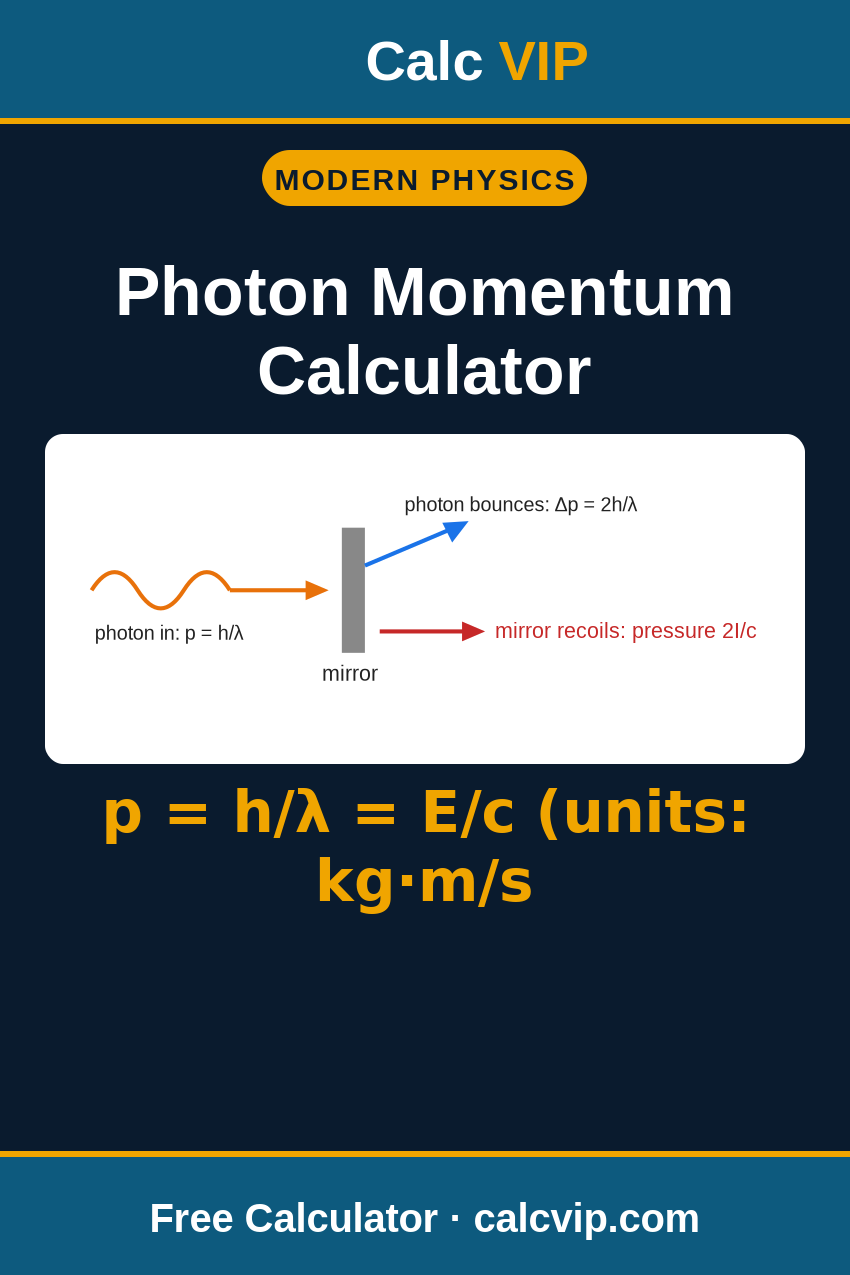
Radiation pressure is where the whispers become audible. Sunlight at Earth's distance presses on a perfect mirror with about 9 × 10⁻⁶ Pa — nine micropascals, absurdly small against atmospheric pressure's 10⁵ Pa, yet applied to a sail hundreds of square metres across, in the frictionless patience of space, it accelerates spacecraft measurably. The same pressure, scaled up inside stars, helps hold them up against gravity; scaled down in laboratories, it traps and cools single atoms. Wavelength in, momentum out, pressure if you ask: that is this page's complete transaction.
Formula
Even though a photon has no rest mass, it carries momentum p = h/λ = E/c (units: kg·m/s, equivalently J·s/m). The formula rearranges for the photon's other identities: from frequency, p = hf/c; from energy, p = E/c. When many photons strike a surface, they produce radiation pressure: P = I/c for a surface that absorbs the light, and P = 2I/c for a perfect mirror, because reflection reverses the momentum and doubles the push. The corresponding force is pressure × area, F = PA — the design equation of every solar sail. Note what is absent: the pressure on an absorber does not depend on wavelength at all, only on intensity. Wavelength sets each photon's share; intensity sets how many arrive; the product cares only about total energy flux.
| Symbol | Meaning | Units |
|---|---|---|
| p | momentum of one photon | kg·m/s |
| λ | photon wavelength | nm (converted to m) |
| h | Planck's constant, 6.626 × 10⁻³⁴ | J·s |
| I | beam intensity (power per area) | W/m² |
| P | radiation pressure | Pa (N/m²) |
Why reflection doubles the push — and why colour drops out
Pressure is momentum delivered per second per square metre, and the two surface types differ in what "delivered" means. An absorbed photon arrives with momentum p and stays: the surface gains p. A reflected photon arrives with p and leaves with −p: its momentum changed by 2p, so by conservation the surface gains 2p. Same photons, twice the recoil — the entire reason solar sails are mirrors, and the reason the calculator's surface-type selector doubles the answer. Real surfaces live between the ideals: a grey surface absorbing a fraction and reflecting the rest feels between I/c and 2I/c, and mission designers integrate the actual reflectivity.
The wavelength-independence of pressure surprises everyone the first time. Split a beam into bluer photons and each carries more momentum — but for the same total power there are proportionally fewer of them, since each costs more energy. The two effects cancel exactly: pressure = (photons per second) × (momentum each) = (I/E) × (E/c) = I/c. Colour matters enormously for single-photon physics — the Compton effect, treated in the batch-21 companion page, reads wavelength shifts photon by photon — but for the bulk push of a beam, only the wattage counts.
How to use
- Enter the photon wavelength in nanometres.
- Optionally enter the beam intensity and surface type to also get the radiation pressure.
- Click "Calculate Photon Momentum" for p per photon and, if requested, the pressure in pascals.
- To turn pressure into force on a real object, multiply by its illuminated area in m²: F = P × A.
Worked examples
Example 1 — a green photon and sunlight's push. Green light has a wavelength of λ = 500 nm.
p = h/λ = 6.626 × 10⁻³⁴ / (500 × 10⁻⁹) = 1.33 × 10⁻²⁷ kg·m/s per photon — tiny, but real.
Sunlight near Earth has intensity I ≈ 1000 W/m², giving a radiation pressure on a black surface of P = I/c = 1000 / 3 × 10⁸ = 3.33 × 10⁻⁶ Pa, and twice that, 6.67 × 10⁻⁶ Pa, on a mirror — enough, over a huge sail and a long time, to push a spacecraft.
Example 2 — an X-ray photon. At λ = 0.01 nm (10⁻¹¹ m): p = 6.626 × 10⁻³⁴/10⁻¹¹ = 6.63 × 10⁻²³ kg·m/s.
That is 50,000 green photons' worth of momentum in one packet — enough recoil to matter in Compton scattering, where a single X-ray photon measurably shoves an electron.
Example 3 — a radio photon. At λ = 1 m: p = 6.63 × 10⁻³⁴ kg·m/s.
Radio photons are momentum paupers; a broadcast beam pushes through sheer census — astronomical numbers of photons per second — which is why radiation pressure from radio sources is a curiosity, not a tool.
Example 4 — a laser pointer on a mirror. A 1 mW laser (P = 10⁻³ W) reflected from a mirror feels F = 2P/c = 2 × 10⁻³/3 × 10⁸ = 6.67 × 10⁻¹² N.
Seven piconewtons will not stir your hand, but torsion balances and optical traps measure forces this size routinely — photon momentum is a laboratory instrument, not just a curiosity.
Example 5 — a serious solar sail. Full sunlight at Earth, I = 1361 W/m², on a reflecting sail of 1,000 m²:
P = 2 × 1361/3 × 10⁸ = 9.07 × 10⁻⁶ Pa, so F = P × A = 9.07 × 10⁻³ N — about the weight of a paperclip, applied without pause or fuel for years. IKAROS's 196 m² sail earned about 1.8 × 10⁻³ N the same way, and measurably changed its orbit.
Example 6 — counting photons in a watt. One watt of 500 nm light: each photon carries E = hc/λ = 3.98 × 10⁻¹⁹ J, so the beam delivers 1/3.98 × 10⁻¹⁹ = 2.52 × 10¹⁸ photons per second.
Their combined momentum rate is 2.52 × 10¹⁸ × 1.33 × 10⁻²⁷ = 3.33 × 10⁻⁹ N — exactly P/c for P = 1 W, confirming that the microscopic and macroscopic formulas are one formula.
Photon momentum in real life
Solar sailing. IKAROS (2010) and LightSail 2 (2019) changed their orbits on sunlight pressure alone — the only propulsion that needs no propellant, designed end-to-end with P = 2I/c.
Optical tweezers. A focused laser traps and moves microscopic beads and living cells; the trap's force is photon momentum redirected by refraction, calibrated in piconewtons — the tool won the 2018 Nobel Prize in Physics.
Laser cooling. Atoms absorbing photons from a head-on laser absorb their momentum too, braking the atoms to microkelvin temperatures. Doppler cooling is radiation pressure applied photon by photon, millions of times a second.
Comet tails. A comet's dust tail curves away from the Sun partly under radiation pressure on the grains — visible, naked-eye evidence that light pushes, recognised since Kepler guessed it in 1619.
Stellar stability. Inside massive stars, radiation pressure on matter rivals gas pressure and helps support the star against gravity; at the Eddington limit it wins, and the star sheds its outer layers.
Laser propulsion concepts. Breakthrough Starshot plans to ride gram-scale probes on ground-based laser arrays, where intensities near 10¹⁰ W/m² turn I/c into newtons of thrust — photon momentum as an interstellar engine.
Quick reference: momentum across the spectrum
| Photon | λ | p = h/λ (kg·m/s) |
|---|---|---|
| gamma / hard X-ray | 0.01 nm | 6.63 × 10⁻²³ |
| X-ray | 1 nm | 6.63 × 10⁻²⁵ |
| ultraviolet | 100 nm | 6.63 × 10⁻²⁷ |
| green light | 500 nm | 1.33 × 10⁻²⁷ |
| infrared | 10 µm | 6.63 × 10⁻²⁹ |
| microwave | 1 mm | 6.63 × 10⁻³¹ |
| radio | 1 m | 6.63 × 10⁻³⁴ |
Eleven orders of magnitude of wavelength, eleven of momentum — and a single constant, h, pacing the whole scale. Note also the bookkeeping identity hiding in the table: p × c = E, so each row's momentum times 3 × 10⁸ returns that photon's energy in joules.
Compton scattering: photon momentum caught in the act
The most direct proof that photons carry p = h/λ is a collision. In 1923 Arthur Compton fired X-rays at graphite and found the scattered rays lengthened in wavelength by Δλ = (h/mec)(1 − cos θ), where θ is the scattering angle. The constant h/(mec) — the Compton wavelength of the electron — is 2.424 pm, so the shift is at most 4.85 pm, at θ = 180°. The formula is pure bookkeeping: treat the photon as a particle with momentum h/λ and energy hc/λ, let it bounce elastically off a stationary electron, and conservation of momentum and energy force exactly that shift. Try the numbers: an X-ray photon of λ = 0.0243 nm (energy 51.1 keV) scattered at 90° emerges at λ′ = 0.0243 + 0.00243 = 0.0267 nm, its energy down to 46.4 keV, the missing 4.63 keV handed to the recoiling electron. Wave theory predicts no shift at all; the photon-as-particle prediction matches to experimental precision. Every photon-momentum calculation on this page is a descendant of that billiard game — the same conservation laws, scaled from one collision to a beam's steady push.
The Eddington limit: radiation pressure as a stellar ceiling
Inside a star, photons streaming outward push on the matter they scatter from, and gravity pulls that matter in. The Eddington luminosity is the brightness at which the push wins: LEdd ≈ 1.26 × 10³¹ W per solar mass of star. The Sun, at 3.83 × 10²⁶ W, sits some 33,000 times below its own limit — comfortably gas-pressure supported. But luminosity grows faster than mass along the main sequence, so the most massive stars live near their limits: at a hundred solar masses the Eddington luminosity is ~1.26 × 10³³ W and real stars of that class radiate within a factor of a few of it, shedding their outer layers in radiation-driven winds. Accreting black holes obey the same ceiling — feed one too fast and its own radiation pressure throttles the inflow. The micropascals of the solar-sail examples, scaled by stellar intensities and areas, become the force that decides how bright anything in the universe is allowed to shine.
The sail's figure of merit: pressure divided by mass
A sail designer cares about one ratio above all: acceleration = pressure ÷ areal density, a = P/σA, where σA is the sail's mass per square metre. At Earth's distance a perfect reflector feels P = 9.07 × 10⁻⁶ Pa; a sail film of σA = 0.01 kg/m² (ten grams per square metre — sailcloth and structure included) therefore accelerates at a = 9.07 × 10⁻⁴ m/s², just under a millimetre per second per second. That sounds negligible until the clock is allowed to run: it is 78 m/s of velocity change per day, every day, for free — over a year, more than the chemical rockets that launched the sail could have provided, delivered silently by momentum bookkeeping at h/λ per photon. Halve the areal density to 0.005 kg/m² and the acceleration doubles to 1.81 × 10⁻³ m/s² (157 m/s per day), which is why sail engineering is a materials science of ever-thinner films: the physics fixes the pressure, and only the denominator is negotiable.
Laser propulsion: buying pressure with watts
Sunlight is free but faint; a laser trades electricity for pressure at the same exchange rate this page has used throughout — force = 2P/c for a reflected beam. A 1 kW laser, perfectly reflected, pushes with F = 2 × 1000/(3 × 10⁸) = 6.7 × 10⁻⁶ N: micronewtons, but continuous, propellant-free and steerable from the ground. Scale the idea and it becomes the interstellar proposal literature's favourite engine: phased laser arrays of tens of gigawatts would press on gram-scale sails with forces of hundreds of newtons — 2 × 10¹⁰/(3 × 10⁸) ≈ 67 N per 10 GW — accelerating them toward a fifth of light speed within minutes. Whether or not such a fleet ever flies, the arithmetic is not speculation; it is the radiation-pressure line of the quick-reference table, extrapolated in a straightedge line from a sunlit sail to a laser-lit one.
Common mistakes
- Using p = mv for a photon. With m = 0 that gives zero — the wrong zero. Photon momentum lives in its energy: p = E/c = h/λ. Mass is sufficient for momentum, not necessary.
- Forgetting the factor of 2 for mirrors. Absorption delivers p per photon; reflection delivers 2p. Selecting the wrong surface type halves (or doubles) every pressure and sail-force answer.
- Expecting pressure to depend on colour. At fixed intensity it does not: bluer photons hit harder but arrive fewer. Pressure questions need I and the surface type, not λ.
- Leaving λ in nanometres. p = h/λ needs λ in metres. Skipping the × 10⁻⁹ inflates the momentum a billionfold — the most common slip with this calculator.
- Confusing pressure with force. The calculator's pressure is per square metre. A sail's thrust is P × A; quoting pascals as newtons overstates a small sail's push by its whole area.
FAQ
How can light have momentum without mass?
Relativity gives E² = (pc)² + (mc²)². With m = 0 this reduces to p = E/c: energy itself carries momentum, and light transports energy.
Why does a mirror feel twice the pressure?
An absorbed photon hands over its momentum once. A reflected photon reverses direction, so its momentum changes by 2p — and by Newton's third law the mirror gains that 2p.
Can radiation pressure really move a spacecraft?
Yes. Solar sails such as JAXA's IKAROS and the Planetary Society's LightSail 2 have demonstrably changed orbit using only sunlight pressure.
What is the momentum of a photon in everyday units?
Very small: a green photon's 1.33 × 10⁻²⁷ kg·m/s is the momentum of a 1-gram mass moving at 10⁻²⁴ m/s. Photon momentum matters only in aggregate (beams) or in single-photon collisions with electrons (Compton effect).
Does a photon's momentum change in glass or water?
Subtly — this is the Abraham–Minkowski controversy. The canonical momentum in a medium of index n is often written p = nh/λ₀ (larger), while the kinetic momentum is h/(nλ₀) (smaller); which one a given experiment measures depends on what recoils. In vacuum, both reduce to h/λ.
Why doesn't sunlight knock us over?
Scale. Full sun presses at ~10⁻⁵ Pa on a mirror; on a person's ~1 m² that is 10⁻⁵ N — against a weight of ~700 N, utterly imperceptible. Spacecraft feel it only because nothing else pushes back and time is long.
Can radiation pressure hold up a star?
In massive stars, yes, partially: the outward push of the intense internal radiation field on matter supplements gas pressure. At the Eddington luminosity the push balances gravity entirely, setting a maximum brightness for a star of given mass.
Is the Crookes radiometer driven by photon momentum?
Mostly not — its vanes turn the wrong way and far too strongly, driven by thermal effects in the residual gas. True photon-pressure demonstrations need hard vacuum and torsion balances (Nichols and Hull, 1901), which confirmed P = I/c and 2I/c precisely.
How much thrust does a 1 kW laser give?
As a photon rocket, F = P/c = 1000/3 × 10⁸ = 3.33 × 10⁻⁶ N reflected (half absorbed) — real, but the feeblest engine imaginable per watt. Lasers propel sails, not their own source, for this reason.
Does photon momentum conserve momentum in Compton scattering?
Exactly — that is the effect's proof. The X-ray photon's wavelength lengthens by precisely the amount whose momentum loss balances the recoiling electron's gain, treating the photon as a particle with p = h/λ in a billiard-style collision.