 Calc
Maximum Height Calculator – H = u² sin²θ / 2g Projectile Peak
 Created by Sarah Mitchell · Physics Editor · Motion & Measurement · Last updated: November 2026
Use this free Maximum Height Calculator to find the highest point a projectile reaches. Enter the launch speed and the launch angle, and the calculator gives the peak height using H = u² sin²θ / 2g.
Every thrown ball, kicked football, fountain jet and fireworks shell asks the same question on its way up: how high will it get? The answer turns out to depend on surprisingly little. Not on the object's mass, not on how far it will travel, not even on the full launch speed — only on the vertical part of that speed, u sinθ, the portion of the launch that points at the sky. Gravity then spends that vertical velocity at its fixed rate of 9.81 m/s per second, and the height at which the account runs dry is the maximum height, H = u² sin²θ / 2g.
The squared terms in that formula are its personality. Double the launch speed and the height does not double — it quadruples, because the projectile starts with twice the vertical velocity and keeps climbing for twice as long. The angle is squared too, through sin²θ, which is why tilting a launch from 30° towards 60° buys height so handsomely (sin²θ grows from 0.25 to 0.75, tripling H at the same speed) while the last tilt from 80° to a vertical 90° adds comparatively little (0.97 to 1.00). Height is a game of steep, fast launches — but steepness is bought with range, and the tension between the two runs through every sport and siege engine in history.
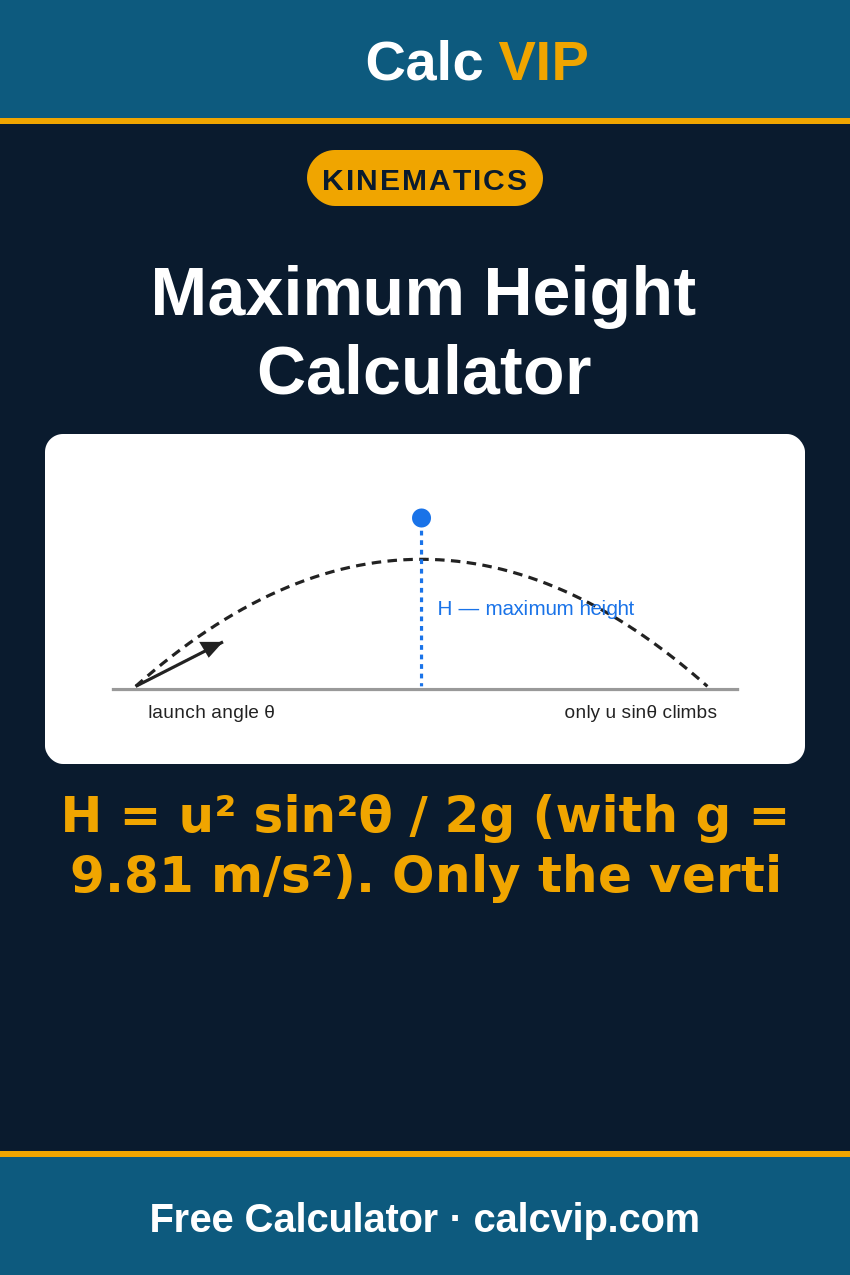
This calculator needs just the launch speed u in m/s and the angle θ in degrees above the horizontal, and it returns the peak height above the launch point, using g = 9.81 m/s² and ignoring air resistance, as standard projectile calculations do. If the launch happens from a raised platform — a balcony, a cliff, a player's hands — add that starting height to the result to get the height above the ground. The sections below unpack where the formula comes from, how the angle trades height against distance, and why the same equation reappears inside fountains, volcanoes and basketball arcs.
Formula
Maximum height H = u² sin²θ / 2g (with g = 9.81 m/s²). Only the vertical part of the launch speed, u sinθ, decides how high the projectile climbs.
The formula is the third equation of motion, v² = u² + 2as, applied to the vertical component alone: at the peak the vertical velocity is 0, so 0 = (u sinθ)² − 2gH, and H falls out directly. Its rearrangements answer the reverse questions. The launch speed needed to reach a chosen height at a chosen angle: u = √(2gH) / sinθ. The angle needed with a known speed: sinθ = √(2gH) / u. And for the special case of a straight-up launch (θ = 90°, sinθ = 1) it collapses to the vertical-motion formula H = u² / 2g. A useful companion is the time to reach the peak, t = u sinθ / g — for the worked example below, 25 sin 40° ÷ 9.81 = 16.07 ÷ 9.81 ≈ 1.64 s. Note what never appears: the horizontal component u cosθ. It sets the range, but the height neither knows nor cares how fast the projectile is travelling sideways.
| Symbol | Meaning | Units |
|---|---|---|
| H | maximum height above the launch point | m |
| u | launch speed — the full speed at release | m/s |
| θ | launch angle above the horizontal | degrees |
| u sinθ | vertical component of the launch velocity — the part that climbs | m/s |
| u cosθ | horizontal component — sets the range, not the height | m/s |
| g | acceleration due to gravity | m/s² (9.81 on Earth) |
Why only the vertical component matters
Projectile motion is two independent motions sharing a clock. Horizontally, with no force acting (air resistance aside), the projectile keeps its launch component u cosθ forever — it neither gains nor loses sideways speed. Vertically, gravity rewrites the velocity every instant: vy = u sinθ − gt, falling by 9.81 m/s each second. The peak of the flight is simply the moment the vertical account empties — vy = 0 — and everything about the height is contained in how much vertical velocity there was to spend and how quickly gravity spends it. The horizontal motion is a spectator: it decides where the peak occurs along the ground, never how high it is.
Energy tells the same story in a second language. At launch, the vertical motion holds kinetic energy ½m(u sinθ)² per the vertical component; at the peak that share has been fully converted into gravitational potential energy mgH. Setting them equal, the mass cancels and H = u² sin²θ / 2g drops out — the formula is energy conservation wearing kinematic clothes. This is also why mass is absent: gravity accelerates all masses equally, and the energy bookkeeping per kilogram is identical for a tennis ball and a cannonball. What breaks the equality in real life is air resistance, which taxes fast, light, bulky projectiles hardest; for dense objects at modest speeds the formula is accurate to a few percent.
The angle's role deserves a closer look, because sin²θ has a distinctive shape. It starts at 0 for a flat launch (no vertical component, no height — a horizontal throw's "peak" is its launch point), rises steeply through the middle angles, and flattens as it approaches 1 at 90°. So equal steps of angle buy unequal height: 15°→30° multiplies sin²θ by about 3.7 (0.067 to 0.25), while 60°→75° multiplies it by only about 1.24 (0.75 to 0.93). Coaches and artillery officers alike live on this curve — most of the height is available well before the launch turns vertical, which is why real-world launches for distance-with-height, like a rugby punt or a mortar, cluster in the 40°–60° band rather than near 90°.
How to use
- Enter the launch speed u in metres per second — the speed at the instant of release, kick or firing.
- Enter the launch angle θ in degrees above the horizontal (0–90). Use 90 for a throw straight up.
- Click "Calculate Max Height" to see the peak height above the launch point.
- If the launch point is itself raised — hands, a platform, a cliff edge — add that height to the answer for the height above the ground.
- To find the speed a throw needs for a target height, rearrange: u = √(2gH) / sinθ, and check your answer by entering it back into the calculator.
Worked examples
Example 1 — the kicked ball. A ball is kicked at u = 25 m/s at θ = 40°. sin 40° = 0.6428, so sin²40° = 0.4132, and H = (625 × 0.4132) ÷ 19.62 = 258.25 ÷ 19.62 = 13.16 m — about the height of a four-storey building, reached 1.64 s after the kick, with the ball still travelling sideways at u cos 40° = 19.15 m/s.
Example 2 — the textbook 45° launch. At u = 20 m/s and θ = 45°, sin²45° = 0.5 exactly, so H = (400 × 0.5) ÷ 19.62 = 200 ÷ 19.62 = 10.19 m. The 45° angle splits the launch evenly between height and range duties — half the squared speed goes to climbing.
Example 3 — straight up. The same 15 m/s thrown vertically (θ = 90°, sinθ = 1): H = 225 ÷ 19.62 = 11.47 m. Compare Example 5 below: a faster but angled launch can peak lower than a slower vertical one — the angle's sin² factor can outweigh raw speed.
Example 4 — a steep mortar angle. At u = 18 m/s and θ = 60°, sin²60° = 0.75, so H = (324 × 0.75) ÷ 19.62 = 243 ÷ 19.62 = 12.39 m. Three quarters of the squared speed is spent on climbing, which is why high-angle fire drops shells steeply onto targets behind cover.
Example 5 — a basketball shot. A shot leaves the hands at u = 12 m/s at θ = 50°: sin²50° = 0.5868, so H = (144 × 0.5868) ÷ 19.62 = 84.50 ÷ 19.62 = 4.31 m above the release point. Released from 2 m, the ball peaks at about 6.31 m — comfortably above the 3.05 m rim, giving the arc its forgiving entry angle.
Example 6 — doubling the speed quadruples the height. At θ = 45°, a 10 m/s launch peaks at (100 × 0.5) ÷ 19.62 = 2.55 m, while 20 m/s peaks at 10.19 m — exactly four times higher, not two. The square in u² is the single most important feature of this formula: height is bought with speed at a steep exchange rate, in both directions.
Maximum height in real life
Goal kicks and punts. A goalkeeper launching at 25 m/s near 40° sends the ball some 13 m up — high enough to clear every player and hang in the air while the team reshapes. The hang time and the height are the same physics: both grow out of u sinθ.
Fountains and fire hoses. A fountain jet is a continuous projectile. To make water peak 5 m above the nozzle at a near-vertical angle requires u = √(2 × 9.81 × 5) ≈ 9.9 m/s at the nozzle — the pump pressure is chosen from this formula.
Volcanic eruptions. Geologists film eruption columns and time the rising bombs of lava; from the heights reached (some exceed 1 km) the formula, run backwards, gives ejection speeds of 140 m/s or more — a measurement made from a safe distance with nothing but this equation.
Fireworks. A shell's burst height is set at manufacture: the lift charge gives the speed, the time fuse is cut for t = u sinθ/g so the starburst opens at the peak, where the shell momentarily hangs — the most beautiful point of the flight, chosen by arithmetic.
High jump and pole vault run-ups. A vaulter converts running speed into height through the pole; the energy form of this formula, H = u²/2g, caps what any approach speed can yield — at 9.5 m/s, 4.60 m of centre-of-mass rise, which is why vaulters are sprinters first.
Safety netting and screens. Building sites and driving ranges size their screens from this calculation: a golf ball mishit at 40 m/s at 30° peaks at (1600 × 0.25) ÷ 19.62 ≈ 20.39 m, so netting near the tee must stand taller than that, or be placed where the ball has already fallen below it.
Quick reference: peak heights in metres
| Launch speed | θ = 30° | θ = 45° | θ = 60° | θ = 90° |
|---|---|---|---|---|
| 10 m/s | 1.27 | 2.55 | 3.82 | 5.10 |
| 20 m/s | 5.10 | 10.19 | 15.29 | 20.39 |
| 30 m/s | 11.47 | 22.94 | 34.40 | 45.87 |
Two patterns are worth memorising from this grid. Down any column, tripling the speed multiplies the height by nine — the u² law again. Across any row, the climb from 30° to 60° triples the height (sin²θ: 0.25 → 0.75), but the final step to 90° adds only a third more. Height-hungry launches should therefore spend on speed first and on extreme steepness last.
The peak is a moment — but projectiles linger near it
The projectile passes its maximum height in an instant, yet it spends a surprising share of the flight near the top. Because vertical motion slows as it climbs, the ball loiters in the upper region: for the Example 1 kick, solving the height equation shows the ball is above half its peak height (6.58 m) from t ≈ 0.48 s to t ≈ 2.80 s — about 2.32 s of the 3.28 s flight, roughly 71%. That fraction is no coincidence: for any launch landing back at its start level, the share of flight spent above half the maximum height is exactly 1/√2 ≈ 70.7%. It is why catches at the top of a throw feel unhurried, why jugglers work near the peak of each toss, and why a high ball seems to "hang" — the top of the arc is where the projectile's time is spent, even though its height there changes slowly.
Height on other worlds
The formula's g is Earth's, but nothing else about it is parochial. On the Moon, g = 1.62 m/s², so the Example 1 kick (25 m/s at 40°) would peak at 258.25 ÷ (2 × 1.62) = 258.25 ÷ 3.24 ≈ 79.71 m — six times higher, matching the famous footage of Apollo astronauts' tools and golf balls sailing improbable distances. On Mars (g = 3.71) the same kick peaks at 258.25 ÷ 7.42 ≈ 34.80 m. Mission engineers use exactly this scaling when they design hopping rovers and sample-launch tubes: the height a given spring or charge can achieve is a property of the planet as much as of the machine.
Common mistakes
- Forgetting to square the sine. H uses sin²θ, not sinθ. At 40°, sinθ = 0.64 but sin²θ = 0.41 — skipping the square inflates the answer by more than half. If your height looks too generous, this is the first suspect.
- Leaving the calculator in radian mode. The angle here is in degrees. sin(40 radians) is a meaningless number for this problem and produces heights that are too small or even negative-looking nonsense. Check the mode before the maths.
- Reporting height above ground when the formula gives height above launch. The two differ by the launch point's own height. A ball released at 2 m that "peaks at 4.31 m" by this calculator is 6.31 m above the ground — state which you mean.
- Expecting the horizontal speed to help. A faster sideways component adds range, not height. Two launches with the same u sinθ peak identically even if one travels three times as far.
- Trusting the number for feathers and beach balls. The formula ignores air resistance. For dense, compact objects at moderate speeds it is excellent; for light, draggy ones the real peak can be far lower, and no rearrangement of this equation will fix that — a drag model is needed.
FAQ
At what angle is the maximum height greatest?
At 90° — a straight-up launch — because all of the speed is vertical. But then the range is zero, so games and sports use lower angles.
Is the height measured from the ground or the launch point?
From the launch point. If the launch happens above the ground (for example from a platform), add that starting height to the result to get the height above the ground.
What is the velocity at the highest point?
The vertical velocity is zero for an instant, but the horizontal velocity continues unchanged — the projectile does not stop completely.
How long does the projectile take to reach the peak?
t = u sinθ / g. For 25 m/s at 40° that is 16.07 ÷ 9.81 ≈ 1.64 s — exactly half the total flight time when the projectile lands back at launch level, because the rise and fall are mirror images.
Does a heavier projectile reach a different height?
Not in this calculation: mass cancels out. In reality, heavier (denser) projectiles often do fly closer to the prediction, because air resistance disturbs them less — but the formula itself is mass-blind.
What launch speed do I need to clear a 10 m wall?
At 45°, u = √(2gH) / sinθ = √(196.2) ÷ 0.7071 = 14.01 ÷ 0.7071 ≈ 19.81 m/s — and that only grazes the top at the peak; allow margin, and remember the ball must reach that height at the wall's position, not somewhere beyond it.
Why do two different angles sometimes give the same height?
They cannot at the same speed — sin²θ rises steadily from 0° to 90°, so each angle has its own height. (It is range that pairs angles: 30° and 60° land together on flat ground.) Different speed–angle combinations can of course share a height whenever u² sin²θ matches.
How does air resistance change the answer?
It lowers the peak and moves it earlier and closer: the real trajectory is not a symmetric parabola but leans, with a steeper descent. The error is small for balls and stones at school-lab speeds, and large for shuttlecocks, balloons and anything supersonic.
Is the descent speed at launch level equal to the launch speed?
The vertical component is: the projectile returns to launch height with vertical velocity −u sinθ, the mirror of its start. Its total speed there equals the launch speed too, since the horizontal component never changed.
Can the formula be used for a rocket or a jumping animal?
Only after the thrust or push ends. While an engine burns or legs extend, the object is not a projectile. From the instant of release — the rocket's burnout, the jumper's take-off — the formula governs the coasting arc, with u the velocity at that instant.