 Calc
Meeting Time Calculator – Two Objects Towards Each Other or Catching Up
 Created by Sarah Mitchell · Physics Editor · Motion & Measurement · Last updated: November 2026
Use this free Meeting Time Calculator to find when and where two moving objects meet. It handles the two classic cases: two objects moving towards each other, and a faster object catching up with a slower one that had a head start.
Two travellers, one road, two questions: when do they meet, and where? It is among the oldest problem shapes in mathematics — couriers between cities fill Babylonian tablets and medieval textbooks alike — and it survives because the world keeps asking it: two trains on a single-track line, a patrol car and a suspect, a faster runner lapping training partners, two delivery drones converging on a rendezvous. This calculator answers both questions for the two geometries that cover almost everything: the objects move towards each other, or one chases the other from behind.
Both cases collapse into a single idea — the closing speed. Watch the gap, not the travellers. When two objects move towards each other, each eats the gap at its own speed, so the gap shrinks at v1 + v2, and the meeting time is just the gap divided by that combined rate. In a chase, the leader also eats road — forwards — so the gap shrinks only by the excess, v1 − v2, and the time is the gap divided by the difference. Everything else is arithmetic: once t is known, the meeting point is v1 × t from A's start, with B's own distance as the built-in check, since the two distances must sum to the original gap (towards) or differ by it (chase).
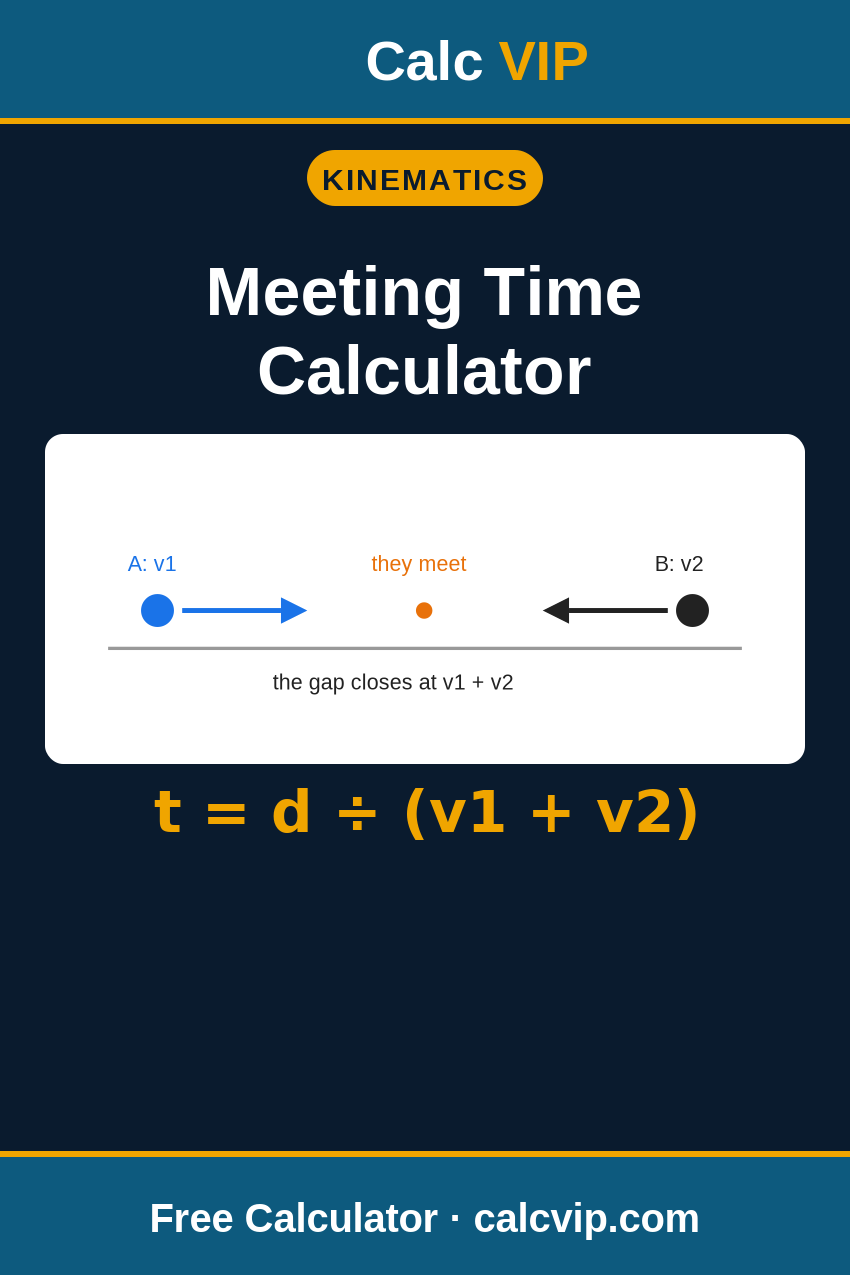
The calculator assumes the textbook conditions — both objects start at the same moment and hold constant speeds — and within those conditions its answers are exact. Its two modes also police their own logic: a chase in which A is not faster than B returns "never", which is not an error message but the correct physical answer, the gap frozen or growing forever. Real meetings add wrinkles — staggered starts, changing speeds, stops — and the depth section below shows how the same closing-speed idea absorbs most of them.
Formula
Towards each other: t = d ÷ (v1 + v2) • Catch-up: t = d ÷ (v1 − v2) • Meeting point from A = v1 × t • d in metres, speeds in m/s, t in seconds
Both formulas are the Speed Distance Time triangle applied to the gap itself: the gap is a distance, the closing speed is its rate of shrinkage, and the meeting time is distance ÷ rate. The towards-case closing speed is the sum because the gap is attacked from both ends; the catch-up closing speed is the difference because the leader is simultaneously extending the road ahead. Checks are built into the geometry: in towards mode the two travelled distances must sum to exactly d, and in catch-up mode the chaser's distance minus the leader's must equal d — the head start, repaid exactly at the meeting. If speeds are given in km/h and the gap in kilometres, the same formulas return hours; units need only be consistent. The generalisation to a delayed start appears in the depth section: convert the delay into extra gap (towards) or extra head start (chase) before dividing.
| Symbol | Meaning | Units |
|---|---|---|
| d | starting gap — distance between the objects (towards), or B's head start (catch-up) | m |
| v1 | speed of object A | m/s |
| v2 | speed of object B | m/s |
| t | time until they meet | seconds (s) |
| v1 + v2 | closing speed, towards mode | m/s |
| v1 − v2 | closing speed, catch-up mode (must be positive) | m/s |
Relative motion: why the gap is the only actor
Step into A's shoes and the whole problem simplifies to theatre with one moving actor. From A's frame, A is stationary and the world slides past; B approaches at the closing speed — v1 + v2 head-on, v1 − v2 in a chase — across a gap of d. One object, one speed, one distance: the meeting time is d divided by that speed, and the only remaining task is to translate the answer back into the ground's frame to find where (v1 × t from A's start). This is Galileo's relativity in its nursery form, and it is why the formulas are sums and differences rather than anything more exotic: velocities in a shared direction simply add and subtract when viewed from a moving observer. Every relative-motion problem in physics — boats crossing rivers, planes in winds, particles colliding — is this page's trick wearing a bigger coat.
The distance–time graph draws the same truth. Plot each object's position against time and each is a straight line whose slope is its speed. Towards each other, the lines lean in from opposite sides and cross once; the crossing point's coordinates are the meeting time and place. In a chase, the lines start offset and converge only if the chaser's slope is steeper — if it is not, the lines diverge forever and the calculator's "never catches up" is the graph's plain verdict. Reading meetings off crossing lines is more than a picture: it is how dispatchers, air-traffic systems and collision-avoidance software actually represent the problem.
Scale the same idea up and it turns serious. Two airliners on reciprocal headings at 250 m/s each close at 500 m/s — half a kilometre per second — so a 100 km separation evaporates in 200 s. Nothing about the arithmetic changes from the cyclists of Example 1; only the consequences do, which is why collision-avoidance systems exist to compute this page's division continuously and object loudly when the answer comes out small. Relative motion is the rare piece of school physics that professionals use verbatim, at full scale, with lives priced into the remainder.
How to use
- Choose the situation: "Moving towards each other", or "Catch-up" where A is the faster object starting behind B.
- Enter the starting distance between them in metres (in catch-up mode this is B's head-start gap — the field's label changes to say so).
- Enter both speeds in m/s — in catch-up mode A must be the faster one.
- Click "Calculate Meeting Time" to see when they meet and where, measured from A's starting point (and, in towards mode, from B's as a check).
- In towards mode, verify the two distances sum to the original gap; in catch-up mode, verify A's distance exceeds B's by exactly the head start. If either check fails, a number was mistyped.
Worked examples
Example 1 — both classic cases. Towards each other: two cyclists are d = 300 m apart, riding at v1 = 8 m/s and v2 = 7 m/s. Meeting time t = 300 ÷ (8 + 7) = 20 s, and they meet 8 × 20 = 160 m from A's start (140 m from B's — and 160 + 140 = 300, the check passes).
Catch-up: B has a 100 m head start at 7 m/s; A chases at 12 m/s. t = 100 ÷ (12 − 7) = 20 s, catching B after travelling 240 m (B travelled 140 m; 240 − 140 = 100, the head start repaid exactly).
Example 2 — the two trains. Two trains 500 m apart approach at 15 m/s and 10 m/s: t = 500 ÷ 25 = 20 s, meeting 300 m from the faster train's start and 200 m from the other's — the meeting point always leans toward the slower object's side, because the faster one covers more of the gap.
Example 3 — the walkers. Two walkers 1,200 m apart stroll towards each other at 1.5 m/s and 2.5 m/s: t = 1,200 ÷ 4 = 300 s — five minutes — meeting 450 m from the slower walker's start (and 750 m from the faster's).
Example 4 — the motorway chase. A patrol car at 20 m/s chases a car at 15 m/s with a 250 m gap: t = 250 ÷ 5 = 50 s, and the catch happens 1,000 m from where the patrol car started — half a minute and a full kilometre to close a modest gap at a modest speed advantage.
Example 5 — the training-ground pursuit. A runner at 9 m/s chases a partner at 7.5 m/s who has 60 m of head start: t = 60 ÷ 1.5 = 40 s, catching them 360 m along the track — small speed differences make long chases, as the 1.5 m/s closing speed shows.
Example 6 — the head-on vehicles. Two vehicles 2,000 m apart close at 22 m/s and 28 m/s: t = 2,000 ÷ 50 = 40 s, meeting 880 m from the first vehicle's start (1,120 m from the second's; 880 + 1,120 = 2,000 ✓). Forty seconds of combined 50 m/s closure is also, read in a safety register, exactly how fast a head-on situation develops.
Meetings and chases in real life
Railway single-line working. On single-track sections, dispatchers schedule crossing loops from meeting calculations: two trains' times to each loop are closing-speed problems, and the timetable is the set of answers.
Search and rescue rendezvous. A rescue boat and a drifting vessel moving towards a rendezvous point plan with combined closing speeds; a pursuer and a fleeing vessel plan with differences — the same two modes, with fuel as the constraint.
Motor racing strategy. When a faster car on fresh tyres hunts the leader, the pit wall computes catch time as gap ÷ pace difference, lap by lap — Example 5 with telemetry, deciding whether the chase is worth the tyre life.
Air traffic and drone delivery. Converging aircraft are monitored by time-to-meeting along their tracks; delivery drones meeting a moving van for a handoff solve a catch-up in three dimensions with this same difference-of-speeds core.
Relay and pursuit cycling. In team pursuit, the catch — one team reaching the other — is the event's climax and its arithmetic is t = gap ÷ (v1 − v2) ridden out loud by the coaches.
Everyday rendezvous. Two friends walking a towpath from opposite ends, a parent driving to meet a school bus coming the other way — the estimate everyone makes ("we'll cross in about five minutes") is the towards formula running on instinct.
Staggered starts: folding a delay into the gap
The calculator assumes simultaneous starts, but real chases rarely have them — and the fix is elegant. If B starts Δt seconds before A, then during those seconds B travels v2 × Δt alone, so by the time A begins, the gap has grown to d + v2Δt in a chase, or shrunk to d − v2Δt when moving towards. Enter that adjusted gap with the usual speeds and the simultaneous-start formulas give the meeting time measured from A's start; add Δt back for the time from B's. Worked once: B sets off 10 s early at 7 m/s in Example 1's chase, adding 70 m of head start — the gap becomes 170 m, the catch takes 170 ÷ 5 = 34 s of A's travel, 44 s after B began. Delays are just distance in disguise, paid in advance.
Quick reference: how closing speed devours a 300 m gap
| Situation | Speeds (m/s) | Closing speed | Meeting time for 300 m |
|---|---|---|---|
| towards | 8 and 7 | 15 | 20 s |
| towards | 15 and 10 | 25 | 12 s |
| towards | 1.5 and 2.5 | 4 | 75 s |
| catch-up | 12 vs 7 | 5 | 60 s |
| catch-up | 20 vs 15 | 5 | 60 s |
| catch-up | 9 vs 7.5 | 1.5 | 200 s |
The chase rows carry the moral: identical gaps take three to ten times longer to close in pursuit than head-on, because only the difference works for you. Small pace advantages are nearly no advantage at all.
Meetings on a loop: lapping and being lapped
Close the road into a circle and meetings repeat. On a track, the "gap" is the lap itself: the faster runner gains on the slower at v1 − v2, and they draw level each time the gain accumulates to a full lap. Two training partners on a 400 m track, one lapping in 60 s (6.67 m/s) and the other in 75 s (5.33 m/s), close at 1.33 m/s and meet every 400 ÷ 1.33 = 300 s — five minutes, in which the faster completes exactly five laps and the slower four. The formula is the catch-up mode with d set to the lap length, and it governs everything from pursuit cycling to satellite rendezvous phasing, where "meeting" repeatedly and predictably is the entire design problem. It also explains a small mercy of the velodrome and the running track: however mismatched the athletes, the meetings arrive on a schedule set only by the difference of speeds — and when the speeds are equal, the schedule is never, which is the calculator's catch-up verdict wearing a tracksuit.
Common mistakes
- Adding speeds in a chase. The chase closes at the difference v1 − v2, never the sum. Adding gives an absurdly early catch — and hides the real question of whether A is faster at all.
- Swapping A and B in catch-up mode. A is defined as the faster chaser starting behind. Enter the leader as A and the calculator correctly reports "never catches up" — about a race that was described backwards.
- Reporting only the time. Meetings have a place as well as a moment, and the place is often the actionable answer (which loop, which junction, which kilometre post). The calculator gives both; quote both.
- Assuming a delayed start breaks the method. It does not — convert the delay into extra (or reduced) gap first, as the depth section shows, then divide as usual.
- Expecting real pursuits to hold constant speeds. Traffic, corners and fatigue bend both speeds; the calculator's answer is the constant-speed ideal, a planning figure. Recompute as the gap and speeds update — dispatchers and pit walls do exactly that, continuously.
FAQ
Why do the speeds add when objects move towards each other?
Because both objects are shrinking the gap at the same time, so the closing speed is v1 + v2. In a chase only the difference v1 − v2 shrinks the gap.
What if the chaser is not faster in catch-up mode?
Then the gap never closes and they never meet — the calculator will tell you this.
Do both objects need to start at the same moment?
Yes, this calculator assumes both start moving at the same time and keep a constant speed.
How do I handle a head start given in time instead of distance?
Multiply the leader's speed by the time advantage to get the gap in metres — 7 m/s with a 10 s head start is a 70 m gap — then use catch-up mode with that distance.
Where exactly do they meet — closer to which start?
Closer to the slower object's start in towards mode, because the faster object covers more than half the gap. With equal speeds they meet exactly halfway.
What if one object is stationary?
Set its speed to zero. Towards mode becomes a simple approach (t = d/v1), and catch-up mode becomes a chase of a parked target — both handled by the same formulas.
Can the objects meet more than once?
Not in this model — constant speeds on a line meet at most once. On a circular track they can meet repeatedly (lapping), and each meeting is again a closing-speed division using the lap length as the gap.
Why does the meeting point use v1 × t and not the average speed?
Because the meeting point is a place on the ground, measured along A's own journey: A travelled at v1 for the whole time t. The average of the two speeds locates nothing physical.
What if the objects move at an angle to each other?
Then the closing speed is the component along the line joining them, and the problem becomes two-dimensional — the component method from the Projectile Components page is the way in. This calculator covers the collinear cases, which include most road and rail problems.
How accurate is this for real vehicles?
As accurate as the constant-speed assumption: excellent for trains and walkers at cruise, rougher for cars in traffic. Treat the answer as the idealised rendezvous and recompute as conditions change.