 Calc
Projectile Flight Time Calculator – Time of Flight Launched From a Height
 Created by Sarah Mitchell · Physics Editor · Motion & Measurement · Last updated: November 2026
Use this free Projectile Flight Time Calculator to find how long a projectile stays in the air when it is launched from a height — for example thrown from a cliff or a building. Enter the launch speed, angle and starting height, and the calculator solves the quadratic motion equation for the moment it hits the ground. It also shows how far it lands.
The ground-launch version of projectile motion is the tidy one taught first: up, across, down, land at the same level, with flight time 2u sinθ/g. Real launches are rarely so courteous. Stones leave cliff edges, packages leave aircraft doors, water leaves hose nozzles on embankments, and divers leave platforms — all starting above their landing level. That head start of height changes the flight time in a way no tidy doubling formula captures: the projectile must first spend its upward journey, then fall not merely back to launch level but all the way down the extra height h. This calculator handles the general case, solving the exact quadratic for the moment the height returns to zero.
The mathematics is one line of vertical motion: the height at time t is y = h + u sinθ × t − ½gt², a downward-opening parabola in time that starts at h, rises to a peak, and crosses zero exactly once at a positive time. Setting y = 0 and taking the positive root gives t = [u sinθ + √((u sinθ)² + 2gh)] / g. Read the root's anatomy: u sinθ/g is the time the launch's upward component "buys", and the square-root term is the fall from the peak folded into the same expression. Set h = 0 and the formula politely collapses to the schoolbook 2u sinθ/g — the general case contains the tidy one.
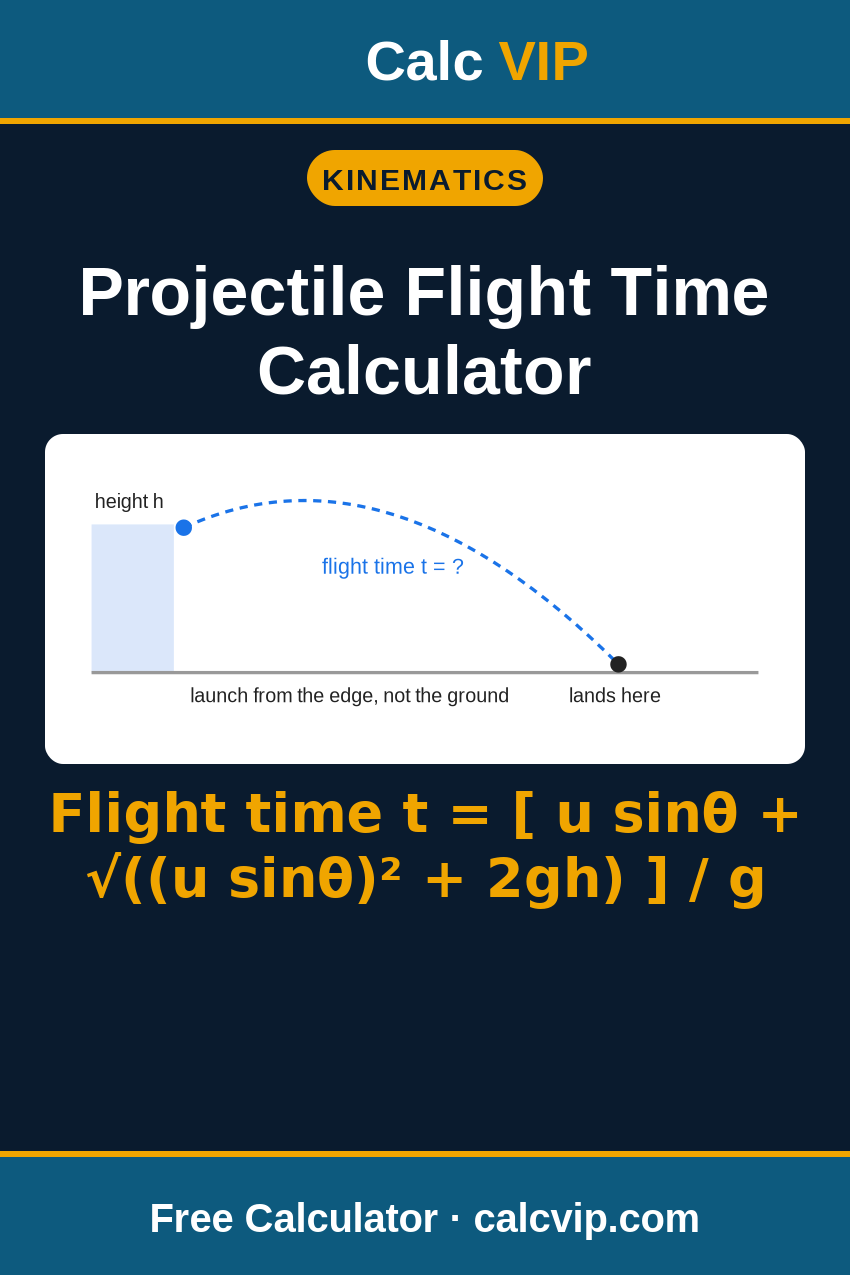
Flight time is the master variable of projectile problems because the horizontal motion is a passenger: with no air resistance the horizontal component u cosθ never changes, so the landing distance is simply that constant speed multiplied by however long the vertical motion allows. That is why this calculator reports both numbers together — find the time, and the range follows by one multiplication. Every extra second the height buys is worth u cosθ extra metres of range, which is why cliff launches fly so satisfyingly far.
Formula
Flight time t = [ u sinθ + √((u sinθ)² + 2gh) ] / g • u in m/s, θ in degrees, h in metres, g = 9.81 m/s²
The formula is the positive root of the height equation y = h + u sinθ × t − ½gt² = 0. Its pieces rearrange into the whole projectile toolkit: the time to the peak is tpeak = u sinθ / g, the peak height is H = h + (u sinθ)² / 2g, and the horizontal distance is range = u cosθ × t. Special cases fall out by substitution: h = 0 gives t = 2u sinθ/g (the level-ground flight); θ = 0 gives t = √(2h/g) (the horizontal launch, where only the height matters); θ = 90° gives the straight-up case with zero range. The calculator uses g = 9.81 m/s² throughout and ignores air resistance, so treat results for light, fast or long-flying objects as upper bounds — real flights through air are shorter and land closer.
| Symbol | Meaning | Units |
|---|---|---|
| u | launch speed | m/s |
| θ | launch angle above the horizontal (0–90°) | degrees |
| h | launch height above the landing level | m |
| u sinθ | vertical launch component — sets the time aloft | m/s |
| u cosθ | horizontal launch component — constant, sets the range | m/s |
| t | total flight time until y returns to 0 | seconds (s) |
Anatomy of a flight from a height: three acts
Every flight this calculator describes has the same three acts. Act one: the rise. The vertical component u sinθ bleeds away under gravity at 9.81 m/s per second, reaching zero at the peak after u sinθ/g seconds, at a height h + (u sinθ)²/2g above the ground. Act two: the fall back to launch level, which — gravity being even-handed — takes exactly as long as the rise and returns the projectile to height h moving downward at exactly u sinθ. Act three: the extra fall, the part level-ground problems never meet, in which the projectile drops the remaining h metres starting with that downward speed. The quadratic formula is nothing but these three acts compressed into one root: the rise-and-return contributes 2u sinθ/g when h = 0, and the root's square-root term stretches the total by precisely the extra fall's duration.
Notice what the horizontal motion is doing during the drama: nothing. It neither speeds nor slows, so the trajectory's shape — a parabola stretched sideways by u cosθ — is set by the ratio of the two components, while its duration is owned entirely by the vertical component and the height. This separation of powers is the deepest fact in projectile physics, and it is why a bullet fired horizontally and a bullet dropped from the same height strike the ground together: their vertical acts are identical, second for second, whatever their horizontal stories.
How to use
- Enter the launch speed u in metres per second (m/s).
- Enter the launch angle θ in degrees above the horizontal — 0 for a flat throw off the edge, 90 for straight up.
- Enter the launch height h in metres above the landing surface (0 for a ground-level launch).
- Click "Calculate Flight Time" to see the total time aloft and the horizontal distance from the launch point.
- Compare against h = 0 with the same u and θ to see exactly how much time and distance the height bought — often the most instructive number on the page.
Worked examples
Example 1 — the cliff throw. A ball is thrown at u = 20 m/s at θ = 30° from a cliff h = 45 m high.
u sinθ = 10 m/s, so t = [10 + √(100 + 2 × 9.81 × 45)] ÷ 9.81 = 41.35 ÷ 9.81 = 4.22 s. It lands u cosθ × t = 17.32 × 4.22 = 73.01 m from the base. The same throw from ground level would last only 2.04 s and land 35.31 m out — the cliff more than doubles both.
Example 2 — the level-ground check. A projectile launched at 25 m/s at 40° from ground level (h = 0): t = 2 × 25 × sin40° ÷ 9.81 = 2 × 16.07 ÷ 9.81 = 3.28 s, landing 19.15 × 3.28 = 62.74 m away. The general formula reducing to the schoolbook one is the calculator passing its own exam.
Example 3 — flat off a high cliff. A stone thrown horizontally (θ = 0) at 12 m/s from an 80 m cliff: the vertical component is zero, so t = √(2 × 80 ÷ 9.81) = 4.04 s, and it lands 12 × 4.04 = 48.46 m from the base. Height alone sets the time; speed alone sets how far that time carries it.
Example 4 — off a tower at 45°. A ball launched at 15 m/s at 45° from a 25 m tower: u sinθ = 10.61, t = [10.61 + √(112.5 + 490.5)] ÷ 9.81 = [10.61 + 24.56] ÷ 9.81 = 3.58 s, landing 10.61 × 3.58 = 38.02 m out.
Example 5 — straight up from a rooftop. A ball thrown vertically (θ = 90°) at 10 m/s from a 30 m roof: t = [10 + √(100 + 588.6)] ÷ 9.81 = [10 + 26.24] ÷ 9.81 = 3.69 s — and the horizontal distance is exactly 0 m; it lands at the building's base, having spent its flight going up and coming down past its own launch point.
Example 6 — the low, fast launch. A projectile at 30 m/s at a flat 20° from a 10 m bank: u sinθ = 10.26, t = [10.26 + √(105.3 + 196.2)] ÷ 9.81 = [10.26 + 17.36] ÷ 9.81 = 2.82 s, but the big horizontal component, 28.19 m/s, turns that modest time into 79.38 m of range — flat and fast beats high and slow when height is limited.
Flight time from a height in real life
Cliff diving and bridge jumps (the legal kind). Organisers and safety teams compute the fall time from platform height to water to set everything from entry technique to the depth checks below — at 27 m, the top diving platform height, the flight is about 2.3 s of pure fall before any launch component.
Aerial delivery. A supply package released from a moving aircraft is a horizontal projectile whose flight time is set by altitude alone; the release point is placed one range — speed × flight time — before the target.
Firefighting water jets. A hose on an embankment or ladder platform launches water above the fire's level; the reach of the jet is flight time × horizontal component, which is why platform height is a tactical asset.
Ski jumping. The jumper leaves the table nearly horizontally at 25 m/s or more, and the landing slope falls away beneath — the "height" grows as they fly, stretching the flight toward 5–6 s and distances beyond 140 m.
Golf from elevated tees. A tee box 20 m above the fairway adds measurably to carry: the ball's flight time stretches, and the constant horizontal component converts each extra fraction of a second into metres — the reason elevated tees feel generous.
Volcanic bomb and debris safety. Ballistic fragments from an eruption are projectiles launched from a vent above the surrounding terrain; exclusion zones are drawn from flight-time-and-range calculations of exactly this kind.
Why the best angle from a height is not 45°
On level ground, 45° maximises range. From a height, the optimum drops below 45° — the extra fall time that the height provides for free is worth more when spent travelling horizontally than when topped up with more vertical launch. The exact optimum depends on h and u (for Example 1's launch it sits at about 29° — the example's own 30° throw is within a whisker of it — and it falls toward 0° as the height grows enormous), but the direction of the correction is universal: elevation is a resource, and a launch from height should spend its own velocity more horizontally because gravity and the drop will supply the airtime. This is why the long jump — a launch from a board effectively at landing height, but with the pit dug below — and the cliff-diving throw both favour flatter trajectories than textbook intuition suggests.
The optimum has a formula of its own: tanθopt = u ÷ √(u² + 2gh). For Example 1, that is 20 ÷ √(400 + 882.9) = 20 ÷ 35.82, giving θopt ≈ 29.2° — and the ranges bear it out: 73.02 m at 29°, 73.01 m at the example's 30°, sagging to 67.83 m at the level-ground favourite of 45°. Note also how flat the maximum is: a full degree off optimum costs a centimetre. Precision about the angle matters far less than the qualitative correction — from a height, aim flatter than 45° — which is why experienced throwers learn it in their shoulders rather than from the formula.
Quick reference: flight time for a horizontal launch (θ = 0), t = √(2h/g)
| Height h (m) | Flight time t (s) | Range at u = 10 m/s | Range at u = 20 m/s |
|---|---|---|---|
| 5 | 1.01 | 10.1 m | 20.2 m |
| 20 | 2.02 | 20.2 m | 40.4 m |
| 45 | 3.03 | 30.3 m | 60.6 m |
| 80 | 4.04 | 40.4 m | 80.8 m |
| 125 | 5.05 | 50.5 m | 101.0 m |
Quadrupling the height only doubles the time — the square root rationing falls — yet every row shows the same time buying twice the range when the speed doubles. Time is bought with height at a discount; distance is bought with speed at par.
The same cliff on other worlds
The formula's structure is universal; only g is local. Replay Example 1 — 20 m/s at 30° from a 45 m cliff — under other skies. On the Moon (g = 1.62 m/s²): t = [10 + √(100 + 2 × 1.62 × 45)] ÷ 1.62 = [10 + 15.68] ÷ 1.62 = 15.85 s aloft, landing 17.32 × 15.85 = 274.54 m out — nearly four times the Earth flight, in silence, with no air to complicate a single metre of it (one reason lunar projectile demonstrations in astronaut footage look dreamlike). On Mars (g = 3.71 m/s²): t = [10 + √(100 + 333.9)] ÷ 3.71 = [10 + 20.83] ÷ 3.71 = 8.31 s, landing 143.93 m out — though Mars's thin atmosphere, about 1% of Earth's density, still taxes real projectiles slightly. The comparison isolates exactly what gravity contributes to a flight: not the shape of the story, which the components keep, but its tempo and its scale. Every world runs the same three acts; heavier worlds just hurry them.
Common mistakes
- Using 2u sinθ/g when h is not zero. The schoolbook formula assumes landing at launch level. From any height it understates the flight time — in Example 1 by more than half. If the launch is elevated, the height belongs in the calculation.
- Feeding the full speed into the vertical motion. Only u sinθ acts vertically. Entering u where u sinθ belongs inflates the rise time and the whole answer — at 30° it doubles the vertical component.
- Taking the negative root seriously. The quadratic's other root is negative — it is the time before launch at which the parabola, extended backwards, would have crossed ground level. Physics keeps the positive root; so does the calculator.
- Measuring h to the wrong level. h is the height above the landing surface, not above the ground at the cliff's base if the projectile lands on a slope, a roof or water at a different level. Measure to where it will actually land.
- Trusting the number for light projectiles. Air resistance shortens real flights — a beach ball or a shuttlecock lands far sooner and closer than this predicts. The formula is exact for dense, slow projectiles and an upper bound for everything else.
FAQ
Why is the flight time longer than for a ground launch?
Because after passing its peak the projectile still has the launch height to fall through, which adds extra time.
Does the horizontal speed change during flight?
No. Ignoring air resistance, the horizontal component u cosθ stays constant, which is why range is just that speed multiplied by the flight time.
What angle gives the longest flight time?
90° — throwing straight up. But then the horizontal distance is zero, so it lands back at the launch point.
What angle gives the longest range from a height?
Less than 45° — the height supplies airtime for free, so more of the launch speed should be spent horizontally. The exact optimum depends on u and h and slides toward 0° as the height grows.
Does a heavier projectile stay up longer?
No. Mass appears nowhere in the formula; in the no-air-resistance model all projectiles with the same u, θ and h fly identical flights. (In real air, heavier, denser projectiles resist drag better and come closer to the model.)
How long does the projectile spend above its launch level?
Exactly 2u sinθ/g — the rise plus the fall back to launch height. Everything beyond that in the calculator's answer is the third act: the extra fall through h.
What is the peak height in Example 1?
H = h + (u sinθ)²/2g = 45 + 100/19.62 = 45 + 5.1 = 50.1 m above the ground — the cliff contributes most of the altitude; the throw adds only a tenth.
Can this calculator handle a launch from below the landing level?
Formally, entering a negative h works while (u sinθ)² + 2gh stays positive — throwing up onto a ledge. If that term goes negative the projectile never reaches the landing level at all, and no flight time exists.
Why is g fixed at 9.81?
It is Earth's surface value, and these are Earth-bound problems. On the Moon (g = 1.62) the same cliff throw would last roughly two and a half times longer — the formula's structure is universal, only the constant changes.
How does air resistance change the answer?
It shortens the flight and the range, and breaks the neat symmetry: the descent becomes slower than the ascent's mirror image, and the trajectory's landing half steepens. For balls thrown by hand the error is a few percent; for anything light or fast it dominates.