 Calc
Projectile Components Calculator – Horizontal & Vertical Velocity Components
 Created by Sarah Mitchell · Physics Editor · Motion & Measurement · Last updated: November 2026
Use this free Projectile Components Calculator to split a launch velocity into its horizontal and vertical components, and to find the velocity and direction of the projectile at any moment during its flight. Enter the launch speed, angle and the time you are interested in.
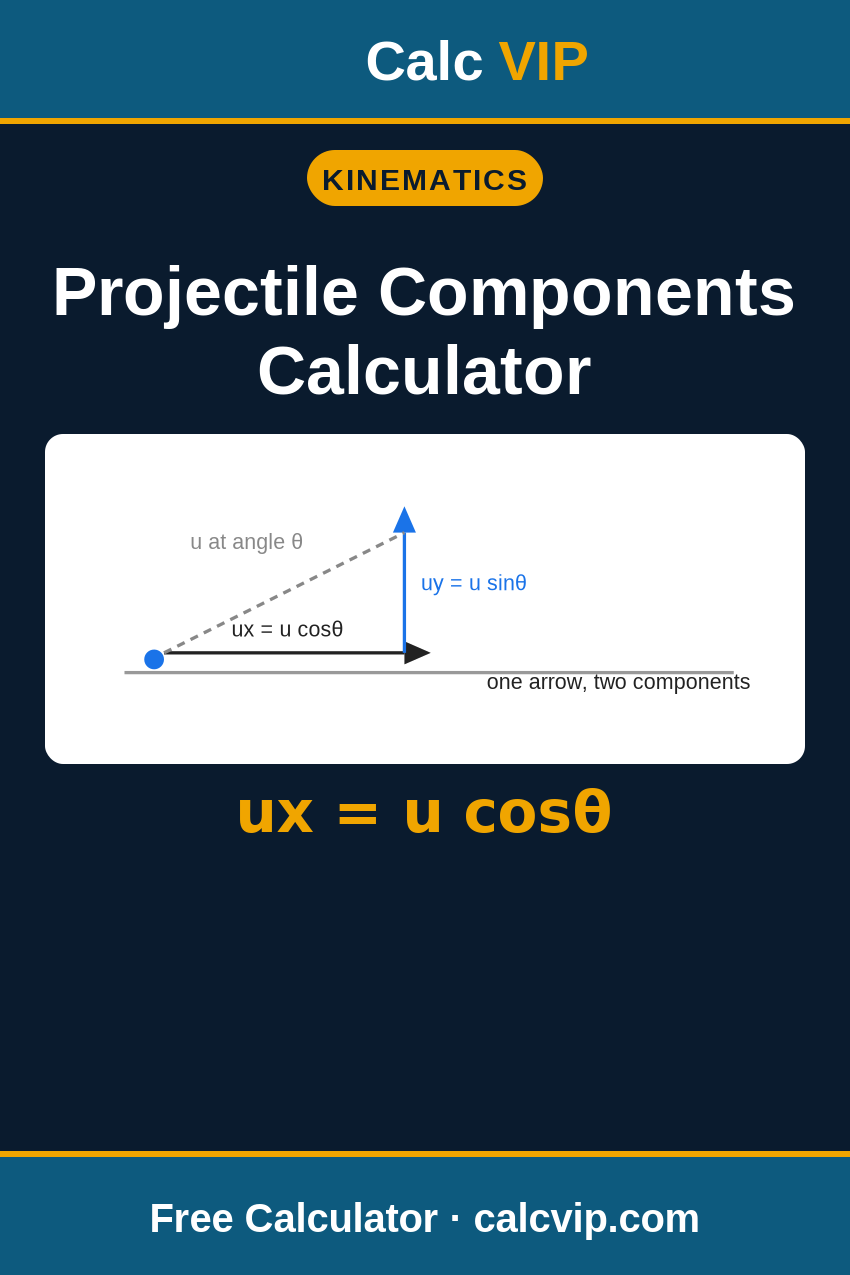
A projectile's velocity is a single arrow that gravity edits continuously — but it edits only half of it. The moment a projectile leaves the hand, the bow or the barrel, its velocity splits conceptually into two independent components: a horizontal component ux = u cosθ, which nothing in the flight will ever change, and a vertical component uy = u sinθ, which gravity rewrites at 9.81 m/s every second. Every question about a projectile — where it is, how fast it moves, which way it points at any instant — is answered by tracking these two components separately and recombining them. This calculator performs that split and that recombination at any time t you choose.
The recombination is Pythagoras with a direction: the speed at time t is √(ux² + vy²), where vy = uy − gt, and the direction is tan⁻¹(vy/ux), measured from the horizontal. Watch what those two formulas do across a flight. At launch the arrow points at θ, steep and full-length. As vy drains away the arrow flattens and shortens, until at the peak vy = 0 and the projectile moves purely horizontally at its minimum speed, ux. Then vy turns negative, the arrow tilts downward and lengthens again, and — for a landing at launch level — it touches down with exactly its launch speed at exactly −θ: the flight's second half is the first half in a mirror.
Components are not a computational convenience; they are the reason projectile physics is solvable at all. Newton's laws apply axis by axis: with no horizontal force, horizontal acceleration is zero and ux is frozen; with gravity the only vertical force, vertical motion is just free fall wearing a head start. Two trivial one-dimensional problems replace one apparently two-dimensional one. This calculator is that idea with a user interface — enter the launch, pick the moment, and see both the parts and the whole.
Formula
ux = u cosθ • uy = u sinθ • vy = uy − gt • speed = √(ux² + vy²) • direction = tan⁻¹(vy / ux) (g = 9.81 m/s²)
The component split uses the launch angle's cosine for the horizontal part and sine for the vertical — adjacent and opposite sides of the velocity triangle. Thereafter the components evolve by separate laws: ux stays constant for the whole flight (no horizontal force, no air resistance), while vy decreases by 9.81 m/s every second, passing through zero at the peak time tpeak = uy/g. The position follows by the same split: x = ux × t and y = uy × t − ½gt². Angles in this calculator are measured from the horizontal in degrees; a negative direction result means the projectile is travelling below the horizontal — falling — and the calculator says so in words as well as numbers.
| Symbol | Meaning | Units |
|---|---|---|
| u | launch speed | m/s |
| θ | launch angle above the horizontal | degrees |
| ux | horizontal component — constant all flight | m/s |
| uy | vertical component at launch | m/s |
| vy | vertical component at time t, uy − gt | m/s |
| t | time since launch at which to inspect the velocity | seconds (s) |
The velocity arrow through a flight: a guided tour
Freeze the flight at successive instants and inspect the arrow. At launch (t = 0) it is the full u at angle θ — the longest and steepest it will be while rising. Halfway to the peak, vy has halved; the arrow is shorter and flatter, and the speed has dropped, though not by half — Pythagoras is forgiving of the shrinking component. At the peak the arrow is purely horizontal, length ux: the slowest moment of the entire flight, and the only moment the direction is exactly 0°. Past the peak the mirror unwinds: vy grows downward, the arrow steepens below horizontal and lengthens. For a level landing it arrives with its launch length restored — energy conservation in arrow form, since height, and therefore speed, has returned to its start value. Launch from a height and the arrow lands longer than it left: the extra fall has bought extra vy, and the impact speed exceeds u.
One subtlety rewards attention: the direction angle changes fastest near the peak and slowest near launch and landing. Early on, vy is large, so each second's 9.81 m/s reduction is a small fraction of it; near the peak vy hovers near zero, and the same 9.81 m/s per second swings the arrow through horizontal briskly. Pilots of thrown balls know this in their hands — a ball seems to "tip over" at the top of its arc — and it is pure component arithmetic, visible in the calculator by stepping t through the peak in tenths of a second.
The energy view of the peak is equally tidy. Kinetic energy splits between the components in proportion to their squares, so the fraction surviving at the peak is cos²θ — for a 40° launch, 58.7% of the launch energy is still kinetic at the top, the rest temporarily banked as height, to be refunded exactly on the way down. Steep launches bank most of their energy (a 75° launch keeps only 6.7% kinetic at the peak); flat launches keep nearly all of it in motion. The components are not merely a calculation trick — they are the ledger in which the flight's energy accounts are kept.
How to use
- Enter the launch speed u in metres per second (m/s) and the launch angle θ in degrees above the horizontal.
- Enter the time t in seconds after launch at which you want the velocity inspected.
- Click "Calculate Components" to see ux, the launch uy, the vy at your chosen moment (labelled rising, falling or at the peak), the total speed and the direction of travel.
- Try t = uy ÷ 9.81 to land exactly on the peak, and t = 2uy ÷ 9.81 for the level-flight landing, and watch the direction mirror itself.
- Remember the model has no air resistance and assumes landing checks are yours to make — the calculator will happily report components for times after the projectile would have landed.
Worked examples
Example 1 — just past the peak. A projectile is launched at u = 30 m/s at θ = 40°.
Components: ux = 30 cos40° = 22.98 m/s, uy = 30 sin40° = 19.28 m/s. At t = 2 s: vy = 19.28 − 9.81 × 2 = −0.34 m/s (just starting to fall), speed = √(22.98² + 0.34²) = 22.98 m/s, direction = −0.84° (just below horizontal).
Example 2 — a steep launch, at the instant of launch. u = 50 m/s at θ = 60°, t = 0: ux = 50 cos60° = 25 m/s, uy = 50 sin60° = 43.30 m/s. The steep angle buys a towering vertical component at the price of halving the horizontal one — the split that decides between height and distance in every launch.
Example 3 — one second into a 45° throw. u = 20 m/s at θ = 45°: ux = uy = 14.14 m/s. At t = 1 s, vy = 14.14 − 9.81 = 4.33 m/s (still rising), speed = √(14.14² + 4.33²) = 14.79 m/s, direction = 17.03° — already less than half the launch angle, though barely a second has passed.
Example 4 — finding the peak by components. A launch at 40 m/s at 30° has uy = 20 m/s and ux = 34.64 m/s. The peak arrives when vy = 0: t = 20 ÷ 9.81 = 2.04 s, at which moment the speed is exactly ux = 34.64 m/s and the height gained is uy²/2g = 400 ÷ 19.62 = 20.39 m.
Example 5 — deep into the fall. A projectile launched at 25 m/s at 50° has ux = 16.07 m/s and uy = 19.15 m/s. At t = 3 s: vy = 19.15 − 29.43 = −10.28 m/s (falling), speed = √(16.07² + 10.28²) = 19.08 m/s, direction = −32.6° — the arrow now points steeply down and has regained most of its launch length.
Example 6 — the mirror landing. Example 1's projectile completes its level flight at t = 2 × 19.28 ÷ 9.81 = 3.93 s, where vy = 19.28 − 9.81 × 3.93 = −19.28 m/s and the speed is √(22.98² + 19.28²) = 30 m/s at −40° — launch speed and launch angle, both restored with the angle's sign flipped. Symmetry is not a coincidence; it is energy and time-reversal agreeing.
Components in real life
Ballistics and artillery tables. Firing tables are component bookkeeping at scale: the horizontal component sets the range timing, the vertical component sets the time of flight, and corrections (wind, drag) are applied component by component.
Sports analysis. A javelin's release is coached in components — coaches trade uy against ux deliberately, because the implement's optimum angle (~30–36° with aerodynamic lift) is a component compromise, not the textbook 45°.
Video-game and film physics. Every game engine integrates projectiles exactly this way — constant horizontal velocity, gravity-fed vertical velocity — which is why game arcs feel right when the components are right and floaty when g is mis-set.
Fireworks and fountain design. A shell's burst height is uy and g alone; the spread of stars is their own component splits. Fountain designers size pumps by the uy needed for the display height, and the basin by ux × flight time.
Crash and debris reconstruction. An object thrown from a vehicle or explosion follows components from its launch state; investigators run the split backwards from the landing point to recover launch speed and direction.
Robotics and drone delivery. A drone releasing a package must solve the components in advance: the package keeps the drone's ux, falls with growing vy, and lands ux × fall-time ahead of the release point.
Why sine gets the vertical and cosine the horizontal
The split is a right triangle: the launch velocity is the hypotenuse, the angle θ sits at the launch point, the horizontal component is the side adjacent to the angle and the vertical component the side opposite. Adjacent over hypotenuse is cosine; opposite over hypotenuse is sine — hence ux = u cosθ, uy = u sinθ, with no freedom in the matter. The checks write themselves: at θ = 0 the launch is flat, cos 0 = 1 gives ux = u and sin 0 = 0 gives uy = 0; at θ = 90° the launch is vertical and the two swap roles. If a remembered formula fails those two tests, it is the wrong formula. Students who swap sine and cosine mid-course produce projectiles that fly at 90° − θ — the calculator's fixed split is the antidote.
Quick reference: the split at common angles (u = 20 m/s)
| Angle θ | ux = 20 cosθ (m/s) | uy = 20 sinθ (m/s) | Peak time uy/g (s) |
|---|---|---|---|
| 15° | 19.32 | 5.18 | 0.53 |
| 30° | 17.32 | 10.00 | 1.02 |
| 45° | 14.14 | 14.14 | 1.44 |
| 60° | 10.00 | 17.32 | 1.77 |
| 75° | 5.18 | 19.32 | 1.97 |
The table is symmetric — 15° and 75° swap their components — because cos θ = sin(90° − θ). Complementary angles launch mirror-image splits, which is why they share the same range on level ground while reaching very different heights.
From velocity components to position: the trajectory itself
Components locate the projectile as readily as they describe its velocity: after time t it sits at x = ux × t horizontally and y = uy × t − ½gt² vertically. Eliminating t between those two gives the trajectory — the actual curve in the sky — as y = x tanθ − gx²/(2u²cos²θ), a parabola in x whose coefficients are nothing but the launch components in disguise. Worked on Example 1's launch (30 m/s at 40°): when the projectile has travelled x = 20 m horizontally, the time is 20 ÷ 22.98 = 0.87 s, and its height is y = 19.28 × 0.87 − 4.905 × 0.87² = 16.78 − 3.71 = 13.07 m — confirmed identically by the trajectory equation, as it must be. This is the form engineers actually design with: the question is rarely "where is it at 1.3 seconds?" but "does it clear the wall at 20 metres?" — a question asked at a place, not a time, and the trajectory equation is the component split rearranged to answer it.
The same split hands back the range of Example 1's launch as a closing check: it lands when y returns to zero at t = 3.93 s, by which time x = ux × t = 22.98 × 3.93 = 90.34 m. Velocity components, flight time and range are not three topics but one — each is the others, rearranged — and fluency is being able to walk between them without noticing the joins.
Common mistakes
- Swapping sine and cosine. The classic. Check with the extremes: at θ = 0 the vertical component must vanish — if your formula gives uy = u there, the two are swapped.
- Letting gravity edit ux. In this model nothing touches the horizontal component. Applying gt to both components flattens the trajectory into a wrong, short flight.
- Reading the direction as measured from vertical. The calculator's angle is from the horizontal, like the launch angle. A landing at −40° means 40° below horizontal — steep, but not the 50°-from-horizontal the other convention would suggest.
- Inspecting times after landing. The formulas run forever; the flight does not. A vy at t beyond the flight time describes a projectile that would be underground — check t against the flight time (2uy/g on level ground, more from a height).
- Expecting the speed at the peak to be zero. Only vy is zero at the peak. The projectile still carries ux — at 40° launch, 77% of its launch speed. "Momentarily at rest" is true only of a vertical throw.
FAQ
Why does the horizontal component never change?
Because gravity acts vertically only. With no air resistance there is no horizontal force, so ux stays the same for the whole flight.
What does a negative vy mean?
It means the projectile is on its way down — the vertical component points downwards instead of up.
What is the vertical component at the top of the flight?
Exactly zero. At the peak vy = 0 and the projectile moves purely horizontally for that instant.
What is the slowest the projectile ever moves?
At the peak, where the speed is exactly ux. For a 40° launch that is 76.6% of the launch speed; for a steep 75° launch it is only 25.9% — steep flights nearly pause at the top, flat ones barely slow.
How do I find where the projectile is, not just its velocity?
Multiply out the components: x = ux × t horizontally, and y = uy × t − ½gt² vertically. The Projectile Flight Time calculator on this site builds the landing point from the same ingredients.
Does the direction angle ever exceed the launch angle?
On a level flight it ends exactly at −θ, never steeper. From a height it can: the extra fall keeps growing vy while ux stays fixed, so cliff launches land steeper than they left.
What changes with air resistance?
Everything, quietly: drag opposes the velocity, so it eats ux as well as vy, the peak shifts earlier, and the descent steepens. The component method still works — it just needs a drag term in both columns, and closed-form answers disappear.
Why is the peak time uy/g?
Because vy = uy − gt reaches zero when gt = uy. Gravity needs uy/9.81 seconds to cancel the vertical component — 1.97 s for the 19.28 m/s of Example 1, which is why at t = 2 s that projectile is just barely falling.
Can the launch angle be measured from the vertical instead?
Some fields do (rocketry sometimes quotes elevation from horizontal, artillery from horizontal too) — if your angle is from vertical, convert by subtracting from 90° before entering, or sine and cosine swap and the split inverts.
What if the projectile is launched downward?
In the mathematics you would give uy a negative start — this calculator restricts θ to 0–90°, so for downward launches treat the vertical component as a negative uy in the flight-time formula; the purely horizontal case is covered by the Horizontal Projectile calculator on this site.