 Calc
Overtaking Calculator – Time & Distance Needed to Overtake
 Created by Sarah Mitchell · Physics Editor · Motion & Measurement · Last updated: November 2026
Use this free Overtaking Calculator to find how long an overtake takes and how much road it needs. The overtaking vehicle must cover its own length, the length of the vehicle ahead, plus a safety gap before and after — all at the difference between the two speeds.
An overtake is a race you run against a moving finish line. Your front bumper must start behind their rear bumper — with a safe gap — and finish ahead of their front bumper, with another gap, and every metre of that relative journey is travelled not at your speed, but at the difference between the two speeds. That single fact explains the whole character of overtaking: why a healthy speed advantage makes it brisk and safe, why a timid one stretches it into a long, exposed occupation of the wrong side of the road, and why the manoeuvre deserves a calculator rather than a guess.
The model on this page is deliberately simple: both vehicles hold constant speed, and the overtaker pops out, passes, and slots back in. Reality adds acceleration, hills, and oncoming traffic, but the constant-speed model already delivers the verdict that matters — the time you will spend exposed and the length of road the manoeuvre consumes. Those two numbers, compared against the clear road actually visible ahead, are the difference between a routine pass and a gamble.
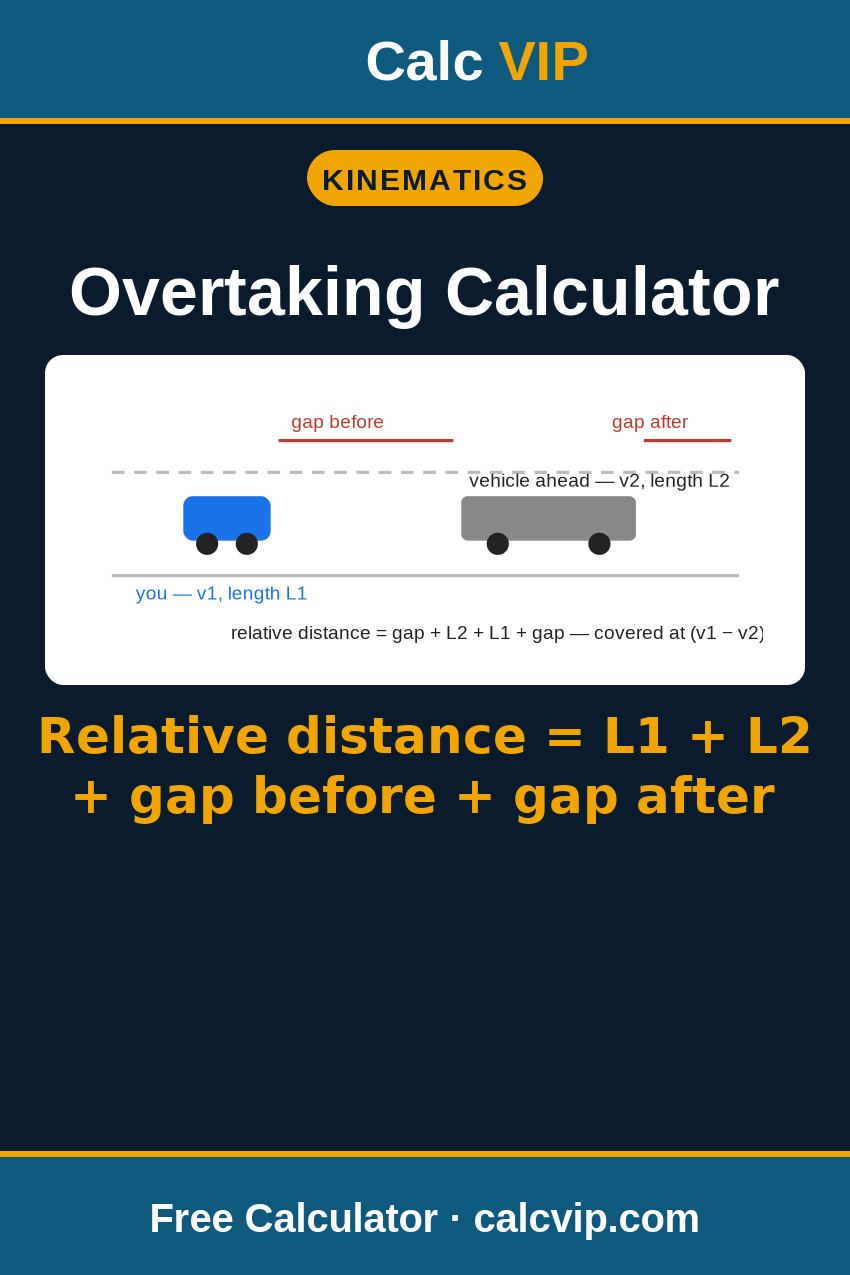
Notice, too, whose lengths matter. Beginners count only the vehicle ahead; the formula counts yours as well, because your rear bumper must clear their front bumper before you can pull back in. A long truck is therefore a double obstacle: it adds its own length to the pass, and it usually travels slowly enough to invite the pass in the first place. This calculator exists to put honest numbers on that invitation before you accept it.
Formula
Relative distance = L1 + L2 + gap before + gap after • Time = relative distance ÷ (v1 − v2) • Road used = v1 × time
Everything is relative motion. Sit mentally in the vehicle ahead and the world simplifies: it is stationary, and you approach it at (v1 − v2). You must gain on it by the full relative distance — your gap behind, its length, your length, and your gap in front — before the pass is complete. Divide that distance by the closing speed and you have the time; multiply the time by your true speed v1 and you recover how much actual road the manoeuvre eats, which is the number to compare with the clear stretch ahead. The calculator converts km/h to m/s (dividing by 3.6) before dividing, because lengths and gaps are in metres. Rearranged, the same relations answer design questions: to complete a pass of relative distance D within a time T, you need a speed advantage of at least D ÷ T.
| Symbol | Meaning | Units |
|---|---|---|
| v1 | your speed (the overtaker) | km/h |
| v2 | speed of the vehicle ahead | km/h |
| L1, L2 | lengths of your vehicle and the vehicle ahead | m |
| g1, g2 | safety gaps before pulling out and after pulling in | m |
| t | time spent completing the overtake | s |
Relative speed: the only speed that matters
Stand on the roadside and an overtake at 90 km/h past a truck at 60 km/h looks fast. Sit in the truck and the same event is a car creeping past at 30 km/h — the difference — taking a leisurely 3.18 s to gain 26.5 m. Both views are correct; only the second one predicts the duration. This is Galilean relativity doing everyday work: subtract the motion you share and the problem reduces to a slow vehicle passing a parked one. It also delivers the uncomfortable corollary — halve your speed advantage and you double your exposure, exactly, with no appeal. A driver who edges out at 5 km/h faster than a truck has chosen to spend some 19 seconds alongside and beyond it, whatever their speedometer says.
The same subtraction governs ships passing in channels, aircraft overtaking on airways (where closure rates decide separation rules), and cyclists filtering past buses. Anywhere one moving thing passes another, the difference of speeds is the clock, and the sum of lengths plus margins is the distance. Learn it once, on this page, and you own it everywhere.
How to use
- Enter your speed v1 and the speed of the vehicle ahead v2, both in km/h — v1 must be the larger, or no overtake is possible at constant speed.
- Enter both vehicle lengths in metres: roughly 4–5 m for a car, 10–12 m for a rigid truck, up to 18 m or more for an articulated lorry.
- Enter the gaps you intend to keep before pulling out and after pulling back in, in metres.
- Click "Calculate Overtake" to get the relative distance, the time the pass takes, and the road you will travel while completing it.
- On a two-way road, double the road figure and add a margin before comparing it with the clear road ahead — oncoming traffic is consuming the same road from the other end.
Worked examples
Example 1 — car passes truck. You travel at 90 km/h behind a truck doing 60 km/h: a speed difference of 30 km/h = 8.33 m/s. Your car is 4.5 m long, the truck 12 m, with 5 m gaps both sides: relative distance = 4.5 + 12 + 5 + 5 = 26.5 m. Time = 26.5 ÷ 8.33 = 3.18 s, and at 25 m/s you cover 25 × 3.18 = 79.5 m of road while passing.
Example 2 — the timid pass. Same vehicles, but you only manage 90 km/h against the truck's 80 — a 10 km/h advantage, 2.78 m/s. Time = 26.5 ÷ 2.78 = 9.54 s, and the road consumed balloons to 25 × 9.54 = 238.5 m. Triple the exposure for a pass that feels, from the driver's seat, only slightly more cautious.
Example 3 — the long lorry. At 100 km/h you pass an 18 m articulated lorry doing 70 km/h, keeping generous 8 m gaps: relative distance = 4.5 + 18 + 8 + 8 = 38.5 m; closing speed 30 km/h = 8.33 m/s; time = 38.5 ÷ 8.33 = 4.62 s; road used = 27.78 × 4.62 = 128.33 m. Length, not speed, did most of the damage here.
Example 4 — van passes lorry, slowly. A 6 m van at 85 km/h passes a 16.5 m lorry at 75 km/h with 10 m gaps: relative distance = 6 + 16.5 + 10 + 10 = 42.5 m at a closing speed of just 2.78 m/s: time = 15.3 s, road used = 23.61 × 15.3 = 361.25 m. A third of a kilometre on the wrong side of the road — a pass to decline unless the road ahead is visibly empty for far longer.
Example 5 — a motorcycle filters past. A motorcycle (2 m long) at 50 km/h passes a car (4.5 m) doing 30 km/h, keeping 3 m gaps: relative distance = 2 + 4.5 + 3 + 3 = 12.5 m, closing speed 20 km/h = 5.56 m/s. Time = 12.5 ÷ 5.56 = 2.25 s, road used = 13.89 × 2.25 = 31.25 m. Short vehicles and a healthy speed difference make for fleeting passes.
Example 6 — the oncoming half of the problem. Repeat Example 1 on a two-way road: your pass takes 3.18 s and 79.5 m. An oncoming car at 90 km/h covers 25 × 3.18 = 79.5 m in the same time. The road must therefore be clear for at least 79.5 + 79.5 = 159 m — plus a margin for the other driver's surprises — before the pass is even arithmetically possible.
Overtaking in real life
Road design. Highway engineers design overtaking sight distances from exactly this model: the road must offer a clear view long enough for the pass time at the design speed difference, plus the oncoming vehicle's travel, plus a margin. Where hills and bends cannot provide it, the double white line appears — the formula, painted.
"Two-second rule" gaps. Safety campaigns express gaps in time because a time gap scales itself with speed. At 90 km/h a 2-second gap is 50 m; at 60 km/h it is 33.33 m. Feed gaps like these into the calculator and watch the pass times grow — that growth is the honest price of the safer margin.
Truck platoons and convoys. When several long vehicles travel together, the relative distance for passing the whole platoon is the sum of every length and every internal gap — easily 80 m or more — which is why passing a convoy is a project, not a moment, and why drivers are taught to pass such groups only on multi-lane roads.
Cycling races. A rider attacking from a group is solving this problem with legs: the speed advantage over the peloton might be only 3–5 km/h, so gaining 30 m of clear road takes the better part of half a minute of maximum effort — the arithmetic behind why breakaways so often get reeled back in.
Railway passing loops. On single-track lines, a faster train "overtakes" at a loop where the slower one waits. The timetable is built from relative distances and speed differences exactly as on this page, with train lengths of hundreds of metres turning the gaps into minutes rather than seconds.
River and canal traffic. A barge overtaking another on a canal closes at perhaps 2 km/h — 0.56 m/s — so passing two 70 m hulls with margins can take several minutes and the better part of a kilometre of straight, wide water. Canal rules about where overtaking is permitted are this calculation, codified.
What the simple model leaves out
Real overtakes begin with acceleration, not a constant speed advantage. A driver who pulls out at the truck's speed and then accelerates spends the first seconds gaining little, and the true exposure is longer than this model says — treat the calculator's answer as a best case, a floor beneath the real time. Hills tilt the table too: a vehicle ahead slows on a climb (tempting you out) and speeds up on the descent (stranding you alongside). Wind, spray, a second vehicle hiding behind the first, and the simple fact that the other driver may speed up all stretch the manoeuvre further. The professional habit is to compute the ideal number here, then demand a generous multiple of it in visible clear road before committing — the model tells you the price; judgement decides whether to pay.
The gap is a time, not a distance
Notice that the gaps in this calculator are entered in metres, yet experienced drivers think of them in seconds — and the conversion between the two is quietly doing safety work. A 5 m gap at 30 km/h is a roomy 0.6 s of following time; the same 5 m at 100 km/h is a blink of 0.18 s, far inside any human reaction time. That is why fixed metre gaps feel generous in town and suicidal on a motorway, and why the two-second rule survives every attempt to replace it: it scales the gap with the speed automatically. When you use this calculator, it is worth entering time-based gaps — your speed in m/s multiplied by the seconds you want — rather than a fixed number of metres carried over from slower roads. The pass time will grow, honestly, and the road figure will tell you whether the manoeuvre still fits the road you can actually see.
Quick reference: time to gain 26.5 m at different speed advantages
| Speed advantage | In m/s | Time to complete the pass |
|---|---|---|
| 5 km/h | 1.39 | 19.08 s |
| 10 km/h | 2.78 | 9.54 s |
| 15 km/h | 4.17 | 6.36 s |
| 20 km/h | 5.56 | 4.77 s |
| 30 km/h | 8.33 | 3.18 s |
| 40 km/h | 11.11 | 2.39 s |
The pattern is pure inverse proportion: double the advantage, halve the time. There is no cleverness available — the only ways to shorten a pass are a bigger speed difference or a smaller relative distance, and of the two, only the speed difference is safely yours to choose.
Common mistakes
- Forgetting your own length. The pass ends when your rear clears their front. Omitting L1 shortens the computed time and can cut the pass dangerously fine.
- Dividing by your speed instead of the difference. Time = relative distance ÷ (v1 − v2). Dividing by v1 alone describes passing a parked vehicle and understates the time, often wildly.
- Mixing km/h with metres. The closing speed must be in m/s when the distance is in metres. The calculator converts for you; on paper, divide km/h by 3.6 first.
- Ignoring oncoming traffic in the road budget. The road you travel is only half the requirement on a two-way road; the oncoming vehicle consumes an equal share during your pass.
- Assuming the vehicle ahead keeps its speed. If it accelerates — up a hill's crest, or out of spite — your advantage shrinks mid-pass and every number on this page stretches. Build in margin.
FAQ
Why does a small speed difference make overtaking take so long?
Only the difference in speeds closes the gap. At just 10 km/h faster (2.78 m/s), the same 26.5 m would take about 9.5 s and roughly 240 m of road.
Does oncoming traffic matter?
Yes — on a two-way road you need the road to be clear for at least twice the distance you travel while overtaking, plus a safety margin, because an oncoming vehicle is closing in too.
What gaps are safe?
A common guide is at least a 2-second gap in good conditions. This calculator lets you test any gaps in metres to see how they change the time and distance.
Why must my speed be strictly greater than theirs?
If v1 equals v2, the closing speed is zero and the relative distance never shrinks — the formula divides by zero, which is arithmetic's way of saying "never". Any real pass needs a genuine advantage, or an acceleration phase this model does not include.
How long is a typical car and truck?
A family car is about 4.4–4.8 m; a large SUV approaches 5 m. Rigid trucks run 10–12 m, articulated lorries 16–18 m, and road trains in some countries exceed 25 m. When in doubt, overestimate — the error lands on the safe side.
Does the calculator work for overtaking two vehicles at once?
Yes — treat the pair as one long "vehicle": add both lengths and the gap between them into the relative distance. The same trick extends to a whole platoon, and the resulting times explain why such passes belong on dual carriageways.
What if I accelerate during the pass?
Then your average closing speed is higher than the initial difference and the pass is quicker than a constant-speed estimate made with the starting speeds — but slower than one made with the final speeds. This calculator's constant-speed answer, using your cruising pass speed, is the standard planning figure; keep a margin either way.
Why do racing cars "slipstream" before passing?
The vehicle ahead punches a hole in the air; tucked behind it, the follower needs less power to hold the same speed and can spend the surplus on a burst of extra speed at the moment of pulling out — manufacturing a bigger (v1 − v2) exactly when it matters.
Is it ever right to overtake with a tiny speed advantage?
On a multi-lane road with no oncoming traffic, a slow pass is merely tedious. On a two-way road, the exposure time is spent in the oncoming lane, and the table above shows what a 5 km/h advantage costs: over 19 seconds there. The arithmetic argues no.
How does this apply to boats and planes?
Identically, with their lengths and speeds: a ship overtaking in a channel and an aircraft overtaking on an airway both close at the difference of speeds across the sum of lengths plus regulated margins. Only the numbers — and the consequences — grow.