 Calc
Motion Time Calculator – Solve SUVAT s = ut + ½at² for Time
 Created by Sarah Mitchell · Physics Editor · Motion & Measurement · Last updated: November 2026
Use this free Motion Time Calculator to find how long an accelerating object takes to cover a given distance. Enter the displacement, the initial velocity and the acceleration, and the calculator solves the SUVAT equation s = ut + ½at² for time — and also shows the final velocity at that moment.
"How long will it take to get there?" is the most human question in mechanics, and for anything that speeds up or slows down on the way, it is also the trickiest of the basic questions to answer. You cannot simply divide distance by speed, because the speed keeps changing: the object covers the early metres slowly and the later metres quickly (or the reverse, when braking). The honest answer lives inside the equation s = ut + ½at², which says the displacement is built from two contributions — the distance the initial velocity alone would have covered, ut, plus the extra (or missing) distance the acceleration adds, ½at². Solving that equation for t means untangling a quadratic, which is exactly the work this calculator does for you.
The quadratic is the reason this page exists separately from the simpler velocity calculators. A quadratic equation has two roots, and the mathematics cheerfully offers both; physics accepts only the one that makes sense — a positive time, in a motion that can actually reach the stated displacement. Sometimes both roots are positive and both mean something, as when a braking car passes a point, stops, and (if the acceleration continued) would pass it again coming back. Sometimes the equation has no real root at all: ask how long a decelerating object takes to cover more distance than its stopping distance allows, and the correct answer is "it never gets there" — the calculator says so rather than inventing a number.
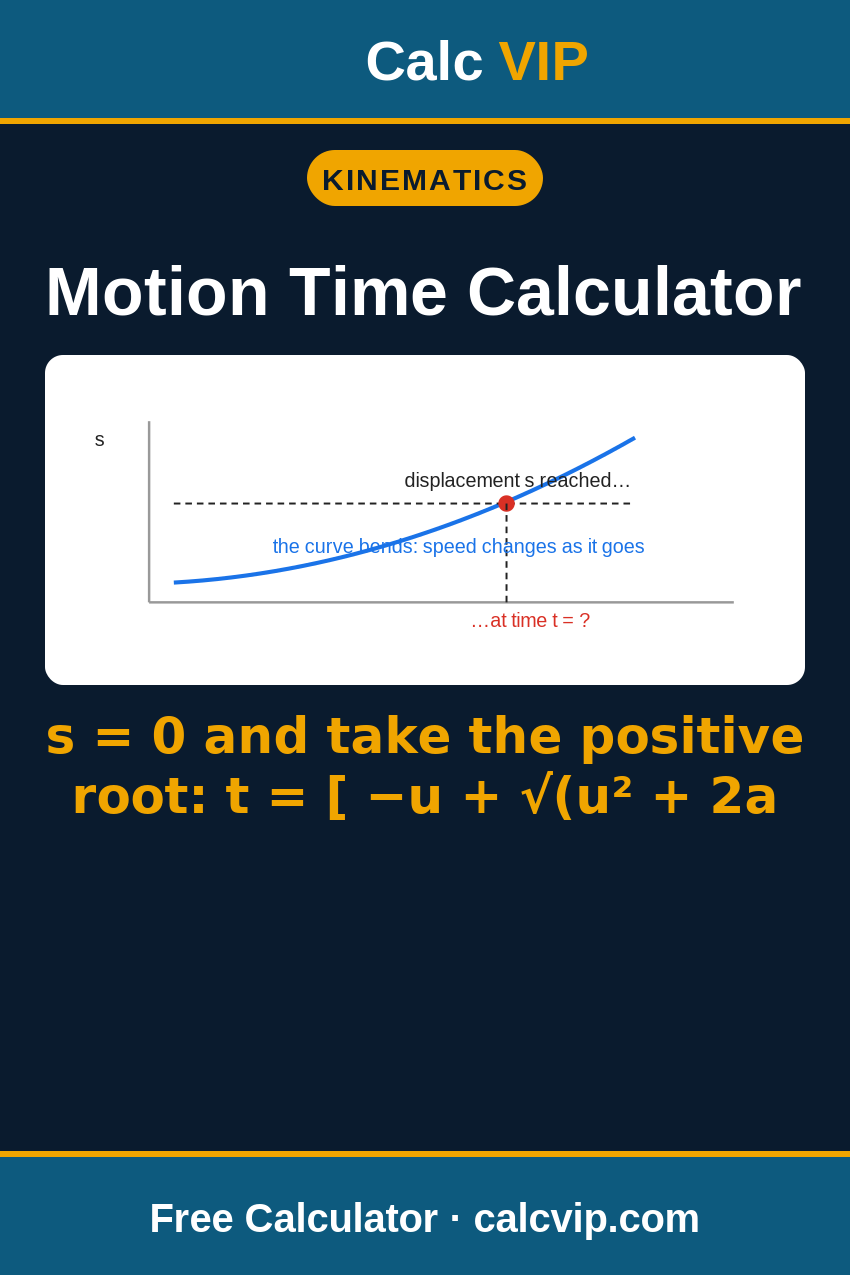
Enter the displacement s in metres, the initial velocity u in m/s and the acceleration a in m/s² (negative for braking), and the calculator returns the time taken and the final velocity v = u + at at that moment. It handles the special case a = 0 automatically, dropping back to t = s/u for steady motion. Below, the examples range from trolleys and trains to falling stones and braking cars, and the depth sections explain the two roots, the no-solution case, and how this equation partners with v² = u² + 2as.
Formula
s = ut + ½at² → solve the quadratic ½at² + ut − s = 0 and take the positive root:
t = [ −u + √(u² + 2as) ] / a (if a = 0, then t = s / u)
Look inside the root and you will find a familiar face: u² + 2as is exactly v² from the third equation of motion, so the formula can be read as t = (v − u)/a — "the time is the velocity change divided by the acceleration", which is the first equation of motion rearranged. The three equations are one story told three ways. The expression under the root (the discriminant) is also the calculator's gatekeeper: if u² + 2as is negative, no real time exists — the motion never reaches that displacement, typically because a braking object stops first. If a = 0 the quadratic term vanishes and time is the plain t = s/u of constant-speed motion. And if u = 0 (starting from rest) the formula simplifies to the memorable t = √(2s/a): time grows with the square root of distance, so quadrupling the distance only doubles the time.
| Symbol | Meaning | Units |
|---|---|---|
| s | displacement to be covered — the target distance along the motion | m |
| u | initial velocity at the moment timing starts | m/s |
| a | acceleration — constant; negative when braking | m/s² |
| t | time taken to reach displacement s (the answer) | s |
| v = u + at | final velocity at that moment — also reported | m/s |
| u² + 2as | the discriminant — must be ≥ 0 for the motion to be possible | m²/s² |
Two contributions to every displacement
The equation s = ut + ½at² rewards being read as a sum of two journeys happening at once. The first, ut, is the journey the object would have made had it simply kept its starting velocity — the "cruising" part. The second, ½at², is the correction the acceleration writes over time: it grows quadratically, negligible in the first instants and dominant later, which is why accelerating objects seem to loiter at the start of their motion and devour distance at the end. For a braking object the correction is negative: the car covers less than ut because every second it is slower than it was. When you solve for t you are asking when the sum of those two journeys reaches a prescribed total — and because the correction involves t², the question is unavoidably quadratic.
The factor ½ has a picture. Plot velocity against time for constant acceleration and the graph is a straight line rising from u; the displacement is the area beneath it, a rectangle (u × t) plus a triangle (½ × t × at). The ½ is the triangle's signature — the average of "no extra velocity yet" and "the full at gained by the end". This is also why average velocity over the interval is (u + v)/2: the line's midpoint height, and s = ((u+v)/2) × t is the same equation in disguise. Students who see the picture once rarely forget the ½ again.
Solving for time rather than distance reverses the usual direction of thought, and that reversal has practical teeth. Most real questions are deadline questions — when does the train reach the station, when does the stone hit the ground, when must the brakes bite — and they are all this equation. It is also the first place learners meet a quadratic doing honest physical work, complete with the adult responsibilities quadratics bring: choose the right root, and notice when there is no root to choose.
How to use
- Enter the displacement s in metres — the distance along the motion you want timed.
- Enter the initial velocity u in m/s (0 if starting from rest).
- Enter the acceleration a in m/s² — negative if the object is braking or otherwise decelerating.
- Click "Calculate Time" to get t, plus the final velocity v = u + at at that moment.
- If the calculator reports no solution, the motion never reaches that displacement — most often a braking object that stops first. Reduce s below the stopping distance u²/2|a| and a solution will exist.
Worked examples
Example 1 — the trolley. A trolley starts at u = 5 m/s, accelerates at a = 2 m/s² and covers s = 40 m. Solving t² + 5t − 40 = 0 gives t = (−5 + √185) ÷ 2 = (−5 + 13.60) ÷ 2 = 4.30 s, and its final velocity is v = 5 + (2 × 4.30) = 13.6 m/s.
Example 2 — from rest, the square-root law. A sledge starts from rest (u = 0) with a = 4 m/s² and must cover 100 m: t = √(2s/a) = √(200 ÷ 4) = √50 = 7.07 s, arriving at v = 4 × 7.07 = 28.28 m/s. Note the final velocity also equals √(2as) = √800 — the equations agree, as they must.
Example 3 — no acceleration at all. A conveyor-paced walker moves at a steady u = 15 m/s (a = 0) for 150 m: the quadratic vanishes and t = s/u = 150 ÷ 15 = 10 s, with v still 15 m/s. The calculator detects a = 0 and uses this simpler rule automatically.
Example 4 — a falling stone. A stone dropped from rest falls s = 45 m under a = 9.81 m/s²: t = √(2 × 45 ÷ 9.81) = √9.17 = 3.03 s, striking at v = 9.81 × 3.03 = 29.71 m/s (about 107 km/h). Three seconds and 45 metres is roughly a 15-storey drop — a useful calibration for how unforgiving falling is.
Example 5 — braking, and the two roots. A car at u = 25 m/s brakes at a = −5 m/s². When has it covered 60 m? The discriminant is 625 + 2 × (−5) × 60 = 25, so t = (−25 + 5) ÷ (−5) = 4.0 s, still moving at v = 25 − 20 = 5 m/s. The quadratic's other root, 6 s, is the moment the car would pass the 60 m mark again if it kept accelerating backwards after stopping at 5 s and 62.5 m — mathematics offering a second scene that real brakes decline to perform.
Example 6 — a train between markers. A train passes a marker at u = 10 m/s, accelerating at a = 1.2 m/s², and must cover 500 m: the discriminant is 100 + 1,200 = 1,300, so t = (−10 + √1,300) ÷ 1.2 = (−10 + 36.06) ÷ 1.2 = 21.71 s, by which time v = 36.06 m/s — notice v equals √1,300 exactly, the discriminant revealing itself as v².
Motion time in real life
Drag racing. A quarter-mile (402 m) dragster's elapsed time is this equation with an enormous a and u = 0 — though real cars vary their acceleration so much that crews integrate in slices, the constant-a estimate t = √(2s/a) is the paddock's first guess for any new setup.
Lift and escalator design. A lift accelerating at about 1 m/s² from rest needs t = √(2s/a) to reach a floor s metres up if it never cruises — for a 4 m floor, 2.83 s of pure acceleration phase, a number that shapes the motor programme before comfort limits trim it further.
Falling-object safety. Dropped-tool exclusion zones are sized from t = √(2h/g): a tool slipping from a 20 m scaffold reaches the ground in 2.02 s — less than anyone's reaction-plus-movement time, which is why the rule is prevention and helmets, not dodging.
Traffic-light spacing. Engineers timing a junction ask how long a vehicle accelerating from the stop line at ~2.5 m/s² takes to clear a 25 m box: t = √(50 ÷ 2.5) = √20 ≈ 4.47 s from rest — the amber phase and clearance intervals are built around such figures.
Ski jump and bobsleigh. The in-run of a ski jump is a timed acceleration down a slope: from rest at an effective 4 m/s² along a 90 m track, the jumper reaches the take-off in t = √(180 ÷ 4) ≈ 6.71 s — the few seconds in which the whole jump's speed is decided.
Spacecraft rendezvous. A chasing vehicle closing on a station with a small steady thrust solves this equation continuously: given the gap s and a braking acceleration, mission control needs the root that arrives with v ≈ 0 exactly at s — the two-root structure of the quadratic is a docking problem in disguise.
The no-solution case is an answer, not an error
When the discriminant u² + 2as turns negative, the quadratic has no real roots, and it is tempting to treat the calculator's refusal as a failure. It is the opposite: it is the mathematics detecting an impossible journey. A car braking at −5 m/s² from 25 m/s can cover at most u²/(2 × 5) = 62.5 m before stopping; asking for the time to cover 80 m is asking when it will reach a place it never reaches. The boundary case, discriminant exactly zero, is the stopping point itself — the two roots merge into the single moment t = −u/a = 5 s. Whenever a problem seems to break this calculator, check whether the requested displacement exceeds the stopping distance; nine times out of ten, that is the whole story, and it is a genuinely useful piece of physics to have learned.
Galileo's insight: falling time ignores mass
Set u = 0 and a = g and this calculator becomes Galileo's law of fall: t = √(2h/g), with no mass anywhere in it. A hammer and a feather dropped together on the Moon (Apollo 15, 1971) struck the dust simultaneously because the formula governing them contains nothing that could separate them — on Earth, air resistance does the separating, not gravity. The numbers are worth memorising as a scale of danger: a fall of 5 m takes 1.01 s, 20 m takes 2.02 s, 45 m takes 3.03 s and 80 m takes 4.04 s. Even the tallest of these gives a falling person barely four seconds — the square-root law compresses what intuition expects to be a long drama into a few heartbeats.
Quick reference: times from rest (u = 0)
| Distance | a = 2 m/s² | a = 5 m/s² | a = 9.81 m/s² (falling) |
|---|---|---|---|
| 10 m | 3.16 s | 2.00 s | 1.43 s |
| 25 m | 5.00 s | 3.16 s | 2.26 s |
| 50 m | 7.07 s | 4.47 s | 3.19 s |
| 100 m | 10.00 s | 6.32 s | 4.52 s |
Every entry is t = √(2s/a). Read across a row and the square-root law shows its character: multiplying the acceleration by five (2 → 10 would be needed for an exact halving pattern) does not divide the time by five. Doubling the distance multiplies the time by only √2 ≈ 1.41 — which is why the 100 m row is not double the 50 m row, in any column.
Common mistakes
- Dividing distance by the final velocity. t = s/v uses the speed at the end of the motion as if it had ruled throughout — for an accelerating object that underestimates the time badly. The correct average is (u + v)/2, and the quadratic handles it exactly.
- Taking the negative root. The quadratic formula's ± offers two times; the smaller or negative one is usually the artefact. If your answer is negative, you picked the wrong branch — this calculator selects the physical root for you.
- Forgetting the sign of a when braking. Enter a as a negative number for deceleration. With a positive sign the calculator happily times an object that speeds up — a different journey with a different (shorter) time.
- Using distance where displacement is needed. s in this equation is the displacement along the direction of motion. For straight-line motion without reversal they coincide; once an object turns back, only the net displacement belongs in the formula.
- Assuming no solution means wrong numbers. A negative discriminant is information: the object stops before reaching s. Recheck against the stopping distance u²/2|a| before blaming your arithmetic.
FAQ
Why does the equation give two answers for time?
The quadratic has two mathematical roots, but one is negative. Time cannot be negative, so this calculator always shows the positive root — the physically meaningful one.
What if the acceleration is zero?
Then the object moves at constant velocity and time is simply t = s / u. The calculator handles this case automatically.
What does SUVAT mean?
SUVAT is a nickname for the five motion variables: s (displacement), u (initial velocity), v (final velocity), a (acceleration) and t (time).
Can both roots ever be physically meaningful?
Yes. When an object passes a point, is turned around by the acceleration, and passes it again — a braking car that then rolls backwards, or a ball rising and falling past a window — the two roots are the two passing times. Example 5 shows the pattern.
How is this related to v = u + at?
Directly: the solution can be rewritten as t = (v − u)/a with v² = u² + 2as. This calculator reports that v as well, so you can watch the first equation of motion fall out of the second.
What if the object starts from rest?
Then u = 0 and the formula simplifies to t = √(2s/a). It is the fastest form to use for falls, launches from a standstill and vehicles pulling away.
Why does the time grow so slowly with distance?
Because of the square root: an accelerating object covers ground ever faster, so each additional metre costs less time than the one before. Four times the distance takes only twice the time.
Can I time a braking car with this?
Yes — enter a as a negative number. But keep s within the stopping distance; beyond it there is no solution, because the car has already stopped.
Does the mass of the object matter?
No. Like all the SUVAT equations, this one describes motion once the acceleration is known. Mass decides what force produces that acceleration, not how the motion unfolds.
What if acceleration changes during the motion?
Split the journey at each change: solve one interval, take its final velocity and position as the next interval's starting values, and add the times. The calculator handles one constant-a stretch at a time.