 Calc
Projectile Motion on Other Planets Calculator – Range, Height & Flight Time
 Created by Sarah Mitchell · Physics Editor · Motion & Measurement · Last updated: November 2026
Use this free Projectile on Other Planets Calculator to see how far a thrown or launched object would fly on worlds with different gravity. Enter the launch speed and angle, pick a planet — Earth, Moon, Mars or Jupiter — or type a custom gravity, and get the range, maximum height and flight time.
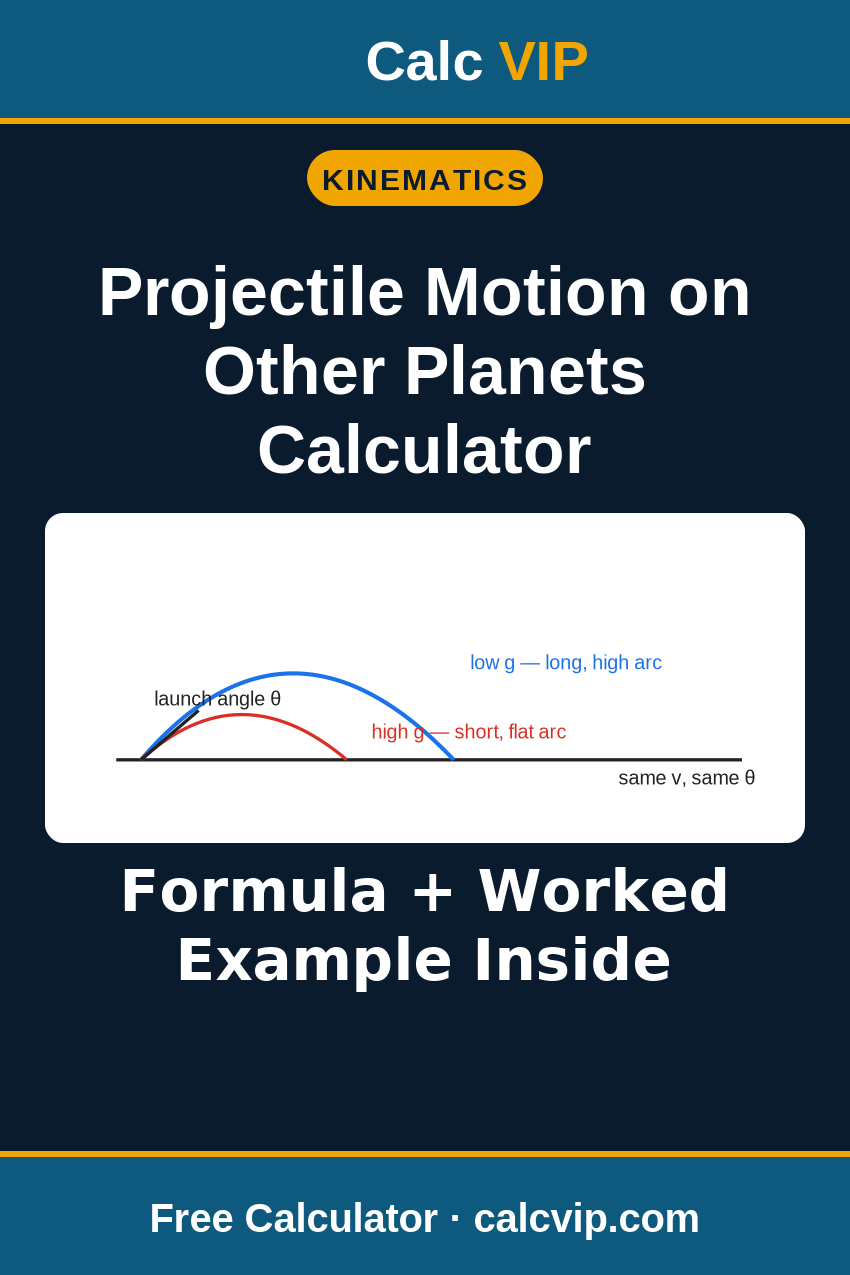
A projectile's flight is a negotiation between the launch you give it and the gravity that takes it away. On Earth we learn the negotiation by feel: a thrown ball's arc, a fountain's parabola, a long jumper's hang time. Change the planet and the same throw becomes unrecognisable — on the Moon it sails six times farther and hangs six times longer, while on Jupiter it is snatched down in a quarter of the Earth time. Nothing about the throw changed; only g did. This calculator runs the standard projectile equations with the gravity of Earth, the Moon, Mars or Jupiter — or any custom value — so you can watch one launch play out under four different skies.
The equations assume the clean, textbook world: no air resistance, launch and landing at the same height, and gravity constant over the flight. On the Moon and in the vacuum of space those assumptions are nearly exact, which is why lunar trajectories really are parabolas. On Earth they are an idealisation — a real baseball loses a noticeable share of its range to drag — but an honest one: the vacuum answer is the skeleton every real trajectory is a fleshing-out of, and it is exact about the thing this page studies, which is how the flight scales with g. Range, height and flight time all grow in simple inverse proportion to gravity. One number, g, rescales the whole show.
That rescaling has been lived, not just calculated. Apollo astronauts discovered that a casual lunar hop carries you startlingly far, that tools thrown in fun vanished over the horizon of a grey plain, and that the golf ball Alan Shepard struck on Apollo 14 flew — in his words — "miles and miles". The physics on this page is the physics they were feeling in their boots: at one sixth of Earth's gravity, every familiar throw is a record attempt.
Formula
For a launch speed v at angle θ in gravity g, with launch and landing at the same height and no air resistance:
Range R = v² × sin(2θ) ÷ g • Maximum height H = v² × sin²θ ÷ (2g) • Flight time T = 2 × v × sinθ ÷ g
Every result carries the same 1/g factor, which is the whole lesson of this calculator: halve the gravity and you double the range, double the height and double the hang time, all at once. Rearranged, the formulas answer design questions: the speed needed for a target range is v = √(R × g ÷ sin 2θ), and the gravity a flight implies is g = v² sin 2θ ÷ R — the trick used to weigh the gravity of worlds from the flight of thrown objects in lander footage. The angle enters through sin(2θ), which peaks at θ = 45°: on every planet in the list, 45 degrees is the range champion, because gravity rescales the flight but never reshapes the geometry.
| Symbol | Meaning | Units |
|---|---|---|
| v | launch speed | m/s |
| θ | launch angle above horizontal | degrees |
| g | surface gravity of the world | m/s² |
| R, H, T | range, maximum height, flight time | m, m, s |
Why the parabola never changes shape — only size
Split the launch into two independent motions and the whole topic opens up. Horizontally, nothing pushes or pulls (in vacuum), so the projectile cruises at the constant speed v cos θ. Vertically, gravity decelerates it at g until it stops, then accelerates it back down — a symmetric rise and fall lasting T = 2v sin θ ÷ g. The range is just horizontal speed multiplied by that time, and the height is where the vertical speed runs out. Because the two motions are independent, gravity's only job is to set the vertical clock; the horizontal motion simply runs for however long the clock allows. That is why everything scales as 1/g, and why the trajectory is always the same parabola, drawn bigger or smaller: change g and you stretch the film, you do not rewrite it.
Air resistance is the great reshaper the vacuum model omits, and its importance is itself a lesson in scaling. Drag grows with the square of speed and with the density of the air, and it bites hardest on light, fast, blunt objects. A 20 m/s throw on Earth — the speed used throughout this page's examples — loses only a few percent of its vacuum range for a dense ball, but a table-tennis ball at the same speed loses most of it. Mars, with air one percent as dense as Earth's, is nearly a vacuum for projectiles; Venus, with air ninety times denser at the surface, would strangle a throw within metres despite its Earth-like gravity. Gravity picks the size of the parabola; the atmosphere decides how much of it survives.
How to use
- Enter the launch speed in metres per second (a strong human throw is 20–30 m/s; a baseball pitch reaches 40 m/s).
- Enter the launch angle in degrees above horizontal — 45° gives the maximum range on every world.
- Choose a planet preset (Earth 9.81, Moon 1.62, Mars 3.71, Jupiter 24.79 m/s²) or pick Custom and type any gravity you like.
- Click "Calculate Flight" to see the range, maximum height and flight time for that world.
- Run the same launch on several worlds: the ratios between the answers are exactly the inverse ratios of the gravities.
Worked examples
Example 1 — the reference throw, on the Moon. v = 20 m/s at 45°, g = 1.62 m/s².
R = 400 × sin 90° ÷ 1.62 = 246.91 m; H = 400 × 0.5 ÷ (2 × 1.62) = 61.73 m; T = 2 × 20 × 0.7071 ÷ 1.62 = 17.46 s. A casual throw crosses two and a half football pitches and stays airborne longer than a coffee sip.
Example 2 — the identical throw on Earth. v = 20 m/s at 45°, g = 9.81 m/s².
R = 400 ÷ 9.81 = 40.77 m; H = 200 ÷ 19.62 = 10.19 m; T = 28.28 ÷ 9.81 = 2.88 s. Compare with Example 1: every figure is smaller by the factor 9.81 ÷ 1.62 = 6.06 — the gravity ratio, exactly as promised.
Example 3 — the same throw on Mars. v = 20 m/s at 45°, g = 3.71 m/s².
R = 400 ÷ 3.71 = 107.82 m; H = 200 ÷ 7.42 = 26.95 m; T = 28.28 ÷ 3.71 = 7.62 s. Mars sits between the two: a throw there is a strong highlight on Earth and a warm-up toss on the Moon.
Example 4 — the same throw on Jupiter. v = 20 m/s at 45°, g = 24.79 m/s².
R = 400 ÷ 24.79 = 16.14 m; H = 200 ÷ 49.58 = 4.03 m; T = 28.28 ÷ 24.79 = 1.14 s. Jupiter's gravity is a thief: it steals the flight before it has begun. (No solid surface exists to stand on — this is a thought experiment in a very deep gravity well.)
Example 5 — a harder, higher launch on Mars. v = 30 m/s at 60°, g = 3.71 m/s².
R = 900 × sin 120° ÷ 3.71 = 210.09 m; H = 900 × 0.75 ÷ 7.42 = 90.97 m; T = 2 × 30 × 0.866 ÷ 3.71 = 14.01 s. The steeper angle trades range for height — sin 120° (0.866) is less than sin 90° (1) — on every planet alike.
Example 6 — a gentle Earth throw. v = 15 m/s at 30°, g = 9.81 m/s².
R = 225 × sin 60° ÷ 9.81 = 19.86 m; H = 225 × 0.25 ÷ 19.62 = 2.87 m; T = 2 × 15 × 0.5 ÷ 9.81 = 1.53 s. Run it on the Moon (divide g by 6.06) and the same gentle toss flies 120 m — the reason lunar astronauts learned to throw like they were lobbing grenades at distant targets, gently.
Projectile physics in real life
Apollo surface work. Astronauts' tool tosses, core-tube throws and Shepard's golf shots all followed lunar parabolas. Mission planners used exactly these equations — with g = 1.62 — to predict where discarded equipment would land and to set safe distances for the lunar module's ascent-engine blast zone.
Olympic throwing events. Shot, discus, javelin and hammer all peak near 45° in vacuum — but release height and aerodynamics pull real optima down to 38–42°. Coaches use the vacuum model as the baseline and the deviation as the coaching target.
Artillery and ballistics. Gunnery is projectile physics with consequences: range tables are the R formula corrected for drag, wind and the Earth's rotation. The 1/g scaling explains why the same gun, fired on a high plateau (marginally lower g), shoots a shade farther.
Volcanic bombs. Volcanologists read eruption violence from where volcanic bombs land: measure the range, estimate the angle, invert the formula, and you have the ejection speed — routinely hundreds of metres per second — of a young eruption.
Water fountains and firefighting. A fountain jet is a continuous projectile; its reach is set by pump pressure (speed) and nozzle angle through the same equations. Fire crews judge hose angles the same way, trading range against the height needed to clear a roofline.
Planetary defence and landers. Sample-return capsules, lander hops (like the Ingenuity helicopter's ballistic descents) and impactor missions all plan trajectories in gravities no human has stood in. The calculator's custom-g slot is where such planning starts.
Complementary angles and the 45° rule
Because range depends on sin(2θ), two angles symmetric about 45° — 30° and 60°, or 20° and 70° — produce identical ranges, arriving by completely different journeys: the flat one fast and low, the steep one slow and towering, with the steep one's flight time longer by the ratio of sin θ values. The identity holds on every world, because g cancels out of the comparison entirely. It is more than a curiosity: a mortar crew choosing between a flat and a plunging trajectory over an obstacle, or a basketball player choosing arc over line-drive, is spending this identity. The 45° maximum itself deserves its fame — sin(2θ) peaks at exactly 1 when 2θ = 90° — but real athletes launch from above ground level and land below their release, which tilts the true optimum a few degrees lower; spacecraft and artillery, launching and landing at one level in thin air, come closest to the textbook's promise.
When the throw never lands: escape velocity
Push the launch speed far enough and the parabola quietly stops being the right picture. The formulas on this page assume a flat world with gravity pulling in one fixed direction; over hundreds of kilometres the planet's curvature matters, and past a threshold speed the projectile never returns at all — it has reached escape velocity. On the Moon that threshold is only 2,375 m/s, roughly 119 of this page's 20 m/s throws stacked together; on Earth it is 11,186 m/s. Between the two regimes sits the artilleryman's world and the orbital one: Newton's own cannonball diagram, in which a projectile fired ever faster from a mountaintop falls ever farther around the curve of the Earth until its fall becomes a permanent orbit. Every row of the quick-reference table above is the slow, flat-world end of that single continuous story.
Quick reference: one throw, five worlds
| World (g) | Range | Height | Flight time |
|---|---|---|---|
| Moon (1.62 m/s²) | 246.91 m | 61.73 m | 17.46 s |
| Mars (3.71 m/s²) | 107.82 m | 26.95 m | 7.62 s |
| Earth (9.81 m/s²) | 40.77 m | 10.19 m | 2.88 s |
| Jupiter (24.79 m/s²) | 16.14 m | 4.03 m | 1.14 s |
All rows are the same 20 m/s throw at 45°. Divide any row by another and the gravity ratio falls out — the table is the 1/g law wearing numbers.
Common mistakes
- Expecting the mass to matter. In vacuum it does not: a hammer and a feather follow the same parabola at the same launch — demonstrated on the Moon by Apollo 15's famous hammer-feather drop. Mass enters only through air resistance.
- Using degrees in a radians calculator (or the reverse). sin(2θ) is merciless about angle units. This page takes degrees; a spreadsheet's SIN takes radians — mixing them produces ranges that are wrong by wild factors.
- Forgetting the same-height assumption. The formulas assume landing at launch height. Throw from a cliff or a balcony and the true range is longer; the equations need the extended form with a height term.
- Applying Earth drag intuition to the Moon. There is no air on the Moon, so the vacuum answers there are the real answers. On Earth they are upper bounds — real ranges fall short, especially for light or blunt projectiles.
- Believing a steeper angle always flies farther. Past 45°, extra angle buys height at the price of range. The range champion is exactly 45° on every planet — gravity rescales the contest but never changes the winner.
FAQ
Why is 45° the best angle?
Range is proportional to sin(2θ), which peaks at θ = 45° when launch and landing heights are equal. On the Moon there is no air, so 45° really is optimal; on Earth, drag makes a slightly lower angle better for fast projectiles.
Does the mass of the projectile matter?
No — in these formulas mass cancels out, so a hammer and a feather launched at the same speed and angle follow the same path in a vacuum. Apollo 15 astronaut David Scott famously demonstrated this on the Moon in 1971.
What gravity should I use for an asteroid or a space station?
Choose "Custom" and enter any g you like — for example 0.001 m/s² for a small asteroid. On a space station in free fall the effective g is ~0, so a "projectile" simply travels in a straight line and never lands.
Why is 45 degrees always the best angle for range?
Because range is proportional to sin(2θ), and sin peaks at 90° — that is, at θ = 45°. Gravity appears only as the 1/g scaling factor, so it changes how far the best throw goes, never which angle is best.
How far could an astronaut throw a ball on the Moon?
A strong 30 m/s throw at 45° would fly 900 ÷ 1.62 ≈ 556 m in vacuum — over half a kilometre — and stay up for about 26 seconds. Spacesuit stiffness cuts real throws well below that, but even a gentle lunar toss outranges an Earth throw several times over.
Does the projectile's mass change the answer?
Not in this model, and not in vacuum at all: the equations contain v, θ and g only. Mass matters only when air resistance enters, because drag decelerates light objects more than heavy ones.
What gravity should I use for an asteroid?
Tiny ones: a kilometre-wide asteroid's surface gravity is around 0.0003 m/s². Enter it as a custom g — but beware: at such gravities a firm throw exceeds escape velocity, and the "projectile" never lands at all.
Why is Jupiter in the list if nobody can stand on it?
As a limiting case. Its 24.79 m/s² shows what strong gravity does to the same launch, and the number is real — it is the gravity a probe feels in Jupiter's cloud tops, where its trajectory bends exactly this hard.
How accurate are these results on Earth?
For dense, slow projectiles (a shot put, a stone) within a few percent. For fast or light ones (a shuttlecock, a table-tennis ball) drag dominates and real ranges can be half the vacuum figure or less. Treat Earth results as the ideal the real flight falls short of.
Can I find the launch speed from a known range?
Yes — rearrange: v = √(R × g ÷ sin 2θ). A volcanic bomb found 246.91 m from its vent, assumed launched at 45° on Earth-like gravity, implies v = √(246.91 × 9.81) ≈ 49.2 m/s. Volcanologists run this inversion routinely.