 Calc
Snell's Law Calculator – Refraction Angle n₁ sinθ₁ = n₂ sinθ₂
 Created by Rachel Novak · Senior Editor · All Topics · Last updated: November 2026
Use this free Snell's Law Calculator to find the angle at which light bends (refracts) when it passes from one material into another — for example, from air into glass or water.
Refraction is the most familiar strange effect in physics. A drinking straw in a glass of water looks broken at the surface; a swimming pool is always deeper than it looks; a spoon in a teacup appears to bend. In every case the culprit is the same: light changes speed when it crosses from one material into another, and when it crosses at an angle, the change of speed swings its direction. Snell's law is the exact rule for that swing — given the two materials and the incoming angle, it hands you the outgoing angle, and it has been getting the answer right for four hundred years.
The materials enter the law through their refractive indices. The index n of a material is simply the factor by which it slows light: n = c/v, the speed of light in vacuum divided by its speed in the material. Air barely slows light at all (n = 1.00), water slows it to three-quarters speed (n = 1.33, so v = 2.25 × 10⁸ m/s), ordinary glass to two-thirds (n = 1.50, v = 2.00 × 10⁸ m/s), and diamond to well under half (n = 2.42). Bigger index, slower light, stronger bending — the whole of lens design, fibre optics and gem cutting is the art of arranging these slowdowns.
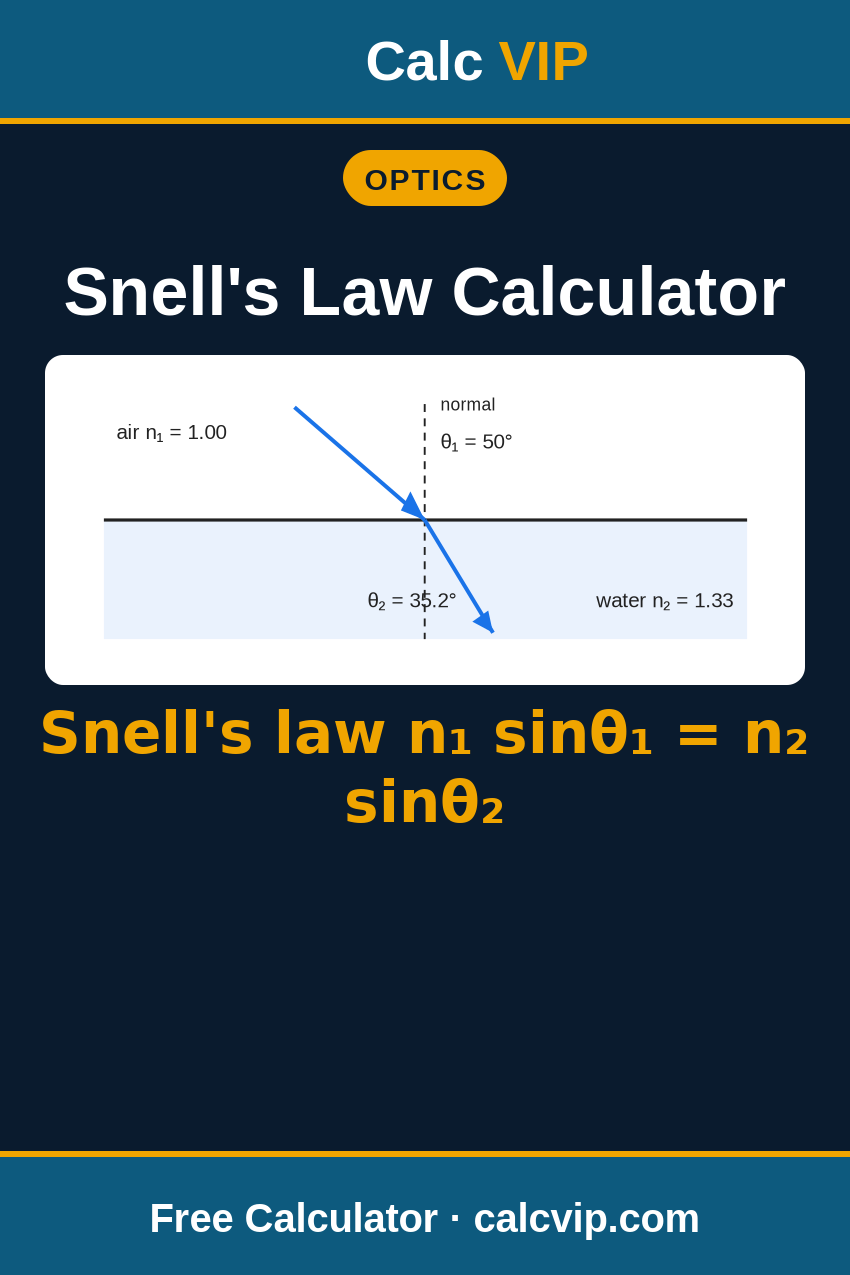
Two features of the law deserve emphasis before you calculate. First, both angles are measured from the normal — the line at right angles to the surface — never from the surface itself; half of all student errors are born right there. Second, the law is perfectly reversible: a ray's path through any stack of materials can be traced backwards along exactly the same line, which is why you can see a fish that can also see you. This calculator applies the law at a single boundary, in either direction, and warns you when no refracted ray exists at all — the total internal reflection case.
Formula
Snell's law n₁ sinθ₁ = n₂ sinθ₂, so θ₂ = sin−1(n₁ sinθ₁ / n₂) • both angles are measured from the normal (the dashed line at 90° to the surface)
Common refractive indices: air 1.00, water 1.33, glass 1.50, diamond 2.42.
The law rearranges for every unknown. Finding the second material from a measured bend: n₂ = n₁ sinθ₁ / sinθ₂ — light entering an unknown liquid from air at 50° and bending to 35.2° gives n₂ = 1.00 × 0.7660 ÷ 0.5759 = 1.33, so the liquid is water. Finding the incidence angle that produces a wanted refraction: θ₁ = sin−1(n₂ sinθ₂ / n₁). There is also a speed form of the law, sinθ₁ / sinθ₂ = v₁ / v₂, which exposes what the indices are bookkeeping: the ray bends so that the ratio of the sines matches the ratio of the speeds. And because frequency never changes at a boundary, the wavelength must absorb the speed change instead: λ₂ = λ₁ × (n₁ / n₂) — green light of 530 nm in air has a wavelength of 530 × (1.00 ÷ 1.33) ≈ 398 nm inside water, while remaining exactly the same green.
| Symbol | Meaning | Units |
|---|---|---|
| n₁, n₂ | refractive indices of the first and second materials | none (ratios) |
| θ₁ | angle of incidence, from the normal | degrees (°) |
| θ₂ | angle of refraction, from the normal | degrees (°) |
| v₁, v₂ | speed of light in each material, v = c / n | m/s |
Why the ray bends: the wavefront picture
Pictures of single rays can make refraction look arbitrary, so picture a wave instead: a train of parallel wavefronts, like lines of marching soldiers, advancing towards the boundary at an angle. As each line reaches the surface, its lower end crosses into the slower material first and is forced to slow down, while the upper end is still marching at full speed in the fast material. The line therefore pivots — its slow end lags, its fast end swings forward — and by the time the whole front has crossed, it is travelling in a new direction, closer to the normal. Entering a faster material reverses the pivot and the ray bends away from the normal. The soldiers do not aim anywhere; the bending is pure bookkeeping of speeds, and Snell's law is that bookkeeping written exactly.
Two consequences of this picture are worth keeping. First, a ray arriving along the normal (θ₁ = 0°) does not bend at all: the whole wavefront slows simultaneously, so there is no pivot — the ray continues straight, merely slower, which is why looking straight down into water shows objects where they truly are (though still raised, as the apparent-depth section explains). Second, the wavefronts themselves are closer together in the slow material, because each front has less time to advance before the next is emitted: the wavelength shrinks by the factor n₁/n₂ while the frequency — the rate at which fronts pass — stays fixed by the source. Refraction is thus a change of speed and wavelength wearing the disguise of a change of direction.
How to use
- Enter the refractive index of the material the light starts in (n₁).
- Enter the angle of incidence θ₁ in degrees, measured from the normal.
- Enter the refractive index of the material the light enters (n₂), then click "Calculate Refraction Angle".
- If the calculator reports total internal reflection instead of an angle, your ray (going from denser to less dense) has struck above the critical angle — no refracted ray exists at that incidence.
Worked examples
Example 1 — air into glass. Light travels from air (n₁ = 1.00) into glass (n₂ = 1.50) at an incidence angle of 45°.
sinθ₂ = (1.00 × sin 45°) ÷ 1.50 = 0.7071 ÷ 1.50 = 0.4714
θ₂ = sin−1(0.4714) = 28.13° — the ray bends towards the normal in the denser material.
Example 2 — air into water, steeper. At θ₁ = 60° into water (n₂ = 1.33): sinθ₂ = sin60° ÷ 1.33 = 0.8660 ÷ 1.33 = 0.6511, so θ₂ = sin−1(0.6511) = 40.63°. Note how the bend grows with the incidence angle: in Example 1 the ray bent by 45 − 28.13 = 16.87°, while here it bends by 60 − 40.63 = 19.37° — which is why low sun over water throws such long, stretched reflections.
Example 3 — glass into air. The same boundary crossed the other way, at θ₁ = 30° inside glass: sinθ₂ = 1.50 × sin30° ÷ 1.00 = 1.50 × 0.5 = 0.75, so θ₂ = sin−1(0.75) = 48.59° — bending away from the normal now, and by more than the incoming angle, because the ray is speeding up.
Example 4 — when there is no answer. Inside glass at θ₁ = 45°: sinθ₂ would need to be 1.50 × sin45° = 1.50 × 0.7071 = 1.0607 — greater than 1, which no angle has. The calculator therefore reports total internal reflection: 45° exceeds glass's critical angle of 41.81°, so the ray reflects inside instead. Snell's law contains its own breaking point, and this is it.
Example 5 — water into glass. Refraction does not need air to be involved. Light underwater (n₁ = 1.33) entering a glass porthole (n₂ = 1.50) at 40°: sinθ₂ = 1.33 × sin40° ÷ 1.50 = 1.33 × 0.6428 ÷ 1.50 = 0.5700, so θ₂ = sin−1(0.5700) = 34.75° — towards the normal again, because the light is slowing further. Divers' masks and submarine windows are designed with exactly this double refraction in mind.
Snell's law in real life
Pools, ponds and apparent depth. Light from the bottom of a pool bends away from the normal as it leaves the water, so your eye traces it back to a shallower position than the truth: apparent depth = real depth ÷ n. A pool 2 m deep looks 2 ÷ 1.33 = 1.50 m deep — the reason diving into "shallow-looking" water is dangerous and why lifeguards are trained to distrust their eyes.
Spearfishing and herons. A fish seen from the bank is not where it appears: its image is raised and shifted. Experienced spearfishers aim below the apparent fish; herons, stabbing from above, have the correction built into instinct and strike rate alike.
Every lens you own. A lens is two Snell's-law boundaries back to back. Lens designers choose glass indices and surface curvatures so that the two bendings conspire to focus light — the calculator's single boundary, doubled and aimed.
Mirages. On a hot road, air near the tarmac is warmer and slightly less dense, with a slightly lower n. Sky light passing down through the gradient bends continuously, curving back up into the driver's eye — arriving as if reflected from a wet surface. It is refraction in a smoothly varying index rather than at a sharp boundary.
Rainbows and prisms. Because n depends slightly on colour (dispersion), Snell's law bends blue light a touch more than red at every boundary. A raindrop bends sunlight twice with refraction and once with internal reflection, fanning the colours into the rainbow's arc; a prism does the same on a laboratory bench.
Fibre optics. A fibre guides light by total internal reflection, but Snell's law governs the front door: the angle at which light may enter the fibre's end and still strike the walls above the critical angle defines the fibre's acceptance cone — miss it, and the light refracts out of the walls and is lost.
Quick reference: refractive indices and light speeds
| Material | n | Speed of light in it |
|---|---|---|
| vacuum | 1.0000 | 3.00 × 10⁸ m/s |
| air (sea level) | 1.0003 | 3.00 × 10⁸ m/s |
| ice | 1.31 | 2.29 × 10⁸ m/s |
| water | 1.33 | 2.25 × 10⁸ m/s |
| crown glass | 1.52 | 1.97 × 10⁸ m/s |
| flint glass | 1.62 | 1.85 × 10⁸ m/s |
| sapphire | 1.77 | 1.69 × 10⁸ m/s |
| diamond | 2.42 | 1.24 × 10⁸ m/s |
The speed column is the physical story behind the index column: Snell's law is what happens when a wave must reconcile a new speed with an unbroken wavefront. Where the speed changes little — air to ice-cold air layers, say — the bending is gentle; where it halves, as into diamond, the bending is dramatic.
Through a window pane: the parallel slab
Most real refraction involves two boundaries, and the commonest case is a parallel-sided slab — a window pane, a microscope slide, a sheet of ice. Apply Snell's law at the first face and the ray bends towards the normal (45° becomes 28.13° entering glass, as in Example 1). At the second face the geometry is mirrored: the ray, now inside glass at 28.13°, bends away from the normal on leaving — and because the faces are parallel, the two bendings exactly cancel, so the ray emerges at precisely its original 45°. It does not emerge on its original line, however: it is shifted sideways, by an amount that grows with the slab's thickness and the incidence angle. Through a 10 mm glass slab at 45°, the sideways (lateral) displacement is about 3.3 mm — small, but enough that precision optical instruments account for every window and filter the light passes through, and enough to see if you sight along a thick glass block at a printed page: the text steps sideways at the block's edge, twice-bent but never re-angled.
The fibre acceptance cone mentioned above can be put in numbers. For a core of n = 1.48 with cladding of n = 1.46, the numerical aperture — the sine of the widest entry angle that still traps the light — is NA = √(ncore² − nclad²) = √(1.48² − 1.46²) = √0.0588 = 0.2425, so the acceptance half-angle is sin−1(0.2425) = 14.03°. Light arriving within about 14° of the fibre's axis is captured and guided; light arriving more steeply refracts through the walls and is lost within centimetres. Two applications of Snell's law — one at the end face, one at the wall — decide the fate of every photon a fibre carries.
Common mistakes
- Measuring angles from the surface. A ray grazing along at 10° above the surface is at 80° to the normal. Feeding 10° into the formula answers a different question entirely.
- Swapping n₁ and n₂. The first material is the one the light is in now. Swapping them predicts bending the wrong way — towards the normal when it should be away.
- Expecting bending at normal incidence. At θ₁ = 0° the answer is θ₂ = 0°, always. Light slows down but goes straight; diagrams that show a bend at 0° are wrong.
- Leaving the calculator in radians. sin−1 on many calculators returns radians. This page works in degrees throughout; if you check by hand, confirm your calculator's mode — 0.49 rad and 28.13° are the same answer in different clothes.
- Trusting a refraction answer past the critical angle. If n₁ sinθ₁ / n₂ exceeds 1, no refracted ray exists. Any "angle" computed by forcing the maths is fiction — the light has reflected instead.
FAQ
Why does light bend when it enters glass or water?
Light travels more slowly in denser materials. When it hits the boundary at an angle, one side of the wavefront slows down first, which swings the whole ray around — like a car veering when one wheel hits mud.
Which way does the ray bend?
Going into a denser material (bigger n), light bends towards the normal, so θ₂ < θ₁. Coming out into a less dense material, it bends away from the normal.
What if no refraction angle exists?
If light tries to leave a denser material at too steep an angle, n₁ sinθ₁ / n₂ is bigger than 1 and there is no refracted ray — the light reflects back inside instead. This is total internal reflection, and this calculator will tell you when it happens.
Does the frequency of the light change at the boundary?
No. The source sets the frequency and the boundary cannot create or destroy wavefronts, so the frequency — and therefore the colour — is unchanged. What changes are the speed and the wavelength, which shrink together by the factor n₁/n₂.
Why does a straw look bent in a glass of water?
Light from the submerged part of the straw bends away from the normal as it leaves the water, so your eye — which assumes light travels straight — places the straw's underwater section higher and shifted from its true position. The straw is straight; the image of it is not.
What exactly is refractive index?
It is the ratio n = c/v: how many times slower light travels in the material than in a vacuum. It is measured by exactly the bending on this page — refractometers are Snell's-law instruments — and it depends slightly on colour and temperature.
Does Snell's law work for sound?
Yes — refraction belongs to all waves. Sound bends at layers of warm and cool air (which is why distant sounds carry oddly on still evenings) and at temperature layers in the ocean, a fact sonar operators and whales both exploit. The same sine law applies, with the speeds of sound in each layer in place of the indices.
Why do diamonds throw coloured flashes?
Dispersion: diamond's index is unusually high and varies noticeably with colour, so white light entering a facet is fanned into its spectrum, then total internal reflection delivers the separated colours to your eye. Glass, with weaker dispersion, sparkles white; diamond sparkles in colour.
Can the refraction angle ever be bigger than 90°?
No. θ₂ = 90° is the limiting case where the refracted ray skims along the surface, reached when the incidence angle equals the critical angle. Beyond that incidence there is no refracted ray at all — only reflection.
How was Snell's law discovered?
The sine relationship was found experimentally by Willebrord Snellius around 1621 (and independently described by Descartes), centuries before anyone knew light had a speed that changes between materials. That the law fell out of careful angle measurements first — and was explained by wave speeds later — makes it a model of how physics often proceeds.