 Calc
Snell's Law Solver – Find the Refraction Angle θ₂ or Refractive Index n₂
 Created by Rachel Novak · Senior Editor · All Topics · Last updated: November 2026
Use this free Snell's Law Solver to rearrange n₁ sinθ₁ = n₂ sinθ₂ either way. Find the refraction angle θ₂ when you know both refractive indices, or work backwards from a measured angle to find the unknown refractive index n₂ of a material.
Refraction is light changing its mind about direction at a border. Cross from one transparent material into another and the ray bends — towards the normal entering a denser medium, away from it entering a rarer one — by an amount that Willebrord Snell captured in 1621 with one elegant product: n₁ sinθ₁ = n₂ sinθ₂. The refractive index n of each material measures how much it slows light (n = c/v), and the law says the quantity n sinθ is conserved across the boundary. Four variables, one equation: know any three and the fourth — an angle or an index — is yours. That is the whole of this calculator, and a surprising fraction of all optical engineering.
The two modes correspond to the two lives the law leads. In its forward life it is a design tool: given glass of known index, predict where every ray goes — the daily arithmetic of lens design, prism spectrometers and fibre optics. In its backward life it is a measuring instrument: shine light at a known angle, measure the bend, and solve for n₂ — the refractometer principle by which gemmologists identify stones, brewers measure sugar, and laboratories fingerprint unknown liquids. Same equation, opposite unknowns; this solver is built to run in both directions, including the honest failure case where no refracted ray exists at all.
That failure case — total internal reflection — deserves its place in the introduction because Snell's law predicts it rather than merely permitting it. Travelling from dense to rare, θ₂ grows faster than θ₁; the formula eventually demands sinθ₂ > 1, which no angle can supply. Nature's resolution is that the ray does not refract at all: it reflects, perfectly, back into the first material. The calculator reports this plainly instead of inventing an angle, because in fibre optics, endoscopes and diamond cutting that "failure" is the entire technology.
Formula
n₁ sinθ₁ = n₂ sinθ₂ • solving for the angle: θ₂ = sin−1(n₁ sinθ₁ / n₂) • solving for the index: n₂ = n₁ sinθ₁ / sinθ₂ • index itself: n = c / v
All angles are measured from the normal (the line perpendicular to the surface), not from the surface itself. Light entering a denser material (bigger n) bends towards the normal, so θ₂ < θ₁; light entering a rarer material bends away, and past the critical angle it cannot escape at all — total internal reflection. Two useful corollaries live inside the same formula: at normal incidence (θ₁ = 0) there is no bend at any index, θ₂ = 0; and the path is reversible — swap the two materials and angles and the same equation describes the ray returning along its own track, the principle that lets you solve for an index from either side of a sample.
| Symbol | Meaning | Units |
|---|---|---|
| n₁, n₂ | refractive indices of the first and second materials | no units; vacuum = 1, air ≈ 1.00 |
| θ₁ | angle of incidence, from the normal | degrees (0–90) |
| θ₂ | angle of refraction, from the normal | degrees (0–90) |
| c, v | speed of light in vacuum and in the material | m/s; n = c/v |
Why light bends: the speed changes
Snell's law looks like a rule about angles, but its cause is a rule about speeds. A wavefront crossing a boundary at an angle cannot keep its direction when one side of it slows down before the other — exactly as a marching band wheeling across the edge of a muddy field slews round when the front rank slows first. In the denser material light travels at v = c/n: 2.26 × 10⁸ m/s in water, 1.97 × 10⁸ m/s in crown glass. The sine ratio in Snell's law is precisely the bookkeeping that keeps the wavefronts continuous across the boundary while the speed changes underneath them. Bending is not something light does at surfaces; it is what a speed change looks like from the side.
Huygens' wavelet picture makes the same point constructively, and Fermat's principle of least time makes it inevitable: of all paths from a point in one medium to a point in the other, light takes the fastest — and the fastest path, trading a longer route through the fast medium against a shorter one through the slow, is exactly the Snell path. Three centuries of optics have not improved on the statement; they have only explained it three different ways, each deeper than the last.
How to use
- Choose whether to find the refraction angle θ₂ or the unknown index n₂ — the input you don't need disappears.
- Enter n₁, the incidence angle θ₁ (measured from the normal), and the remaining value.
- Click "Solve Snell's Law". If the light physically cannot refract (total internal reflection), the calculator says so instead of inventing an angle.
- If your problem gives the angle from the surface rather than the normal, subtract it from 90° first — every angle in this law is a normal angle.
Worked examples
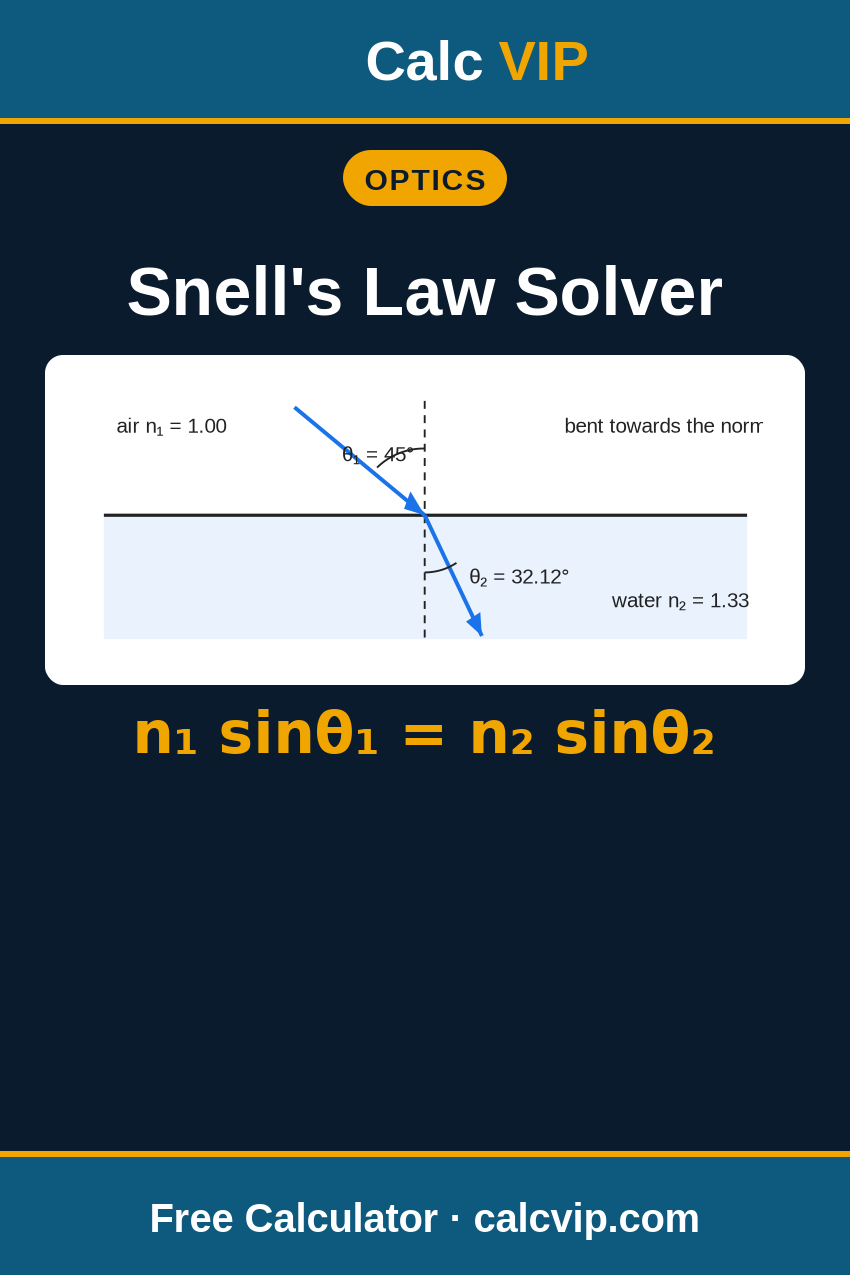
Example 1 — air into water. Light in air (n₁ = 1.00) hits water (n₂ = 1.33) at θ₁ = 45°.
sinθ₂ = (1.00 × sin45°) ÷ 1.33 = 0.7071 ÷ 1.33 = 0.5317, so θ₂ = 32.12° — the ray bends towards the normal in the denser water.
Run backwards with the measured θ₂ = 32.12° and you recover n₂ = sin45° ÷ sin32.12° = 1.33, which is exactly how a refractometer identifies a liquid.
Example 2 — air into glass. A ray meets crown glass (n₂ = 1.52) at θ₁ = 30°.
sinθ₂ = sin30° ÷ 1.52 = 0.5 ÷ 1.52 = 0.3289, so θ₂ = 19.2°. The denser glass bends the ray more strongly than water did — compare 19.2° here with water's gentler geometry at the same family of angles.
Example 3 — water into air: bending away. Underwater light reaches the surface at θ₁ = 30° from below.
sinθ₂ = 1.33 × sin30° = 0.665, so θ₂ = 41.68°. The ray bends away from the normal, and the gap widens faster than the incidence angle grows — the mechanism that will slam the door entirely in the next example.
Example 4 — the door slams: total internal reflection. The same boundary, but θ₁ = 60°.
n₁ sinθ₁ ÷ n₂ = 1.33 × sin60° = 1.15 — greater than 1, so no θ₂ exists. The calculator reports total internal reflection: every ray reflects back into the water. This is the Snell's-window edge a diver sees, and the working principle of every optical fibre.
Example 5 — identifying an unknown liquid. Light from air strikes a liquid at θ₁ = 50° and refracts at θ₂ = 35°. Solve for n₂:
n₂ = sin50° ÷ sin35° = 0.766 ÷ 0.5736 = 1.34. Close to water's 1.33 but measurably distinct — the liquid is a light oil or a sugar solution, and a table of indices narrows it further. One angle measurement has fingerprinted a substance.
Example 6 — escaping glass, near the limit. Light inside crown glass (n₁ = 1.52) reaches the surface at θ₁ = 40°, just below glass's critical angle of 41.14°.
sinθ₂ = 1.52 × sin40° = 0.977, so θ₂ = 77.7° — the ray escapes, but only just, skimming out close to the surface. Two degrees steeper and Example 4's fate would have befallen it instead.
Snell's law in real life
Refractometers everywhere. The backward mode of this solver is an industry: gemmologists read a stone's index from its critical-angle edge, brewers and jam-makers infer sugar content from n, hospitals estimate protein in serum — all are Snell's law solved for n₂ with the angle measured optically.
Why pools look shallow. Light from the pool floor bends away from the normal leaving the water, so your eye traces it back to a virtual floor at apparent depth = real depth ÷ n: a 2 m pool presents its floor at 2 ÷ 1.33 = 1.5 m. Spearfishers learn to aim below the fish for the same reason — the fish is deeper than its image.
Lens design. Every surface of every camera lens is a Snell calculation; a modern design traces millions of rays through a dozen surfaces, each bend computed by this law (in its vector form), accumulating into the sharp image on your sensor.
Mirages and looming. Air itself has a slightly varying n when heated: hot road surfaces create a gradient that bends light continuously — Snell's law applied layer by layer — until rays from the sky reflect totally and appear as water on the road.
Fibre optics and endoscopes. Example 4 industrialised: light inside a glass core (n = 1.46) surrounded by cladding of slightly lower index reflects totally at every bounce, piping images and data around corners and across oceans.
Gradient-index optics. In a GRIN lens or rod the index varies continuously instead of jumping at one surface, so a ray bends smoothly along a curve — Snell's law integrated layer by layer. Millimetre-thick GRIN rods image inside endoscopes and photocopier scanner bars, bending light with no curved surfaces at all.
Rainbows and prisms. A raindrop is two Snell refractions with a reflection between; the angles this solver computes (about 42° for the primary bow) are why the bow always appears at the same place in the sky, and why a prism's deviation can be turned into a measurement of n.
Quick reference: refractive indices of common materials
| Material | n | Light speed in it | θ₂ for θ₁ = 45° from air |
|---|---|---|---|
| vacuum / air | 1.00 | 3.00 × 10⁸ m/s | 45° (no bend) |
| ice | 1.31 | 2.29 × 10⁸ m/s | 32.7° |
| water | 1.33 | 2.26 × 10⁸ m/s | 32.12° |
| ethanol | 1.36 | 2.21 × 10⁸ m/s | 31.33° |
| glycerine | 1.47 | 2.04 × 10⁸ m/s | 28.8° |
| crown glass | 1.52 | 1.97 × 10⁸ m/s | 27.7° |
| flint glass | 1.62 | 1.85 × 10⁸ m/s | 25.9° |
| diamond | 2.42 | 1.24 × 10⁸ m/s | 16.99° |
Read the last column as a bending league table: the bigger the index, the harder the ray is pulled towards the normal at the same incidence — and, run in reverse, the smaller the critical angle at which escaping light gives up entirely.
Apparent depth: Snell's law you can see from a boat
The pool-floor illusion of the applications section generalises into a formula worth owning: for an object at real depth d viewed from nearly straight above, apparent depth = d ÷ n. It is Snell's law in the small-angle limit (where sinθ ≈ tanθ), and it explains a shelf of everyday observations: the oar that looks bent and shortened at the waterline, the stream bed that turns out deeper than it looked when you step in, the fish that is never quite where it appears. Surveyors and anglers correct for it instinctively; this solver's full-angle version is there for when the viewing angle is too steep for the approximation — apparent depth shrinks further as you view more obliquely, an effect the exact law predicts and the simple d/n rule does not.
Astronomical refraction: the atmosphere as a weak prism
The largest Snell system you will ever use is the sky itself. Air's index falls smoothly with altitude, so a ray from a star bends continuously as it descends — the layered limit of this page's law — arriving as if from a slightly higher position. The effect is about 1 arcminute at 45° altitude but grows to roughly 35 arcminutes at the horizon: more than the Sun's whole diameter (about 32 arcminutes). Consequences follow that every astronomer lives with: the Sun you watch touching the horizon has geometrically already set; every rising object appears early; and the flattened oval of the setting Sun is the same refraction varying across its disc. Surveyors correct for it on long sight lines, and the green flash at sunset is its dispersive flourish — Snell's law, run by the planet, on a beam from space.
Common mistakes
- Measuring angles from the surface. Snell's law is defined from the normal. Entering a "30° to the surface" ray as θ = 30° instead of 60° corrupts everything downstream — the most common refraction error by a wide margin.
- Swapping n₁ and n₂. The ray's starting material owns n₁ and θ₁. Reversing them computes the return journey — a real path, but not the one your problem describes (unless reversibility is what you are exploiting deliberately).
- Expecting a θ₂ beyond the critical angle. When n₁ sinθ₁/n₂ > 1 there is no refracted ray, full stop. Reporting an angle anyway — or taking sin⁻¹ of 1.15 on a calculator that quietly errors — misses the physics: the light reflected.
- Using degrees and radians inconsistently. This solver takes degrees. Feeding radian numbers (0.785 instead of 45°) into a degree tool produces bends that belong to a different universe.
- Treating n as a constant of nature for a material. Index depends on wavelength (dispersion) and slightly on temperature and pressure: 1.33 is water for yellow light at room temperature. Precision work specifies all three.
FAQ
What if the calculator says total internal reflection?
That happens when light travels from a denser to a rarer material (n₁ > n₂) at a steep enough angle that n₁ sinθ₁ / n₂ exceeds 1 — no real refraction angle exists. All the light reflects back inside, the effect that keeps signals trapped in optical fibres.
Why must the angles be measured from the normal?
Snell's law is defined that way, and every textbook angle — incidence, refraction, critical angle — uses the normal as zero. If a problem gives you the angle from the surface, subtract it from 90° before entering it here.
Can I identify an unknown liquid with this?
Yes. Shine light from air at a known angle, measure the refraction angle, and solve for n₂. Water gives 1.33, ethanol about 1.36, and glycerine about 1.47 — the index is a fingerprint of the material.
What happens at exactly 0° incidence?
Nothing bends: θ₂ = 0 whatever the indices, because the wavefront meets the boundary square-on and slows uniformly. Light still changes speed and a little of it reflects — but its direction is untouched, which is why windows work.
Does the colour of light change the answer?
Slightly. n is larger for blue than for red in most materials (dispersion), so blue bends a little more at the same incidence — the effect a prism stretches into a spectrum, and the reason precision indices are quoted for a standard yellow line.
Is the light path really reversible?
Yes — a ray from B to A retraces the A-to-B path exactly, angles swapped. It follows from Snell's law's symmetry and from Fermat's least-time principle, and it is what legitimises solving for n₂ from measurements taken on either side.
Why does a straw look bent in a glass of water?
Light from the submerged part bends away from the normal as it leaves the water (Example 3's geometry), so your eye, assuming straight travel, places that part of the straw higher and displaced. The straw is straight; the rays are not.
How fast is light in diamond, and does it matter?
v = c ÷ 2.42 ≈ 1.24 × 10⁸ m/s — slower than in any common gem material. The high index behind that slowness gives diamond its tiny critical angle (24.41°) and hence its trapped, fiery brilliance.
What is the critical angle in terms of this solver?
The incidence angle at which the formula returns θ₂ = 90°: sinθc = n₂/n₁. Beyond it, this solver's TIR message appears. The dedicated Critical Angle Solver on this site computes θc directly from a material.
Can Snell's law handle three layers, like glass between air and water?
Apply it at each boundary in turn — or notice the shortcut: n sinθ is conserved through parallel layers, so the final angle depends only on the first and last indices. A parallel-sided glass slab therefore displaces a ray sideways but returns it to its original direction.