 Calc
Refrigeration COP Calculator – Refrigerator & Heat Pump COP
 Created by Anna Kowalski · Physics Editor · Heat & Atoms · Last updated: November 2026
Use this free Refrigeration COP Calculator to find the coefficient of performance of a refrigerator or a heat pump. For a refrigerator COP = QL/W (heat removed from the cold space per unit of work); for a heat pump COP = QH/W (heat delivered to the warm space per unit of work).
A refrigerator is a heat smuggler. Left alone, heat flows from warm to cold and never the other way; the fridge's compressor pays an energy toll to run the traffic backwards, lifting heat out of a cold cabinet and dumping it into a warm kitchen. The coefficient of performance, COP, is the smuggler's exchange rate: how many joules of heat get moved for each joule of work paid. A COP of 3 means three joules ride for every one spent — a figure that looks like 300% efficiency until you remember nothing is being created, only carried.
The same machine wears two hats, and this calculator prices both. Run it as a refrigerator or air conditioner and the product you care about is QL, the heat extracted from the cold side: COP = QL/W. Run it as a heat pump and the product is QH, the heat delivered to the warm side: COP = QH/W. Since energy conservation insists QH = QL + W, the heat-pump COP is always exactly the refrigerator COP plus 1 for the same machine under the same conditions — the work you pay for arrives at the warm side too, riding along with the smuggled heat.
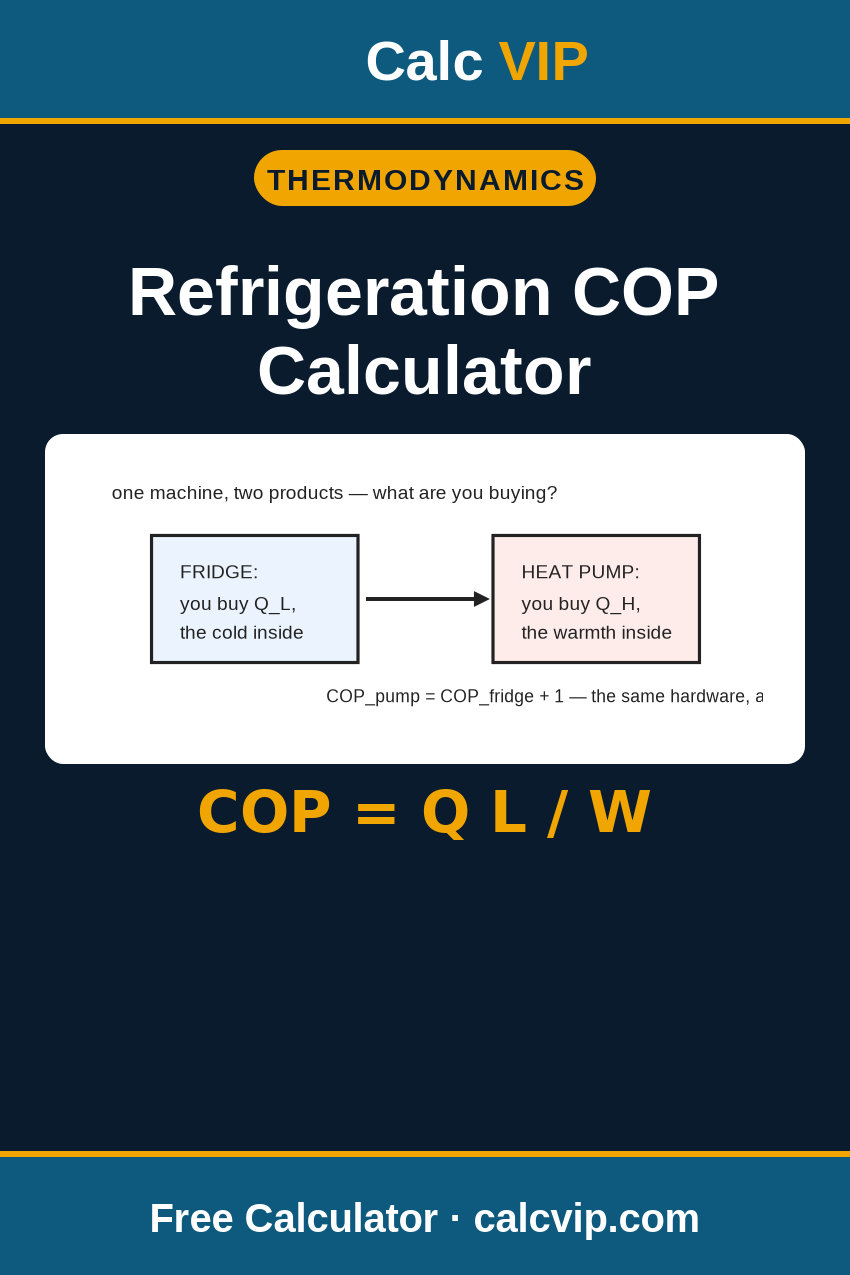
Why does any of this matter beyond textbook problems? Because COP is the number that decides heating bills and climate policy. An electric bar heater turns 1 J of electricity into 1 J of heat — a "COP" of exactly 1. A heat pump at COP 4 delivers 4 J of heat for the same joule, three of them harvested free from the outdoor air. That factor-of-four is the entire economic and environmental case for heat pumps, and it is computed with the two divisions on this page.
Formula
Refrigerator / air conditioner: COP = QL / W • Heat pump: COP = QH / W • with QH = QL + W
From those three lines everything else follows: COPheat pump = COPfridge + 1, and given any two of QL, QH, W the third is arithmetic. COP is dimensionless — a pure ratio — so Q and W may be in joules, kilojoules or (for a machine running steadily) watts, as long as both use the same unit. There is a ceiling on COP set by the temperatures alone, the Carnot limit: COPfridge,max = TL/(TH − TL) and COPpump,max = TH/(TH − TL), temperatures in kelvin. Real machines achieve perhaps a third to a half of their Carnot ceiling; the gap is friction, pressure drops and imperfect heat exchange. This calculator finds the COP for either machine type and reports the companion heat from QH = QL + W.
Because the ceiling moves with the weather, honest ratings are seasonal. A heat pump's COP measured on a mild autumn afternoon flatters it; the figure that decides a winter bill is the average over cold snaps, defrost cycles and all — which is why rating schemes publish seasonal performance factors (SCOP, SEER) alongside the spot COP. The spot value this calculator returns is the machine's character at one moment; the seasonal value is its biography. Both are the same ratio — only the averaging differs.
| Symbol | Meaning | Units |
|---|---|---|
| COP | coefficient of performance — heat moved per unit work | — (ratio) |
| QL | heat removed from the cold space | J (or W for rates) |
| QH | heat delivered to the warm space | J (or W for rates) |
| W | work input (compressor electricity) | J (or W for rates) |
| TL, TH | cold and warm absolute temperatures (Carnot limit) | kelvin (K) |
Why COP is not efficiency — and why it can exceed 1
Efficiency answers the question "what fraction of what I paid for became the thing I wanted?" For an engine, paid-for heat becomes wanted work, and the fraction is capped at 1 — really at the Carnot fraction, well below 1. COP asks a different question: "how much heat did each unit of work succeed in moving?" Moving is not converting. The joules of QL already existed in the cold space; the work merely transports them uphill. A delivery van that carries 600 kg of parcels on 200 kg of fuel has not violated conservation of mass, and a fridge with COP 3 has not violated conservation of energy: the full audit, QH = QL + W, balances to the joule.
The confusion costs real money when the two are muddled in reverse. A heat pump advertised at "400% efficiency" is using marketing language for COP 4 — legitimate physics, sloppy vocabulary. Meanwhile a resistive heater genuinely is 100% efficient at turning electricity into heat, and still loses four-to-one against the heat pump, because the pump's other three joules were never electricity at all. COP also explains why the figure degrades exactly when you need it most: the colder it is outside, the wider the temperature gap the pump must lift heat across, and the lower the COP slides — thermodynamics charging more for a harder carry.
How to use
- Choose the machine type: refrigerator/air conditioner (you know QL, the heat removed) or heat pump (you know QH, the heat delivered). The heat input box relabels itself.
- Enter that heat in joules — or in watts if you are working with a running machine's rates; just use the same unit for both boxes.
- Enter the work input W in the same unit.
- Click "Calculate COP". The result shows the COP and, from QH = QL + W, the companion heat on the other side of the machine.
Worked examples
Example 1 — the reference fridge. A refrigerator removes QL = 600 J of heat from its cold space using W = 200 J of work:
COP = QL/W = 600 / 200 = 3.0. It dumps QH = 600 + 200 = 800 J into the room, so the same machine used as a heat pump would have COP = 800/200 = 4.0.
Example 2 — an air conditioner by the watt. A room AC unit extracts heat at 3,500 W while drawing 1,000 W of electricity: COP = 3,500/1,000 = 3.5, and it rejects QH = 4,500 W outside — which is why the outdoor unit of an air conditioner blows hot air with more power than the room ever lost.
Example 3 — a heat pump heating a house. A heat pump delivers QH = 12,000 J of heat per cycle for W = 3,000 J of work: COP = 12,000/3,000 = 4.0. Of the 12,000 J delivered, QL = 12,000 − 3,000 = 9,000 J was harvested from the outdoor air for free; only 3,000 J appears on the electricity bill.
Example 4 — the Carnot ceiling for a fridge. A refrigerator cabinet at 260 K in a 300 K kitchen has COPmax = TL/(TH − TL) = 260/40 = 6.5. No real fridge between those temperatures can beat 6.5, whatever its engineering; typical machines reach 2–3, a third to a half of the ceiling.
Example 5 — the Carnot ceiling for a heat pump. Heating a house at 295 K from outdoor air at 270 K: COPmax = 295/(295 − 270) = 295/25 = 11.8. Real heat pumps deliver 3–5 under such conditions — comfortably inside the law, and still three to five times better than any resistance heater.
Example 6 — the freezer's harder job. A freezer removes QL = 400 J per cycle using W = 250 J: COP = 400/250 = 1.6, dumping QH = 650 J. Compare Example 1: the freezer's COP is half the fridge's, because its cold side sits much further below room temperature — a wider gap, a pricier carry, exactly as the Carnot formula predicts (its ceiling is only 255/45 ≈ 5.67).
COP in real life
The heat-pump revolution. Example 3 is the sales pitch and the physics in one line: three free joules harvested per paid joule. In cold-climate field trials, modern heat pumps hold COP above 2 even at −15 °C, which is why governments subsidise them as decarbonisation hardware.
Why the fridge warms the kitchen. A refrigerator dumps QH = QL + W into the room — it is a net heater. Leaving the fridge door open to "cool the kitchen" does the opposite: the cabinet stops being cold, but the compressor's W keeps arriving as heat.
Air-conditioner ratings. AC units are sold by cooling capacity (the QL rate) and an efficiency label derived from COP — in the US, EER and SEER express the same ratio in BTU per watt-hour (COP 3.5 ≈ EER 11.9). Two units with equal cooling and different COP differ only in what they cost to run.
Data-centre cooling. A server hall must remove megawatts of QL — every watt of computing becomes heat. At COP 3, cooling adds a third again to the power bill, which is why operators chase free cooling and why "PUE" metrics are watched like fuel gauges.
Industrial heat pumps. Factories that need 80–150 °C process heat increasingly lift waste heat from their own effluent with large heat pumps at COP 2–4, replacing gas boilers. The wider the lift, the thinner the margin — the Carnot ceiling is an engineering budget, not an abstraction.
Cryocoolers. At the far end of the gap, cooling a sensor to 77 K from a 300 K room has a Carnot ceiling of 77/223 ≈ 0.35 — and real cryocoolers achieve COP near 0.05. Deep cold is the most expensive heat-lifting there is, which this one formula explains completely.
The Carnot ceiling in numbers
The ceiling formula rewards small temperature gaps extravagantly and punishes wide ones, which is why underfloor heating (low delivery temperature) pairs so well with heat pumps. For a kitchen fridge working between 277 K inside and 303 K in the room, COPmax = 277/26 ≈ 10.65 — yet real fridges run at 2–3, because their compressors, fans and heat exchangers spend most of the theoretical allowance. For a freezer at 255 K against the same 300 K room the ceiling drops to 255/45 ≈ 5.67. And for the heat pump of Example 5 the ceiling of 11.8 against a real-world 3–5 shows the same pattern: the laws of thermodynamics are generous, the machinery is lossy, and the ratio between the two — sometimes called the second-law efficiency — is the honest grade of any real machine. When a datasheet quotes a COP, ask at which temperatures; a COP without its TL and TH is a number without a context.
The same ceiling explains a piece of everyday experience: a refrigerator works noticeably harder in a heatwave. Lift the kitchen from 300 K to 308 K while the cabinet holds 260 K and the gap widens from 40 K to 48 K; the ceiling falls from 6.5 to 260/48 ≈ 5.42, and the real COP slides with it, so the compressor runs longer for the same cold. Air conditioners suffer the mirror image on the hottest afternoons — the very hours of peak demand are the hours of worst COP, a coupling between weather and grid load that energy planners model with this exact formula.
Quick reference: typical COP values
| Machine | Typical COP | Note |
|---|---|---|
| Electric bar heater | 1.0 | converts, does not move |
| Home freezer | 1.5–2 | wide temperature gap |
| Home refrigerator | 2–3 | Carnot ceiling ≈ 10.65 |
| Room air conditioner | 3–4 | sold by EER/SEER in the US |
| Air-source heat pump (mild weather) | 3–5 | falls as outdoor temperature drops |
| Ground-source heat pump | 4–6 | the ground is a steadier reservoir |
| Cryocooler at 77 K | ≈ 0.05 | ceiling itself is only ≈ 0.35 |
Read down the table and you are reading the Carnot formula in disguise: the smaller the temperature lift, the larger the COP nature permits.
Common mistakes
- Calling COP an efficiency and capping it at 1. COP routinely exceeds 1 because heat is moved, not created. Marking COP 3 as "impossible" mistakes the definition.
- Mixing up QL and QH. The fridge COP divides QL by W; the heat-pump COP divides QH. Swapping them shifts the answer by exactly 1 — the most common COP error of all.
- Forgetting QH = QL + W. The work does not vanish; it joins the delivered heat. Any audit that loses W has lost energy the first law insists on.
- Using Celsius in the Carnot limit. TL/(TH − TL) needs kelvin. With Celsius, a fridge at 4 °C in a 30 °C room gives 4/26 — nonsense; in kelvin it is 277/26 ≈ 10.65.
- Comparing COPs quoted at different temperatures. A heat pump's COP 5 on a mild day and COP 2.2 in a frost are the same machine. Compare like with like, or not at all.
FAQ
How can a COP be bigger than 1 — isn't that over 100% efficient?
COP is not an efficiency. The machine does not create energy; it moves heat. Moving 600 J of heat with 200 J of work breaks no law — the total energy (800 J) is exactly conserved.
What COP do real fridges and heat pumps have?
Typical home refrigerators run at COP ≈ 2–3, air conditioners ≈ 3–4, and good heat pumps ≈ 3–5 — one reason heat pumps heat a house far more cheaply than an electric bar heater (whose "COP" is only 1).
What is the maximum possible COP?
The Carnot limit: COPfridge,max = TL/(TH − TL) with temperatures in kelvin. Real machines always fall short of it because of friction and other losses.
Why is the heat-pump COP always 1 more than the fridge COP?
Because QH = QL + W. Dividing by W: QH/W = QL/W + 1. The work input itself is delivered as part of the heat — nothing is wasted, it just changes which side of the machine you are standing on.
Does a bigger COP mean a more powerful fridge?
No. COP is a rate of exchange, not a capacity. A tiny thermoelectric cooler can have a respectable COP and almost no cooling power; capacity is QL per second, a separate specification.
Why does COP drop in cold weather for heat pumps?
The temperature gap TH − TL widens, dragging the Carnot ceiling down with it, and the machine's real COP follows its ceiling. Ground-source pumps suffer less because soil temperature barely moves.
What is EER and SEER?
US rating labels for air conditioners: EER is the COP expressed in BTU of cooling per watt-hour of electricity (COP × 3.412), and SEER is its season-long average. They are this page's ratio wearing imperial units.
Can COP be less than 1?
Yes — when the temperature gap is huge or the machine is poor. Cryocoolers and thermoelectric (Peltier) coolers often run below 1: they spend more work than the heat they manage to lift, the difference joining the rejected heat.
Is a refrigerator with the door open an air conditioner?
No — it is a heater. With the door open, QL is drawn from the same room that receives QH = QL + W, so the room gains exactly W. The COP arithmetic is the whole explanation.
How do I find W if I know COP and Q?
Rearrange: W = QL/COP for a fridge, W = QH/COP for a heat pump. A fridge with COP 2.5 that removes 750 J per cycle consumes W = 750/2.5 = 300 J per cycle.