 Calc
RMS Speed Calculator – Root-Mean-Square Speed of Gas Molecules
 Created by Anna Kowalski · Physics Editor · Heat & Atoms · Last updated: November 2026
Use this free RMS Speed Calculator to find the root-mean-square speed of gas molecules from vrms = √(3RT/M). Pick a gas (or enter a custom molar mass) and the temperature in kelvin, using R = 8.314 J/(mol·K).
A gas is never still. Inside any bottle of air, trillions of molecules are flying in straight lines, colliding, rebounding and flying again, each at its own speed. There is no single "speed of the molecules" — there is a spread, from near-stationary stragglers to rare speedsters several times faster than typical. The rms speed is the spread's most useful summary: the square root of the mean of the squared speeds, chosen because it is the one average that connects directly to energy. A molecule moving at vrms carries exactly the average kinetic energy of the whole crowd.
That connection is what makes the formula inevitable rather than arbitrary. Kinetic theory shows the average translational kinetic energy of a molecule is (3/2)kT — fixed by temperature alone. Setting ½mvrms² = (3/2)kT and scaling up from one molecule to a mole turns Boltzmann's constant into the gas constant and the molecular mass into the molar mass, giving vrms = √(3RT/M). Temperature in the numerator, mass in the denominator: heat a gas and its molecules must move faster; swap in heavier molecules at the same temperature and they must move slower, so that the energy per molecule comes out the same.
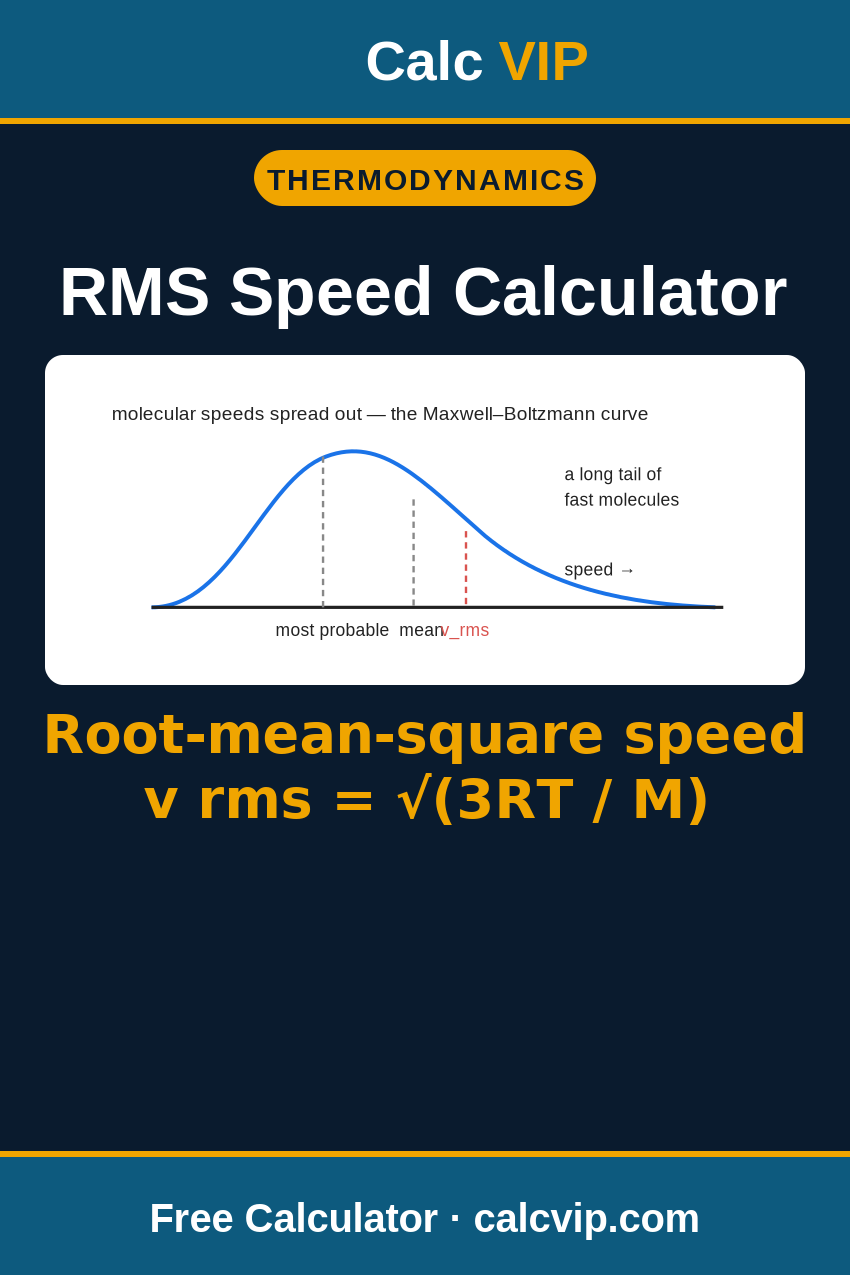
The numbers surprise everyone the first time. The oxygen you are breathing right now is moving at about 484 m/s — faster than a Formula 1 car at full stretch, roughly the muzzle velocity of a pistol bullet — yet you feel nothing, because each molecule is so light and the collisions so numerous that they average into the gentle, steady push we call pressure. Hydrogen, sixteen times lighter, moves four times faster still, and that single fact explains why Earth has almost no hydrogen left in its air while Jupiter kept plenty: speed is escape, given geological time.
Formula
Root-mean-square speed vrms = √(3RT / M) • vrms in m/s, T in kelvin, M in kg/mol
The formula rearranges to give the temperature a gas must have for a chosen speed, T = Mvrms² / (3R), or the molar mass from a measured speed, M = 3RT / vrms². Two scaling rules cover most quick questions: vrms grows with the square root of temperature (quadruple T to double the speed), and falls with the square root of molar mass (a gas four times heavier moves half as fast). The one lethal detail is the unit of M: the formula wants kilograms per mole, so 32 g/mol must enter as 0.032 kg/mol. This calculator accepts g/mol and converts for you, then reports the speed in m/s and km/h.
| Symbol | Meaning | Units |
|---|---|---|
| vrms | root-mean-square molecular speed | m/s |
| R | gas constant, 8.314 | J/(mol·K) |
| T | absolute temperature | kelvin (K) |
| M | molar mass | kg/mol in the formula |
Three averages, one distribution: why "rms" and not just "average"?
Ask for "the average speed" of gas molecules and you have asked an ambiguous question, because the Maxwell–Boltzmann distribution supports three natural averages, each answering to a different name. The most probable speed, √(2RT/M), is the peak of the curve — the single speed more molecules have than any other. The mean speed, √(8RT/πM), is the ordinary arithmetic average. The rms speed, √(3RT/M), is the largest of the three, because squaring before averaging gives extra weight to the fast tail.
For oxygen at 300 K the three come out at 394.83 m/s, 445.51 m/s and 483.56 m/s — in the fixed ratio √2 : √(8/π) : √3 ≈ 1.414 : 1.596 : 1.732, whatever the gas or temperature. Physics reaches for the rms value because energy is what couples molecules to the rest of thermodynamics: pressure, internal energy and temperature are all statements about ½mv², and only the rms average makes ½Mv² per mole equal (3/2)RT exactly. Use the mean speed where distance travelled matters — diffusion and effusion — and the rms speed wherever energy does.
Heat the gas and the whole distribution stretches: every characteristic speed scales by √T together, so the curve keeps its shape and simply redraws itself on a wider axis. Oxygen's most probable speed, 394.83 m/s at 300 K, becomes about 558 m/s at 600 K; the tail reaches proportionally further, which is why reaction rates explode with temperature — chemistry lives in the tail, where molecules carry enough energy to react on collision, and a modest warming multiplies the tail's population far more than it moves the average. Evaporation is the same story at a liquid surface: the fastest few percent of molecules escape, carrying away more than the average energy, which is why the liquid left behind cools. The distribution, not the average, is where temperature does its real work.
How to use
- Choose a gas from the list — oxygen, nitrogen, hydrogen or helium — or pick "Custom" and type any molar mass in g/mol (44 for CO₂, 18 for water vapour).
- Enter the absolute temperature in kelvin (add 273.15 to a Celsius reading first).
- Click "Calculate RMS Speed" to get vrms in m/s and km/h.
- Sanity-check the result: at room temperature, common gases land between about 400 and 2,000 m/s. A result of 15 m/s or 15,000 m/s almost always means grams were used where kilograms belong, or Celsius where kelvin belongs.
Worked examples
Example 1 — oxygen at room temperature. Find vrms for oxygen (M = 32 g/mol = 0.032 kg/mol) at 300 K:
vrms = √(3 × 8.314 × 300 / 0.032) = √233,831 = 483.56 m/s — about 1,740.82 km/h. The air in your lungs is moving at airliner speed, molecule by molecule.
Example 2 — nitrogen, the bulk of air. For N₂ (M = 28 g/mol) at 300 K: vrms = √(3 × 8.314 × 300 / 0.028) = √267,236 = 516.95 m/s. Slightly lighter than oxygen, so slightly faster — air's two main ingredients cruise within 7% of each other.
Example 3 — hydrogen, the escape artist. For H₂ (M = 2 g/mol) at 300 K: vrms = √(3 × 8.314 × 300 / 0.002) = 1,934.24 m/s — exactly 4 times the oxygen value, because √16 = 4. Even at a chilly 273 K it still manages 1,845.15 m/s.
Example 4 — helium balloons. For He (M = 4 g/mol) at 300 K: vrms = √1,870,650 = 1,367.72 m/s. Helium atoms move nearly three times faster than oxygen molecules, which is why a balloon's helium leaks through the rubber and drifts away so much more keenly than air would.
Example 5 — carbon dioxide, the heavyweight. For CO₂ (use Custom, M = 44 g/mol) at 300 K: vrms = √170,030 = 412.38 m/s. The heaviest common gas in air is also the slowest — one reason CO₂ pools in cellars and wells instead of mixing away instantly.
Example 6 — heating oxygen. Raise O₂ to 600 K: vrms = √(3 × 8.314 × 600 / 0.032) = 683.86 m/s. Doubling the absolute temperature multiplied the speed by √2 ≈ 1.414, not by 2 — the square root in the formula is doing exactly what it promises.
RMS speed in real life
Why Earth lost its hydrogen. Escape velocity from Earth is 11.2 km/s. Hydrogen's rms speed at 300 K is 1.93 km/s — only about a sixth of escape velocity, but the Maxwell tail always contains molecules several times faster than rms, and over billions of years that tail leaked away to space. Oxygen at 0.48 km/s has a far thinner fast tail, so it stayed. Jupiter, with escape velocity near 60 km/s, kept everything.
The smell crossing a room. Perfume molecules move at hundreds of m/s, yet a scent takes seconds to cross a room — because each molecule collides billions of times per second and random-walks rather than flying straight. Speed sets the collision rate; the wandering path sets the arrival time.
Speed of sound. Sound is a hand-off between neighbouring molecules, so it can never outrun the molecules themselves. In air at room temperature sound travels at about 343 m/s while the molecules average 445–484 m/s — the same ballpark, and no coincidence: the sound speed is a fixed fraction of the molecular speeds, which is why both grow as √T.
Effusion and isotope separation. Through a pinhole, molecules escape at a rate proportional to their speed — Graham's law. Light isotopes leak faster than heavy ones, an effect once used at industrial scale to enrich uranium: UF₆ made from the lighter isotope effuses measurably faster through porous barriers.
Vacuum technology. In a vacuum chamber the few remaining molecules still cross at rms speeds, setting how fast they find the pump and how quickly a clean surface gets contaminated — a monolayer of gas can form in seconds at modest vacuum if the pressure is not low enough.
Hot fusion plasmas. At the 150 million kelvin of a fusion reactor core, hydrogen nuclei move at rms speeds above a million metres per second. Confinement is a race between those speeds and the magnetic bottle — the formula on this page, extrapolated ten orders of magnitude, is the design brief.
Effusion: the speed you can measure with a pinhole
Let a gas leak through a hole much smaller than the molecules' mean free path and the leak rate is proportional to the average molecular speed — Graham's law: rate₁/rate₂ = √(M₂/M₁). It gives a laboratory handle on this page's invisible speeds. Time how long equal volumes take to effuse and you can weigh an unknown gas: if a mystery gas effuses 1.41 times more slowly than oxygen, its molar mass is 32 × 1.41² ≈ 64 g/mol. The same square-root-of-mass rule explains why a helium balloon sags overnight while an air balloon lasts for days, and why hydrogen-filled tyres were never a good idea. Note the ratio uses the mean speed rather than vrms — but since every average of the distribution carries the same √(T/M) dependence, the ratio law comes out identical whichever average you choose.
Reading the formula backwards: thermometers made of speed
Turned around, vrms = √(3RT/M) is a way to measure temperature — or to measure mass. Time-of-flight instruments in molecular-beam laboratories clock individual molecules over a known distance and recover the temperature of the source from the speed distribution, kelvin by velocity. The same inversion weighs the atmospheres of planets: from the speeds thermal motion gives to each species at a given temperature, astronomers compute which gases a planet's gravity can hold — the Jeans escape criterion, which asks whether a meaningful slice of the distribution's tail exceeds escape velocity. Earth's verdict from this one calculation: nitrogen and oxygen are prisoners for the age of the universe, water vapour is marginal and mostly saved by condensing first, helium leaks slowly, and hydrogen was never going to stay. The Moon, with escape velocity of only 2.38 km/s, fails the test for everything — even oxygen's tail escapes — which is why it is airless. One square root, applied patiently, explains the skies of two worlds.
There is a laboratory echo worth knowing: the distribution's shape lets you extract Boltzmann's constant itself. Measure the fraction of molecules in a narrow speed band at two temperatures, fit the Maxwell–Boltzmann curve, and k falls out — modern determinations of temperature at the lowest levels are, at heart, exercises in counting fast and slow molecules. Temperature, which feels like the most primitive of quantities, is in precision work a statistic of speeds all the way down.
Quick reference: v_rms at 300 K
| Gas | M (g/mol) | vrms (m/s) | vrms (km/h) |
|---|---|---|---|
| Hydrogen H₂ | 2 | 1,934.24 | 6,963.28 |
| Helium He | 4 | 1,367.72 | 4,923.78 |
| Water vapour H₂O | 18 | 644.75 | 2,321.09 |
| Nitrogen N₂ | 28 | 516.95 | 1,861.01 |
| Oxygen O₂ | 32 | 483.56 | 1,740.82 |
| Argon Ar | 40 | 432.51 | 1,557.04 |
| Carbon dioxide CO₂ | 44 | 412.38 | 1,484.58 |
| Xenon Xe | 131 | 239.00 | 860.39 |
Every entry obeys the same two square roots — pick any two rows and the speed ratio is exactly √(M₂/M₁): xenon is 65.5 times heavier than hydrogen and moves √65.5 ≈ 8.1 times more slowly.
The table doubles as a thermometer in reverse: measure any one gas's rms speed and the temperature follows from T = Mv²/(3R). Astronomers use exactly this on the broadening of spectral lines — the widths of absorption lines from a distant gas cloud encode the spread of molecular speeds along the line of sight, and with it the cloud's temperature, read from light that left before the telescope was built.
Common mistakes
- Using grams per mole in the formula. M must be in kg/mol. Entering 32 instead of 0.032 makes the speed √1000 ≈ 31.6 times too small — the single most common rms error.
- Using Celsius for T. At "300 °C" the formula needs 573.15 K. Celsius inputs understate the speed, and a Celsius input below zero makes the square root imaginary.
- Expecting pressure to matter. Doubling the pressure at fixed temperature doubles the number of molecules, not their speeds. vrms reads T and M only.
- Doubling T to double the speed. Speed grows as √T: doubling the speed needs four times the absolute temperature.
- Confusing rms with the mean or most probable speed. They differ by fixed factors (√3 vs √(8/π) vs √2). For energy questions only the rms value gives the right kinetic energy.
FAQ
What does "root-mean-square" mean?
Gas molecules all move at different speeds. The rms speed is the square root of the average of the squares of their speeds — the single speed that gives the correct average kinetic energy, ½mv² = (3/2)kT per molecule.
Why do hydrogen molecules move so fast?
vrms depends on 1/√M. Hydrogen (M = 2) is 16 times lighter than oxygen (M = 32), so at the same temperature its molecules move √16 = 4 times faster — about 1,934 m/s at 300 K. That is why light gases escape Earth's atmosphere.
Does the rms speed depend on pressure?
No. At a fixed temperature, squeezing the gas raises the pressure but the molecular speeds stay the same — only T and M matter.
What is the rms speed of air itself?
Air is mostly N₂ and O₂ with an average molar mass near 29 g/mol, giving vrms ≈ 508 m/s at 300 K — between the nitrogen value (516.95) and the oxygen value (483.56), as it must be.
How fast must a gas be heated for its molecules to double their speed?
Four times the absolute temperature: from 300 K to 1,200 K. The square root is unforgiving — each doubling of speed costs a quadrupling of T.
Is v_rms the speed of sound?
No, but they are relatives. Sound in air at room temperature travels at about 343 m/s, while the molecules' rms speed is 484 m/s for oxygen. Sound is a coordinated drift passed between molecules, so it moves at a fixed fraction of the molecular speeds and shares their √T dependence.
Do all molecules of a gas really move at different speeds?
Yes — collisions constantly shuffle energy between them, maintaining the Maxwell–Boltzmann spread. At any instant a few molecules are nearly stationary and a few move at three times vrms; the distribution, not any individual molecule, is what temperature fixes.
What happens to v_rms as T approaches absolute zero?
It falls toward zero as √T — at 3 K oxygen's rms speed would be a tenth of its 300 K value, about 48 m/s. (Long before that, of course, oxygen stops being a gas at all.)
Why is there a 3 in the formula?
Because space has three dimensions. Each direction of motion contributes ½kT of average energy — (3/2)kT in total — and the 3 in 3RT is that count of directions, one per axis.
Can I use this for a liquid or a solid?
No. The formula assumes free flight between collisions, which is the defining picture of a gas. In liquids and solids the particles are bound to their neighbours and vibrate instead — their energies still average (3/2)kT per direction of freedom in the classical limit, but "speed" no longer means travel.