 Calc
Redshift Calculator – z, Recession Velocity (Classical & Relativistic)
 Created by Yuki Tanaka · Physics Editor · Modern Physics · Last updated: November 2026
Use this free Redshift Calculator to find the redshift z of a galaxy from the emitted and observed wavelengths of a spectral line, and estimate how fast the galaxy is receding from us — with both the simple classical formula and the relativistic one.
Stretch a spectral line toward longer wavelengths and you have written down a speed. The redshift z measures that stretch as a fraction: z = (λobs − λ)/λ, the observed minus emitted wavelength, divided by the emitted. This calculator takes the rest wavelength of any known spectral line and the wavelength at which it is actually observed, and returns z together with the recession speed in two versions — the classical v = cz and the relativistic Doppler result — so you can watch the simple formula work beautifully for nearby galaxies and fail, instructively, for distant ones.
The method's power is its anchoring. Spectral lines are nature's barcodes: hydrogen's H-alpha line is emitted at 656.3 nm by every hydrogen atom everywhere, so when a galaxy's spectrum shows that line at 700 nm, the shift is unambiguous and z follows immediately — no knowledge of the galaxy's brightness or size required. Slipher measured such shifts a century ago; Hubble turned them into a law, v = H₀d, linking speed to distance; and the modern form of that discovery is that the universe expands, carrying galaxies apart and stretching their light en route. The "recession velocity" this calculator reports is the standard working translation of z into speed — for far galaxies, cosmologists treat z itself as the primary quantity and the velocity as an interpretation.
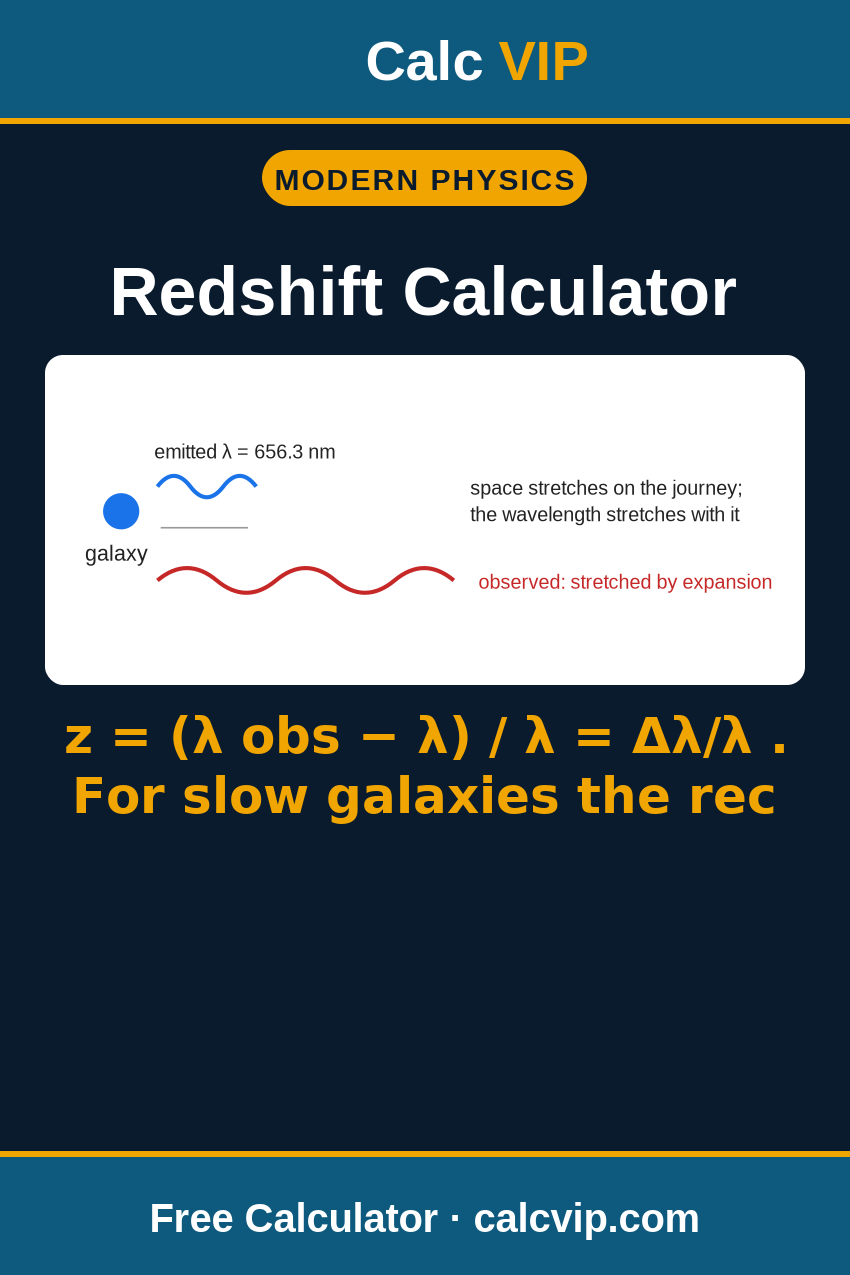
The two velocity formulas bracket the story. Classically, v = cz: tidy, and fine while z ≪ 1 — at z = 0.0666 it errs by only about 3%. But it happily predicts v > c for z > 1, which nature forbids. The relativistic Doppler formula, 1 + z = √((1 + β)/(1 − β)), caps the speed properly: β = ((1+z)² − 1)/((1+z)² + 1) tends to 1 but never reaches it, even as z → ∞. Between them the calculator spans the observable universe, from Andromeda's approaching blueshift (z ≈ −0.001) to quasars at z > 7 whose H-alpha has been stretched clean out of the visible into the infrared.
Formula
The redshift is z = (λobs − λ) / λ = Δλ/λ. For slow galaxies the recession speed is roughly v = cz (Hubble's law). For accuracy at high speed, special relativity gives 1 + z = √((1 + β)/(1 − β)), which can be rearranged to β = ((1+z)² − 1)/((1+z)² + 1), where β = v/c. The same relation works in frequency: since fλ = c, a wavelength stretched by (1 + z) is a frequency shrunk by the same factor, fobs = f/(1 + z). A negative z (observed wavelength shorter) is a blueshift — the object is approaching. Two honest caveats: for cosmological redshifts the "velocity" is a translation, not a motion through space — the stretching happens because space expanded while the light travelled — and gravitational redshift (light climbing out of a deep gravity well) adds its own small z on top of any motion.
| Symbol | Meaning | Units |
|---|---|---|
| z | redshift — fractional wavelength stretch | dimensionless |
| λ | emitted (rest) wavelength of the spectral line | nm |
| λobs | observed wavelength of the same line | nm |
| β | recession speed as a fraction of c (relativistic) | 0 ≤ β < 1 |
| H₀ | Hubble constant, ≈ 70 km/s per megaparsec | km/s/Mpc |
Doppler shift or expanding space? The honest picture
For a galaxy across the street, cosmically speaking, redshift behaves exactly like the Doppler effect of a receding source, and v = cz is a fine description. But the mature cosmological picture is subtler: the light is stretched because the space it traverses expands during the journey — the wavelength grows in proportion to the universe's scale factor, 1 + z = anow/athen. This is why the relativistic-Doppler "velocity" of a high-z galaxy, while a useful translation, is not the whole truth: galaxies at z ≈ 1.5 and beyond recede, in the expansion sense, faster than light (their proper distance grows superluminally), which relativity permits because nothing is moving through space faster than c — space itself is growing. The calculator's relativistic column should be read as "the speed a Doppler source would need", which for z ≲ 0.1 is the speed, full stop.
None of this dilutes z's status as one of the best-measured numbers in astronomy. A spectrograph pins line positions to parts in 10⁵; the main error sources are mundane — misidentifying which line you are looking at (a stretched ultraviolet line masquerading as a visible one), and the galaxy's own peculiar motion through space, a few hundred km/s of local traffic superimposed on the Hubble flow. For nearby galaxies that traffic can rival the expansion signal — Andromeda's local approach overwhelms it entirely — which is why Hubble's law is applied statistically, and beyond a few tens of megaparsecs, where the flow dominates.
How to use
- Enter the rest wavelength of a known spectral line (H-alpha is 656.3 nm).
- Enter the wavelength at which the line is actually observed in the galaxy's spectrum.
- Click "Calculate Redshift" to get z plus the classical and relativistic recession speeds.
- Trust the relativistic column once z exceeds ~0.1; below that, the two agree to within a few percent and either serves.
Worked examples
Example 1 — a mid-range galaxy. A galaxy's H-alpha line, emitted at 656.3 nm, is observed at 700 nm.
z = (700 − 656.3)/656.3 = 0.0666.
Classical speed: v = cz = 0.0666 × 3 × 10⁸ = 19,976 km/s.
Relativistic: β = ((1.0666)² − 1)/((1.0666)² + 1) = 0.0644, so v = 19,312 km/s.
At this modest redshift the two answers differ by only ~3%, but for z near 1 and beyond the classical formula fails badly (it would claim v > c).
Example 2 — Andromeda's blueshift. Andromeda's H-alpha is observed at 655.6 nm instead of 656.3 nm.
z = (655.6 − 656.3)/656.3 = −0.00107; both formulas give v ≈ −320 km/s.
The negative sign is an approach: our nearest large neighbour is falling toward us at some 300 km/s and will merge with the Milky Way in a few billion years — the expansion of the universe loses to local gravity at this range.
Example 3 — z = 1. A galaxy whose H-alpha arrives at 1312.6 nm, in the infrared.
z = (1312.6 − 656.3)/656.3 = 1.000. Classical v = cz = 300,000 km/s = c — already impossible.
Relativistic: β = ((2)² − 1)/((2)² + 1) = 3/5 = 0.6, so v = 180,000 km/s. We see this galaxy as it was when the universe was half its present age.
Example 4 — a quasar at z = 2. H-alpha observed at 1968.9 nm: z = 2.000.
Classical: v = 600,000 km/s — twice light speed, the formula's resignation letter.
Relativistic: β = ((3)² − 1)/((3)² + 1) = 0.8, v = 240,000 km/s. Quasar surveys catalogue thousands of objects at such redshifts, their visible light long since stretched into the infrared.
Example 5 — a Hubble-law distance. A galaxy at z = 0.01 recedes at v ≈ cz = 3,000 km/s.
Hubble's law, d = v/H₀ with H₀ ≈ 70 km/s/Mpc, places it at 3000/70 = 42.9 Mpc ≈ 140 million light-years. The relativistic correction at this z is half a percent — cz plus Hubble's law is the working astronomer's everyday tool, and it is built from this calculator's first column.
Example 6 — the cosmic microwave background. The CMB's redshift is z ≈ 1100.
β = ((1101)² − 1)/((1101)² + 1) = 0.99999835 — the relativistic formula squeezes against c while the classical one demands 330,000 times c. Radiation emitted at visible and infrared wavelengths (the hot early universe's glow, ~3,000 K) arrives stretched by 1101: a 656.3 nm line would land at 0.72 mm, in microwaves. The CMB is the highest redshift "object" there is.
Redshift in real life
Mapping the universe. Galaxy surveys (SDSS, DESI) measure millions of redshifts to build 3D maps of cosmic structure — each galaxy's z is its radial coordinate, obtained by this page's arithmetic on its spectral lines.
The expanding universe and dark energy. Hubble's diagram of velocity against distance revealed expansion; its refinement with distant supernovae revealed the expansion is accelerating — the discovery of dark energy began with redshift measurements.
Exoplanet hunting. The radial-velocity method reads a star's wobble as a periodic redshift/blueshift of its lines, z oscillating by ~10⁻⁸ — the same formula, pushed to exquisite precision with stabilised spectrographs.
Gravitational redshift tests. Light climbing out of the Sun's gravity well is redshifted by z ≈ 2 × 10⁻⁶; white dwarfs show more. Measuring it tests general relativity — and GPS engineers correct for its terrestrial cousin daily.
Looking back in time. Because 1 + z = anow/athen, a galaxy at z = 1 is seen when the universe was half its present size and roughly 60% of its present age — redshift is astronomy's time machine dial.
Cosmological time dilation. Distant supernova light curves are stretched by (1 + z), exactly as the wavelength argument predicts — an independent confirmation that the stretching is a property of the journey, not of the source.
Quick reference: from z to relativistic speed
| z | β (relativistic) | v relativistic (km/s) | v classical cz (km/s) | H-alpha observed (nm) |
|---|---|---|---|---|
| 0.001 | 0.00100 | 300 | 300 | 657.0 |
| 0.01 | 0.00995 | 2,985 | 3,000 | 662.9 |
| 0.1 | 0.0950 | 28,507 | 30,000 | 721.9 |
| 0.5 | 0.385 | 115,385 | 150,000 | 984.5 |
| 1 | 0.600 | 180,000 | 300,000 (= c!) | 1,312.6 |
| 2 | 0.800 | 240,000 | 600,000 (impossible) | 1,968.9 |
| 5 | 0.946 | 283,784 | 1,500,000 (impossible) | 3,937.8 |
Read the classical column's collapse as a parable: v = cz is a local ordinance, valid in the nearby universe, silently repealed by distance. The relativistic column's β, by contrast, behaves itself at every z — one of the many places where Einstein's formula is not a correction to Newton's but its completion.
Reading z as time: the lookback table
Because light travels at finite speed, redshift doubles as a clock: the larger z, the longer the light has travelled and the younger the universe it shows. In the standard ΛCDM cosmology the correspondence is roughly: z = 0.1 → light emitted 1.3 billion years ago; z = 0.5 → 5.0 billion years; z = 1 → 7.8 billion years, when the universe was about 6 billion years old; z = 2 → 10.3 billion years; z = 5 → 12.5 billion years; and the CMB's z = 1100 → 13.8 billion years, a snapshot just 380,000 years after the Big Bang. These figures carry the cosmology inside them — change the assumed matter and dark-energy densities and the lookback times shift by a few percent while z itself, the measured quantity, does not move. That separation is why astronomers publish z and let the cosmology-dependent translations follow: the spectrum is data, the clock is interpretation, and this calculator deals in the data.
Our own motion writes a redshift too
Not every measured z is cosmic. The Solar System orbits the Galaxy and the Galaxy falls toward the Virgo cluster and beyond, and that motion imprints a dipole on the cosmic microwave background: the sky's temperature is higher in the direction of motion, lower behind, by a fraction corresponding to our speed of about 370 km/s — a Doppler z of roughly 0.00123 across the whole sky. Galaxy redshift surveys must subtract this and smaller peculiar motions (individual galaxies wander at a few hundred km/s under their neighbours' gravity) before the clean Hubble flow emerges. The corrections are this calculator's formulas run in reverse and at tiny argument — the same physics that spans z = 1100 also calibrates our own 0.1%-of-light-speed drift through the cosmos.
How far away is a z = 1 galaxy, really?
Three distances answer to one redshift, and keeping them apart is the mark of having understood this page. The z = 1 galaxy's light travelled for 7.8 billion years (the lookback distance, 7.8 billion light-years at c). When the light set out, the galaxy was closer than that figure suggests — expansion carried it away while the photons crossed — at about half the present separation. And now, at the moment we receive the light, that same galaxy sits at a comoving distance of roughly 3.3 billion parsecs, about 10.8 billion light-years. All three numbers are correct; each answers a different question (how long did the light travel, where was the source then, where is it now). Redshift itself sits serenely beneath the argument — measured once, from two wavelengths and this page's subtraction, while cosmologists debate the translations.
Common mistakes
- Quoting v = cz for high-z objects. Beyond z ≈ 0.1 the classical speed drifts from the relativistic one, and past z = 1 it exceeds c. Journalists' "galaxies receding at twice light speed" from cz arithmetic are formula errors, not discoveries.
- Dividing by λobs instead of λ. z is defined with the emitted wavelength in the denominator: z = (λobs − λ)/λ. Using the observed value understates every redshift.
- Applying Hubble's law next door. Within the Local Group and for the nearest galaxies, peculiar motions swamp the Hubble flow — Andromeda approaches us despite the expansion. Hubble distances are trustworthy only well beyond ~10–20 Mpc, or statistically.
- Misidentifying the line. A single observed line at 700 nm could be H-alpha at z = 0.067 or a stretched ultraviolet line at much higher z. Real redshifts are confirmed with several lines sharing one z — never trust a one-line identification.
- Treating redshift as ordinary motion for the CMB and early universe. At z = 1100 the "velocity" language fails entirely; the correct statement is that space has expanded 1101-fold since the light set out. Use z itself as the quantity of record.
FAQ
Is redshift really caused by the Doppler effect?
For nearby galaxies it behaves like one, but cosmologists describe it as the stretching of light by the expansion of space itself while the light travels. The formulas here still give the standard working values.
How do astronomers get distances from z?
Through Hubble's law, v = H₀ × d: with H₀ ≈ 70 km/s per megaparsec, the example galaxy at ~19,500 km/s lies roughly 280 million parsecs (about 900 million light-years) away.
What does a blueshift mean?
A negative z: the lines shift to shorter wavelengths because the object moves toward us. The Andromeda galaxy is blueshifted (z ≈ −0.001) and is heading for a future encounter with the Milky Way.
Which spectral lines do astronomers use besides H-alpha?
The workhorses are the oxygen doublet [O III] at 500.7 nm, H-beta at 486.1 nm, the calcium H and K lines near 393–397 nm, and Lyman-alpha at 121.6 nm for distant objects. A robust redshift matches several lines at the same z.
What is the largest redshift ever measured?
Galaxies confirmed spectroscopically beyond z = 13 — seen as they were within a few hundred million years of the Big Bang — and the cosmic microwave background at z ≈ 1100 remains the ultimate limit: beyond it the universe was opaque.
Does redshift affect the light's energy?
Yes: photon energy falls as 1/(1 + z), since E = hc/λobs. The "lost" energy is a bookkeeping subtlety of expanding space — energy conservation in its global Newtonian form does not survive general relativity intact.
Can redshift be caused by anything besides motion and expansion?
Gravity: photons climbing out of a deep potential well lose energy and redshift (measured for the Sun, white dwarfs, and at the Earth's surface in the Pound–Rebka experiment). Tired-light alternatives were proposed historically and are ruled out by the time-dilation evidence.
Why do distant galaxies look red even in false-colour images?
Often they are imaged in the infrared because their light has been shifted there; the "red" in press images may be a rendering of infrared data. The redshift is real — only the colour palette is a choice.
How precise is the Hubble constant from redshift surveys?
Redshifts themselves are exquisitely precise; the uncertainty lives in the distances. Current values cluster near 67–73 km/s/Mpc depending on method — the famous "Hubble tension" — so distances quoted from v/H₀ carry that few-percent systematic.
What would a blueshifted galaxy at z = −0.5 mean?
An approach at β = ((1 + z)² − 1)/((1 + z)² + 1) = (0.25 − 1)/(0.25 + 1) = −0.6, i.e. 0.6c toward us. Nothing in the universe does this; observed blueshifts are all tiny (|z| ≲ 0.01) and local, because expansion dominates at every great distance.