 Calc
Projectile Range Calculator – Range with Launch Height
 Created by Sarah Mitchell · Physics Editor · Motion & Measurement · Last updated: November 2026
Use this free Projectile Range Calculator to find how far a projectile lands when it is launched from a height — for example a ball thrown from a balcony or a cliff edge. Enter the launch speed, the launch angle and the starting height, and you get the horizontal range and the total flight time.
Most textbook range problems cheat a little: they land the projectile at exactly the height it was launched from, because that symmetry produces the tidy formula R = u² sin2θ/g. The real world is less tidy. Balls are thrown from balconies and cliffs, water arcs from hoses raised above the flowerbed, shells leave barrels on hilltops, and stunt riders launch from ramps — almost every genuine launch enjoys some height over its landing. That height is not a detail: it buys extra flight time, and flight time is what range is made of. This calculator therefore solves the full problem, height included, and the tidy textbook formula emerges as its special case when h = 0.
The physics underneath is the familiar split of projectile motion into two independent halves. Horizontally the projectile keeps its component u cosθ forever, untouched by gravity. Vertically it is simply a thrown object: it rises with initial component u sinθ, is taxed 9.81 m/s of velocity every second, falls back past the launch level, and keeps falling through the extra height h before the ground interrupts. The flight ends when the vertical journey totals −h (h below the start), and solving that condition — a quadratic again — gives the flight time. Multiply by the patient horizontal component and the range appears.
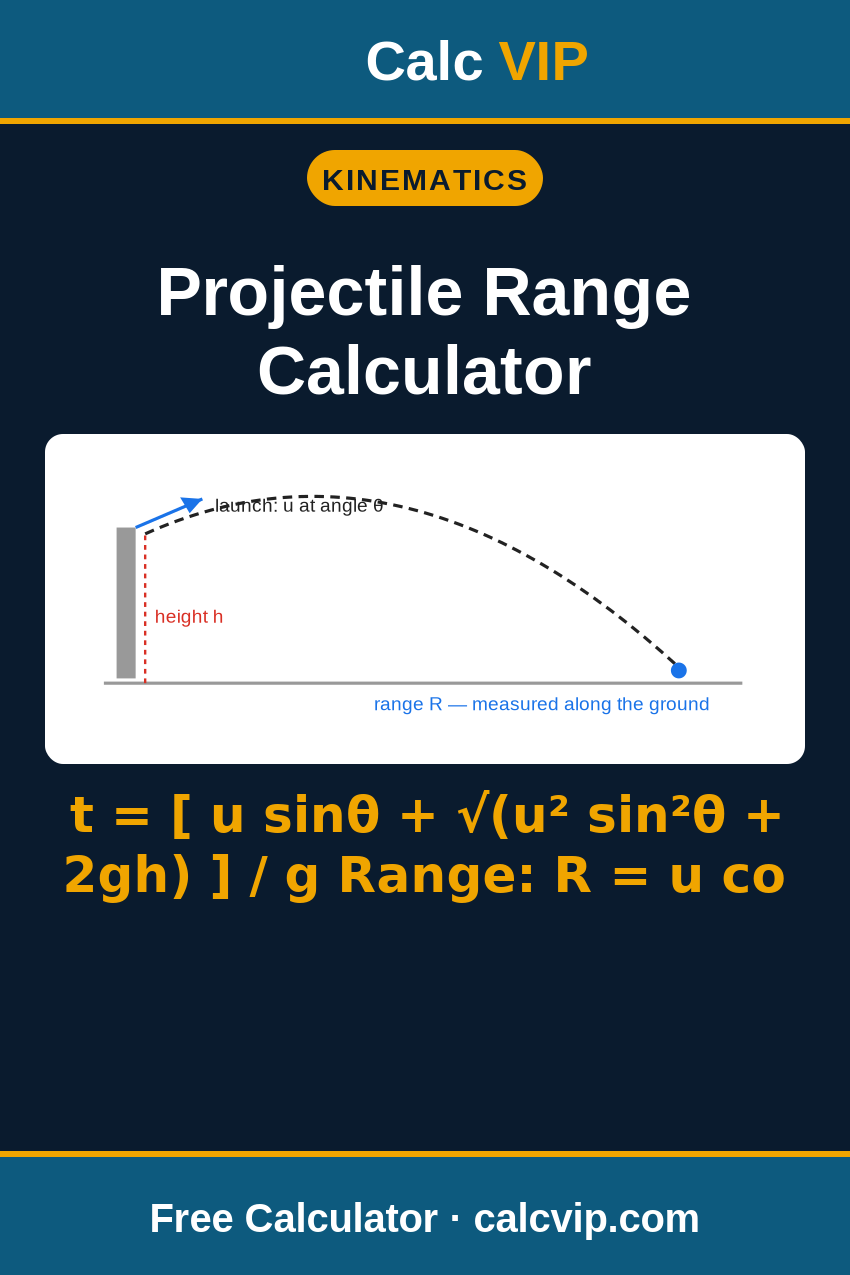
Enter the launch speed u in m/s, the angle θ in degrees above the horizontal, and the launch height h in metres above the landing surface, and the calculator returns the range and the flight time, using g = 9.81 m/s² and neglecting air resistance. Set h = 0 and you recover the flat-ground problem, handy for checking against the textbook formula. The examples below climb from a garden hose to a cliff-top throw, and the depth sections explain why a raised launch shifts the best angle below 45°, and just how much each extra metre of height is worth.
Formula
Flight time: t = [ u sinθ + √(u² sin²θ + 2gh) ] / g
Range: R = u cosθ × t (with g = 9.81 m/s²)
Every symbol earns its place. Inside the root, u² sin²θ is the square of the vertical launch component — the part that decides how long the projectile takes to return to launch level — and 2gh is the extra the fall through height h contributes; together they give the square of the vertical velocity at landing, a neat echo of v² = u² + 2as. Set h = 0 and the root becomes u sinθ, the flight time collapses to t = 2u sinθ/g, and the range becomes R = u² × 2 sinθ cosθ/g = u² sin2θ/g — the school formula, recovered exactly, which is the surest check that the general formula is right. The range itself is the simpler half of the story: because the horizontal component never changes, range is just that component multiplied by however long gravity allows the flight to last. Everything interesting about this calculator is therefore a question about time.
| Symbol | Meaning | Units |
|---|---|---|
| R | range — horizontal distance from launch point to landing point | m |
| u | launch speed at release | m/s |
| θ | launch angle above the horizontal | degrees |
| h | launch height above the landing surface | m |
| u cosθ | horizontal component — constant throughout the flight | m/s |
| u sinθ | vertical component at launch — gravity spends it, then rebuilds it downwards | m/s |
| t | total flight time, until the projectile has fallen h below launch level | s |
| g | acceleration due to gravity | m/s² (9.81) |
Height buys time, and time is range
Strip the problem to its logic and one sentence remains: the range equals the horizontal speed multiplied by the flight time, and the launch height exists to lengthen that time. A projectile launched from a height does everything a ground-launched one does — rises, peaks, returns to launch level — and then keeps going, falling the extra h with all the speed it has gathered. That final fall is pure profit for range: the horizontal component, undiminished, keeps converting each extra fraction of a second into metres. This is why the numbers in the quick-reference table below grow so generously: at 20 m/s and 30°, raising the launch from ground level to a 40 m cliff stretches the range from 35.31 m to 70.17 m — the height nearly doubles the throw without the thrower adding any speed at all.
The vertical component plays a double role worth separating. Its first job is altitude: u sinθ sets the peak (the maximum-height formula lives on that fact). Its second job is timekeeping: the projectile must shed that upward velocity, regain it downward to launch level, and then fall the height — the total vertical story the flight-time formula compresses into one root. A steep launch spends its budget on the vertical story (long time, small horizontal component), a flat launch on horizontal speed (short time unless height rescues it), and the range is the product of the negotiation. From ground level the negotiation famously balances at 45°; from a height, as the depth section shows, it tips a few degrees flatter.
Air resistance, as ever, is the tax collector outside the model. It bleeds the horizontal component the formula assumes immortal, and it caps the vertical fall at a terminal velocity the formula never reaches. For stones, balls and shells at tens of metres per second the predictions hold within a few percent; for a badminton shuttle or a beach ball they fail completely, and the honest response is a drag model, not a bigger g. Knowing which regime you are in is part of using this calculator well.
How to use
- Enter the launch speed u in metres per second.
- Enter the launch angle θ in degrees above the horizontal (0–90). Use 0 for a purely horizontal throw or roll-off.
- Enter the launch height h in metres — the height of the launch point above the landing ground. Use 0 for a ground-level launch.
- Click "Calculate Range" to see the range and the flight time.
- Sanity-check with h = 0: the range should match u² sin2θ/g. If it does not, an input — usually the angle's units or the speed's — has gone astray.
Worked examples
Example 1 — the balcony throw. A ball is thrown at u = 20 m/s at θ = 30° from a balcony h = 10 m high. The vertical component is u sinθ = 10 m/s, so flight time = (10 + √(100 + 196.2)) ÷ 9.81 = (10 + 17.21) ÷ 9.81 = 2.77 s, and the range is R = 20 × cos30° × 2.77 = 17.32 × 2.77 = 48.04 m. From the ground the same throw would manage only 35.31 m — the balcony bought nearly 13 extra metres.
Example 2 — straight off a cliff. A stone is thrown horizontally (θ = 0°) at 15 m/s from a 45 m cliff. The flight is a pure fall: t = √(2 × 45 ÷ 9.81) = 3.03 s, and R = 15 × 3.03 = 45.43 m. With no upward component at all, height alone sets the time — this is the falling-stone equation wearing a horizontal hat.
Example 3 — the flat-ground check. At u = 20 m/s, θ = 45°, h = 0: t = 2 × 20 × 0.7071 ÷ 9.81 = 2.88 s and R = 20 × 0.7071 × 2.88 = 40.77 m, matching u² sin2θ/g = 400 ÷ 9.81 = 40.77 m to the centimetre. Always run this check when a general formula is new to you.
Example 4 — a low balcony, a gentle throw. At u = 12 m/s, θ = 20°, h = 5 m: u sinθ = 4.10 and u cosθ = 11.28. Flight time = (4.10 + √(16.84 + 98.1)) ÷ 9.81 = (4.10 + 10.72) ÷ 9.81 = 1.51 s, so R = 11.28 × 1.51 = 17.04 m — a respectable garden throw, more than a third of it contributed by the modest 5 m of height.
Example 5 — the high cliff, steep launch. At u = 25 m/s, θ = 60°, h = 30 m: u sinθ = 21.65, u cosθ = 12.5. Flight time = (21.65 + √(468.7 + 588.6)) ÷ 9.81 = (21.65 + 32.52) ÷ 9.81 = 5.52 s, and R = 12.5 × 5.52 = 69.02 m. Five and a half seconds aloft — the steep angle and the cliff conspire to keep the projectile flying long after a flat throw would have landed.
Example 6 — the garden hose. Water leaves a hose horizontally at 8 m/s from a hand 1.2 m above the lawn: t = √(2 × 1.2 ÷ 9.81) = 0.49 s, so the jet lands R = 8 × 0.49 = 3.96 m away. Gardeners solve this problem by eye every summer; the formula merely explains why raising the hose — more h — waters further beds with the same pressure.
Projectile range in real life
Cliff and quarry safety. Workers at edges need to know where dropped or kicked objects land. A stone knocked horizontally at even 3 m/s from a 20 m quarry face flies t = √(40 ÷ 9.81) ≈ 2.02 s and lands some 6 m out — exclusion zones at the base are drawn with exactly this arithmetic.
Water cannons and firefighting. A monitor on a fire truck deck, raised several metres and pumping at a known speed, places its jet by this formula; the height term is why deck-mounted cannons outrange handheld hoses at the same pressure.
Stunt and ski jumps. Ramp designers choose the take-off height and angle together: the landing slope is positioned where this calculator says the flight ends, and the flight time it reports is the performer's airtime — the quantity the whole spectacle is selling.
Ballistics and artillery. Guns sited on high ground have always outranged valley opponents at equal charge, for the reason in Example 1: height converts directly into time aloft. Historical range tables were this formula, computed by hand, with drag corrections pasted on.
Golf from elevated tees. A drive launched at 65 m/s at 12° from a tee 15 m above the fairway gains several metres of carry from the height alone — the flight-time term grows while the ball descends to a lower landing, which is why elevated tees feel generous.
Seed and fertiliser spreading. Spinners fling granules from about a metre up; the spread width that sets the driving pattern is the range of thousands of tiny projectiles, and it widens or narrows with spinner height exactly as the h term predicts.
Why the best angle from a height is not 45°
On flat ground, 45° wins because it balances the two components perfectly. Launch from a height and the balance shifts: the fall through h adds flight time regardless of angle, which devalues the vertical component's time-buying role and rewards spending more of the launch on the horizontal component instead. The optimum therefore slides below 45° — the higher the launch relative to the speed, the flatter the best angle. For the Example 1 throw (20 m/s from 10 m), testing angles in this calculator shows the range peaking near 40° rather than 45°; from a tall cliff at modest speed it can fall towards 30° or lower. Shot-putters discovered this empirically long before the algebra was common: the shot leaves from about 2 m up, and elite release angles sit near 37°–42°, not 45°. Whenever a coach or a game engine tells you 45° is always best, check whether the landing is level with the launch — if it is lower, the true optimum is flatter.
Quick reference: what height is worth (u = 20 m/s, θ = 30°)
| Launch height h | Flight time | Range |
|---|---|---|
| 0 m (ground) | 2.04 s | 35.31 m |
| 5 m | 2.45 s | 42.51 m |
| 10 m | 2.77 s | 48.04 m |
| 20 m | 3.28 s | 56.83 m |
| 40 m | 4.05 s | 70.17 m |
Each extra metre of height buys less than the one before — the first 5 m add 7.2 m of range, the last 20 m add 13.3 m between them — because the fall time grows with the square root of the height. Height is valuable, but with diminishing returns; speed, which enters the range almost linearly through u cosθ and also lifts the flight time, remains the stronger currency.
Common mistakes
- Using R = u² sin2θ/g for a raised launch. That formula assumes landing at launch height. From a balcony it under-reports badly — 35.31 m instead of 48.04 m in Example 1. If h is not zero, the general formula on this page is the one to use.
- Measuring h from the wrong place. h is the vertical distance from the launch point to the landing surface — not to the ground beneath the launcher if the projectile lands on a slope, a roof or a lower field. Picture the landing spot first, then measure.
- Entering the angle from the vertical. θ here is measured from the horizontal. A launch described as "20° from vertical" is 70° in this calculator's language; swapping them exchanges sin and cos and wrecks both time and range.
- Expecting 45° to be best from a cliff. With a lower landing, the optimal angle drops below 45°. Blindly using 45° from a height can cost several metres against a flatter launch at the same speed.
- Blaming the formula for a beach ball. Air resistance dominates light, slow, bulky projectiles and shortens real ranges drastically. The calculator models the ideal case; treat its answer as an upper bound whenever drag is visibly at work.
FAQ
How is this different from the standard range formula?
The school formula R = u² sin2θ / g only works when the projectile lands at the same height it was launched from. This calculator includes the launch height, so it also works for cliffs, balconies and platforms.
Does a higher launch point always increase the range?
Yes — a higher start gives the projectile more time in the air, so it travels further horizontally before landing.
Is air resistance included?
No. Like all standard projectile calculations, this assumes no air resistance and g = 9.81 m/s².
What is the range if the launch is horizontal?
Set θ = 0: the flight time becomes t = √(2h/g) and the range is u × that. Example 2 works it through: 15 m/s from 45 m gives 45.43 m.
How fast is the projectile moving when it lands?
Its horizontal component is still u cosθ; its vertical component has grown to √(u² sin²θ + 2gh) — the quantity inside this formula's root. For Example 1 that is √296.2 ≈ 17.21 m/s downward, for a landing speed of √(17.32² + 17.21²) ≈ 24.42 m/s.
Does the projectile's mass affect the range?
Not in this model — mass cancels throughout. In reality, denser projectiles resist air drag better and land closer to the predicted range, but the prediction itself is mass-free.
Can the landing be above the launch point?
Not with this calculator: h is a drop, not a rise. To hit a higher target, the projectile must arrive while still rising or at its peak — a different condition, best explored with the maximum-height calculator and the trajectory equation.
Why does the flight time formula have a square root?
Because the vertical motion is governed by a quadratic — distance accumulates as t² under constant acceleration. Solving "when has it fallen h below the start?" means taking the root of that quadratic.
What angle gives the maximum range from a height?
Somewhat less than 45°, and less the higher the launch compared with the speed. There is no single magic number; step the angle through this calculator in 5° increments around 35°–45° to find your case's peak.
How does the Moon change the answer?
With g = 1.62 m/s² the flight lasts far longer: Example 2's cliff throw would fly for √(90 ÷ 1.62) ≈ 7.45 s and land about 111.80 m out. Lower gravity stretches every range, which is why lunar golf remains the most famous range demonstration ever made.