 Calc
Relative Velocity Calculator – Same & Opposite Direction Motion
 Created by Sarah Mitchell · Physics Editor · Motion & Measurement · Last updated: November 2026
Use this free Relative Velocity Calculator to find how fast one moving object appears to travel from another moving object. Enter both velocities, choose whether they move in the same or opposite directions, and get the relative velocity (the closing or separating speed).
Velocity is never a property of an object alone — it is a relationship between the object and whoever is measuring. The train you sit in travels at 100 km/h relative to the ground, at 0 km/h relative to you, and at 200 km/h relative to the train passing on the next track. All three numbers are correct simultaneously, because each answers for a different observer. Relative velocity is the discipline of keeping those observers straight: it asks not "how fast is it going?" but "how fast is it going as seen from there?" — and the "there" is usually another moving object whose motion must be subtracted away.
Along a straight line the rule could not be simpler. Objects travelling in the same direction have a relative velocity equal to the difference of their speeds — the faster pulls away from the slower at exactly the gap between their speedometers. Objects travelling towards each other have a relative velocity equal to the sum — the gap between them closes by both motions at once. Everything on this page is those two sentences, applied carefully: to overtaking cars, meeting trains, boats on rivers, aircraft in winds, and walkers on moving walkways. The complications in real problems are never in the arithmetic; they are in deciding whose viewpoint the question wants, and this calculator makes that choice explicit with its direction selector.
Enter the two speeds as positive numbers, pick the direction of travel — same direction, or opposite directions towards each other — and choose the unit both are measured in (km/h, m/s or mph). The calculator returns the relative velocity and a plain-language reading of what it means: who is pulling away, or how fast the gap is closing. The examples and depth sections below take the idea from motorway overtakes to river crossings and the sideways slant of rain on a car window, where relative velocity quietly becomes two-dimensional.
Formula
Same direction: vrel = |vA − vB|
Opposite directions: vrel = vA + vB
Both lines are one rule in two costumes: the relative velocity of A as seen from B is vA − vB, with velocities carrying signs for direction. Give eastward motion a positive sign and a westbound object's velocity is negative; subtracting it — vA − (−vB) — produces the sum automatically, which is why "opposite adds" needs no separate memorising once signs are respected. The absolute-value bars in the same-direction line simply report the size of the effect; the sign, if you keep it, tells you who is gaining. The formula's most-used rearrangement turns it into a clock: time to close a gap = gap ÷ vrel, the equation behind every "how long until they meet?" and "how long will the overtake take?" question ever set. Units must match before any of this — both speeds in the same unit, and the gap in the matching distance unit, before dividing.
| Symbol | Meaning | Units |
|---|---|---|
| vA | velocity of object A, measured from the ground (or chosen frame) | km/h, m/s or mph |
| vB | velocity of object B — the moving viewpoint | same as vA |
| vrel | relative velocity — rate at which the gap between them changes | same as vA |
| gap ÷ vrel | time for the gap to close (or open) by that amount | matching time unit |
| closing speed | v_rel when approaching — the sum for head-on motion | same as vA |
| separating speed | v_rel when moving apart — the difference for same-direction motion | same as vA |
Frames of reference: choosing where to stand
Every velocity measurement silently names a frame of reference — the ground, the water, the air, another vehicle — and relative velocity is the translator between frames. The translation rule at everyday speeds is Galileo's: to find how A looks from B, subtract B's velocity from A's. Sit in car B and the world re-organises itself around you: you are stationary by definition, car A approaches or recedes at vA − vB, and the roadside streams backwards at −vB. Nothing physical has changed; only the bookkeeping origin has moved. Physics insists — and experiment agrees — that the laws of motion are identical in every such uniformly moving frame, which is why you can pour coffee in a cruising airliner exactly as at your kitchen table, and why a ball tossed in a train lands back in your hand as if the train were parked.
The subtraction picture also explains the two headline behaviours. Same direction: the observer's own motion cancels part of the other's, leaving the difference — two motorway cars at 100 and 80 km/h pass each other with the gentleness of a 20 km/h encounter, which is why overtaking feels calm while the ground flashes by. Opposite directions: the observer's motion works against the gap from the other side, so the velocities add — a head-on meeting at 50 + 50 km/h closes at 100 km/h, with collision energies to match, which is why median barriers matter more than any other piece of road furniture. And when the difference is zero, the relative velocity vanishes: matched speeds make fellow-travellers of strangers, each frozen in the other's window — the formation-flying, motorway-platoon, docking-spacecraft condition.
One caution completes the picture: this page's arithmetic is Galilean, and Galileo's translation is an approximation that fails gracefully only near light speed. At 0.5c and beyond, Einstein's velocity-addition formula takes over and two head-on beams of light still pass at exactly c, never 2c. Nothing with wheels, wings or propellers comes within a whisper of that regime — even the fastest spacecraft humans have built move at well under a thousandth of light speed — so for every vehicle on Earth the add-and-subtract rules here are exact for all practical purposes.
How to use
- Enter the velocity of object A and object B (speeds, as positive numbers).
- Choose whether they travel in the same direction or in opposite directions.
- Choose the unit both velocities are measured in, then click "Calculate Relative Velocity".
- Read the note under the result: it tells you whether the gap is closing, opening, or holding steady, and who is pulling away.
- To turn the answer into a time, divide the gap by the relative velocity — a 10 km gap closing at 200 km/h closes in 10 ÷ 200 = 0.05 h = 3 minutes.
Worked examples
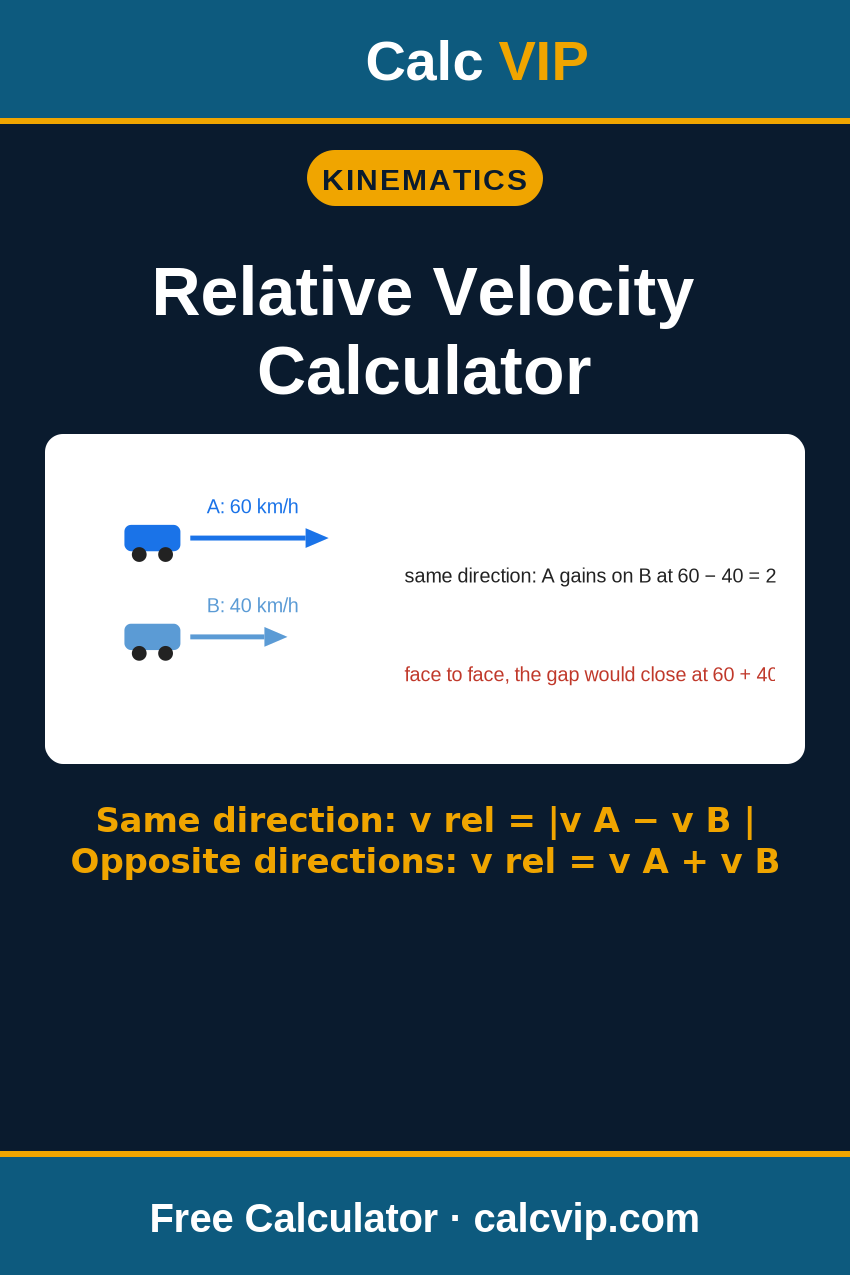
Example 1 — two cars, two stories. Car A travels at 60 km/h and car B at 40 km/h. In the same direction, the relative velocity is 60 − 40 = 20 km/h — from car B, car A pulls away slowly. In opposite directions, it is 60 + 40 = 100 km/h — they approach each other very fast. Same cars, same speeds; only the relationship changed, and with it the entire physical situation.
Example 2 — the meeting trains. Two trains approach on parallel tracks at 90 km/h and 110 km/h. Closing speed = 90 + 110 = 200 km/h. If they are 10 km apart, they meet in 10 ÷ 200 = 0.05 h = 3 minutes — the classic timetable problem, solved by adding first and dividing second.
Example 3 — the patient overtake. A car at 100 km/h catches a truck at 80 km/h on a straight road: relative velocity 20 km/h = 5.56 m/s. To gain 500 m on the truck takes 500 ÷ 5.56 = 90 s — a full minute and a half spent in the overtaking lane, which is why experienced drivers wait for a proper gap rather than trusting to a small speed advantage.
Example 4 — the boat on the river. A boat that makes 5 m/s in still water travels a river flowing at 2 m/s. Relative to the bank, downstream it moves at 5 + 2 = 7 m/s (the water is its moving viewpoint, adding its flow); upstream it manages 5 − 2 = 3 m/s. Relative to the water itself, it is 5 m/s both ways — three frames, three correct answers, one boat.
Example 5 — the airliner and the wind. A jet's airspeed is 250 m/s. With a 20 m/s headwind its ground speed is 250 − 20 = 230 m/s; with the same wind behind it, 250 + 20 = 270 m/s. Over a 1,150 km leg that difference is worth roughly twelve minutes of flight time — the entire economics of wind-aware routing in one subtraction.
Example 6 — walking inside a train. A train moves at 30 m/s. A passenger walks the aisle at 1.5 m/s towards the front: relative to the ground she moves at 30 + 1.5 = 31.5 m/s. Walking back towards the rear: 30 − 1.5 = 28.5 m/s. Relative to the train she is 1.5 m/s either way — the frame decides which of the three numbers answers your question.
Relative velocity in real life
Collision avoidance at sea and in the air. Radar systems plot other vessels in relative motion: a ship that stays at a constant bearing while the range closes is on a collision course, whatever its compass heading. The "closest point of approach" calculations behind every course change are this page's gap ÷ closing-speed arithmetic, automated.
Mid-air refuelling and spacecraft docking. A tanker and receiver fly formation with relative velocity trimmed to zero, then close the final metres at a relative speed of centimetres per second. Docking a capsule to a station orbiting at 7.66 km/s is safe precisely because the relative velocity is nearly nil — matching speeds matters, absolute speeds do not.
River crossings and ferry glides. A ferry captain aiming straight across a tidal river lands downstream, because the water adds its velocity to the boat's. Pointing partly upstream — crabbing — cancels the drift: a two-dimensional relative-velocity problem solved by eye on every crossing.
Cycling and motorsport drafting. A rider tucked behind another at 45 km/h experiences air approaching at far less than 45 km/h — the lead rider has already paid part of the air's relative-velocity bill. Breakaways and slipstream overtakes are negotiations over who faces the full relative wind.
Conveyor belts, walkways and escalators. Airport walkways advertise their benefit in relative terms: walk at 1.4 m/s on a belt moving at 0.8 m/s and the terminal approaches at 2.2 m/s relative to you — a 57% speed gain for the same legs, purchased entirely by adding frames.
Weather on the move. A storm advancing at 40 km/h meets a driver heading into it at 90 km/h with a closing speed of 130 km/h: the rain arrives sooner and strikes harder than the forecast's ground-based numbers suggest. Sailors and storm-chasers plan with relative, not absolute, weather speeds.
When relative velocity turns two-dimensional
Everything above runs along one line, but the subtraction rule is really about vectors, and the rain on a car window shows it. Rain falls vertically at 8 m/s while the car drives at 12 m/s. From the ground, the rain has no sideways motion at all; from the car, the rain's velocity is the rain's ground velocity minus the car's — which hands the rain a sideways component of 12 m/s towards the car, on top of its 8 m/s downward. The streaks on the side window therefore slant at arctan(12 ÷ 8) ≈ 56° from vertical, and the rain's speed relative to the car is √(8² + 12²) = √208 ≈ 14.42 m/s — faster than either ingredient, because the car is driving into the fall. Pilots crabbing into crosswinds, swimmers aiming upstream of their target, and umbrellas tilted into a walk are all solving this same vector subtraction. This calculator covers the one-dimensional core; the two-dimensional version replaces "add or subtract" with "add or subtract, component by component".
Quick reference: meetings and overtakings
| Situation | Speeds | Relative velocity | Effect |
|---|---|---|---|
| Overtaking on a motorway | 100 and 80 km/h, same way | 20 km/h | gentle pass |
| Head-on, two cars | 50 and 50 km/h, opposing | 100 km/h | severe closing |
| Trains passing | 90 and 110 km/h, opposing | 200 km/h | 10 km gap closes in 3 min |
| Matched motorway pair | 90 and 90 km/h, same way | 0 km/h | frozen alongside |
| Boat downstream / upstream | 5 m/s boat, 2 m/s current | 7 m/s / 3 m/s vs bank | current helps or hinders |
| Jet with tailwind | 250 m/s airspeed, 20 m/s wind | 270 m/s vs ground | earlier arrival |
Keep the pattern rather than the numbers: the relative velocity is always the rate at which the gap changes, and every question about meetings, pursuits and collisions is that rate, a gap, and a division away from its answer.
Common mistakes
- Adding when you should subtract. Same direction means difference, opposite means sum. The picture to hold is the gap: ask whether both motions shrink it (add), or only the excess of one over the other does (subtract).
- Mixing units between the two objects. 60 km/h and 15 m/s cannot be combined until they match: 15 m/s is 54 km/h, so the true relative velocity is 6 km/h, not 45 of anything. Convert first — this calculator forces a single unit for both, deliberately.
- Reporting a speed when the question wants a time. "When do they meet?" needs gap ÷ relative velocity after the relative velocity itself. Many exam answers stop one step early, holding the right number for the wrong question.
- Forgetting the observer in boat and plane problems. Airspeed and water speed are relative to the air and water; ground speed is relative to the ground. Problems that mix the two frames mid-sentence are designed to catch exactly this slip.
- Believing a zero relative velocity means nothing is moving. Two jets in formation have zero relative velocity and 900 km/h of absolute velocity each. Zero relative motion means the relationship is frozen — which is precisely what makes formation flight and docking possible.
FAQ
What does relative velocity mean?
It is the velocity of one object as measured by an observer riding on the other object. It tells you how quickly the gap between them grows or shrinks.
Why do opposite directions add up?
When two objects move towards each other, the distance between them shrinks by both amounts at once, so their speeds add.
Can relative velocity be zero?
Yes — if two objects move in the same direction at the same speed, each appears stationary to the other, like two cars side by side on a motorway.
Is relative velocity the same from both viewpoints?
In size, yes: if A sees B approaching at 20 km/h, B sees A approaching at 20 km/h. Only the direction (the sign) flips. The gap does not care which end you measure it from.
How do I find the time until two objects meet?
Divide the gap between them by the closing speed. Two trains 10 km apart closing at 200 km/h meet in 0.05 hours — 3 minutes. For objects moving apart, the same division gives the time to open a chosen gap.
What about objects moving apart in the same direction?
The faster one's excess speed is the separating rate: a 100 km/h car leaving an 80 km/h truck opens the gap at 20 km/h, so after half an hour they are 10 km apart.
Does relative velocity work for objects moving at an angle to each other?
Yes, but as vectors: subtract component by component. The rain example in the depth section shows the pattern — the result is generally larger than either speed and points diagonally.
Why do passengers feel no wind in a moving car with the windows up?
Because the air inside moves with the car: its velocity relative to the passengers is zero. Open a window and the outside air, stationary relative to the ground, suddenly has a relative velocity equal to the car's full speed — the blast is relative velocity made tangible.
What is the relative velocity of two light beams approaching head-on?
Exactly c, not 2c. Near light speed Galileo's addition gives way to Einstein's formula, which caps every relative velocity at the speed of light. For all ordinary vehicles the simple rules on this page are indistinguishable from exact.
Can relative velocity be negative?
As a signed quantity, yes: the sign records direction — closing versus separating, gaining versus falling behind. This calculator reports the size and describes the direction in words, which is how the idea is usually needed.