 Calc
Relativistic Energy Calculator – E = γmc² & Kinetic Energy (γ−1)mc²
 Created by Yuki Tanaka · Physics Editor · Modern Physics · Last updated: November 2026
Use this free Relativistic Energy Calculator to find the total energy of a fast-moving particle, E = γmc², together with its rest energy mc² and its relativistic kinetic energy KE = (γ − 1)mc² — the formulas that replace ½mv² near light speed.
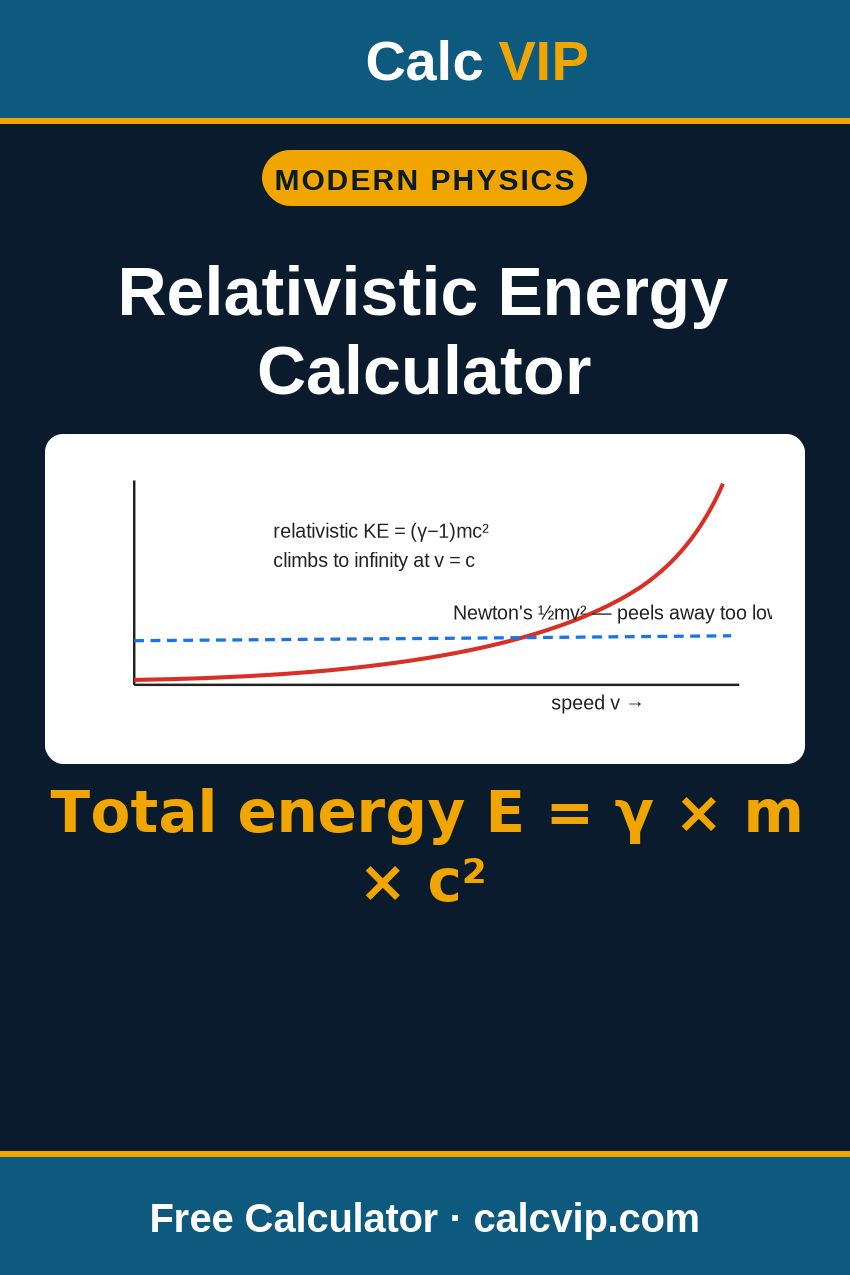
Newton's kinetic energy, ½mv², is a low-speed approximation — superb for cricket balls, quietly wrong for electrons in a TV tube, and catastrophically wrong in a particle accelerator. Einstein's replacement, computed here, splits a moving object's energy into two parts: the rest energy mc² it has merely by existing, and the kinetic energy (γ − 1)mc² it gains by moving, where γ = 1/√(1 − v²/c²) is the Lorentz factor. At walking pace γ − 1 is so small that (γ − 1)mc² and ½mv² agree to many decimal places; at 0.8c they differ by a factor of two; at 0.99c, by a factor of twelve. This calculator keeps the honest books at any speed.
The split explains the universe's speed limit in one glance. As v approaches c, γ races to infinity, so the kinetic energy required grows beyond any bound: each additional increment of speed costs more than the last, and the final increment — actually reaching c — would cost infinite energy. Nothing with mass can pay it. Accelerators live on this curve: the LHC's protons, at γ ≈ 6900, carry 6.5 trillion electron-volts each not because they are going meaningfully faster than a 100 GeV proton in any stopwatch sense (both are within a hair of c) but because γ, and with it their energy, is seventy times larger. Near light speed, "faster" stops meaning speed and starts meaning energy.
Working in electron-volts keeps the numbers human. An electron's rest energy is 0.512 MeV; give it another 0.341 MeV of kinetic energy and it moves at 0.8c (Example 1). A proton's rest energy is 939.9 MeV with the constants used here. These rest energies are the currency of particle physics: collisions spend kinetic energy and mint new particles whose rest energies are paid from the takings, so every accelerator experiment is, at bottom, arithmetic of the kind this calculator performs — total energy in, rest energies out, the difference left as motion.
Formula
Total energy E = γ × m × c² • Rest energy E₀ = m × c² • Kinetic energy KE = (γ − 1) × m × c² • γ = 1 ÷ √(1 − β²)
The three quantities are one identity viewed three ways: E = E₀ + KE. Rearranged, the formulas answer the inverse questions: γ = E ÷ E₀ from a known total energy, β = √(1 − 1/γ²) for the speed that energy implies, and KE = E − E₀ whenever total and rest energies are quoted. Momentum joins the family through E² = (pc)² + (mc²)², the complete energy–momentum relation, of which this page's formulas are the p-written-differently special case. Units discipline: masses in kilograms give joules; particle physicists skip the conversion by quoting rest energies directly in MeV (electron 0.512, proton 939.9 with these constants) and doing the whole calculation in energy units — try it in the examples and watch the arithmetic simplify.
| Symbol | Meaning | Units |
|---|---|---|
| E | total energy (rest + kinetic) | J (or MeV) |
| E₀ | rest energy, mc² | J (or MeV) |
| KE | relativistic kinetic energy, (γ − 1)mc² | J (or MeV) |
| γ | Lorentz factor | dimensionless |
| m | rest mass (invariant — never changes) | kg |
| β | speed as a fraction of c | dimensionless |
Where ½mv² goes wrong — and where it survives
Expand γ in powers of speed and the secret is revealed: γ = 1 + ½β² + ⅜β⁴ + …, so KE = (γ − 1)mc² = ½mv² + ⅜mv⁴/c² + …. Newton's formula is literally the first term of Einstein's — an approximation that discards everything after ½mv². The discarded terms stay negligible while β is small: at 0.1c they add just 0.75% (Example 5), at 0.5c about 9%, and beyond that they take over entirely. This is why engineers of bridges and ballistics may keep Newton forever, while designers of electron microscopes (electrons at 0.3–0.7c), accelerator magnets and GPS signal timing may not: their particles live exactly where the correction terms stop being corrections.
The same expansion explains the speed limit's softness. There is no wall at c, no barrier to crash into — only a price curve that steepens without end. Doubling an electron's energy from 0.5 MeV to 1 MeV of KE raises its speed from 0.86c to 0.94c; the next doubling buys 0.985c; the next, 0.996c. Each equal payment purchases a smaller slice of the remaining gap, and the gap never closes. When accelerator physicists speak of a beam's "energy" rather than its speed, this is why: near c, energy is the variable that still moves.
How to use
- Pick the particle — electron or proton — or choose "Custom mass" and enter any rest mass in kilograms.
- Enter the speed as a fraction of light speed (0.8 means 0.8c); it must be less than 1.
- Click "Calculate Relativistic Energy" to see γ, the rest energy, total energy and kinetic energy, each in joules and MeV.
- Compare with Newton: compute ½mv² for the same speed and note the ratio — below about 0.2c the difference is under 2%; by 0.8c the classical answer is barely half the true KE.
Worked examples
Example 1 — an electron at 0.8c. γ = 1.667; the electron's rest energy is 0.512 MeV.
Total E = 1.667 × 0.512 = 0.853 MeV; KE = (1.667 − 1) × 0.512 = 0.341 MeV. Newton's ½mv² gives only 0.5 × 0.64 × 0.512 = 0.164 MeV — less than half the true kinetic energy. At the speed of an electron in a modest accelerator, classical physics is not approximately right; it is simply wrong.
Example 2 — an electron at 0.99c. γ = 7.089: total E = 7.089 × 0.512 = 3.628 MeV, KE = 6.089 × 0.512 = 3.116 MeV. The classical prediction is 0.251 MeV — twelve times too small. Note the bookkeeping: at this speed the electron's kinetic energy is six times its entire rest energy; most of what the particle "is", energetically, is now motion.
Example 3 — a proton at 0.9c. γ = 2.294; proton rest energy 939.9 MeV.
Total E = 2.294 × 939.9 = 2156 MeV; KE = 1.294 × 939.9 = 1216 MeV ≈ 1.22 GeV. Cosmic rays of this energy strike the atmosphere constantly; accelerators reached it in the 1950s, and it is the energy scale where proton collisions begin producing new particles in earnest.
Example 4 — the LHC proton. A 6.5 TeV kinetic energy means γ = 1 + 6,500,000 ÷ 939.9 ≈ 6917. Its speed follows from β = √(1 − 1/γ²): it falls short of light speed by only c ÷ (2γ²) ≈ 3.1 m/s — walking pace, out of 3 × 10⁸. Humanity's fastest macroscopic objects are separated from light speed by less than the speed of a bicycle, and closing even that gap would need infinite energy.
Example 5 — a kilogram at 0.1c: Newton nearly survives. γ = 1.00504, so KE = 0.00504 × 9 × 1016 = 4.53 × 10¹⁴ J, against the classical ½ × 1 × (3 × 107)² = 4.50 × 10¹⁴ J — a difference of just 0.75%. At a tenth of light speed Einstein's correction is a refinement; the examples above show how quickly it becomes the whole story.
Example 6 — from voltage to velocity. An electron accelerated through 1 million volts gains KE = 1 MeV. Then γ = 1 + 1 ÷ 0.512 = 2.954, and β = √(1 − 1/2.954²) = 0.941 — the electron emerges at 0.941c. Newton would have predicted √(2 × 1 ÷ 0.512) × c… a speed of 1.98c, an impossibility that shows the classical formula doesn't merely err at these energies; it breaks its own universe's speed limit.
Relativistic energy in real life
Particle accelerators. Every collider's design begins here: magnet strengths, tunnel sizes and collision energies are all specified in γ and GeV from these formulas. The Higgs boson was found by colliding protons whose combined kinetic energy could pay its 125 GeV rest energy — this calculator's arithmetic, at industrial scale.
Electron microscopes and old television tubes. A 100 keV microscope electron has γ = 1.196 and moves at 0.55c; its wavelength (which sets the resolution) must be computed relativistically, and was in the de Broglie calculator's terms. Even a humble CRT television ran electrons at ~0.3c, where Newton's error already reaches several percent.
Radiation therapy. Medical linacs accelerate electrons to 4–25 MeV (γ up to ~50) to generate treatment X-rays or to treat directly. Dose planning uses relativistic energies throughout — the "MeV" on the machine's dial is this page's KE.
Cosmic rays. The most energetic particles known arrive with energies up to 3 × 10²⁰ eV — a proton with γ ≈ 3 × 10¹¹, carrying the kinetic energy of a well-struck tennis ball in a single subatomic particle. Their energies are quoted from this formula because their speeds are indistinguishable from c.
Antimatter production and storage. Making an antiproton requires a collision energetic enough to pay its 939.9 MeV rest energy twice over (particle plus antiparticle) with kinetic energy to spare — the reason antiproton factories are accelerators, and antimatter is the most expensive substance on Earth.
GPS and deep-space navigation (again). The same γ that stretches clock rates (time dilation) is the one in this energy formula — a single factor governing both. Spacecraft navigation software applies it to signals and clocks alike; the unity of the concept is why one constant-laden factor appears across so many calculators.
Quick reference: γ and energy milestones
| Speed | γ | Electron KE | KE ÷ ½mv² (Newton error) |
|---|---|---|---|
| 0.1c | 1.005 | 0.00258 MeV | 1.008× |
| 0.5c | 1.155 | 0.0792 MeV | 1.24× |
| 0.8c | 1.667 | 0.341 MeV | 2.08× |
| 0.9c | 2.294 | 0.662 MeV | 3.19× |
| 0.99c | 7.089 | 3.116 MeV | 12.4× |
| 0.999c | 22.37 | 10.93 MeV | 42.8× |
Check one row by hand: at 0.5c, KE = (1.155 − 1) × 0.512 = 0.0792 MeV, while Newton offers ½ × 0.25 × 0.512 = 0.064 MeV — already 24% short at merely half light speed. The last column is the obituary of classical kinetic energy, written in factors.
The complete relation: E² = (pc)² + (mc²)²
This calculator's formulas are one face of a deeper identity linking energy, momentum and mass: E² = (pc)² + (mc²)². Set the momentum to zero and it returns E = mc²; set the mass to zero and it returns E = pc, the photon's rule — light carries energy and momentum while having no rest energy at all, which is why it must always travel at c. For a moving particle the identity is also the practical tool: accelerator physicists routinely measure a particle's momentum (from how little its track bends in a magnet) and compute its energy from this relation rather than from γ, because momentum is what detectors see. It also defines the invariant mass of a whole system — total energy and total momentum combined through this formula give a mass that every observer agrees on, even when the system is a spray of particles flying apart. When the Higgs boson was reconstructed from two photons, this identity — applied to the pair — is what produced its famous 125 GeV mass peak.
Mass does not increase — energy does
Older textbooks spoke of "relativistic mass" growing with speed, m → γm. Modern physics has abandoned that language, deliberately: mass is a fixed, frame-independent property (the rest mass, the m in every formula on this page), and what grows with speed is energy and momentum. The change is more than tidiness. "Relativistic mass" misleads — it suggests the object would gravitate more in all directions and resist acceleration equally from every side, neither of which is true. Keeping m constant and letting E = γmc² carry the growth, as this calculator does, gives the same numbers with none of the false pictures. When you read that the LHC proton is "heavier", translate: it is more energetic, by exactly the factor γ its rest energy has been multiplied.
The same γ explains why the largest electron colliders hit an energy ceiling that proton machines escape. A charged particle forced around a curve radiates — synchrotron radiation — and the power radiated grows as γ⁴ for a given ring. LEP, CERN's great electron–positron collider, pushed electrons to 104.5 GeV (γ ≈ 200,000) and was losing several GeV per turn to this glow; going further in a ring became unaffordable, which is why future electron colliders are designed straight (linear) while protons — 1,836 times heavier, radiating ~(1/1836)⁴ as much — still enjoy rings. One factor γ, computed by this page, quietly dictated the architecture of two generations of machines.
Common mistakes
- Using ½mv² at accelerator speeds. The classical formula is the first term of a series; at 0.8c it underestimates KE by a factor of 2, at 0.99c by a factor of 12. If β exceeds ~0.2, switch to (γ − 1)mc².
- Reporting total energy as kinetic energy. E = γmc² includes the rest energy. A "3.6 MeV electron" at 0.99c has 3.116 MeV of kinetic energy; conflating the two overstates beam energies throughout particle physics.
- Saying the mass increases. The rest mass never changes; γ multiplies energy and momentum. (See the depth section — the older "relativistic mass" phrasing survives in popular writing but not in the physics.)
- Entering the speed in m/s. This calculator wants β, the fraction of c. 0.8 is 0.8c; 240,000,000 is an error message waiting to happen.
- Expecting a finite energy to reach exactly c. γ → ∞ as β → 1, so KE → ∞. Any calculation that lands a massive particle at β = 1 with finite energy has gone wrong upstream.
FAQ
Why can't a particle reach light speed?
As v → c, γ → infinity, so the kinetic energy needed grows without limit. No finite amount of energy can get a massive particle all the way to c.
What is the electron's rest energy used for?
0.511 MeV is a famous constant in particle physics: a positron and electron annihilating produce two gamma photons of 0.511 MeV each — the signal used in PET medical scanners.
Does the particle's mass increase with speed?
Modern physics keeps mass fixed (the rest mass) and puts the γ into the energy and momentum instead. The energy grows — the invariant mass does not.
What is the difference between total energy and kinetic energy here?
Total energy E = γmc² counts everything, including the mc² the particle has at rest. Kinetic energy is the extra due to motion, (γ − 1)mc². Accelerators are rated by the kinetic part (plus rest, in "total energy" conventions) — always check which a problem wants.
How much energy would it take to fly a 1 kg probe at 0.9c?
KE = (2.294 − 1) × 9 × 1016 ≈ 1.16 × 10¹⁷ J — roughly the annual electricity consumption of a mid-sized country, for one kilogram, before any engineering inefficiency. This is why interstellar probes remain thought experiments.
Why do physicists quote energies in GeV instead of speeds?
Because near c, speed stops being informative: 6.5 TeV and 7 TeV protons differ in speed by centimetres per second but in energy — the thing collisions spend — by 8%. Energy is the currency; speed is small change near the limit.
Where does the extra energy go when a fast particle stops?
Into whatever stops it: heat, ionisation, and — in collisions at high enough energy — new particles' rest energy. A cosmic-ray proton's γ-energy ends as a shower of secondary particles and, ultimately, warmth in the ground.
Is E = γmc² consistent with E = mc²?
It contains it: at rest γ = 1 and the formula reduces to E = mc² exactly. The mass–energy calculator is this one evaluated at β = 0.
What is the most energetic particle ever detected?
The 1991 "Oh-My-God particle", a cosmic ray (probably a proton) with about 3.2 × 10²⁰ eV ≈ 51 joules of kinetic energy — γ ≈ 3 × 10¹¹. A single nucleus carrying the energy of a served tennis ball; nothing since has beaten it.
Can kinetic energy exceed the rest energy?
Easily — it happens whenever γ > 2, i.e. above 0.866c. LHC protons carry kinetic energy nearly 7,000 times their rest energy; for them, rest energy is a rounding error in their own budget.