 Calc
Relativistic Momentum Calculator – p = γmv vs Classical mv
 Created by Yuki Tanaka · Physics Editor · Modern Physics · Last updated: November 2026
Use this free Relativistic Momentum Calculator to find the true momentum p = γmv of a fast particle, and compare it with the classical value mv. The difference becomes huge as the speed approaches the speed of light.
Newton's momentum, p = mv, is a low-speed approximation — superb for baseballs, bankrupt for particles near light speed. Special relativity repairs it with a single factor: p = γmv, where the Lorentz factor γ = 1/√(1 − v²/c²) inflates the momentum as v approaches c. This calculator evaluates the true momentum for an electron, a proton or any custom mass at any fraction of light speed, and places the classical value beside it so the size of Newton's error is always visible.
The factor γ is the whole story. At β = v/c = 0.1 it is 1.005, a half-percent correction nobody needs. At 0.5c it is 1.155; at 0.8c, 1.667; at 0.99c, 7.089; and it climbs without limit as β → 1. Because γ multiplies the momentum, the momentum can grow forever while the speed asymptotes to c — pushing a fast particle harder mostly buys γ, not velocity. That single fact dictates the engineering of every particle accelerator: their magnets must bend beams whose momenta are γ times the classical guess, and a designer who trusted mv would build a machine that loses its beam at the first turn.
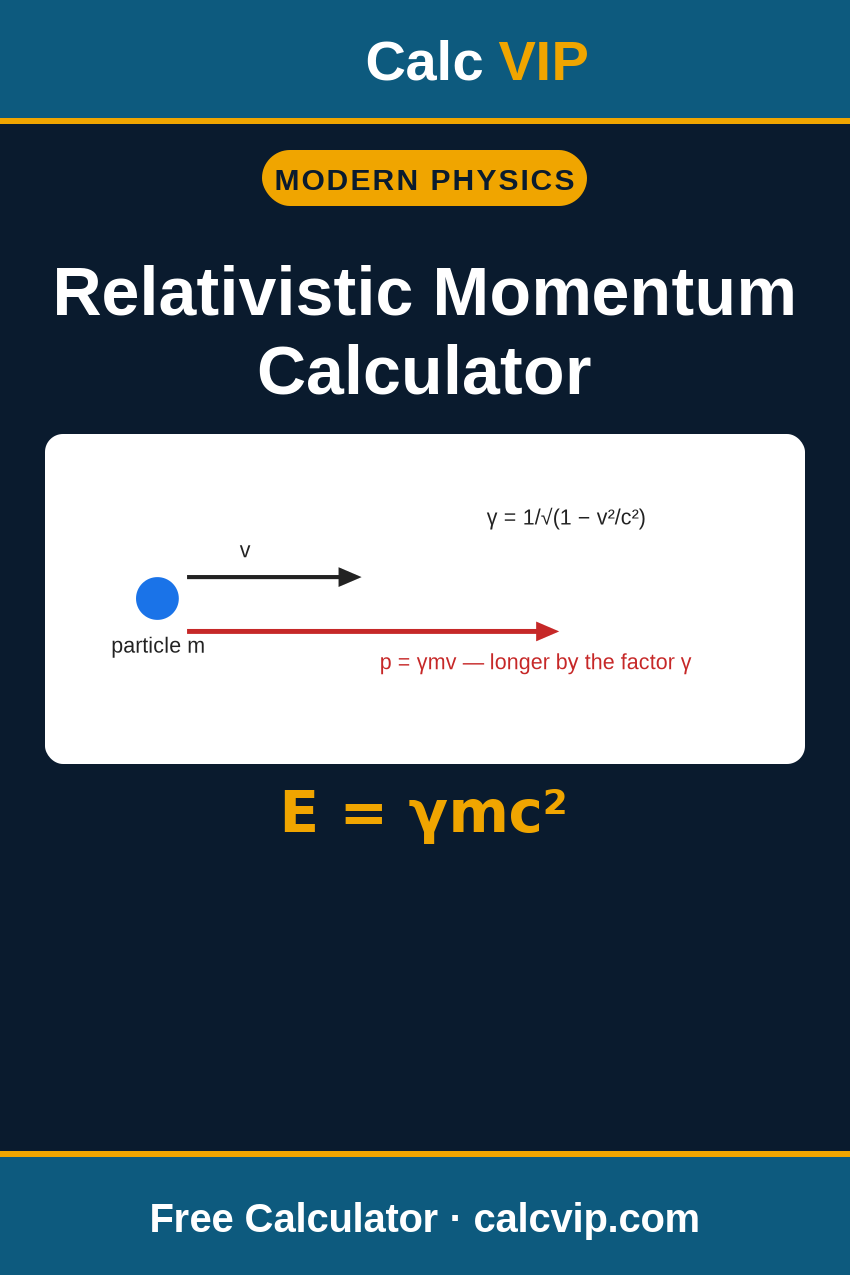
Why should momentum be redefined at all? Because momentum's job is to be conserved, and mv is not conserved in collisions when speeds approach c — different observers would disagree about whether it balanced. The quantity γmv is conserved for everyone, which is why relativity adopts it. It also slots into the energy relation E² = (pc)² + (mc²)², with total energy E = γmc²: momentum and energy become two faces of one conserved four-vector. This page's modest calculator is thus a window on the deepest bookkeeping in physics — enter a mass and a β, and watch Newton's ledger and Einstein's diverge.
Formula
In special relativity, momentum is p = γmv, where the Lorentz factor is γ = 1/√(1 − v²/c²). At everyday speeds γ ≈ 1 and the formula reduces to Newton's p = mv, but γ grows without limit as v → c — which is one way of seeing why no massive particle can ever quite reach light speed. The formula's companions are worth having beside it: total energy E = γmc², kinetic energy KE = (γ − 1)mc², and the invariant relation E² = (pc)² + (mc²)², which lets you cross-check any momentum against its energy. A useful accelerator form eliminates v entirely: given the kinetic energy in eV, p follows from pc = √(KE² + 2·KE·mc²). This calculator takes the speed as β = v/c directly, so γ is one square root away.
| Symbol | Meaning | Units |
|---|---|---|
| p | relativistic momentum | kg·m/s |
| γ | Lorentz factor, 1/√(1 − β²) | dimensionless, ≥ 1 |
| β | speed as a fraction of light speed, v/c | 0 ≤ β < 1 |
| m | rest mass of the particle | kg |
| c | speed of light, 3 × 10⁸ | m/s |
Conservation is the reason: why γ had to join the formula
Momentum is not conserved because nature loves the symbol p; it is conserved because space is uniform — the laws are the same here and one metre over — and Noether's theorem turns that symmetry into a conserved quantity. The catch is that the form of the conserved quantity depends on the spacetime geometry. In Newton's Galilean world it is mv. In Einstein's world, where velocities combine by the relativistic rule and simultaneity is relative, mv fails: two observers watching the same elastic collision, moving relative to each other, would compute different total mv before and after. The γmv definition is the unique repair — with it, every observer, in every frame, agrees the books balance. When a formula must be true for everyone, it tends to be the right one.
The repair has a physical personality worth picturing. As a particle is pushed toward c, each additional unit of momentum buys less and less speed: at γ = 7 (β = 0.99), doubling the momentum to γ ≈ 14 moves β only to 0.9974. The speedometer freezes while the momentum gauge spins on — that is the operational meaning of c as a limit. Older texts described this as "relativistic mass increase", m becoming γm; the modern convention keeps m as the invariant rest mass and lets γ live with the motion, in p and E. The calculator follows the modern convention: enter the rest mass, and γ does all the running.
How to use
- Choose the particle (electron, proton, or a custom rest mass in kg).
- Enter the speed as a fraction of c — for example 0.8 means 0.8c. It must be less than 1.
- Click "Calculate Relativistic Momentum" to see γ, the relativistic momentum, and the classical value for comparison.
- Divide the two momenta: the ratio is exactly γ — a quick check that the relativistic correction, nothing else, separates them.
Worked examples
Example 1 — an electron at 0.8c.
γ = 1/√(1 − 0.8²) = 1/√0.36 = 1.667.
Relativistic momentum: p = γmv = 1.667 × 9.11 × 10⁻³¹ × 0.8 × 3 × 10⁸ = 3.64 × 10⁻²² kg·m/s.
Classical physics would say mv = 2.19 × 10⁻²² kg·m/s — an underestimate by a factor of 1.667. Particle accelerators must use the relativistic value, or their magnets would be set wrong.
Example 2 — a proton at 0.5c. γ = 1/√(1 − 0.25) = 1.155.
p = 1.155 × 1.673 × 10⁻²⁷ × 1.5 × 10⁸ = 2.90 × 10⁻¹⁹ kg·m/s, against a classical 2.51 × 10⁻¹⁹. Even at "only" half light speed, Newton is already 15% short — medical proton-therapy machines live in this regime and design for it.
Example 3 — an electron at 0.99c. γ = 1/√(1 − 0.9801) = 7.089.
p = 7.089 × 9.11 × 10⁻³¹ × 2.97 × 10⁸ = 1.92 × 10⁻²¹ kg·m/s; classical mv = 2.71 × 10⁻²². The speed rose 24% from Example 1; the momentum rose more than fivefold. The momentum gauge, not the speedometer, is the honest instrument near c.
Example 4 — an LHC-class proton. At β = 0.9999, γ = 70.71.
p = 70.71 × 1.673 × 10⁻²⁷ × 0.9999 × 3 × 10⁸ = 3.55 × 10⁻¹⁷ kg·m/s. The LHC pushes further still, to γ ≈ 7,460 at 7 TeV, where p ≈ 3.75 × 10⁻¹⁵ kg·m/s — a macroscopic-sounding momentum carried by one proton, and the reason its bending magnets are superconducting giants.
Example 5 — a muon at 0.98c. A muon (m = 1.884 × 10⁻²⁸ kg, custom-mass mode) at β = 0.98 has γ = 5.025.
p = 5.025 × 1.884 × 10⁻²⁸ × 2.94 × 10⁸ = 2.78 × 10⁻¹⁹ kg·m/s, five times its classical 5.54 × 10⁻²⁰. Cosmic-ray muons like this one reach the ground only because the same γ stretches their 2.2 µs lifetime — momentum and time dilation are one package.
Example 6 — a car, for contrast. A 1,000 kg car at 30 m/s has β = 10⁻⁷ and γ − 1 ≈ 5 × 10⁻¹⁵.
p = γmv = 30,000 kg·m/s, identical to Newton's value at any sane precision. Relativity does not correct everyday life; it merely explains why the correction is beneath notice — γ's departure from 1 is quadratic in the tiny β.
Relativistic momentum in real life
Accelerator magnet design. A beam's bending rigidity is Bρ = p/q — momentum per charge sets the magnet strength and ring radius. Every synchrotron on Earth is sized by γmv, not mv.
Proton therapy. Cancer treatment beams at ~0.5c are steered and dosed with relativistic momentum calculations; a classical error of 15% would misplace the dose entirely.
Cosmic-ray physics. The most energetic cosmic rays carry momenta ~10¹¹ times an LHC proton's. Their interactions are analysed wholly in relativistic momentum-energy bookkeeping.
Muon lifetime experiments. The classic proof of time dilation counts muons surviving a journey their classical lifetime forbids; the same γ appears in their momentum, tying the two effects together quantitatively.
Electron microscopes revisited. At 300 kV the electron's β is 0.78 and γ is 1.59 — its momentum is 59% above the classical value, which is why high-end microscope optics use relativistic momenta (and the wavelength correction of the companion calculator).
Spacecraft shielding. Galactic cosmic rays arrive at γ of tens to thousands; shielding design starts from their momenta and energies, not their (nearly identical) speeds.
Magnetic rigidity: momentum you can bend
Accelerator engineers rarely quote momentum in kg·m/s; they quote rigidity, Bρ = p/q, in tesla-metres — the product of magnetic field and bending radius that a particle's momentum demands. For a singly charged particle, Bρ(T·m) ≈ p(GeV/c)/0.2998 with the momentum expressed in the particle physicist's unit, GeV/c. Example 4's proton at 0.9999c carries pc = γmvc ≈ 70.71 × 938 MeV ≈ 66.3 GeV... more precisely p = 3.55 × 10⁻¹⁷ kg·m/s corresponds to pc = 1.06 × 10⁻⁸ J ≈ 66 GeV, demanding Bρ ≈ 221 T·m — beyond any ring but a thought experiment, while the real LHC's 7 TeV protons (pc = 7,000 GeV) need Bρ ≈ 23,350 T·m, supplied as 8.3 T × 2,800 m of bending radius. Momentum is not an abstraction in this field; it is poured concrete and superconducting cable.
Quick reference: the Lorentz factor
| β = v/c | γ | Newton's error | Where it occurs |
|---|---|---|---|
| 0.1 | 1.005 | 0.5% | fast cathode-ray electrons |
| 0.5 | 1.155 | 15% | proton therapy beams |
| 0.8 | 1.667 | 67% | Example 1's electron |
| 0.9 | 2.294 | 129% | research linac electrons |
| 0.99 | 7.089 | 609% | collider injection energies |
| 0.999 | 22.37 | 2,137% | approaching collider operation |
Why colliders exist: momentum bookkeeping and the threshold trick
The deepest everyday use of relativistic momentum is deciding how much energy a reaction needs. Consider manufacturing antimatter: p + p → p + p + p + p̄, making an antiproton. Energy–momentum conservation is most easily audited in the centre-of-momentum frame, where the rule is simple — the total energy there must reach the rest energy of everything produced, 4mpc². Transforming back to a laboratory where one proton sits still as a target, the beam proton must bring a total energy of 7mpc², i.e. a kinetic energy of 6mpc² = 5.64 GeV — the famous threshold the Berkeley Bevatron was built, in 1955, to cross, winning the antiproton's discovery. The "wasted" energy is the tax momentum conservation levies: the products must keep moving forward to conserve momentum, so not all the beam's energy is available for creating mass. Colliders abolish the tax by colliding two beams head-on — the centre-of-momentum frame is the laboratory itself — and the same reaction then needs each proton to carry only mpc² ≈ 0.94 GeV of kinetic energy. That sixfold saving, multiplied across every reaction physicists crave, is the entire economic argument for colliders, and it is written in the language of this page: γ, β, and momentum that refuses to be created or destroyed.
The invariant behind the trick deserves its name: for any system, E² − (pc)² is the same for every observer, equal to (Mc²)² with M the system's invariant mass. Single particles on this page have M = m; systems of particles have an M larger than the sum of their masses whenever they move relative to each other — the extra is kinetic energy wearing mass's clothing. Threshold calculations, collider design and cosmic-ray air-shower analysis are all, at bottom, accountants comparing this invariant before and after.
A one-line audit you can run on any particle
Take the 0.8c electron of Example 1 and audit it with the invariant. Its total energy is E = γmc² = 1.667 × 0.511 = 0.852 MeV; its momentum, in the energy units particle physicists prefer, is pc = γβmc² = 1.333 × 0.511 = 0.681 MeV. Now compute E² − (pc)² = 0.852² − 0.681² = 0.726 − 0.464 = 0.262 MeV², and take the root: 0.511 MeV — the electron's rest energy, recovered exactly. Any observer, in any frame, running this audit on the same electron gets 0.511 MeV, though their E and p values differ wildly. When a calculation in this area is suspected of error, this is the checksum: if E² − (pc)² does not return (mc²)², the arithmetic — not relativity — has slipped.
Common mistakes
- Entering v in m/s where β is expected. This calculator wants the fraction v/c. Typing 2.4 × 10⁸ instead of 0.8 breaks the γ formula (it would take √(1 − huge)) — always divide by c first.
- Trying β = 1. γ diverges there by design: infinite momentum would be needed. The calculator rejects β ≥ 1 because nature does.
- Calling γm a new mass. The rest mass never changes; γ multiplies momentum and energy. "Relativistic mass" is outdated language that confuses more than it explains — the invariant m is what belongs in the formula.
- Applying γ to the kinetic energy as ½γmv². KE is (γ − 1)mc², not a patched Newtonian expression. At 0.8c the electron's KE is 0.667 × 511 keV ≈ 341 keV, not ½γmv²'s different figure.
- Ignoring γ below 0.1c in precision work. "Only" 0.5% at 0.1c is enormous to an accelerator physicist or a metrologist. The classical formula's adequacy is a question of your error budget, not of speed alone.
FAQ
Why does momentum grow faster than speed near c?
Because γ → ∞ as v → c. The momentum can grow without limit even though the speed cannot pass c — pushing harder mostly raises γ, not v.
When is the classical formula good enough?
Below about 0.1c the error is under 0.5%, so mv is fine for everything from baseballs to rockets. Electrons in accelerators and cathode-ray tubes need the relativistic version.
Can I enter v = c?
No — γ becomes infinite, which is the mathematics telling you a massive particle cannot reach light speed. Only massless particles (photons) travel at c.
What momentum unit do particle physicists use?
GeV/c — momentum quoted as an energy divided by c. An electron at 0.8c has pc = γβmc² = 1.667 × 0.8 × 0.511 MeV ≈ 0.681 MeV, so p = 0.681 MeV/c (its total energy E = γmc² ≈ 0.852 MeV). The unit keeps E² = (pc)² + (mc²)² arithmetic painless.
Does a photon fit this formula?
No — it has m = 0 and β = 1 exactly, where γmv is 0 × ∞. Photons use p = E/c instead, the m → 0 limit of E² = (pc)² + (mc²)². The two formulas meet in that invariant relation.
How is γmv verified experimentally?
Directly, by bending beams: the magnetic field needed to curve a particle of known charge and measured speed returns p, and it tracks γmv to high precision — Kaufmann's electron experiments saw the departure from mv as early as 1901–1906, before relativity explained it.
What is the momentum of the fastest human-made object?
Macroscopically, the Parker Solar Probe at ~192 km/s has β ≈ 6.4 × 10⁻⁴ and γ − 1 ≈ 2 × 10⁻⁷ — Newtonian to exquisite precision. The relativistic league belongs to subatomic particles alone.
Why does momentum grow if mass is constant and speed nearly stops growing?
Because momentum in relativity measures total energy flow, not just bulk motion: E = γmc² grows with γ, and p = Ev/c²... precisely, p = γmv keeps conservation true in all frames. The growth is real — it is what the magnets feel — even though v saturates.
Can γ be measured without measuring v?
Yes: from kinetic energy, γ = 1 + KE/(mc²). A 1 GeV electron has γ ≈ 1 + 1000/0.511 ≈ 1,958 regardless of how its speed was (not) measured — often the practical route in accelerator control rooms.
Is relativistic momentum conserved in collisions?
Yes — that is its defining virtue. Total γmv (summed as vectors) and total γmc² are both conserved in every isolated collision, in every inertial frame; the classical pair (mv, ½mv²) manages that only at low speeds.