 Calc
Stopping Potential Calculator – Photoelectric Effect V_s Solver
 Created by Yuki Tanaka · Physics Editor · Modern Physics · Last updated: November 2026
Use this free Stopping Potential Calculator to find the stopping voltage Vs needed to halt the fastest photoelectrons when light of a given wavelength shines on a metal — a standard photoelectric-effect experiment calculation.
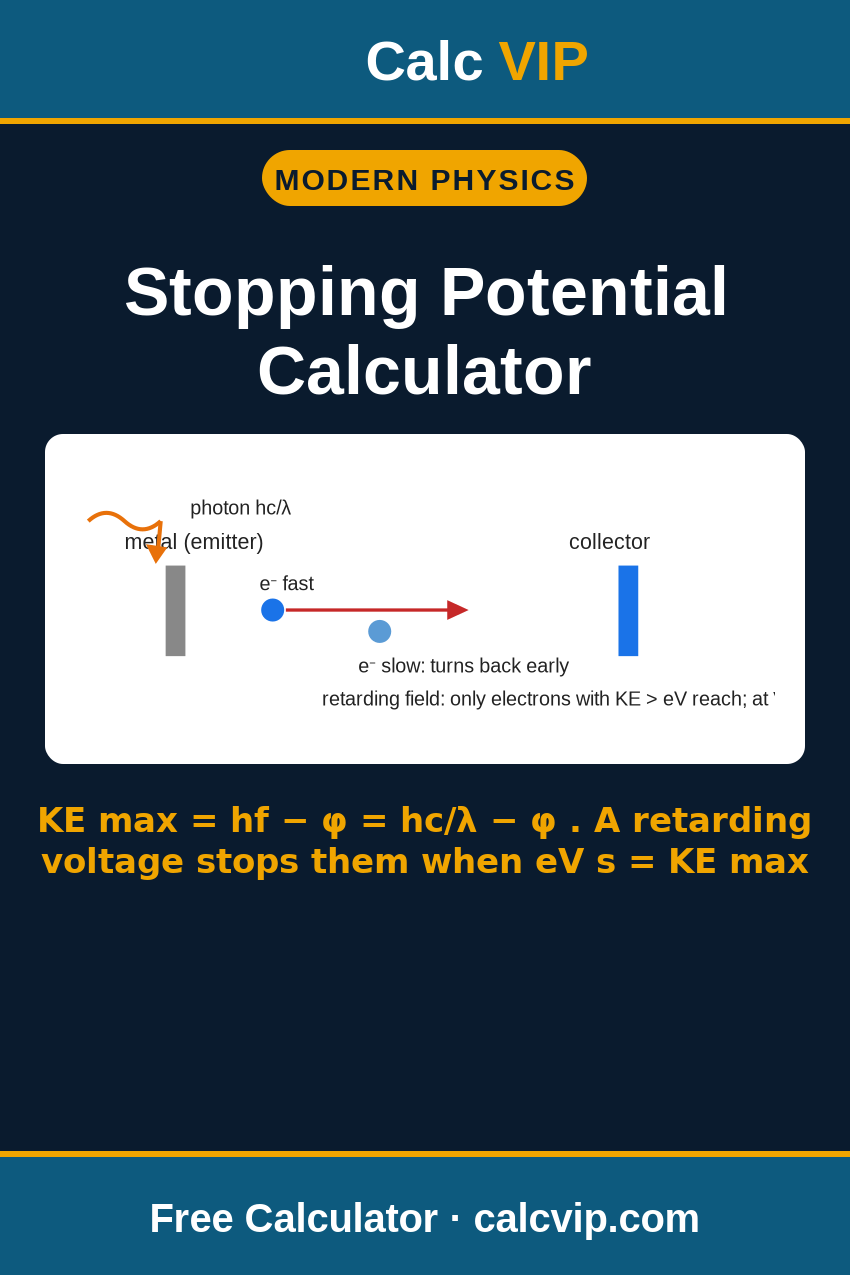
Shine light on a metal in a vacuum tube and electrons fly off — but how energetic are they? The stopping potential is the experiment that answers with a single voltage. A retarding voltage is applied between the emitting surface and a collector, pushing back against the incoming electrons. Turn it up until even the fastest electron just fails to arrive and the current dies: at that point the electrical work eVs exactly cancels the maximum kinetic energy, eVs = KEmax. This calculator works the same equation from the other side — given the light's wavelength and the metal's work function, it predicts the stopping voltage the experiment will find.
The formula is Einstein's photoelectric equation read backwards. A photon brings hf = hc/λ; escaping costs the work function φ; the surplus is the fastest electron's kinetic energy, KEmax = hc/λ − φ. Because one electron crossing one volt trades exactly one electron-volt of energy, the stopping potential in volts is numerically the kinetic energy in eV — a happy unit coincidence that makes photoelectric arithmetic unusually clean. Enter λ in nanometres, choose the metal, and the calculator returns the photon energy, KEmax in eV and joules, and Vs.
This humble measurement carries unusual historical weight. Between 1914 and 1916 Robert Millikan — who set out expecting to disprove Einstein — measured stopping potentials across frequencies with fanatical care and found the straight line Einstein predicted, its slope equal to h/e. From that slope came the first precise value of Planck's constant obtained from photoelectric data, and a sceptic's experiment became the photon theory's strongest witness. Every time you use this calculator you are re-running Millikan's plot at one frequency; the depth section below shows how a handful of such points reconstructs h itself.
Formula
Einstein's photoelectric equation gives the maximum kinetic energy of the emitted electrons: KEmax = hf − φ = hc/λ − φ. A retarding voltage stops them when eVs = KEmax, so Vs = (hc/λ − φ)/e. Working in electron-volts throughout makes the arithmetic transparent: the photon energy in eV is hc/(λe) ≈ 1240.8/λ(nm), subtract φ in eV, and the result is simultaneously KEmax in eV and Vs in volts. If the photon energy hc/λ is smaller than φ, no electrons are emitted at all and there is no stopping potential to measure — the calculator reports exactly that case rather than a negative voltage. Note that Vs characterises only the fastest electrons; most emerge slower, having lost energy on their way out of the metal.
| Symbol | Meaning | Units |
|---|---|---|
| Vs | stopping potential — retarding voltage that halts the fastest electrons | volts (V) |
| KEmax | maximum kinetic energy of emitted electrons | eV or J |
| λ | wavelength of the incident light | nm |
| φ | work function of the metal | eV |
| h, c, e | Planck's constant 6.626 × 10⁻³⁴ J·s; light speed 3 × 10⁸ m/s; electron charge 1.602 × 10⁻¹⁹ C | SI |
What the measurement really maps: an energy distribution with a hard ceiling
It is tempting to imagine all photoelectrons leaving with the same energy. They do not. Electrons start from different depths and different initial energies inside the metal, and they scatter on their way out, so the emitted beam carries a whole distribution of kinetic energies from zero up to KEmax. The stopping potential picks out the ceiling of that distribution — the rare electron that started at the surface with maximum energy and lost nothing. That is why the photocurrent does not switch off abruptly as the retarding voltage rises: it fades as progressively slower fractions of the beam are turned back, reaching zero only at Vs. The shape of that fade is itself data — photoelectron spectroscopy is built on reading energy distributions this way.
The ceiling, though, is law-like. It depends on exactly two things — the light's frequency and the metal's work function — and on nothing else: not the light's intensity (which sets only how many electrons fly), not the temperature, not the history of the sample. This austerity is what made the stopping potential the perfect courtroom for the photon theory. Wave theory predicted the ceiling should rise with brightness; Millikan's ceilings ignored brightness completely and tracked frequency with a straight line of slope h/e. One measured voltage, honestly interpreted, carried the whole quantum hypothesis.
How to use
- Enter the wavelength of the incoming light in nanometres.
- Pick the metal from the list, or choose "Custom φ" and type your own work function in eV.
- Click "Calculate Stopping Potential" to get the photon energy, KEmax and Vs.
- If the result reports no emission, the light is below the metal's threshold — shorten the wavelength or choose a lower-φ metal.
Worked examples
Example 1 — violet light on sodium. Light of λ = 400 nm shines on sodium (φ = 2.36 eV).
Photon energy = hc/λ = (6.626 × 10⁻³⁴ × 3 × 10⁸) / (400 × 10⁻⁹) = 4.97 × 10⁻¹⁹ J = 3.10 eV.
KEmax = 3.10 − 2.36 = 0.74 eV = 1.19 × 10⁻¹⁹ J, so the stopping potential is Vs = 0.74 V.
A retarding voltage of just 0.74 V is enough to stop even the fastest electrons — exactly how Millikan measured Planck's constant.
Example 2 — deeper into the UV. At λ = 300 nm on sodium: photon energy = 1240.8/300 = 4.14 eV.
KEmax = 4.14 − 2.36 = 1.78 eV (2.85 × 10⁻¹⁹ J), so Vs = 1.78 V. Shortening the wavelength by 100 nm more than doubled the stopping voltage — frequency, not brightness, is the lever.
Example 3 — blue light on sodium. At λ = 450 nm: photon energy = 2.76 eV.
KEmax = 2.76 − 2.36 = 0.40 eV, Vs = 0.40 V. The electrons emerge sluggishly; a breath of retarding voltage stops them.
Example 4 — the mercury UV line on zinc. A mercury lamp's λ = 254 nm line on zinc (φ = 4.3 eV): photon energy = 4.89 eV.
KEmax = 4.89 − 4.30 = 0.59 eV, Vs = 0.59 V. Zinc ignores the lamp's visible lines entirely (they are below its threshold) and answers only this ultraviolet one.
Example 5 — green light on caesium. At λ = 500 nm on caesium (φ = 2.1 eV): photon energy = 2.48 eV.
KEmax = 2.48 − 2.10 = 0.38 eV, Vs = 0.38 V. Caesium's loose grip makes even green light productive — the working principle of the classic photocell.
Example 6 — when nothing happens. At λ = 600 nm on sodium: photon energy = 2.07 eV, which is less than φ = 2.36 eV.
KEmax would be −0.29 eV — impossible. No electrons are emitted, the photocurrent is zero at every retarding voltage, and there is no stopping potential to measure. The calculator reports this case explicitly.
Stopping potentials in real life
Measuring Planck's constant. The undergraduate laboratory's finest experiment: measure Vs at several frequencies, plot, and read h from the slope — metrology from a voltmeter and this equation.
Photoelectron spectroscopy (XPS/UPS). Analytical instruments measure electron energy distributions from surfaces to identify elements and chemical states; the energy scale is calibrated by exactly this stopping logic.
Phototube and photomultiplier design. Engineers choose cathode materials and operating voltages around the KEmax values this formula predicts, so photoelectrons are collected efficiently rather than lost to stray fields.
Spacecraft surface charging. Sunlit satellite surfaces emit photoelectrons whose energies — a few eV at most, per this calculation — set the equilibrium voltage the spacecraft floats to, a number mission designers must know.
Light-meter and camera sensor testing. The energy budget of photoemission devices starts with photon energy minus work function; stopping measurements verify a cathode performs to its specification.
Retarding-field analysers in plasma physics. The same trick — retard charged particles against a voltage and find the cut-off — measures electron and ion temperatures in plasmas and ion thrusters.
Millikan's line: measuring h with stopping potentials
Rearrange the formula as Vs = (h/e)f − φ/e and it becomes the equation of a straight line in frequency. Its slope is h/e = 4.136 × 10⁻¹⁵ V·s — a universal constant, the same for every metal. Its intercept on the frequency axis is the threshold f₀, and on the voltage axis, −φ/e, the work function in disguise. So a student who measures stopping potentials for sodium at, say, 300, 350, 400 and 450 nm obtains 1.78, 1.19, 0.74 and 0.40 V; plotted against frequency these points fall on a line whose slope returns h to within a few percent. Millikan's 1916 version of this plot agreed with Planck's radiation value of h and settled the photon question — with an experiment designed by a man hoping for the opposite result.
Quick reference: stopping potential on sodium (φ = 2.36 eV)
| λ (nm) | Photon energy (eV) | KEmax (eV) | Vs (V) |
|---|---|---|---|
| 300 | 4.14 | 1.78 | 1.78 |
| 350 | 3.55 | 1.19 | 1.19 |
| 400 | 3.10 | 0.74 | 0.74 |
| 450 | 2.76 | 0.40 | 0.40 |
| 500 | 2.48 | 0.12 | 0.12 |
| 525.8 | 2.36 | 0 | 0 |
| 600 | 2.07 | — | no emission |
From ceiling to spectrum: photoelectron spectroscopy
Millikan measured only the ceiling of the energy distribution. Modern photoelectron spectroscopy measures the whole distribution — and turns this page's equation into a chemical analysis instrument. Fire X-rays of known energy at a sample (aluminium Kα radiation, hν = 1,486.6 eV, is the laboratory standard) and time the escaping electrons. Each electron's kinetic energy obeys KE = hν − Ebinding − φ, where Ebinding is how deeply its home orbital bound it. A carbon 1s electron (binding energy ≈ 284 eV) in a typical analyser (φ ≈ 4.5 eV) emerges at KE = 1,486.6 − 284 − 4.5 = 1,198.1 eV; gold's 4f electrons (84 eV) emerge at 1,165.1 eV under magnesium Kα light (1,253.6 eV). Because every element's binding energies are unique — and shift slightly with its chemical state — the kinetic-energy spectrum is a fingerprint of both composition and chemistry: XPS reads the first few nanometres of a surface the way this calculator reads a single metal, one stopping measurement at a time, automated a millionfold.
The retarding principle also runs in reverse gear throughout plasma physics. A retarding-field energy analyser placed in a plasma or an ion-thruster plume sweeps its grid voltage and records the surviving current; for a thermal population the current falls exponentially, and the slope of log(current) against voltage yields the electron temperature directly in electron-volts — a volt of slope per eV of temperature. The stopping potential, born as a test of Einstein's equation, survives as a general-purpose energy filter: wherever charged particles fly and their energies matter, someone is stopping them against a voltage and reading the cut-off.
Why real stopping curves have a soft knee
Textbook diagrams show the photocurrent falling in a clean curve to zero at Vs; laboratory curves are scruffier, and the reasons are instructive. The collector itself, if light leaks onto it, emits its own photoelectrons that fly backwards and mimic current near the cut-off. The two electrodes, being different metals, contribute a contact potential — a built-in voltage of a volt or so that shifts the apparent Vs and must be corrected before φ or h can be extracted. Stray leakage currents across insulators set a floor below which "zero" cannot be seen. Millikan's genius was less the idea than the hygiene: freshly cut alkali surfaces prepared in vacuum, shielded electrometers, and corrections applied with what he called "a very good conscience". The lesson transfers intact to any modern stopping measurement — the physics is one line of algebra, and the experiment is the art of defending that line from everything else in the apparatus.
Thermal smearing: why the ceiling is sharp anyway
One might worry that the cathode's own heat blurs the cut-off: electrons inside a room-temperature metal have thermal energies around kT = 0.026 eV at 300 K, so the fastest electrons should spill over the nominal ceiling by roughly that much. They do — and it does not matter, because 0.026 V of smearing on a stopping potential measured in whole volts is a correction of a few percent at worst, and it shrinks the apparent h by far less than Millikan's other errors. The ceiling stays sharp because the photon's gift (electron-volts) dwarfs the thermal change in the electron's pocket (hundredths). Only in precision modern work — or at long wavelengths where hν barely exceeds φ — does the thermal tail become a term worth modelling.
Common mistakes
- Expecting brightness to raise Vs. Intensity multiplies the number of electrons, never their maximum energy. Doubling brightness doubles the photocurrent and leaves the stopping potential untouched — the fact that sank the wave theory.
- Reading Vs as the average electron energy. It measures the maximum. Most electrons emerge with less, having lost energy escaping the metal; the average is well below KEmax.
- Applying the accelerating voltage sign backwards. The stopping voltage retards — it is applied so the collector repels electrons. The same magnitude applied the other way would accelerate them and never stop anything.
- Forgetting the threshold check. If hc/λ < φ the answer is not a small or negative voltage — it is no emission at all. Always compare photon energy with φ first, as the calculator does.
- Mixing wavelength units. The 1240.8/λ shortcut needs λ in nanometres. Entering metres or micrometres into it produces photon energies off by 10⁹ or 10³.
FAQ
Does brighter light change the stopping potential?
No. Brighter light emits MORE electrons, but each electron's maximum energy — and therefore Vs — depends only on the light's frequency and the metal's work function.
What does it mean if Vs comes out negative?
It means the photons carry less energy than the work function, so no photoelectrons are emitted at all. You need shorter-wavelength light or a metal with a smaller φ.
Why is Vs numerically equal to KEmax in eV?
Because one electron-volt is exactly the energy one electron gains or loses crossing one volt. An electron with 0.74 eV of kinetic energy is stopped by 0.74 V.
How is the stopping potential measured in practice?
Light illuminates the emitter in an evacuated tube; a variable voltage is applied to oppose the electrons' flight, and the photocurrent is watched as the voltage rises. The voltage at which the current reaches zero is Vs.
Why does the photocurrent fade gradually instead of cutting off sharply?
Because electrons leave with a spread of energies, not a single energy. Rising retarding voltage turns back the slower ones first; only at Vs is the fastest electron stopped and the current extinguished.
What is contact potential, and does it corrupt the measurement?
When emitter and collector are different metals, a built-in contact voltage of up to a volt or so adds to the applied voltage. Careful experiments — Millikan's included — correct for it; it shifts the line's intercept but not its slope, so h survives.
Can Vs be used to find an unknown work function?
Yes. Measure Vs for light of known λ, compute KEmax = eVs, and φ = hc/λ − KEmax. This is one of the standard ways work functions are tabulated.
Does the stopping potential depend on the distance between the plates?
No. The retarding effect depends on the voltage (energy per charge), not the gap; a wider gap weakens the field but the electron must still climb the same total potential hill eVs.
What if the light is monochromatic but very intense?
The current grows — more electrons per second — and space charge can complicate the measurement, but KEmax and Vs remain fixed by frequency alone.
How does this relate to solar-cell voltage?
Loosely but instructively: a solar cell's open-circuit voltage is capped by its band gap in the same bookkeeping spirit — photon energy in, a fixed toll (there the gap and losses, here φ) paid, the remainder available as electrical energy per charge.