 Calc
Thermal de Broglie Wavelength Calculator – λ = h/√(2πmkT)
 Created by Yuki Tanaka · Physics Editor · Modern Physics · Last updated: November 2026
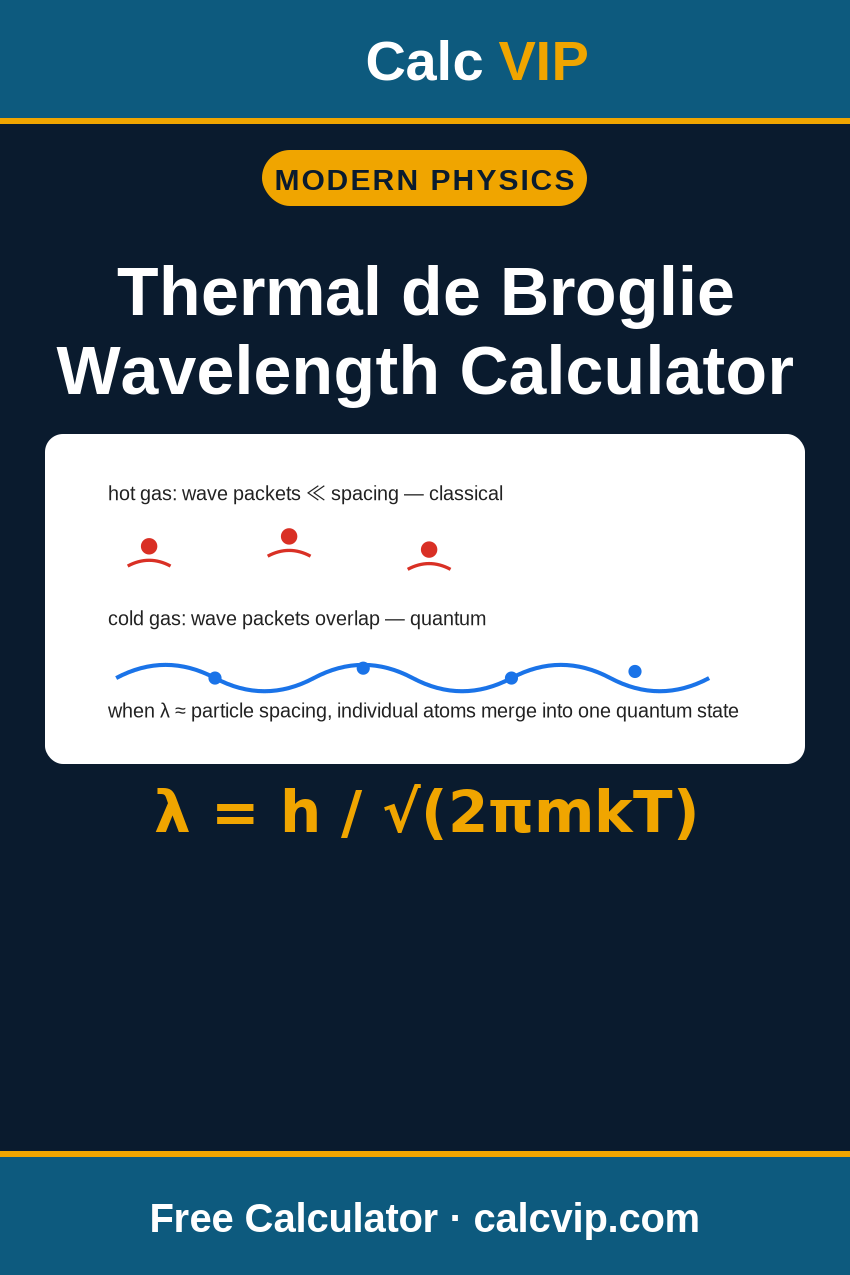
Use this free Thermal de Broglie Wavelength Calculator to find the quantum wavelength of a particle in a gas at temperature T: λ = h / √(2πmkT). When this wavelength becomes comparable to the spacing between particles, quantum effects take over — this is the doorway to Bose–Einstein condensation.
Every particle is a wave, but in a warm gas the waviness is usually too fine to matter. The thermal de Broglie wavelength is the quantity that adjudicates: it takes a particle's typical thermal momentum at temperature T and converts it, through de Broglie's λ = h/p, into the size of the wave packet that particle effectively carries around. Compare that size with the space each particle has to itself, and you know which physics governs the gas. Wave packets much smaller than the spacing: classical billiards, Maxwell and Boltzmann rule. Wave packets comparable to the spacing: the particles stop being distinguishable individuals, quantum statistics take over, and strange collective states — superfluids, superconductors' electron seas, Bose–Einstein condensates — become possible.
The formula's levers are mass and temperature, each under a square root: λ = h/√(2πmkT). Light particles are wavier — an electron at room temperature carries a stately 4.303 nm wavelength, thousands of times its classical "size". Heavy particles are stiffer: a neutron at the same temperature manages 0.100 nm, and a rubidium atom barely 0.011 nm. Temperature works the other way: cool any gas and its wavelengths swell as 1/√T, without limit in principle, which is why the road to quantum degeneracy is always a road downwards in temperature — and why the coldest places in the universe are not between the stars but inside atomic-physics laboratories, at nanokelvin, where thermal wavelengths reach optical sizes and atoms merge into single macroscopic waves.
This calculator evaluates the thermal wavelength for electrons, protons, neutrons or any mass you supply, at any temperature, reporting metres, nanometres and picometres. Its outputs anchor several famous numbers: the neutron's 0.100 nm at 300 K is why thermal neutrons diffract beautifully from crystals; the electron's 4.303 nm is why the electrons in a metal are a quantum fluid at every temperature you will ever meet; and the rubidium atom's march from 0.011 nm at 300 K to hundreds of nanometres near absolute zero is the entire plot of Bose–Einstein condensation, told by one square root.
Formula
λ = h / √(2πmkT) • h = 6.626 × 10⁻³⁴ J·s, k = 1.381 × 10⁻²³ J/K • scalings: λ ∝ 1/√T and λ ∝ 1/√m
The formula packages three ideas. A gas at temperature T gives each particle a thermal energy of order kT; statistical mechanics fixes the typical momentum at p ≈ √(2πmkT) — the 2π is the fingerprint of the Maxwell–Boltzmann distribution's averages, and this particular convention for the thermal wavelength is the one used throughout statistical physics, in the Sackur–Tetrode entropy and the degeneracy criterion alike. De Broglie's relation λ = h/p then converts momentum into wavelength. The rearrangements serve the working questions: the temperature at which a given wavelength is reached is T = h²/(2πmkλ²); the degeneracy comparison needs the mean spacing d = n−1/3 from the number density n. Two disciplines keep calculations honest: T is in kelvin, always — a Celsius slip at room temperature is a 273-fold error inside a square root — and m is in kilograms. This calculator enforces both, accepting a preset particle or your own mass in kg.
| Symbol | Meaning | Units |
|---|---|---|
| λ | thermal de Broglie wavelength — the particle's effective wave-packet size | m (nm, pm here) |
| m | particle mass | kg |
| T | absolute temperature | kelvin (K) |
| k | Boltzmann's constant, 1.381 × 10⁻²³ J/K | J/K |
| nλ³ | phase-space density — the degeneracy dial; quantum behaviour when ≳ 1 | dimensionless |
The degeneracy criterion: when a gas stops being classical
The thermal wavelength earns its keep in one comparison. Give each particle its share of the volume, d = n−1/3 (n the number density), and set λ beside d. If λ ≪ d, wave packets are private property: particles can be labelled and tracked, and classical statistics are exact. As λ/d grows towards 1, packets overlap, particles become indistinguishable in principle, and the gas must be described by quantum statistics — Fermi–Dirac for fermions, Bose–Einstein for bosons. The compact form of the criterion is the phase-space density nλ³: classical below ~1, degenerate above it, with Bose–Einstein condensation of an ideal gas setting in at nλ³ ≈ 2.612. Every route to quantum degeneracy is a strategy for inflating nλ³ — raise the density, or (far more powerfully, since λ ∝ 1/√T) crush the temperature.
The census this criterion produces is startling. Air at room temperature: λ for nitrogen molecules is around 0.02 nm against a spacing of ~3 nm — hopelessly classical, as expected. The electrons in copper: their spacing is a few tenths of a nanometre, their thermal wavelength 4.3 nm — they are deeply degenerate at all temperatures, which is why metals' electrons form a Fermi sea whose behaviour (tiny heat capacity, Pauli paramagnetism) classical physics could never explain. Liquid helium at 2 K, photons in a furnace, neutrons in a reactor moderator, rubidium atoms at 100 nK — one ratio, λ/d, sorts them all, and this calculator supplies its numerator.
How to use
- Pick a particle — electron, proton or neutron — or choose "Custom mass" and type a mass in kg (like 1.675e-27).
- Enter the temperature T in kelvin (room temperature ≈ 300 K; liquid nitrogen 77 K; liquid helium 4.2 K).
- Click "Calculate Thermal Wavelength" to read λ in metres, nanometres and picometres.
- Interpret it against a spacing: for a gas of density n, compute d = n−1/3 and compare. λ within a factor of a few of d means quantum statistics are switching on; λ ≪ d means classical physics is safe. To find the temperature for a target λ, scale from a known point with λ ∝ 1/√T instead of starting over.
Worked examples
Example 1 — an electron and a neutron at 300 K. An electron at room temperature, T = 300 K:
λ = 6.626 × 10⁻³⁴ / √(2π × 9.11 × 10−31 × 1.381 × 10−23 × 300)
= 4.303 × 10⁻⁹ m = 4.303 nm
A neutron at 300 K is much heavier, so its wavelength is only 0.100 nm — about the spacing of atoms in a crystal, which is exactly why thermal neutrons are perfect for diffraction experiments. The mass ratio of 1,839 between them becomes, under the square root, a wavelength ratio of √1839 ≈ 43 — the formula's 1/√m scaling in action.
Example 2 — a proton at 300 K. Nearly the neutron's twin:
λ = 1.004 × 10⁻¹⁰ m = 0.1004 nm (100.4 pm).
Proton and neutron wavelengths differ by less than 0.1% at any temperature, mirroring their masses (1.673 vs 1.675 × 10⁻²⁷ kg). Hydrogen nuclei in a warm plasma are, wave-mechanically, interchangeable with neutrons — both far too stiff to show quantum-gas behaviour at ordinary densities.
Example 3 — an electron at liquid-nitrogen temperature, 77 K. Cool the electron gas and the wavelength stretches by √(300/77) = 1.974:
λ = 4.303 × 1.974 = 8.493 nm.
Semiconductor physicists live here: at 77 K and below, electron wavelengths in devices reach tens of nanometres — the size of the structures themselves — and quantum confinement effects move from corrections to the main event.
Example 4 — an electron at liquid-helium temperature, 4 K. Another factor of √(300/4) = 8.66:
λ = 4.303 × 8.66 = 37.26 nm.
An electron wave packet the size of a virus. In clean semiconductors at this temperature, electrons keep phase coherence over such distances and far beyond, enabling the interference devices — quantum point contacts, Aharonov–Bohm rings — of mesoscopic physics.
Example 5 — cold neutrons at 30 K. Reactor cold sources chill neutrons in liquid hydrogen to about 30 K, stretching λ by √(300/30) = 3.16:
λ = 0.100 × 3.16 = 0.317 nm.
The longer wavelength diffracts from larger structures — polymer coils, magnetic domains, protein assemblies — which is why cold-neutron instruments (small-angle scattering especially) probe the 1–100 nm world that thermal neutrons and X-rays see poorly.
Example 6 — rubidium-87: the road to a condensate. A rubidium atom masses 87 × 1.6605 × 10−27 = 1.445 × 10⁻²⁵ kg. At 300 K:
λ = 1.081 × 10⁻¹¹ m = 0.0108 nm — thoroughly classical.
Laser-cool and evaporatively chill it to 100 nK (10−7 K) and λ grows by √(300/10−7) = 54,772:
λ = 0.0108 × 54,772 ≈ 592 nm — the size of a wavelength of light.
At a typical trapped-gas density of 10²⁰ atoms/m³ the mean spacing is n−1/3 ≈ 215 nm, so somewhere just below a microkelvin the swelling wave packets (592 nm at 100 nK) swallow the spacing whole — and the gas condenses into a single quantum wave, the Bose–Einstein condensate first made in 1995 with exactly this atom.
Thermal wavelengths in real life
Neutron diffraction and scattering. The 0.100 nm thermal wavelength at 300 K matches interatomic spacings, so reactor and spallation sources moderate neutrons to room temperature precisely to hit this calculator's Example 1 value — then diffract them from crystals to locate atoms, hydrogen and magnetic order that X-rays miss.
Bose–Einstein condensation. The entire experimental programme of ultracold atoms is a campaign against this formula's denominator: laser cooling to microkelvin, evaporative cooling to nanokelvin, watching λ swell past the interatomic spacing until a macroscopic fraction of atoms occupies one quantum state. BECs, atom lasers and quantum simulators all begin at nλ³ ≈ 2.612.
Electrons in metals and semiconductors. With λ = 4.303 nm at 300 K against sub-nanometre electron spacings, conduction electrons are always degenerate — the Fermi sea is the consequence, and with it metals' electrical and thermal behaviour. In semiconductor devices cooled or miniaturised, the same comparison decides when classical drift-diffusion design must yield to quantum modelling.
White dwarfs and neutron stars. Stellar remnants pack particles so densely that spacings shrink below even modest thermal wavelengths: degeneracy pressure — the resistance of overlapping wave packets to further compression — is what holds a white dwarf up against gravity. The criterion of this page, evaluated at stellar densities, becomes astrophysics' load-bearing wall.
Superfluid helium. Helium-4 atoms (λ ≈ 0.05 nm at 300 K by this calculator, growing as it cools) reach λ comparable to their ~0.36 nm spacing near 2.17 K — and the liquid turns superfluid, flowing without viscosity. The lambda transition is named for the specific-heat curve's shape, but its cause is the ratio computed here crossing unity.
Atom interferometry. Ultracold atoms with wavelengths of hundreds of nanometres make exquisite interferometers: split the wave packet, let the arms accumulate different phases, recombine. The resulting gravimeters and gyroscopes measure g and rotation with precisions that classical sensors cannot approach — applied de Broglie, at the wavelengths of Example 6.
Why metals are quantum at every temperature
It surprises students that the electrons in a copper wire — at room temperature, in the most classical of technologies — form a thoroughly quantum system. This calculator shows why in one line. The electron spacing in copper is about 0.23 nm (one conduction electron per atom at copper's density); the thermal wavelength at 300 K is 4.303 nm, nearly twenty times larger. The degeneracy criterion is not marginally satisfied but demolished: nλ³ is in the thousands. Equivalently, the electrons' Fermi temperature — the temperature at which λ would shrink to the spacing — is about 8 × 10⁴ K, hotter than the Sun's surface; at any terrestrial temperature the electron gas is effectively at zero on its own scale, its behaviour set by the Pauli principle rather than by heat. Every "anomaly" of metals that defeated classical theory — the tiny electronic heat capacity, the temperature-independent paramagnetism — is this paragraph wearing experimental dress. Temperature is a property a system has relative to its own quantum scale, and for electrons in metals that scale is stellar.
Quick reference: thermal wavelengths of common particles
| Particle | Temperature | λ | Note |
|---|---|---|---|
| electron | 300 K | 4.303 nm | quantum in metals |
| electron | 77 K | 8.493 nm | liquid nitrogen |
| electron | 4 K | 37.26 nm | liquid helium |
| electron | 100,000 K | 0.2357 nm | hot plasma |
| neutron | 300 K | 0.100 nm | diffraction workhorse |
| neutron | 30 K | 0.317 nm | cold source |
| proton | 300 K | 0.1004 nm | neutron's twin |
| helium atom | 300 K | 0.0504 nm | superfluid on cooling |
| rubidium-87 atom | 300 K | 0.0108 nm | classical gas |
| rubidium-87 atom | 100 nK | 592 nm | Bose–Einstein condensate |
The table's arc — from picometres for warm heavy atoms to hundreds of nanometres for ultracold ones — is the story of twentieth and twenty-first century atomic physics: learning to cool matter until its wavelength, this page's humble output, becomes the largest length in the problem.
Common mistakes
- Entering Celsius instead of kelvin. The formula needs absolute temperature. At "25" the difference is a factor of twelve inside the square root (25 vs 298 K) — the single most destructive slip available on this page. Convert first: K = °C + 273.15.
- Using the thermal formula for accelerated beams. An electron microscope's electrons are not thermal: their wavelength is h/√(2meE) (with relativistic correction), set by the accelerating voltage, not by any temperature. The thermal formula describes particles jiggling in equilibrium at T — a different population entirely.
- Expecting heavier particles to be wavier. λ ∝ 1/√m: heavy means shorter wavelength, stiffer, more classical. The electron out-waves the neutron by a factor of ~43 at the same temperature, not the reverse.
- Treating λ as the particle's physical size. It is the coherence size of its wave packet — the scale over which the particle's wave nature is manifest — not a hard diameter. A neutron's λ of 0.100 nm does not make the neutron 0.100 nm wide; it makes crystals see it as a 0.100 nm wave.
- Forgetting the density half of the criterion. A large λ alone does not make a gas quantum: degeneracy needs λ comparable to the spacing, n−1/3. A sufficiently dilute gas stays classical at any temperature — interstellar atoms at 3 K are classical not because they are warm but because they are lonely.
FAQ
Why does the wavelength shrink when the gas gets hotter?
Higher temperature means faster particles with more momentum, and λ = h/p falls as p rises. Cooling does the opposite — λ grows like 1/√T.
What happens when λ reaches the particle spacing?
The wave packets of neighbouring particles overlap and the gas stops behaving classically. For atoms cooled to nanokelvin temperatures this produces a Bose–Einstein condensate, a single giant quantum wave.
Why are thermal neutrons used in diffraction?
At 300 K a neutron's wavelength (≈ 0.1 nm) matches atomic spacings, so crystals diffract neutrons the way they diffract X-rays — but neutrons also reveal magnetic structure and light elements like hydrogen.
Why the 2π in the formula?
It comes from averaging over the Maxwell–Boltzmann distribution of momenta rather than using a single typical speed; different textbooks define slightly different "thermal wavelengths" (some use h/√(3mkT) or h/√(mkT)) that differ by factors of order unity. The 2π version is the standard of statistical mechanics — the one appearing in the Sackur–Tetrode equation and the nλ³ criterion — and it is the one this calculator uses.
At what temperature does a gas of atoms condense?
When nλ³ reaches ≈ 2.612. For rubidium at 10²⁰ atoms/m³, Example 6's arithmetic puts the crossing just under a microkelvin; denser gases condense warmer, more dilute ones colder. Real condensates span roughly 100 nK to a few µK depending on species and density.
What are cold and ultracold neutrons?
Cold neutrons are moderated to tens of kelvin (λ of a few tenths of a nanometre, Example 5) for probing large structures. Ultracold neutrons are chilled below ~1 mK in energy terms — wavelengths of tens of nanometres, energies under ~300 nanoelectronvolts — so feeble they reflect from material walls and can be bottled for minutes to measure the neutron's lifetime and electric dipole moment.
Does pressure change the thermal wavelength?
Not directly: λ depends only on m and T. Pressure enters through density — compressing a gas shrinks the spacing d, so the ratio λ/d (and nλ³) rises even at fixed λ. Degeneracy can be reached by squeezing as well as by cooling, which is precisely the white-dwarf route.
Why do neutron stars and white dwarfs care about this formula?
Because in them, spacings are femtometre-to-sub-nanometre scale, so particles are degenerate regardless of temperature, and the pressure resisting gravity is degeneracy pressure — a direct consequence of wave packets refusing to be squeezed into one another's space. The stability of stellar corpses is this page's criterion written in gravity.
Is the thermal wavelength related to the particle-in-a-box levels?
Intimately: confine a particle to a box of size L ≈ λ and its ground-state confinement energy h²/(8mL²) becomes comparable to kT. The two formulas are the same physics — de Broglie's wavelength versus the space available — one phrased for a gas, the other for a trap.
How cold is the coldest gas ever made?
Laboratory atomic gases have reached tens of picokelvin in effective temperature (and lower still in specialised spin-temperature senses), at which point a rubidium atom's thermal wavelength would be tens of micrometres — vastly larger than the cloud's own interatomic spacing and comparable to the cloud itself. At that frontier the gas is not so much cold as it is a single, engineered quantum object.